Social housing providers face a seismic regulatory shift: from October 2026, structural collapse and explosions will join damp and mould as regulated hazards under Phase 2 of Awaab's Law, triggering mandatory 10-day investigation periods and strict remediation timeframes[2][5]. This expansion creates unprecedented intersection points between housing safety legislation and established party wall procedures, particularly for excavation and demolition projects where structural integrity risks cross property boundaries.
The convergence of Party Wall Awards for Structural Collapse Risks: Safeguards Under Awaab's Law 2026 for Excavation and Demolition Works represents a fundamental evolution in how construction professionals must approach adjoining owner protection. While Phase 1 of Awaab's Law, implemented in October 2025, focused exclusively on damp, mould, and fungal growth[2], the upcoming Phase 2 expansion demands proactive structural risk management that aligns with Party Wall etc. Act 1996 obligations.
Key Takeaways
- 🏗️ Phase 2 expansion: Structural collapse becomes a regulated hazard under Awaab's Law from October 2026, requiring 10-day investigation periods for significant hazards[2][5]
- 📋 Party wall integration: RICS monitoring clauses and right-of-entry provisions in party wall awards provide essential safeguards for high-risk excavation and demolition projects
- ⚖️ Dual compliance framework: Building owners must satisfy both Awaab's Law structural safety requirements and Party Wall Act 1996 obligations simultaneously
- 🔍 Enhanced documentation: Comprehensive schedules of condition become critical evidence for demonstrating compliance with both regulatory frameworks
- ⏱️ Strict timeframes: Social housing providers face mandatory response periods that necessitate pre-emptive party wall procedures and structural assessments
Understanding Party Wall Awards for Structural Collapse Risks Under Current Legislation
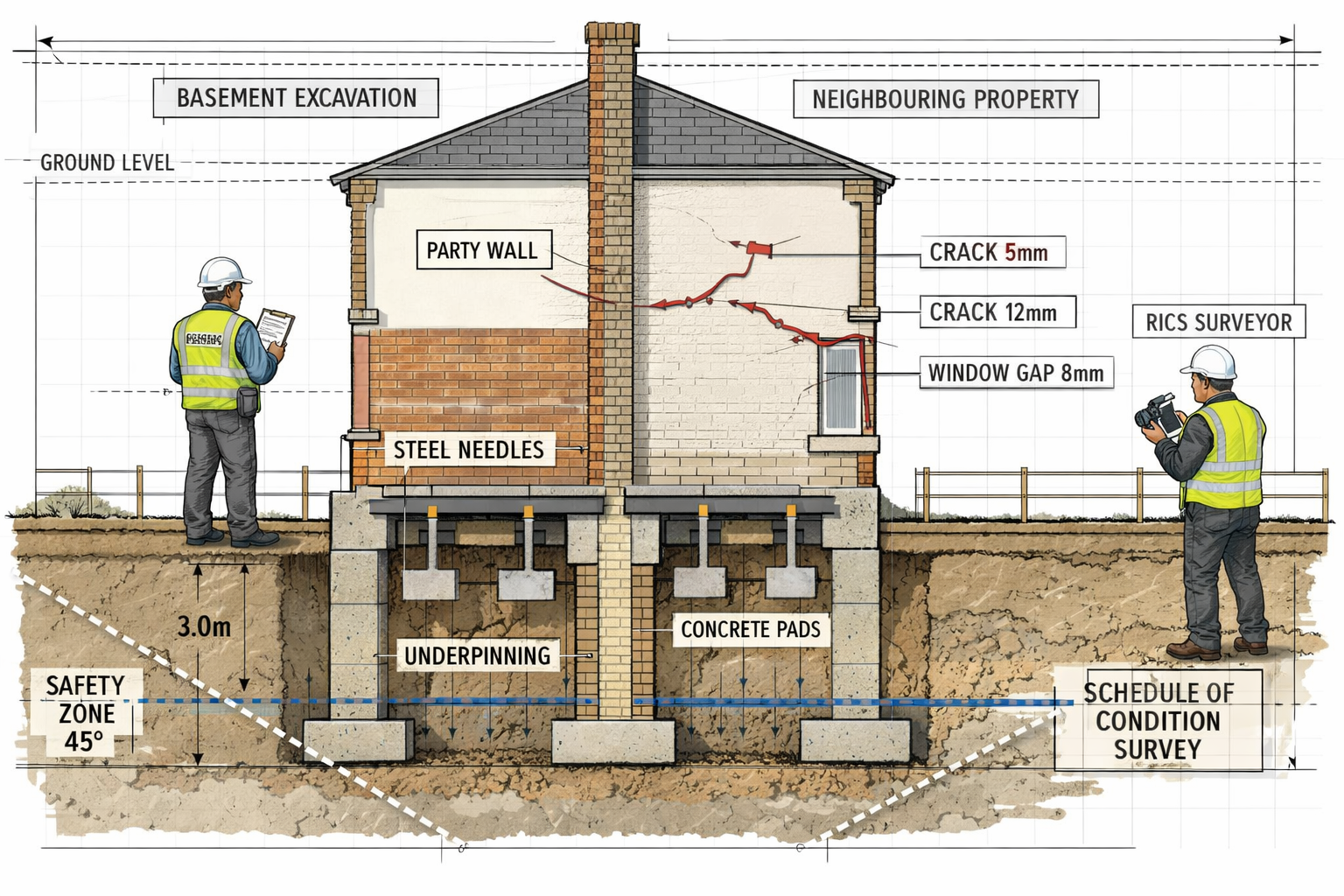
The Party Wall etc. Act 1996 establishes the foundational framework for managing construction risks that affect adjoining properties. When building owners undertake excavation within three or six meters of a neighbor's structure (depending on depth), or demolition works affecting a shared wall, they must serve formal notices and potentially obtain a party wall award.
Structural collapse risks arise most frequently in three scenarios:
- Deep excavations for basements – Removing ground support beneath neighboring foundations
- Demolition of semi-detached or terraced properties – Exposing previously supported party walls
- Underpinning works – Altering load-bearing capacity of shared structural elements
A party wall award serves as a legally binding document that sets out the rights and responsibilities of both building owners and adjoining owners. Crucially, awards can include specific safeguards such as:
- Detailed working methodology to minimize vibration and settlement
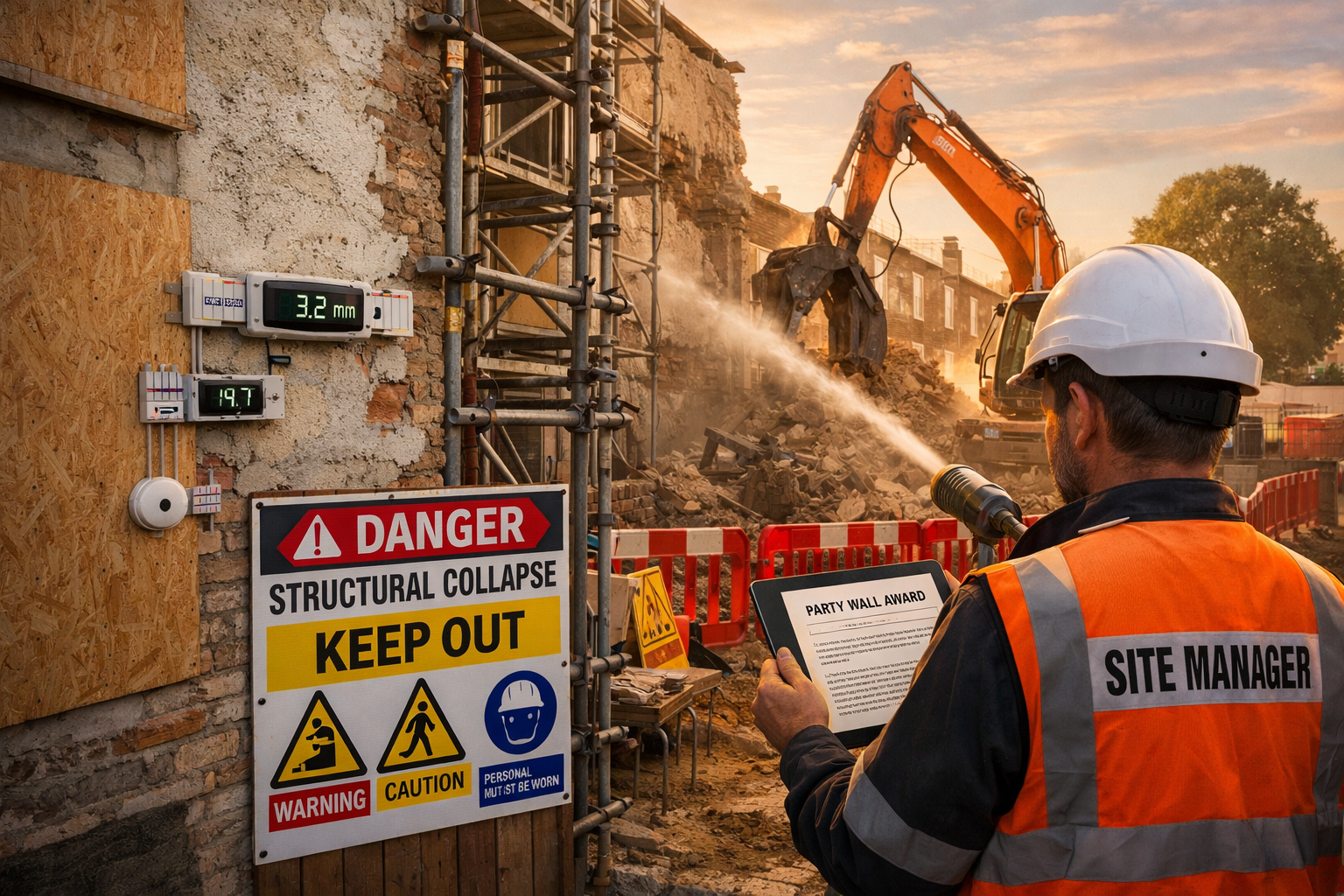
- Structural monitoring requirements (crack gauges, settlement markers, tilt sensors)
- Right of access for surveyors to inspect both properties
- Remediation obligations if damage occurs
- Insurance requirements and financial security provisions
The importance of comprehensive schedules of condition cannot be overstated. These photographic and written records document the pre-construction state of adjoining properties, establishing baseline conditions against which any structural movement or damage can be assessed. Without this evidence, party wall disputes become significantly more complex and costly to resolve.
Traditional Party Wall Protections vs. Emerging Regulatory Requirements
Historically, party wall procedures operated independently from broader housing safety legislation. Surveyors appointed under the Act focused primarily on protecting individual property rights and preventing construction-related damage. However, the regulatory landscape has shifted dramatically.
Traditional party wall protections include:
- Pre-construction notification periods (typically 1-2 months)
- Independent surveyor appointments to resolve disputes
- Technical specifications for temporary support and shoring
- Financial compensation mechanisms for proven damage
The cost of party wall procedures varies considerably based on project complexity, but typically ranges from £700-£2,500 per property for straightforward cases, escalating significantly for contentious matters requiring detailed awards.
Awaab's Law 2026 Phase 2: Structural Collapse as a Regulated Hazard
Awaab's Law emerged from the tragic death of two-year-old Awaab Ishak, who died from prolonged exposure to mould in social housing. The legislation initially targeted damp and mould conditions, but its Phase 2 expansion represents a fundamental broadening of scope[2][5].
From October 2026, social housing providers will face statutory obligations to address structural collapse hazards within defined timeframes:
| Hazard Severity | Investigation Period | Remediation Timeframe |
|---|---|---|
| Imminent danger | Immediate action | 24 hours |
| Serious hazard | 10 working days | 28 days (typical) |
| Moderate risk | 20 working days | 90 days (typical) |
These timeframes, while not yet finalized in secondary legislation, align with the investigative periods established for damp and mould under Phase 1[2]. The critical distinction lies in the nature of structural collapse risks – unlike mould growth, which typically develops gradually, structural instability can deteriorate rapidly, particularly during active construction.
Implications for Excavation and Demolition Projects
The intersection of Party Wall Awards for Structural Collapse Risks: Safeguards Under Awaab's Law 2026 for Excavation and Demolition Works creates several practical challenges:
Challenge 1: Accelerated Investigation Requirements
When a social housing tenant reports concerns about structural movement or cracking potentially linked to neighboring construction, providers must now investigate within 10 working days[2]. This compressed timeline demands that party wall procedures are already in place, with monitoring systems actively tracking structural performance.
Challenge 2: Evidential Standards
Awaab's Law compliance requires demonstrable investigation and remediation efforts. Party wall awards that include comprehensive schedule of condition guidance and ongoing monitoring protocols provide essential documentation to satisfy regulatory scrutiny.
Challenge 3: Cross-Tenure Complications
While Awaab's Law applies specifically to social housing providers, structural collapse risks from excavation or demolition often originate from private development projects. This creates complex liability questions when a social housing property experiences structural issues attributable to a neighboring private development.
"The expansion of Awaab's Law to cover structural collapse hazards fundamentally changes risk allocation in party wall scenarios. Social housing providers can no longer rely solely on neighboring developers' party wall compliance – they must proactively monitor and respond to structural risks regardless of cause." – Industry analysis[3]
RICS Safeguards: Monitoring Clauses and Right of Entry in Party Wall Awards
The Royal Institution of Chartered Surveyors (RICS) provides professional guidance that bridges traditional party wall practice and emerging regulatory requirements. Party wall surveyors increasingly incorporate enhanced safeguards into awards for high-risk excavation and demolition projects.
Essential Monitoring Provisions
Structural monitoring clauses in party wall awards typically specify:
-
Pre-construction baseline surveys – Detailed structural surveys documenting existing conditions, including crack mapping, levelness measurements, and photographic records
-
Installation of monitoring equipment – Crack gauges (tell-tales), settlement markers, tilt sensors, and vibration monitors positioned at critical locations
-
Monitoring frequency – Daily readings during active excavation or demolition, weekly during less intensive phases, with immediate reporting protocols for threshold exceedances
-
Alert thresholds – Specific movement limits (e.g., 5mm crack widening, 10mm settlement) that trigger work stoppages and emergency assessments
-
Independent verification – Requirements for chartered structural engineering review of monitoring data at defined intervals
Right of Entry Provisions
The Party Wall Act grants surveyors right of entry to inspect properties, but awards should explicitly detail:
- Access frequency and timing – Reasonable notice periods (typically 48-72 hours) balanced against emergency access rights
- Scope of inspection – Specific rooms, areas, and structural elements to be examined
- Documentation requirements – Photographic protocols, reporting formats, and distribution of findings
- Tenant cooperation – Procedures when occupiers refuse access, including escalation mechanisms
For social housing providers subject to Awaab's Law, these right-of-entry provisions become particularly critical. The 10-day investigation period for structural collapse concerns[2] necessitates immediate access to inspect potentially affected areas, document conditions, and determine causation.
Enhanced Award Provisions for High-Risk Projects
Party wall awards for deep basements and major demolitions should incorporate:
Temporary works specifications:
- Detailed shoring and propping designs approved by structural engineers
- Sequencing requirements to maintain structural stability
- Load transfer mechanisms during demolition phases
Insurance and bonding requirements:
- Minimum insurance coverage levels (typically £5-10 million for major projects)
- Performance bonds or cash deposits to guarantee remediation funding
- Named coverage for adjoining owners as additional insured parties
Remediation protocols:
- Pre-agreed repair methodologies for common damage types
- Independent damage assessment procedures
- Timeframes for completing remedial works (aligning with Awaab's Law requirements)
Communication frameworks:
- Regular progress updates to adjoining owners
- Immediate notification protocols for structural concerns
- Liaison arrangements with social housing providers when applicable
The absence of a proper party wall agreement exposes building owners to significant liability, particularly when structural issues emerge post-construction. Under the enhanced scrutiny of Awaab's Law, social housing providers may pursue more aggressive enforcement against developers who failed to follow proper party wall procedures.
Integrating Party Wall Procedures with Awaab's Law Compliance Strategies
The practical integration of Party Wall Awards for Structural Collapse Risks: Safeguards Under Awaab's Law 2026 for Excavation and Demolition Works requires coordinated approaches from multiple stakeholders.
For Social Housing Providers
Proactive risk identification:
- Maintain registers of adjoining properties undergoing construction
- Monitor planning applications within 6 meters of social housing stock
- Establish early communication with developers and their party wall surveyors
Enhanced tenant communication:
- Educate residents about structural monitoring during neighboring construction
- Provide clear reporting channels for structural concerns (cracks, movement, unusual sounds)
- Explain Awaab's Law rights and provider obligations regarding structural hazards
Rapid response protocols:
- Pre-qualify structural engineers for emergency assessments
- Establish 24-hour contractor availability for urgent temporary works
- Develop decision trees for determining hazard severity and appropriate response timeframes
Documentation systems:
- Integrate party wall correspondence into asset management databases
- Link monitoring data with maintenance records
- Maintain audit trails demonstrating Awaab's Law compliance efforts
For Developers and Building Owners
Early party wall engagement:
- Serve notices well in advance of statutory minimums (3+ months preferable)
- Proactively offer comprehensive awards rather than waiting for disputes
- Budget adequately for monitoring, insurance, and potential remediation
Enhanced due diligence:
- Identify social housing properties within party wall notification zones
- Engage with housing providers before construction commences
- Consider voluntary monitoring even when not strictly required
Robust temporary works design:
- Engage structural engineers early in design development
- Specify conservative safety factors for shoring and underpinning
- Plan sequencing to minimize exposure periods
Comprehensive insurance:
- Ensure policies explicitly cover Awaab's Law compliance costs
- Consider project-specific policies with enhanced limits for sensitive sites
- Verify coverage extends to investigation and monitoring expenses
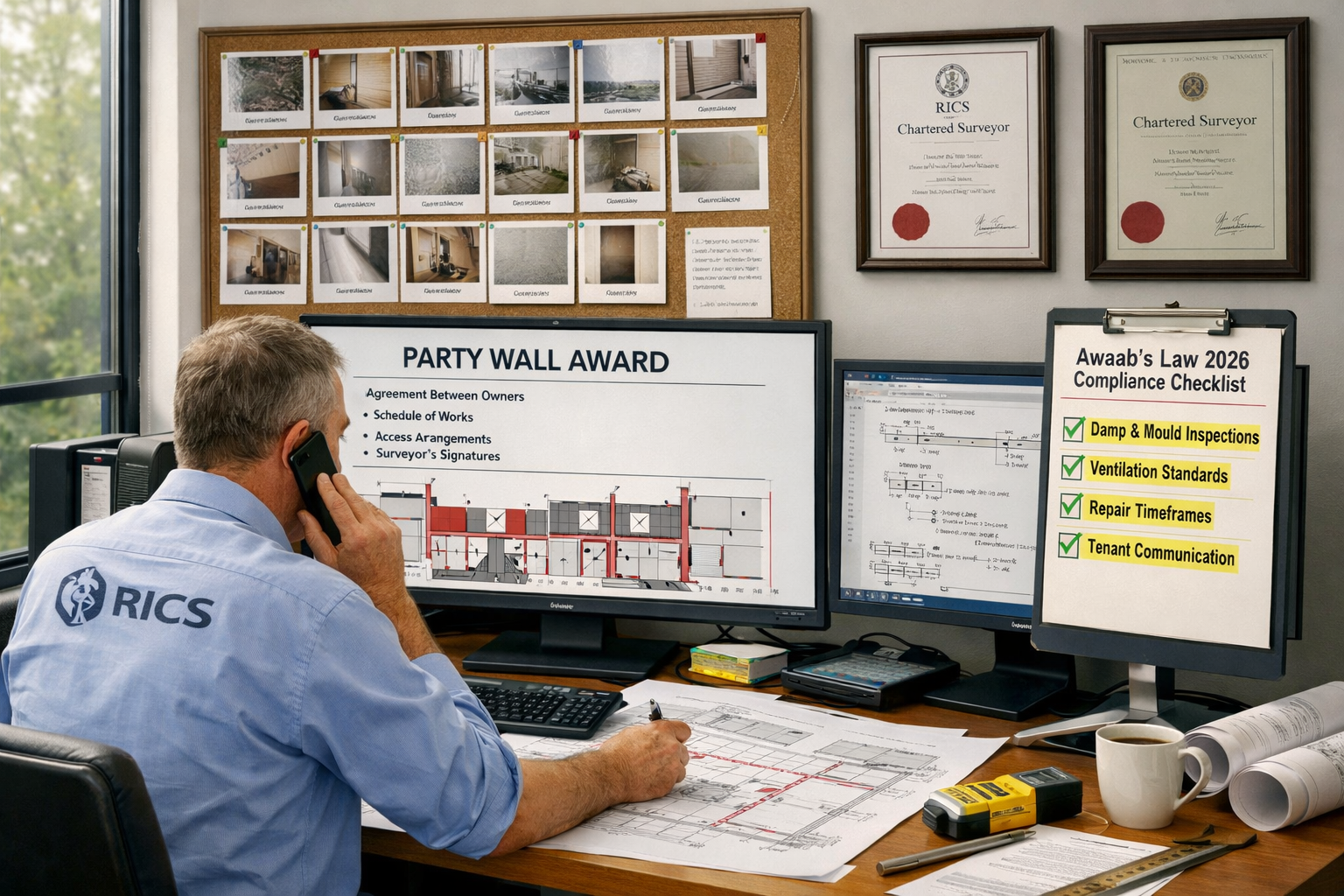
For Party Wall Surveyors
The professional obligations of party wall surveyors evolve under the Awaab's Law framework:
Enhanced duty of care:
- Consider broader regulatory implications beyond traditional property damage
- Incorporate Awaab's Law timeframes into award provisions
- Advise clients on compliance obligations and potential liabilities
Award drafting evolution:
- Include explicit references to structural collapse risk management
- Specify monitoring protocols that generate Awaab's Law-compliant evidence
- Address information-sharing with social housing providers
Monitoring and reporting:
- Establish systems for real-time data collection and analysis
- Develop threshold-based alert protocols
- Maintain detailed records suitable for regulatory scrutiny
Continuing professional development:
- Stay informed on Awaab's Law implementation guidance
- Understand social housing regulatory frameworks
- Develop expertise in structural risk assessment methodologies
Practical Case Studies: Excavation and Demolition Risk Management
Case Study 1: Deep Basement Excavation Adjacent to Social Housing
A private developer planned a 4-meter basement excavation within 2 meters of a 1960s social housing block with shallow strip foundations. The party wall award incorporated:
- Pre-construction measures: Comprehensive structural survey identifying pre-existing settlement cracks, installation of 12 monitoring points with weekly readings
- Construction safeguards: Sequenced excavation in 1-meter lifts, temporary sheet piling, underpinning of adjoining foundations before deep excavation
- Social housing liaison: Direct communication channel with housing provider's asset management team, monthly progress reports, immediate notification protocol for movements exceeding 3mm
Outcome: Minor settlement (4mm maximum) detected early, temporary work stoppages implemented, additional underpinning installed, final settlement within acceptable limits. The comprehensive monitoring data provided the housing provider with clear evidence of proactive risk management, satisfying Awaab's Law due diligence requirements.
Case Study 2: Terraced Property Demolition
Demolition of a mid-terrace property required careful management of the exposed party walls. The award included:
- Structural assessment: Pre-demolition survey by structural engineer confirming party walls required temporary support
- Temporary works: Design and installation of steel needles and props before demolition commenced
- Phased demolition: Roof and upper floors removed before ground floor, maintaining structural stability
- Weather protection: Temporary weatherproofing of exposed party walls within 48 hours of exposure
Outcome: Successful demolition with no damage to adjoining properties. The detailed methodology and monitoring records demonstrated compliance with duty of care standards increasingly expected under the Awaab's Law framework.
Common Pitfalls and How to Avoid Them
Pitfall 1: Delayed Notice Service
Problem: Building owners often serve party wall notices at the last minute, creating compressed timeframes that prevent proper risk assessment and award negotiation.
Solution: Serve notices 3-6 months before planned construction, particularly for complex excavation or demolition projects adjacent to social housing.
Pitfall 2: Inadequate Baseline Documentation
Problem: Superficial schedules of condition fail to capture subtle pre-existing defects, leading to disputes about construction-related damage.
Solution: Commission professional schedule of condition surveys with comprehensive photography, crack mapping, and levelness measurements.
Pitfall 3: Insufficient Monitoring
Problem: Infrequent or poorly located monitoring points fail to detect developing structural issues until significant damage occurs.
Solution: Install monitoring equipment at structurally critical locations, maintain daily readings during high-risk phases, and establish clear alert thresholds.
Pitfall 4: Poor Communication
Problem: Failure to communicate with social housing providers creates unnecessary tension and potential regulatory breaches when tenants report concerns.
Solution: Establish proactive communication channels, provide regular updates, and respond promptly to queries or concerns.
Pitfall 5: Inadequate Insurance
Problem: Standard policies may not cover investigation costs, monitoring expenses, or Awaab's Law compliance activities.
Solution: Review insurance coverage specifically for party wall risks, structural collapse scenarios, and regulatory compliance costs.
Future Regulatory Developments and Industry Response
The October 2026 implementation of Phase 2 Awaab's Law represents the beginning of an evolving regulatory landscape[2][5]. Industry stakeholders anticipate several developments:
Secondary legislation refinement: Detailed regulations specifying exact timeframes, investigation methodologies, and enforcement mechanisms for structural collapse hazards.
Guidance documents: Expected publications from the Department for Levelling Up, Housing and Communities, RICS, and professional bodies providing practical implementation guidance.
Case law development: Early enforcement actions and disputes will establish precedents for interpreting Awaab's Law obligations in party wall contexts.
Insurance market evolution: Insurers will develop specialized products addressing the unique risks created by the Party Wall-Awaab's Law intersection.
Professional practice standards: RICS and other professional bodies may update guidance notes and best practice documents to reflect the new regulatory environment.
Technology adoption: Increased use of remote monitoring systems, IoT sensors, and AI-powered analysis tools to manage the enhanced documentation and response requirements.
The construction industry must prepare for this regulatory convergence proactively. Developers, contractors, surveyors, and social housing providers who integrate Party Wall Awards for Structural Collapse Risks: Safeguards Under Awaab's Law 2026 for Excavation and Demolition Works into standard operating procedures will be best positioned to navigate the new compliance landscape.
Conclusion
The convergence of party wall procedures and Awaab's Law Phase 2 represents a fundamental evolution in construction risk management. From October 2026, structural collapse joins damp and mould as a regulated hazard requiring mandatory investigation within 10 working days and strict remediation timeframes[2][5]. This regulatory expansion creates unprecedented obligations for social housing providers while simultaneously elevating the importance of robust party wall awards for excavation and demolition projects.
Party Wall Awards for Structural Collapse Risks: Safeguards Under Awaab's Law 2026 for Excavation and Demolition Works must now incorporate comprehensive monitoring provisions, explicit right-of-entry clauses, and remediation protocols that satisfy both traditional property protection objectives and emerging regulatory compliance requirements. The enhanced documentation standards, accelerated response timeframes, and cross-tenure complications demand proactive coordination among developers, surveyors, and social housing providers.
Actionable Next Steps
For social housing providers:
- Audit properties adjacent to active or planned construction projects
- Establish rapid response protocols for structural collapse concerns
- Develop communication channels with neighboring developers and their surveyors
- Train staff on Awaab's Law Phase 2 requirements and party wall implications
For developers and building owners:
- Serve party wall notices well in advance of statutory minimums
- Commission comprehensive structural surveys and schedules of condition
- Engage qualified party wall surveyors experienced in high-risk excavation and demolition
- Budget adequately for monitoring, temporary works, and potential remediation
For party wall surveyors:
- Update award templates to incorporate Awaab's Law compliance provisions
- Develop expertise in structural risk assessment and monitoring methodologies
- Establish protocols for coordinating with social housing providers
- Invest in continuing professional development on regulatory developments
The integration of party wall procedures with Awaab's Law compliance represents both a challenge and an opportunity. Organizations that embrace comprehensive risk management, transparent communication, and robust documentation will not only satisfy regulatory obligations but also build stronger relationships with neighbors and communities. As the October 2026 implementation date approaches, proactive preparation will separate industry leaders from those struggling to adapt to the new regulatory reality.
For expert guidance on party wall awards and structural risk management, or to understand what happens if you don't have a party wall agreement, consult qualified RICS chartered surveyors who understand both traditional party wall practice and emerging regulatory requirements. The complexity of Party Wall Awards for Structural Collapse Risks: Safeguards Under Awaab's Law 2026 for Excavation and Demolition Works demands professional expertise to navigate successfully.
References
[1] Awaabs Law Compliance Consequences And Oversight For Social Housing Providers – https://www.penningtonslaw.com/insights/awaabs-law-compliance-consequences-and-oversight-for-social-housing-providers/
[2] Awaabs Law Comes Into Force What Does It Mean For Construction – https://www.trowers.com/insights/2025/november/awaabs-law-comes-into-force-what-does-it-mean-for-construction
[3] Expert Witness Preparation For Awaabs Law Expansion Disputes 2026 Hazard Assessments In Rental Valuations – https://nottinghillsurveyors.com/blog/expert-witness-preparation-for-awaabs-law-expansion-disputes-2026-hazard-assessments-in-rental-valuations
[4] Awaabs Law Technical Compliance Hvac Ventilation – https://www.arm-environments.com/resources/awaabs-law-technical-compliance-hvac-ventilation
[5] First Phase Of Awaabs Law Comes Into Effect – https://www.housingbonds.org/first-phase-of-awaabs-law-comes-into-effect/
[6] Awaab S Law Consultation And Introduction In October 2025 – https://www.bevanbrittan.com/insights/articles/2025/awaab-s-law-consultation-and-introduction-in-october-2025/