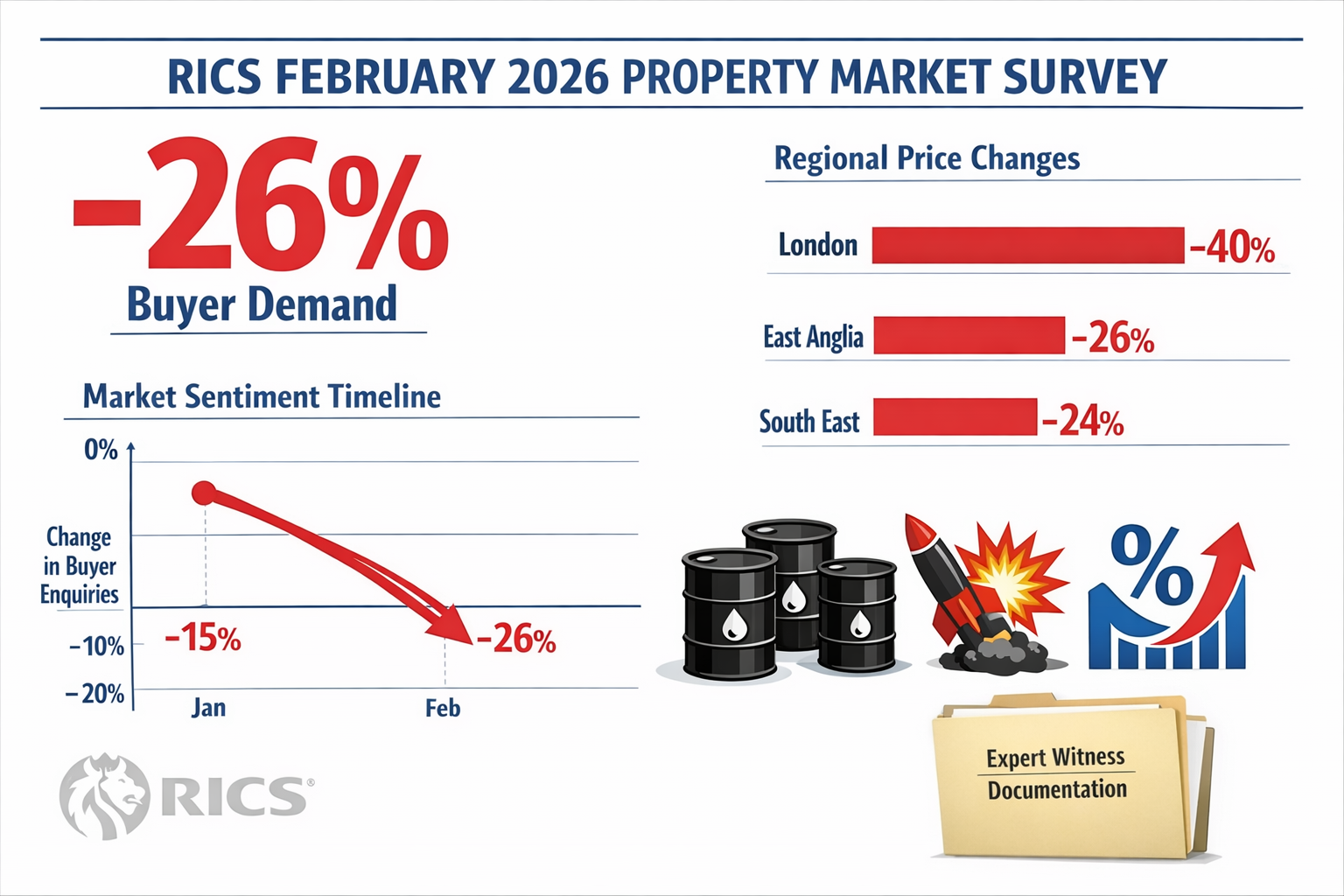
Buyer demand in the UK property market plummeted to a net balance of -26% in February 2026, marking one of the sharpest monthly declines in recent years as Middle East tensions and renewed macroeconomic uncertainty shook market confidence. For expert witnesses tasked with defending property valuations in legal disputes, this volatile environment presents unprecedented challenges—and opportunities for those who can leverage real-time surveyor intelligence over automated valuation models (AVMs).
The RICS UK Residential Survey for February 2026 reveals a market in flux, where geopolitical caution is directly impacting buyer sentiment, transaction volumes, and regional price dynamics. Expert witnesses must now navigate a landscape where traditional comparable evidence may be scarce, where regional divergence is pronounced, and where courts increasingly scrutinize the methodology behind valuation opinions. Understanding how to interpret and apply these survey insights is becoming essential for robust courtroom defense.

Key Takeaways
- 🔻 Buyer demand dropped sharply to -26% in February 2026, driven by geopolitical tensions and interest rate concerns, creating challenges for establishing current market value
- 🌍 Regional divergence intensified, with London experiencing -40% price pressure while Northern Ireland and Scotland show firmer trends—critical for location-specific valuation defense
- 📊 Near-term price expectations deteriorated to -18%, yet 12-month forecasts remain modestly positive at +33%, requiring expert witnesses to distinguish short-term volatility from longer-term trends
- 🏛️ Surveyor intelligence outperforms AVMs in volatile markets, providing courts with nuanced, context-aware evidence that automated models cannot capture
- ⚖️ RICS standards and Red Book compliance remain the foundation for defensible expert witness testimony, particularly when challenging opposing valuations based on inadequate methodology
Understanding the February 2026 Market Context for Defending Valuation Evidence Amid Geopolitical Caution: RICS February 2026 Survey Insights for Expert Witnesses
The February 2026 RICS survey data paints a picture of a market under significant pressure. After a more encouraging start to the year, confidence weakened as concerns over inflation, interest rates, and global instability intensified throughout the month [1]. For expert witnesses preparing valuation evidence, this context is crucial.
The Geopolitical Impact on Market Sentiment
Oil and energy price increases stemming from Middle East tensions are raising expectations that mortgage rates will remain elevated for longer than previously anticipated [1]. This direct link between geopolitical events and domestic property values creates a complex environment where:
- Traditional comparable evidence may reflect pre-crisis conditions
- Buyer psychology shifts rapidly in response to international news
- Lender appetite for mortgage approvals becomes more conservative
- Transaction timelines extend, affecting the relevance of historical data
Expert witnesses must be prepared to explain these dynamics to courts, particularly when defending valuations that may appear inconsistent with automated or desktop assessments that fail to account for real-time market sentiment shifts.
Regional Divergence: A Critical Consideration
The pronounced regional variation in the February 2026 data demands careful attention from expert witnesses. National headline house prices remained broadly flat at -12% net balance, but this masks significant geographical differences [1]:
| Region | Net Balance (%) | Market Characteristic |
|---|---|---|
| London | -40% | Severe downward pressure |
| East Anglia | -26% | Significant decline |
| South East | -24% | Notable weakness |
| Northern Ireland | Positive | Firmer price trends |
| Scotland | Positive | Continued resilience |
| North West England | Positive | Stable performance |
When defending valuation evidence in court, expert witnesses must demonstrate awareness of these regional dynamics and justify why a particular location's market conditions support their valuation conclusions. A RICS valuation surveyor conducting a Red Book valuation in Manchester will encounter vastly different market conditions than a colleague assessing property in central London.
Transaction Activity and Comparable Evidence Challenges
Agreed sales remained subdued with a net balance of -12% in February 2026, reflecting reduced transaction activity and lower market liquidity [1]. This creates a significant challenge for expert witnesses who rely on comparable evidence to support their valuations.
When transaction volumes are low:
- ✅ Fewer recent comparables are available for analysis
- ✅ Time adjustments become more critical and harder to defend
- ✅ Outlier transactions can disproportionately influence market perceptions
- ✅ Forced sales may distort apparent market values
Near-term sales expectations softened to -2%, suggesting continued challenges in establishing comparable evidence for valuations in the coming months [1]. Expert witnesses must therefore develop robust methodologies for defending valuations when comparable evidence is limited or potentially unrepresentative of normal market conditions.
Strategies for Defending Valuation Evidence Amid Geopolitical Caution: RICS February 2026 Survey Insights for Expert Witnesses in Court
The volatile market conditions revealed in the February 2026 RICS survey require expert witnesses to adopt sophisticated strategies when defending their valuation evidence. Courts expect rigorous methodology, transparent assumptions, and clear explanations of how external factors influence property values.
Leveraging Real-Time Surveyor Intelligence Over AVMs
One of the most powerful advantages chartered surveyors possess over automated valuation models is access to real-time market intelligence from fellow RICS members. The February 2026 survey represents aggregated insights from hundreds of practicing surveyors who are actively engaged in the market daily [1].
Why surveyor intelligence outperforms AVMs in volatile markets:
- Contextual awareness: Surveyors understand the nuanced impact of geopolitical events on local buyer psychology
- Forward-looking insights: Unlike AVMs that rely solely on historical data, surveyors can incorporate near-term expectations
- Quality filtering: Surveyors can identify and exclude distressed or unrepresentative transactions
- Micro-market knowledge: Understanding of street-level variations that algorithms cannot capture
When defending valuation evidence, expert witnesses should explicitly reference RICS survey data to demonstrate that their conclusions align with broader professional consensus. For example, if defending a valuation in London that reflects downward pressure, citing the -40% regional net balance provides powerful corroboration [1].
Addressing the Time-Sensitivity Challenge
The sharp deterioration from January's -15% buyer demand to February's -26% illustrates how rapidly market conditions can change [1]. This creates a critical challenge for expert witnesses: how to defend a valuation when market conditions have shifted since the valuation date.
Best practices for addressing time-sensitivity:
- 📌 Clearly state the valuation date and emphasize that opinions reflect market conditions as of that specific date
- 📌 Provide retrospective analysis using RICS survey data from the relevant period to demonstrate market conditions at the valuation date
- 📌 Distinguish between short-term volatility and fundamental value, using the contrast between near-term (-18%) and 12-month (+33%) price expectations [1]
- 📌 Explain the impact of subsequent events on current market conditions without undermining the original valuation's validity
Expert witness reports must clearly articulate that valuations are "snapshots" of market value at a specific point in time, not predictions of future performance. The RICS survey data provides excellent supporting evidence for this position.
Defending Against AVM-Based Challenges
Opposing parties increasingly rely on automated valuation models to challenge professional surveyor opinions. The February 2026 market conditions highlight the limitations of these approaches, providing expert witnesses with strong grounds for rebuttal.
Key arguments for defending against AVM challenges:
1. Inability to capture sentiment shifts: AVMs cannot account for the rapid deterioration in buyer confidence caused by geopolitical events. The February 2026 survey shows how quickly sentiment can change—something algorithms struggle to model in real-time [1].
2. Regional oversimplification: AVMs often apply broad regional adjustments that fail to capture the micro-market variations evident in the RICS data. The difference between London (-40%) and the North West (positive) demonstrates why location-specific surveyor expertise is essential [1].
3. Transaction quality filtering: AVMs typically include all transactions without distinguishing between arm's-length sales and distressed disposals. Professional surveyors apply judgment to ensure comparables are representative of normal market conditions.
4. Compliance with professional standards: RICS standards for surveyors acting as expert witnesses require adherence to the Red Book and specific guidance on expert witness conduct [4], ensuring methodological rigor that AVMs cannot match.
Incorporating Rental Market Evidence
The February 2026 survey reveals important dynamics in the lettings market that can support valuation evidence, particularly for investment properties. Tenant demand remained broadly stable with a net balance of +2%, while landlord instructions declined sharply to -27%, indicating an acute shortage of rental stock [1].
This data is valuable for expert witnesses defending valuations of:
- Buy-to-let properties
- Multi-unit residential investments
- Properties with existing tenancies
- Matrimonial valuations involving rental income
With 20% of survey participants expecting rents to rise over the coming three months [1], yield-based valuation approaches gain additional support. Expert witnesses can reference this data when explaining why investment property values may demonstrate resilience despite weakening sales markets.
Practical Application of RICS February 2026 Survey Insights for Expert Witnesses
Translating survey data into defensible expert witness testimony requires careful methodology and clear communication. The following practical approaches help expert witnesses maximize the value of RICS survey insights when defending valuation evidence.

Building a Robust Valuation Defense Framework
When preparing expert witness testimony in the current market environment, a structured framework ensures comprehensive coverage of all relevant factors:
Step 1: Establish the Valuation Date Context
Begin by documenting market conditions as of the valuation date using contemporaneous RICS survey data. If the valuation was conducted in February 2026, reference the specific metrics:
- Buyer demand net balance: -26%
- National price balance: -12%
- Regional-specific balance for the property location
- Near-term and 12-month expectations
Step 2: Identify Relevant Comparable Evidence
Given the reduced transaction activity (agreed sales at -12% net balance) [1], expert witnesses must be particularly rigorous in selecting and defending comparable evidence:
- ✓ Prioritize transactions from the same time period as the valuation date
- ✓ Apply appropriate time adjustments using RICS survey data to support adjustment percentages
- ✓ Exclude transactions that appear to be distressed or unrepresentative
- ✓ Consider a wider geographical search area if local comparables are limited
- ✓ Document why each comparable was selected and how it supports the valuation conclusion
Step 3: Address Geopolitical and Macroeconomic Factors
The February 2026 survey explicitly identifies geopolitical uncertainty as a key driver of market conditions [1]. Expert witnesses should:
- Explain how oil and energy price increases affect mortgage rate expectations
- Describe the impact of interest rate uncertainty on buyer affordability and sentiment
- Reference the broader economic context without making predictions beyond the valuation date
- Distinguish between temporary volatility and fundamental value drivers
Step 4: Demonstrate RICS Compliance
Courts place significant weight on compliance with professional standards. Expert witnesses must demonstrate adherence to:
- RICS Red Book valuation standards, particularly VPS 1-5 and VPGA guidance
- RICS Practice Statement for Surveyors Acting as Expert Witnesses [4], which sets out mandatory requirements for expert witness conduct
- Regulation and Practice Alerts [2] issued by RICS that may affect valuation methodology
RICS building surveys and Level 3 surveys provide the detailed property information necessary to support defensible valuations, particularly when physical condition affects value.
Handling Cross-Examination on Market Conditions
Cross-examination often focuses on challenging an expert witness's understanding of market conditions. The February 2026 RICS survey provides robust support for responding to common challenges:
Challenge: "The market has changed significantly since your valuation date"
Response framework:
- Acknowledge that markets are dynamic and conditions evolve
- Reference the specific RICS survey data from the valuation date period
- Explain that the valuation reflects market conditions as of that date, which is the legally relevant point in time
- If appropriate, distinguish between short-term volatility (near-term expectations: -18%) and longer-term trends (12-month expectations: +33%) [1]
Challenge: "Your valuation is inconsistent with automated valuation models"
Response framework:
- Explain the limitations of AVMs in capturing real-time market sentiment shifts
- Reference the -26% buyer demand decline and its impact on transaction patterns [1]
- Describe the regional divergence that AVMs may not adequately reflect
- Emphasize the importance of professional judgment in volatile market conditions
- Reference RICS standards that require consideration of factors beyond historical transaction data
Challenge: "There are very few comparable transactions to support your valuation"
Response framework:
- Acknowledge the reduced transaction activity (agreed sales: -12% net balance) [1]
- Explain the methodology used to identify and adjust comparable evidence
- Reference the RICS survey data showing that reduced activity is a market-wide phenomenon, not specific to the subject property
- Describe alternative valuation approaches used to corroborate the primary methodology
- Emphasize that scarcity of comparables reflects market conditions, not inadequacy of the valuation approach
Regional Considerations for Expert Witnesses
The pronounced regional variation in the February 2026 survey data requires expert witnesses to tailor their approach based on property location. A valuation in London requires different contextual explanation than one in Scotland or Northern Ireland.
London and South East (-40% and -24% respectively):
- Emphasize the particularly severe downward pressure in these regions [1]
- Explain how higher average prices make these markets more sensitive to interest rate changes
- Consider the impact of international buyer sentiment on prime central London
- Reference the contrast with more resilient regional markets to demonstrate location-specific analysis
Northern Ireland, Scotland, and North West England (positive net balances):
- Highlight the relative resilience of these markets despite national headwinds [1]
- Explain local factors contributing to firmer price trends (e.g., affordability, local economic conditions)
- Demonstrate awareness of national trends while justifying regional divergence
- Consider whether the property benefits from specific local demand drivers
Regional expert witnesses serving areas like Fulham, Romford, Ealing, or Essex must demonstrate deep understanding of their specific micro-markets while contextualizing within broader regional and national trends.
Specialized Valuation Scenarios
Different types of valuation disputes require tailored application of RICS survey insights:
Matrimonial Valuations:
When conducting matrimonial valuations, expert witnesses must balance the need for current market value with the understanding that divorce proceedings may extend over months. The contrast between near-term (-18%) and 12-month (+33%) expectations [1] is particularly relevant when addressing whether to update valuations during protracted proceedings.
Lease Extension Valuations:
Lease extension valuations require careful consideration of investment market dynamics. The rental market data from the February 2026 survey—showing stable tenant demand (+2%) but declining landlord supply (-27%)—supports arguments for resilient investment values despite sales market weakness [1].
Probate and Tax Valuations:
For capital gains tax valuations and other tax-related assessments, expert witnesses must demonstrate that their valuation reflects the statutory valuation date, regardless of subsequent market movements. RICS survey data provides objective evidence of market conditions at the relevant date.
Commercial Property:
While the February 2026 survey focuses on residential property, expert witnesses conducting commercial property valuations can draw parallels regarding the impact of geopolitical uncertainty on investment sentiment and the importance of surveyor judgment over automated approaches.
Conclusion
Defending valuation evidence amid the geopolitical caution reflected in the RICS February 2026 survey requires expert witnesses to combine rigorous methodology with clear communication of complex market dynamics. The sharp decline in buyer demand to -26%, driven by Middle East tensions and macroeconomic uncertainty, creates both challenges and opportunities for those prepared to leverage real-time surveyor intelligence.
The key to robust courtroom defense lies in understanding that professional surveyor judgment consistently outperforms automated approaches in volatile markets. The pronounced regional divergence—from London's -40% to the positive trends in Northern Ireland and Scotland—demonstrates why location-specific expertise matters. The contrast between near-term caution (-18%) and longer-term optimism (+33%) illustrates the importance of distinguishing short-term volatility from fundamental value.
Actionable Next Steps for Expert Witnesses
-
Stay current with RICS survey data: Regularly review monthly survey publications to maintain awareness of market trends and sentiment shifts that may affect your valuation evidence.
-
Document market conditions contemporaneously: When conducting valuations, capture RICS survey data from the relevant period to support future expert witness testimony.
-
Enhance your regional expertise: Develop deep knowledge of your local market dynamics and how they compare to national trends, using RICS regional data to support your analysis.
-
Strengthen your RICS compliance: Ensure all valuations strictly adhere to Red Book standards and expert witness practice statements, as courts increasingly scrutinize methodology.
-
Prepare for AVM challenges: Develop clear, evidence-based explanations of why professional surveyor judgment is superior to automated approaches, particularly in volatile markets.
-
Consider specialized training: Engage with RICS continuing professional development resources focused on expert witness skills and valuation in challenging market conditions.
The February 2026 survey insights provide expert witnesses with powerful tools for defending valuation evidence in court. By combining these objective market indicators with rigorous professional methodology and clear communication, surveyors can provide courts with the reliable, defensible evidence that justice requires—even amid unprecedented geopolitical uncertainty.
For expert witnesses seeking to enhance their practice, partnering with experienced RICS chartered surveyors who understand both valuation methodology and courtroom requirements is essential for success in 2026's challenging market environment.
References
[1] UK Residential Survey February 2026 – https://www.rics.org/news-insights/uk-residential-survey-february-2026
[2] Regulation Practice Alerts – https://www.rics.org/regulation/how-we-regulate/regulation-practice-alerts
[3] Expert Witness Valuations In 2026s Stabilizing Market RICS Standards For Mortgage Disputes And Property Disagreements – https://nottinghillsurveyors.com/blog/expert-witness-valuations-in-2026s-stabilizing-market-rics-standards-for-mortgage-disputes-and-property-disagreements
[4] Surveyors Acting As Expert Witnesses – https://www.rics.org/profession-standards/rics-standards-and-guidance/sector-standards/dispute-resolution-standards/surveyors-acting-as-expert-witnesses