With Phase 1 of the Renters' Rights Act coming into force on 1 May 2026—just three weeks away—surveyors face an unprecedented challenge: reconciling tenant modification rights with party wall statutory obligations in multi-unit rental properties[1]. The intersection of these two regulatory frameworks creates complex scenarios where pet installations and tenant alterations may trigger party wall procedures that most landlords and tenants don't yet understand.
The Party Wall Implications of Renters' Rights Act 2026: Surveyor Checklists for Pet and Modification Requests represent a critical gap in current professional guidance. While the Act grants tenants expanded rights to keep pets and make reasonable modifications, these changes often involve work to party walls—structures governed by entirely separate legislation dating back to 1996. For RICS-qualified surveyors, this convergence demands new protocols that protect both tenant rights and adjoining owner interests.
Key Takeaways
- 🏠 Dual Compliance Required: Tenant modifications under the Renters' Rights Act 2026 may still trigger Party Wall Act 1996 notice requirements when affecting shared structures
- 📋 New Surveyor Protocols: RICS professionals need updated checklists addressing pet-related installations and tenant modifications in party wall contexts
- ⚖️ Landlord Obligations: Landlords cannot unreasonably refuse pet requests, but party wall procedures remain mandatory for structural alterations
- 🔍 Assessment Standards: Surveyors must evaluate both Decent Homes Standard compliance and party wall integrity when reviewing modification requests
- ⏰ Timing Challenges: The compressed timeline for Phase 1 implementation (1 May 2026) requires immediate protocol adoption
Understanding the Party Wall Implications of Renters' Rights Act 2026
The Renters' Rights Act 2025 received royal assent on 27 October 2025, fundamentally reshaping the rental landscape across England and Wales[1]. However, the legislation's interaction with existing party wall law creates unique complications for multi-unit rental properties where structural boundaries are shared.
The Legislative Intersection
The Party Wall etc. Act 1996 governs work affecting walls, structures, and excavations near boundaries between properties. This legislation remains fully operative despite the new tenancy rights introduced in 2026. When tenants exercise their rights to install pet-related fixtures or make modifications, they may inadvertently trigger party wall notice requirements—even though they're not property owners.
Key scenarios requiring party wall consideration:
- Installing pet gates or barriers requiring wall fixings
- Mounting cat shelving or climbing structures on party walls
- Modifying doorframes or creating pet access points
- Installing soundproofing materials to party walls
- Reinforcing floors above party structures for large pets
The challenge emerges because party wall consent procedures typically involve property owners, yet the Renters' Rights Act empowers tenants to make modifications. This creates a three-party dynamic: tenant (requesting modification), landlord (property owner), and adjoining owner (affected neighbor).
What the Renters' Rights Act Changes
Under the new legislation, landlords cannot unreasonably refuse tenant requests to keep pets[1]. This represents a significant shift from previous arrangements where blanket pet bans were common. The Act establishes that:
- Pet ownership becomes a default right unless specific, justifiable reasons exist for refusal
- Reasonable modifications to accommodate pets must be considered
- Damage deposits can be adjusted but not used as deterrents
- Decent Homes Standard requirements (Phase 2) will affect property conditions
For surveyors, this means assessing whether pet-related modifications constitute "reasonable" requests while simultaneously determining if they trigger party wall procedures. The cost of party wall procedures adds another layer of complexity—who bears responsibility when tenant modifications require formal party wall awards?
Surveyor Checklists for Pet-Related Party Wall Assessments
Developing comprehensive assessment protocols is essential for managing the Party Wall Implications of Renters' Rights Act 2026: Surveyor Checklists for Pet and Modification Requests. RICS-qualified professionals need structured approaches that address both regulatory frameworks simultaneously.
Pre-Installation Assessment Checklist
Before any pet-related modifications proceed, surveyors should complete this comprehensive evaluation:
Structural Impact Assessment
✅ Wall Type Identification
- Determine if structure is a party wall (shared ownership)
- Identify load-bearing vs. non-load-bearing walls
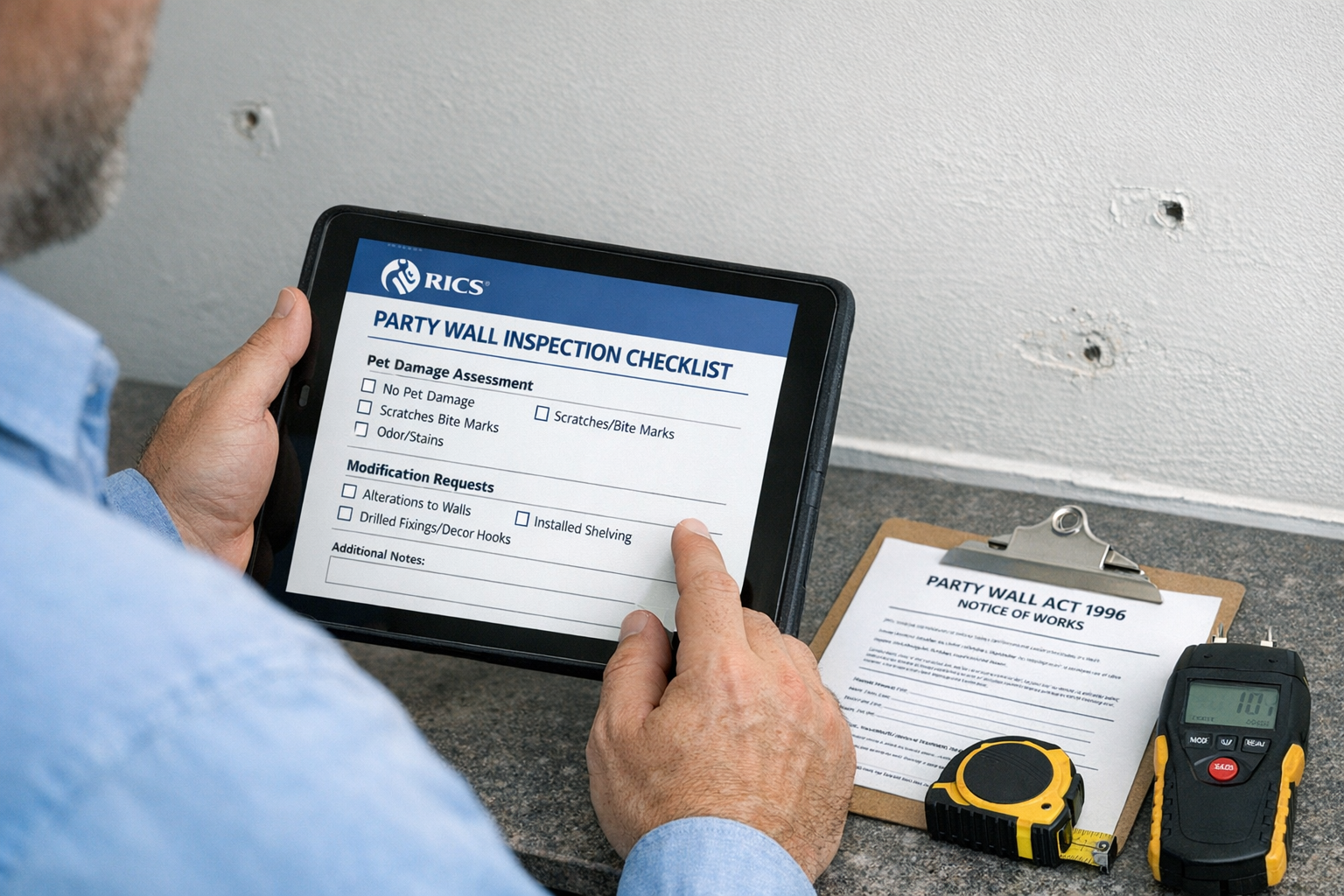
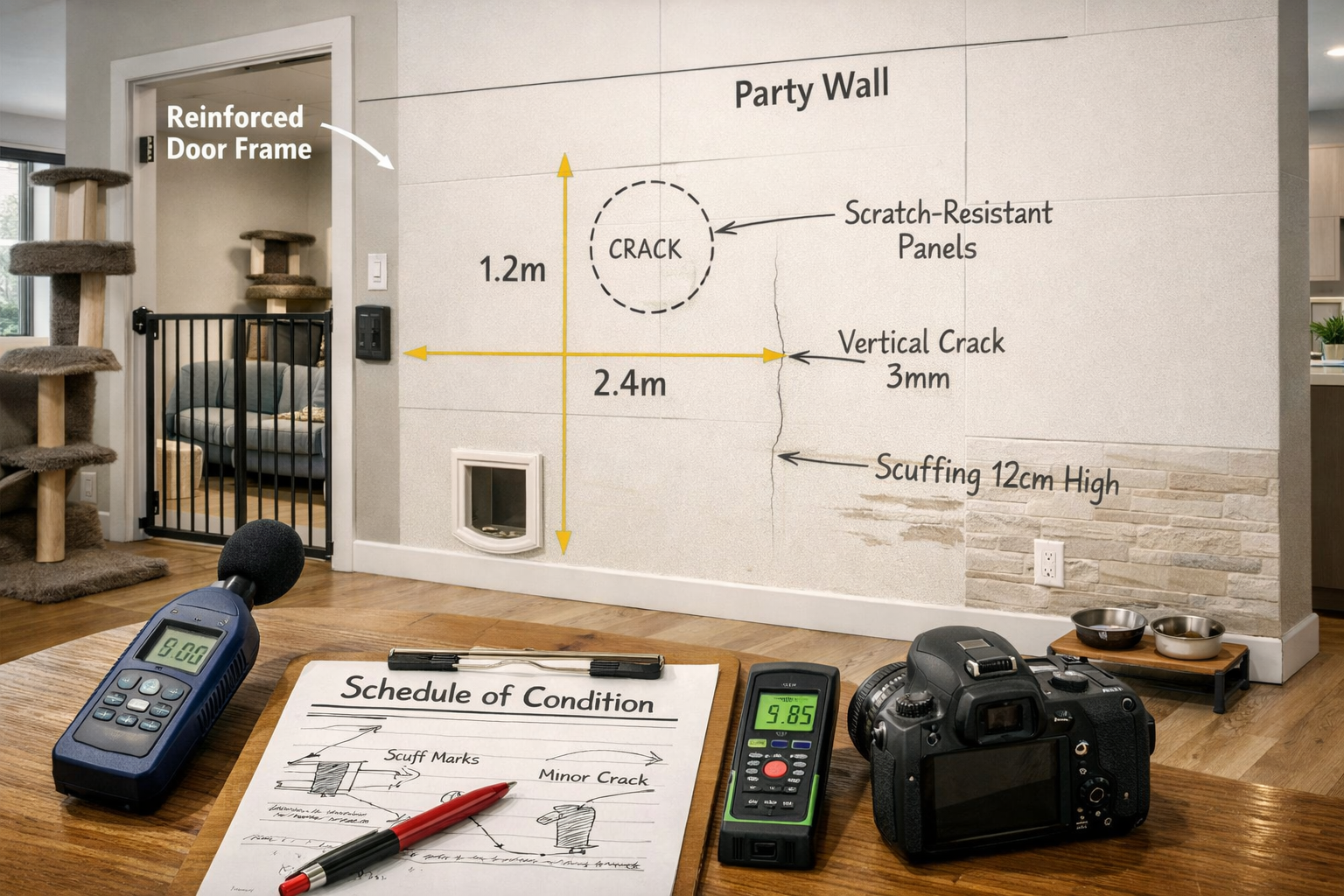
- Document existing condition with schedule of condition guidance
- Assess wall construction materials and age
✅ Proposed Modification Analysis
- Type of fixtures required (mounting brackets, gates, shelving)
- Depth of penetration into party structure
- Weight load implications for wall integrity
- Potential for moisture ingress or structural compromise
✅ Party Wall Act Trigger Evaluation
- Does work constitute "notifiable" activity under the 1996 Act?
- Will modifications affect structural integrity of party wall?
- Are adjoining owners' properties at risk of damage?
- Is excavation or underpinning involved?
Pet-Specific Considerations
Different animals present distinct party wall challenges:
| Pet Type | Primary Concerns | Party Wall Implications |
|---|---|---|
| Large Dogs | Floor loading, scratching damage, noise transmission | Floor reinforcement may affect party walls below; soundproofing installations |
| Cats | Wall-mounted climbing structures, scratching posts | Multiple wall penetrations; vertical loading on party structures |
| Caged Pets | Humidity, ventilation modifications | Moisture control systems affecting party wall damp-proofing |
| Aquariums | Significant weight loads, water damage risk | Floor loading affecting party structures; emergency drainage considerations |
Party Wall Notice Requirements Checklist
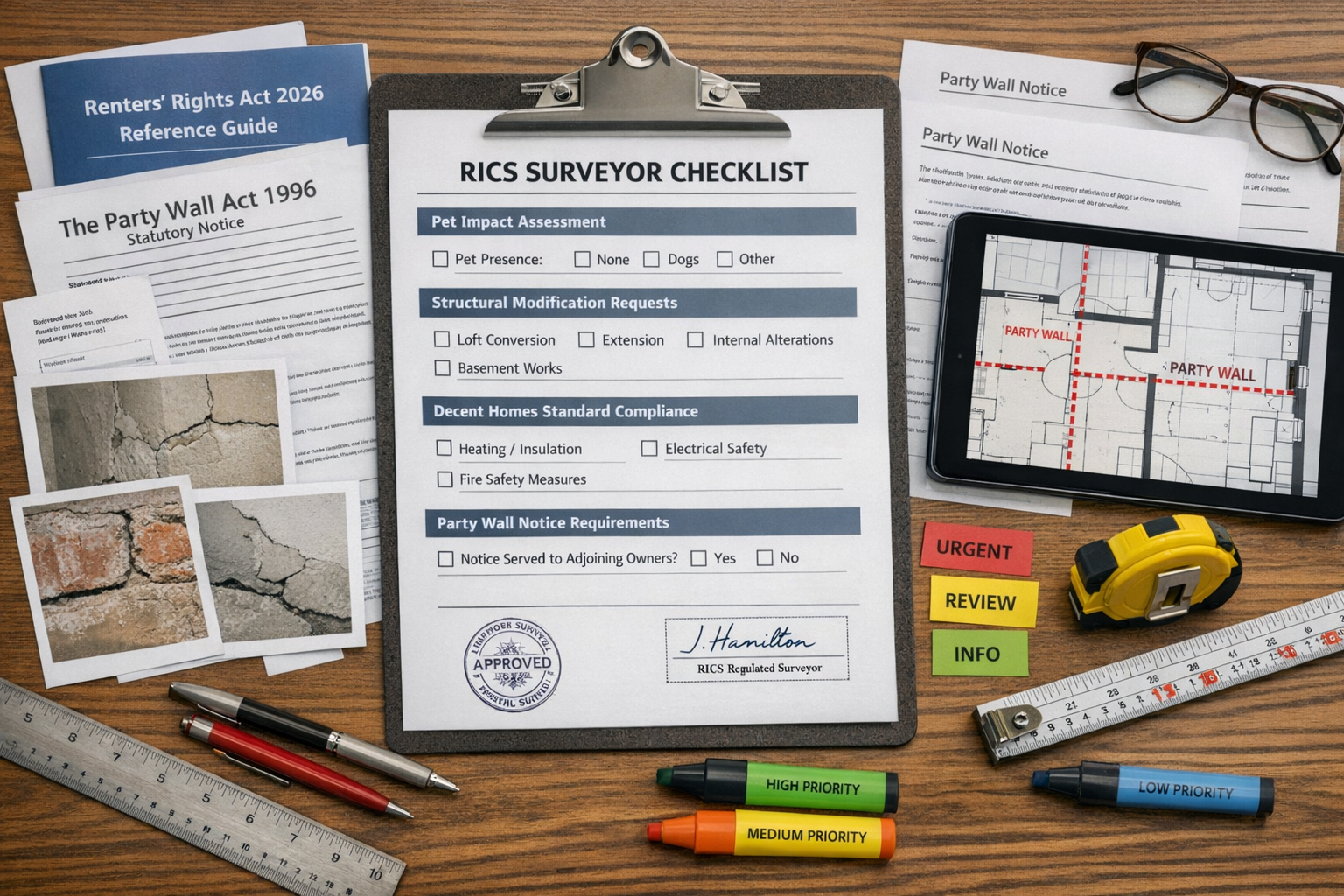
When modifications trigger Party Wall Act procedures, surveyors must guide all parties through proper notification:
🔔 Notice Timing and Content
- Minimum two months' notice for most party wall works
- One month for excavation works within three meters
- Notice must detail exact nature of proposed works
- Include drawings and specifications where applicable
🔔 Consent and Award Process
- Adjoining owner has 14 days to consent or dissent
- No party wall notice served creates legal complications
- Dissent triggers party wall award requirement
- Surveyors must be appointed (agreed or separate)
🔔 Landlord-Tenant Responsibility Matrix
- Landlord remains "building owner" under Party Wall Act
- Tenant initiates modification request under Renters' Rights Act
- Surveyor must clarify who bears party wall procedure costs
- Adjoining owner retains full rights regardless of tenant involvement
Modification Request Evaluation Protocol
For each tenant modification request, surveyors should apply this decision framework:
Step 1: Reasonableness Assessment
- Is the modification necessary for pet welfare?
- Are less invasive alternatives available?
- Does it comply with Decent Homes Standard requirements?
- Is the scale proportionate to the rental property?
Step 2: Structural Safety Verification
- Will modifications compromise building structural integrity?
- Are fire safety or building regulation approvals required?
- Does work affect emergency egress routes?
- Are there implications for building insurance coverage?
Step 3: Reversibility Analysis
- Can modifications be removed at tenancy end?
- What reinstatement costs are anticipated?
- Should damage deposits be adjusted accordingly?
- Are photographic condition records sufficient?
Step 4: Party Wall Procedure Determination
- Complete party wall trigger assessment
- Initiate notice procedures if required
- Coordinate timing with tenant modification approval
- Document all decisions for dispute prevention
RICS-Compliant Protocols for Multi-Unit Rental Properties
Multi-unit rental properties present the most complex scenarios for Party Wall Implications of Renters' Rights Act 2026: Surveyor Checklists for Pet and Modification Requests. Surveyors must balance multiple stakeholder interests while maintaining professional standards.
Multi-Tenant Building Considerations
When multiple rental units share party structures, complications multiply exponentially:
Cascading Modification Requests
If one tenant receives approval for pet-related modifications, neighboring tenants may submit similar requests. Surveyors must evaluate cumulative impacts on party structures:
- Structural loading: Multiple modifications to the same party wall
- Acoustic performance: Degradation from repeated penetrations
- Fire resistance: Compromised fire-stopping in party walls
- Insurance implications: Increased risk profiles affecting coverage
Precedent Effects
Approving one modification request may establish precedents that complicate future refusals. RICS protocols should include:
- Consistency documentation: Record rationale for all approval/refusal decisions
- Building-wide policies: Establish clear modification standards applicable to all units
- Cumulative impact assessments: Evaluate combined effects of multiple modifications
- Review cycles: Periodic reassessment of building-wide modification impacts
Coordination with Decent Homes Standard (Phase 2)
Phase 2 of the Renters' Rights Act will introduce the Decent Homes Standard and extend Awaab's Law, requiring landlords to address hazardous substances like mold and damp[1]. This creates additional surveyor responsibilities:
Integrated Assessment Requirements
- Moisture control: Pet-related modifications must not compromise damp-proofing
- Ventilation: Adequate air circulation for pet welfare and mold prevention
- Structural soundness: Modifications cannot create hazardous conditions
- Thermal performance: Insulation integrity must be maintained
Compliance Documentation
Surveyors should maintain comprehensive records demonstrating:
- Pre-modification condition assessments
- Decent Homes Standard compliance verification
- Party wall structural integrity confirmation
- Post-modification inspection results
Professional Liability and Insurance Considerations
The intersection of tenant rights and party wall obligations creates new professional liability exposures:
⚠️ Key Risk Areas:
- Inadequate party wall notice: Failing to identify notifiable works
- Structural damage: Approved modifications causing party wall damage
- Adjoining owner disputes: Inadequate protection of neighbor rights
- Regulatory non-compliance: Missing building regulation requirements
Risk Mitigation Strategies:
- Maintain comprehensive professional indemnity insurance
- Document all assessment decisions with photographic evidence
- Obtain written confirmations from all parties
- Engage structural engineers for complex modifications
- Keep current with evolving RICS guidance on Renters' Rights Act implications
Dispute Resolution Frameworks
When conflicts arise between tenant modification rights and party wall obligations, surveyors should follow structured resolution approaches:
Tier 1: Informal Resolution
- Facilitate discussions between tenant, landlord, and adjoining owner
- Propose alternative modification approaches
- Clarify legal obligations under both Acts
- Seek consensus on reasonable accommodations
Tier 2: Formal Party Wall Award
- Appoint agreed surveyor or separate surveyors
- Conduct detailed structural assessments
- Prepare comprehensive party wall award
- Include conditions protecting all parties' interests
Tier 3: Legal Proceedings
- Document all previous resolution attempts
- Provide expert witness testimony if required
- Reference party wall statutory requirements
- Maintain professional objectivity throughout proceedings
Building Type-Specific Protocols
Different property types require tailored approaches:
Victorian Terraced Houses
- Typically solid brick party walls with limited soundproofing
- Historical construction may be sensitive to modifications
- Loft conversions party wall considerations if pets access upper floors
- Heritage considerations may limit modification options
Modern Apartment Blocks
- Steel frame or reinforced concrete party structures
- Better baseline soundproofing but complex ownership structures
- Multiple adjoining owners requiring individual notices
- Building management company involvement
Converted Properties
- Mixed construction types within single building
- Unclear party wall boundaries requiring detailed surveys
- Potential for undocumented previous modifications
- Complex ownership histories affecting party wall awards
Implementation Timeline and Practical Steps
With Phase 1 implementation on 1 May 2026 rapidly approaching, surveyors must act immediately to prepare for the Party Wall Implications of Renters' Rights Act 2026: Surveyor Checklists for Pet and Modification Requests.
Immediate Action Items (Before 1 May 2026)
For Surveyors:
- ✅ Review and update professional knowledge on Renters' Rights Act provisions
- ✅ Develop standardized assessment checklists incorporating both Acts
- ✅ Establish protocols for three-party communications (tenant-landlord-neighbor)
- ✅ Update professional indemnity insurance to cover new liability exposures
- ✅ Create client education materials explaining dual compliance requirements
For Landlords:
- ✅ Commission building-wide party wall condition surveys
- ✅ Establish clear modification request procedures for tenants
- ✅ Review tenancy agreements for party wall responsibility clauses
- ✅ Identify properties with shared structures requiring special protocols
- ✅ Budget for potential party wall procedure costs
For Property Managers:
- ✅ Train staff on new tenant rights and party wall obligations
- ✅ Implement modification request tracking systems
- ✅ Establish surveyor appointment procedures
- ✅ Create template party wall notices for common modifications
- ✅ Develop communication protocols for adjoining owners
Long-Term Strategic Considerations
Phase 2 Preparation (Decent Homes Standard)
As Phase 2 implementation approaches, surveyors should anticipate additional complexities:
- Integration of hazardous substance assessments (mold, damp) with party wall evaluations
- Enhanced moisture control requirements affecting party wall treatments
- Ventilation improvements potentially requiring party wall modifications
- Thermal performance upgrades involving party wall insulation
Professional Development Requirements
RICS members should pursue continuing professional development in:
- Renters' Rights Act 2026 detailed provisions and case law
- Party Wall Act 1996 recent tribunal decisions and precedents
- Building pathology relevant to pet-related property damage
- Dispute resolution and mediation techniques
- Multi-party stakeholder management
Cost Allocation Framework
One of the most contentious aspects involves determining who pays for party wall procedures triggered by tenant modification requests:
Typical Cost Distribution:
| Scenario | Party Wall Procedure Costs | Modification Costs | Ongoing Maintenance |
|---|---|---|---|
| Landlord-Approved Pet | Landlord bears notice costs | Tenant or landlord (negotiated) | Tenant responsible for pet damage |
| Structural Modification | Landlord (as building owner) | Typically tenant if voluntary | Depends on tenancy agreement |
| Decent Homes Compliance | Landlord (regulatory obligation) | Landlord | Landlord |
| Emergency Repairs | Landlord | Landlord | Landlord |
Surveyors should provide clear cost estimates early in the assessment process to prevent disputes and enable informed decision-making by all parties.
Documentation Standards
Comprehensive documentation protects all stakeholders and reduces dispute risks:
Essential Records:
- 📸 Pre-modification photographic condition surveys
- 📋 Detailed modification specifications and drawings
- 📄 Party wall notices and responses
- ✍️ Written consent from all relevant parties
- 🔍 Structural assessment reports
- 📊 Compliance certifications (building regulations, fire safety)
- 💰 Cost estimates and final expenditure records
Retention Periods:
- Party wall awards: Permanent retention (they run with the land)[3]
- Condition surveys: Duration of tenancy plus 6 years
- Correspondence: Minimum 6 years from completion
- Structural reports: Permanent building file retention
Conclusion
The Party Wall Implications of Renters' Rights Act 2026: Surveyor Checklists for Pet and Modification Requests represent a critical evolution in property surveying practice. As Phase 1 implementation arrives on 1 May 2026, RICS-qualified professionals must navigate the complex intersection of tenant rights and party wall statutory obligations with precision and expertise.
The key to successful implementation lies in recognizing that these are not competing frameworks but complementary systems requiring integrated assessment approaches. Tenant modification rights under the Renters' Rights Act do not override party wall obligations—they coexist, creating a more complex but ultimately more balanced regulatory environment.
Actionable Next Steps
For Surveyors:
- Implement the comprehensive checklists outlined in this guide immediately
- Establish clear communication protocols for three-party scenarios
- Develop template documentation for common modification requests
- Maintain detailed records of all assessment decisions and rationales
- Stay current with emerging case law and RICS guidance updates
For Property Professionals:
- Commission baseline party wall condition surveys for rental portfolios
- Establish clear modification request procedures before 1 May 2026
- Budget for increased surveyor involvement in tenant modification approvals
- Review insurance coverage for new liability exposures
- Educate tenants about both their rights and party wall obligations
For Tenants:
- Submit modification requests in writing with detailed specifications
- Understand that reasonable requests may still require party wall procedures
- Budget for potential cost-sharing arrangements
- Allow adequate time for multi-party approval processes
- Maintain properties to Decent Homes Standard expectations
The convergence of the Renters' Rights Act 2026 and Party Wall Act 1996 creates challenges, but also opportunities for professional surveyors to provide essential guidance in an evolving regulatory landscape. By adopting comprehensive assessment protocols and maintaining rigorous documentation standards, surveyors can protect all stakeholders while facilitating the reasonable accommodation of pets and tenant modifications in multi-unit rental properties.
As Phase 2 implementation approaches with the Decent Homes Standard and Awaab's Law extensions, these protocols will require further refinement. However, the foundational principles remain constant: thorough assessment, clear communication, comprehensive documentation, and balanced consideration of all parties' legitimate interests under both legislative frameworks.
References
[1] Alerts Realestate Impacts Of The Renters Rights Act – https://www.goodwinlaw.com/en/insights/publications/2026/01/alerts-realestate-impacts-of-the-renters-rights-act
[2] Selling A Rental Property In 2026 How The New Renters Rights Bill Affects You – https://www.gorvinsresidential.com/selling-a-rental-property-in-2026-how-the-new-renters-rights-bill-affects-you/
[3] Buying Property Party Wall Award – https://osborneslaw.com/blog/buying-property-party-wall-award/