
Nearly one in three residential construction disputes in England and Wales involves a neighbour alleging damage, excessive noise, or ground movement caused by works next door — yet fewer than half of those claimants secure expert surveyor evidence early enough to protect their position. That gap between harm suffered and evidence gathered is precisely where Expert Witness Surveyors in Neighbour Nuisance and Damage Claims: Noise, Vibration and Subsidence from Nearby Works add decisive value.
Whether the issue is a crack that appeared overnight after pile-driving began, a floor that has started to slope, or relentless vibration that has made a property uninhabitable, courts and mediators need structured, impartial technical evidence — not just a neighbour's photographs and frustration.
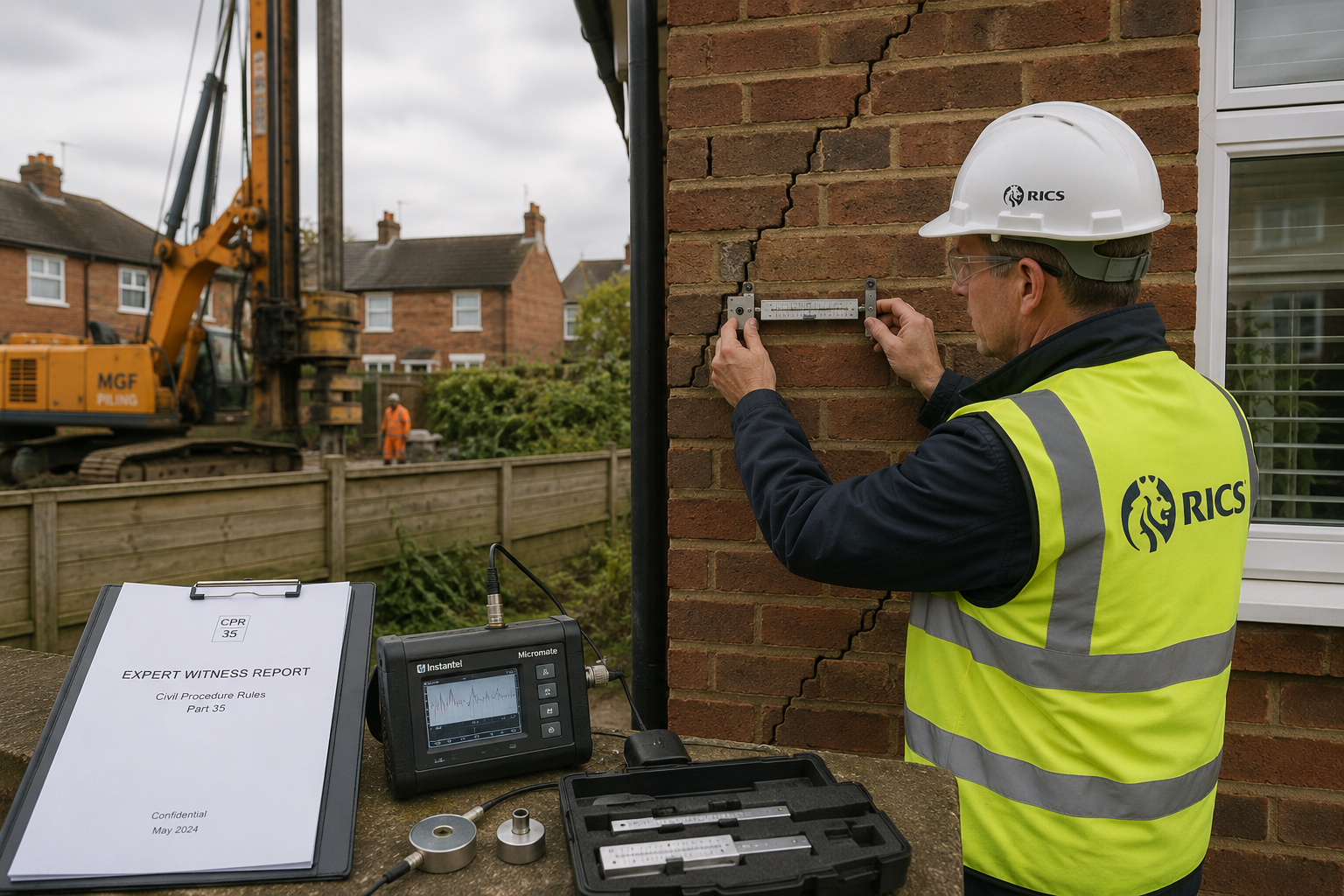
Key Takeaways 📌
- Early instruction matters: Commissioning an expert witness surveyor before litigation begins — ideally before works start — dramatically strengthens a neighbour's claim.
- CPR Part 35 compliance is non-negotiable in England & Wales: reports must be structured, impartial, and addressed to the court, not the instructing party.
- Causation is the hardest hurdle: Expert surveyors must distinguish pre-existing defects from new construction-induced damage using crack monitoring, level surveys, and vibration records.
- The Party Wall etc. Act 1996 creates specific duties on building owners; where those duties are breached, expert evidence directly supports compensation claims.
- Settlement, not trial, is the likely outcome: High-quality expert reports frame realistic settlement parameters and reduce disproportionate legal costs for both sides [10].
Why Neighbour Damage Claims Are Technically Complex
Construction work near a shared boundary creates multiple, overlapping risk pathways. Ground vibration from compactors or pile-drivers travels through soil and can loosen mortar, crack plasterwork, or destabilise shallow foundations. Noise from demolition or concrete breaking can breach statutory limits under the Control of Pollution Act 1974. Excavation for basements or extensions can cause differential settlement, where one part of a neighbouring property sinks relative to another, producing diagonal cracking at window and door openings.
Each of these mechanisms requires a different investigative approach, and courts expect expert witnesses to explain not just what happened but why and who is responsible [1].
💬 "Courts rely on structured technical analysis to decide whether noise, vibration, or ground movement exceeded what is reasonably tolerable — and to allocate responsibility between developer, contractor, and design professionals." [5]
The Overlap with Party Wall Duties
In England and Wales, the Party Wall etc. Act 1996 sits at the heart of most neighbour construction disputes. A building owner carrying out notifiable works must:
- Serve the correct notices on adjoining owners
- Avoid unnecessary inconvenience during works
- Protect the neighbour's property from foreseeable harm
- Make good or pay compensation for resulting damage
Where no Party Wall Notice was served — a surprisingly common situation — the neighbour still retains a common-law right to compensation [3]. In both scenarios, expert surveyor evidence is the mechanism by which damage is proven and quantified. Understanding what happens when a neighbour carries out works without a Party Wall Agreement is an essential first step for any affected property owner.
A Schedule of Condition prepared before works begin is one of the most powerful protective tools available. It creates a photographic and written baseline against which post-works damage can be objectively compared, removing much of the dispute about whether cracks were pre-existing.
How Expert Witness Surveyors in Neighbour Nuisance and Damage Claims Gather Evidence
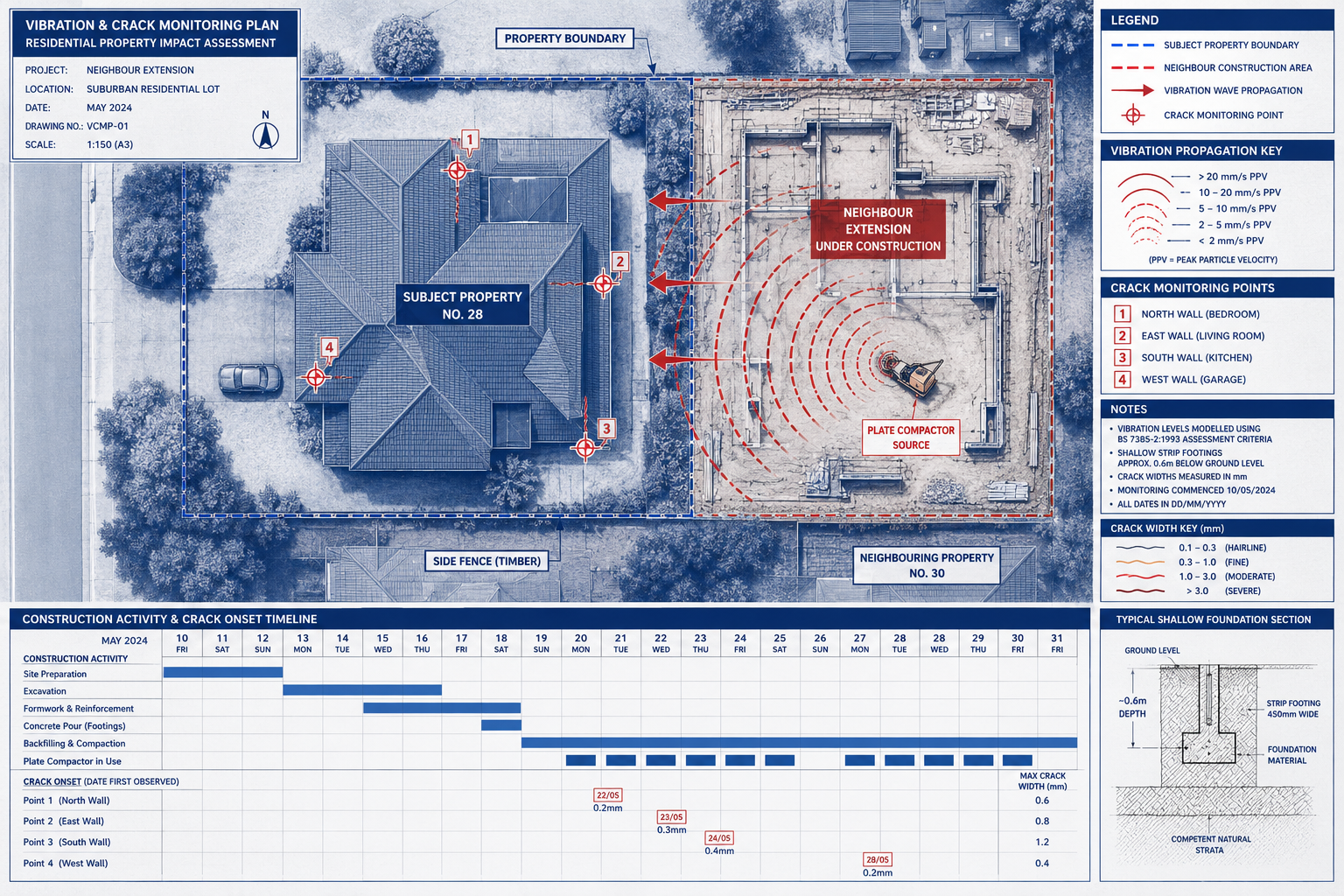
The credibility of any expert witness case depends entirely on the quality of the underlying evidence. Surveyors instructed in noise, vibration, and subsidence disputes typically follow a structured methodology across four phases.
Phase 1: Pre-Instruction Review
Before visiting the site, the expert reviews:
- Planning applications and approved drawings
- Any Party Wall Awards or Notices served (or not served)
- The neighbour's own Schedule of Condition report if one exists
- Construction programmes, contractor method statements, and plant records
- Correspondence between the parties
This desk-based review establishes the chronology of works — a critical framework for correlating construction activities with the onset of damage.
Phase 2: Site Investigation and Monitoring
On-site work typically includes:
| Investigation Type | Purpose |
|---|---|
| Crack monitoring (tell-tales / Demec gauges) | Track progressive movement over weeks or months |
| Precise level surveys | Detect differential settlement in floors and walls |
| Vibration monitoring (seismographs) | Record peak particle velocity (PPV) against BS 7385 thresholds |
| Noise measurements (sound level meters) | Compare against BS 4142 / BS 8233 limits |
| Ground investigation / trial pits | Assess soil type, foundation depth, and groundwater |
| Photographic survey | Document crack patterns, widths, and locations |
The distinction between pre-existing defects and new construction-induced damage is the most contested issue in almost every claim [5]. Crack monitoring over time is the most reliable way to demonstrate that movement is progressive and correlates with specific construction activities rather than seasonal shrinkage or long-standing settlement.
For complex structural movement, a subsidence survey provides the depth of investigation needed to assess foundation behaviour and soil conditions.
Phase 3: Causation Analysis
Once data is gathered, the expert must construct a causation narrative that a judge can follow. This involves:
- Correlating dates: When did pile-driving begin? When did the first crack appear? Do vibration records show PPV spikes on those dates?
- Ruling out alternative causes: Is the soil shrinkable clay? Are there nearby trees? Was there a pre-existing drainage defect? [2]
- Applying recognised standards: Courts scrutinise whether the expert followed established surveying and geotechnical standards, and whether their analysis properly distinguishes natural settlement from construction-induced movement [8].
Where the root cause is a flawed original survey — for example, a boundary re-establishment using incorrect control that led to a retaining wall being built in the wrong position — specialist survey negligence expert witnesses may be needed. These experts review original survey files, undertake new fieldwork, and assess whether measurement errors contributed to encroachment or inadequate clearances [2].
Phase 4: Remedial Costing and Report Preparation
The expert's final report must:
✅ Be addressed to the court (not the instructing party)
✅ Comply with CPR Part 35 in England & Wales
✅ Include a statement of truth and confirmation of the expert's duty to the court
✅ Provide a clear chronology and site investigation data
✅ Differentiate pre-existing from new damage
✅ Set out repair options with itemised costs
✅ Identify areas of uncertainty and their impact on the opinion
A well-prepared expert witness report that meets these standards carries significantly more weight in negotiation and litigation than a partisan letter from a surveyor acting as advocate rather than expert.
Noise and Vibration Claims: Specific Considerations
Statutory vs Common-Law Nuisance
Noise and vibration from construction can give rise to claims under two parallel frameworks:
Statutory nuisance (Environmental Protection Act 1990, s.79): Local authorities can serve abatement notices. Expert surveyors may be instructed to provide evidence on whether noise or vibration constitutes a "prejudice to health or a nuisance."
Common-law nuisance: Neighbours can sue for damages if construction noise or vibration unreasonably interferes with the use and enjoyment of their property. The key legal test is whether the interference exceeds what is reasonably tolerable given the locality and the nature of the works.
The "Best Practicable Means" Defence
Developers frequently rely on the best practicable means (BPM) defence — arguing that they took all reasonable steps to minimise noise and vibration. Expert surveyors assess this by reviewing:
- Whether works were confined to agreed hours
- Whether noise barriers or vibration-dampening methods were used
- Whether alternative, less-disruptive construction methods were available and practicable
- Whether monitoring was carried out and results acted upon [1]
A developer's contemporaneous records of BPM measures often become the central battleground. Where those records are absent or inadequate, the expert's opinion on whether nuisance occurred is harder to rebut.
Vibration Thresholds
The key UK standard is BS 7385-2:1993, which sets guidance values for PPV (peak particle velocity) in mm/s at which cosmetic, minor structural, or major structural damage becomes increasingly probable. Expert surveyors use these thresholds — alongside site-specific monitoring data — to form opinions on whether vibration levels were excessive and whether they were capable of causing the observed damage [5].
The Role of Expert Witness Surveyors in Neighbour Nuisance and Damage Claims at Each Stage of Dispute Resolution
The demand for qualified expert witness surveyors in neighbour nuisance cases has grown steadily, reflecting the volume and complexity of residential construction disputes [7]. Crucially, expert evidence is not just for trial — it is valuable at every stage.

Before Works Begin
- Commission a Schedule of Condition to establish a baseline
- Engage a party wall surveyor to ensure proper notices and Awards are in place
- Consider pre-emptive vibration monitoring if pile-driving or demolition is planned nearby
During Dispute Negotiation and Mediation
High-quality, balanced expert evidence frames realistic settlement parameters and prevents over-litigation [10]. Courts in England and Wales may penalise disproportionate litigation even where a party succeeds on the merits — meaning that an expert report which accurately values the claim (rather than inflating it) is strategically important [6].
At Trial
Expert surveyors may be required to:
- Produce a joint statement with the opposing expert, identifying agreed and disputed issues
- Give oral evidence and withstand cross-examination on their methodology and conclusions
- Respond to the court's own questions under CPR Part 35.6
The court will assess the expert's independence, the rigour of their methodology, and whether their opinion is properly reasoned and supported by evidence [8] [9].
Key Qualities Courts Look For in Expert Surveyors
| Quality | Why It Matters |
|---|---|
| RICS qualification | Demonstrates professional standards and accountability |
| Relevant specialism | Building surveying, geotechnics, acoustics as appropriate |
| Independence | No financial interest in the outcome |
| Methodological rigour | Use of recognised standards (BS 7385, BS 4142, etc.) |
| Clear communication | Ability to explain technical issues to a non-specialist judge |
| CPR Part 35 compliance | Mandatory in England & Wales civil proceedings |
For those seeking chartered surveyors in Central London or chartered surveyors in North West London with expert witness experience, it is important to verify both RICS membership and specific experience in neighbour damage litigation.
Common Mistakes That Undermine Neighbour Damage Claims
🚫 Failing to document damage promptly: Photographs taken weeks after cracks appeared, without contemporaneous dates, are easily challenged.
🚫 Instructing a surveyor too late: Once works are complete and the site is made good, critical evidence — soil conditions, foundation exposure, vibration records — may be lost forever.
🚫 Confusing advocacy with expert evidence: A surveyor who writes a report designed to support their client's position, rather than to assist the court, will be identified and discredited in cross-examination.
🚫 Ignoring pre-existing conditions: Failure to acknowledge and address pre-existing defects in the expert report undermines credibility on all other points [5].
🚫 Overlooking the boundary dimension: Where works near a boundary may have involved encroachment or a flawed boundary survey, a separate boundary survey expert may be needed alongside the building surveyor [4].
Conclusion: Actionable Next Steps for Affected Property Owners
Expert Witness Surveyors in Neighbour Nuisance and Damage Claims: Noise, Vibration and Subsidence from Nearby Works occupy a critical role in the resolution of some of the most technically and emotionally charged disputes in property law. The difference between a successful claim and a failed one often comes down to the quality, timing, and independence of the surveying evidence.
Immediate Actions to Take 🎯
- Document everything now — photograph all cracks, measure widths, note dates, and keep a diary of noise and vibration events.
- Commission a Schedule of Condition before works progress further, or as soon as possible after they begin.
- Instruct a RICS-qualified expert witness surveyor with specific experience in construction damage and neighbour nuisance claims — not a general valuer.
- Check Party Wall compliance — if no notice was served, take legal advice immediately on your common-law rights [3].
- Consider ADR early — mediation supported by a credible expert report is far less costly than trial and produces binding outcomes faster [10].
- Preserve all correspondence with the developer, contractor, and local authority — these records become evidence.
The earlier a qualified expert is engaged, the stronger the evidentiary foundation. Waiting until litigation is underway means working with incomplete data — and incomplete data means incomplete justice.
References
[1] Construction Claims Adjacent Neighbor – https://www.myconstructionexpert.com/blog/construction-claims-adjacent-neighbor/
[2] Surveyor Negligence – https://cnettleman.net/surveyor-negligence/
[3] Damage Caused By A Neighbours Building Work Your Rights – https://www.geoffreyleaver.com/2023/03/27/damage-caused-by-a-neighbours-building-work-your-rights/
[4] Watch – https://www.youtube.com/watch?v=oiLAZiAr5Vs
[5] Expert Witness Surveyors In Construction Defect Claims How To Build A Credible Case Around Poor Workmanship – https://www.canterburysurveyors.com/blog/expert-witness-surveyors-in-construction-defect-claims-how-to-build-a-credible-case-around-poor-workmanship/
[6] Expert Witness Essentials For 2026 Boundary Disputes Strengthening Cases In A Recovering Property Market – https://nottinghillsurveyors.com/blog/expert-witness-essentials-for-2026-boundary-disputes-strengthening-cases-in-a-recovering-property-market
[7] Buildings – https://www.jspubs.com/expert-witness/si/b/buildings/
[8] Mapping Surveying Expert Witness Case Summary – https://www.expertwitnessblog.com/mapping-surveying-expert-witness-case-summary/
[9] Land Surveying Expert Witness – https://seakexperts.com/specialties/land-surveying-expert-witness
[10] Can I Make My Neighbour Pay My Legal Costs In A Boundary Dispute – https://thebarristersinc.com/news/can-i-make-my-neighbour-pay-my-legal-costs-in-a-boundary-dispute/