The abolition of Section 21 "no-fault" evictions under the Renters' Rights Act 2026 has fundamentally altered the power dynamic between landlords and tenants, creating unprecedented challenges for party wall surveyors managing extension works in rental properties. With the new Private Rented Sector (PRS) Ombudsman now operational and tenants empowered to challenge improvement works more vigorously, surveyors must navigate a complex intersection of property law, tenant rights, and construction protocols that didn't exist under the previous legislative framework.
Understanding Party Wall Surveyor Roles in Resolving Renters' Rights Act 2026 Disputes: Protocols for Landlord Extension Works has become essential for property professionals operating in 2026. The legislation, which came into force in May 2026, introduces mandatory rent review mechanisms, strengthened tenant protections, and new dispute resolution pathways that directly impact how party wall awards are prepared, served, and enforced when landlords undertake extension projects.

Key Takeaways
- 🏗️ Party wall surveyors must now account for tenant occupation rights when preparing awards for landlord extension works, ensuring compliance with both the Party Wall Act 1996 and Renters' Rights Act 2026
- ⚖️ The new PRS Ombudsman provides tenants with additional dispute channels beyond traditional party wall procedures, requiring surveyors to coordinate with multiple regulatory bodies
- 📋 Enhanced documentation protocols are mandatory to protect landlords' improvement rights while respecting tenants' strengthened security of tenure
- 💰 Valuation adjustments must reflect the interplay between construction disruption, tenant rights, and property improvement value under the 2026 framework
- ⏱️ Timeline coordination has become more complex, as surveyors must balance construction schedules with tenant consultation requirements and new rent review periods
Understanding the Legislative Intersection: Party Wall Act 1996 Meets Renters' Rights Act 2026
The Party Wall Act 1996 has long governed construction work affecting shared walls, boundaries, and excavations near neighboring properties [1]. However, the introduction of the Renters' Rights Act 2026 creates a new layer of complexity when the "adjoining owner" in party wall proceedings is actually a tenant rather than a freeholder.
The Traditional Party Wall Framework
Under established party wall procedures, building owners must serve notices on adjoining owners before commencing works that affect party structures. The process involves:
- Notice periods: Typically 1-2 months depending on work type [1]
- Consent or dissent: Adjoining owners can agree or appoint a surveyor
- Party wall awards: Legally binding documents detailing work scope, timing, and protections
- Schedule of condition: Pre-work documentation of neighboring property state
This framework assumes relatively straightforward property ownership relationships. When landlords undertake extension works on rental properties, the traditional model becomes significantly more complicated.
How the Renters' Rights Act 2026 Changes the Game
The Renters' Rights Act 2026 introduces several provisions that directly impact party wall procedures:
Abolition of Section 21 evictions: Landlords can no longer issue "no-fault" evictions, meaning tenants have greater security of tenure and cannot be easily removed to facilitate construction work [3].
Mandatory PRS Ombudsman membership: All private landlords must join the PRS Ombudsman scheme, giving tenants a formal dispute resolution channel for concerns about property conditions and improvement works.
Enhanced tenant consultation rights: Tenants must be properly informed about planned works, their rights during construction, and any temporary relocation arrangements.
Rent review protections: New rent increase limitations mean landlords cannot simply raise rents to offset construction costs or tenant inconvenience without justification.
These changes require party wall surveyors to fundamentally rethink their approach to party wall disputes involving rental properties.
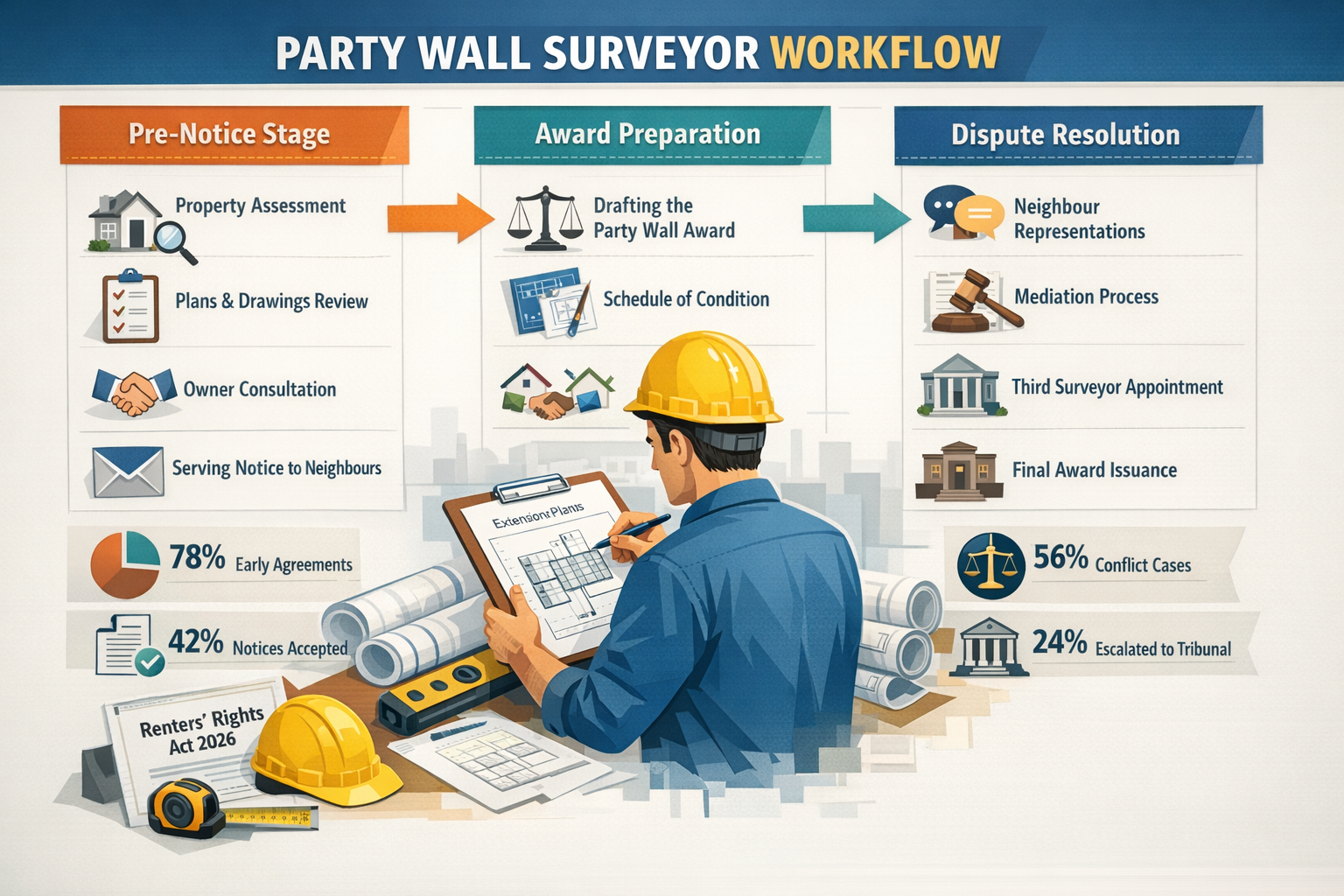
Party Wall Surveyor Roles in Resolving Renters' Rights Act 2026 Disputes: Core Protocols for Extension Works
When landlords plan extension works that trigger party wall procedures, surveyors must now implement enhanced protocols that address both construction requirements and tenant rights under the 2026 legislation.
Pre-Notice Stage: Tenant Identification and Rights Assessment
Before serving formal party wall notices, surveyors must conduct a comprehensive tenant rights assessment:
Occupancy verification: Determine whether the adjoining property is owner-occupied or tenanted. If tenanted, identify whether the tenant has security of tenure under the Renters' Rights Act 2026.
Lease review: Examine tenancy agreements to understand:
- Landlord's rights to undertake improvement works
- Tenant's rights regarding quiet enjoyment
- Any specific clauses about construction or alterations
- Notice requirements for property access
Communication protocols: Establish clear channels between:
- Building owner (landlord undertaking works)
- Building owner's tenants (if applicable)
- Adjoining owner (landlord of neighboring property)
- Adjoining owner's tenants (the parties most affected)
- All appointed surveyors
This multi-party communication structure is far more complex than traditional party wall procedures and requires careful documentation at every stage.
Notice Service: Dual-Track Approach
Surveyors must now implement a dual-track notice approach that satisfies both party wall legislation and tenant rights requirements:
Track 1: Statutory Party Wall Notices
- Serve formal notices under the Party Wall Act 1996 [2]
- Address to the freeholder/landlord as the legal owner
- Include all required technical details about proposed works
- Specify the excavation notice requirements if applicable
Track 2: Tenant Information Notices
- Provide plain-language explanations to occupying tenants
- Detail expected disruption, duration, and mitigation measures
- Explain tenant rights under the Renters' Rights Act 2026
- Offer contact information for the PRS Ombudsman
- Include surveyor contact details for concerns
This dual approach ensures legal compliance while maintaining positive tenant relationships and reducing the likelihood of disputes escalating to the PRS Ombudsman.
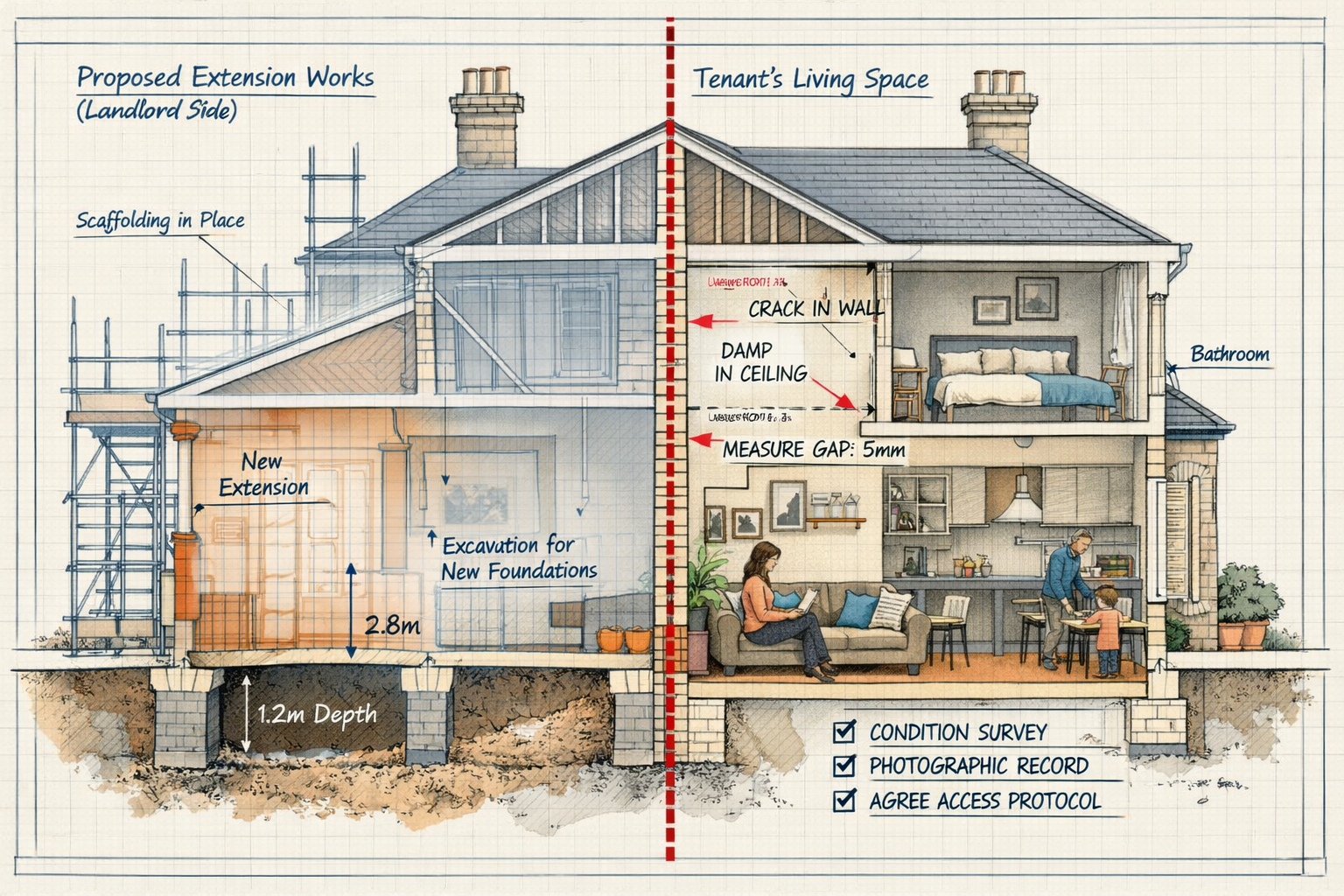
Schedule of Condition: Enhanced Documentation Standards
The traditional schedule of condition takes on heightened importance under the 2026 framework. Surveyors must now document:
Physical property condition: Comprehensive photographic and written records of all areas potentially affected by works, including:
- Internal finishes and decorations
- Structural elements
- Services and utilities
- External facades and boundaries
Tenant occupation factors: Additional documentation specific to rental properties:
- Evidence of tenant belongings and furnishings
- Condition of landlord-provided fixtures and fittings
- Any pre-existing maintenance issues
- Tenant-reported concerns or sensitivities
Baseline compliance status: Assessment of the property's compliance with rental property standards, as this may be relevant if tenants raise concerns about works exacerbating existing issues.
This enhanced documentation protects all parties by establishing clear baselines before works commence, making it easier to resolve any subsequent damage claims.
Dispute Resolution Protocols: Navigating Multiple Jurisdictions
One of the most significant challenges in Party Wall Surveyor Roles in Resolving Renters' Rights Act 2026 Disputes: Protocols for Landlord Extension Works is managing disputes that span multiple regulatory frameworks.
Traditional Party Wall Dispute Resolution
Under the Party Wall Act 1996, disputes follow a well-established path:
- Dissent: Adjoining owner disagrees with proposed works
- Surveyor appointment: Each party appoints a surveyor (or agrees on a single "agreed surveyor")
- Award preparation: Surveyor(s) prepare a detailed award specifying work conditions
- Award service: The award becomes legally binding 14 days after service
- Appeal: Limited right to appeal to county court on specific grounds
This process assumes the dispute is primarily technical and construction-focused.
PRS Ombudsman Jurisdiction
The new PRS Ombudsman scheme creates an additional dispute resolution pathway for tenants who believe:
- Construction works violate their right to quiet enjoyment
- The landlord has failed to properly maintain the property during works
- Disruption is unreasonable or excessive
- Health and safety concerns have not been addressed
- The landlord has not followed proper consultation procedures
Critical distinction: The PRS Ombudsman cannot override party wall awards, but can require landlords to take remedial action regarding tenant welfare, temporary accommodation, or compensation for disruption.
Coordinated Resolution Framework
Party wall surveyors must now operate within a coordinated resolution framework that acknowledges both jurisdictions:
Step 1: Early identification of tenant concerns
- Proactively engage with tenants during the notice period
- Document all concerns and questions
- Address issues before they escalate to formal complaints
Step 2: Award provisions for tenant protection
- Include specific clauses in party wall awards addressing:
- Working hours that minimize tenant disruption
- Noise and dust control measures
- Emergency contact procedures
- Temporary access arrangements
- Compensation mechanisms for excessive disruption
Step 3: Ongoing monitoring and communication
- Regular site inspections to ensure award compliance
- Scheduled check-ins with affected tenants
- Prompt response to concerns before they become formal disputes
- Documentation of all communications and resolutions
Step 4: Coordinated dispute response
- If a tenant raises concerns with the PRS Ombudsman, the party wall surveyor should:
- Provide technical evidence about award compliance
- Demonstrate reasonable steps taken to minimize disruption
- Cooperate with Ombudsman investigations
- Recommend practical solutions that satisfy both party wall requirements and tenant rights
This framework recognizes that successful outcomes require satisfying both the technical requirements of construction work and the human needs of affected tenants.
Specific Protocols for Common Landlord Extension Works
Different types of extension works present unique challenges under the combined party wall and tenant rights framework.
Rear Extensions and Single-Story Additions
Party wall considerations:
- Often trigger Section 1 notices (work to existing party walls)
- May require Section 6 notices if excavations within 3 meters of neighboring structures
- Typically involve temporary loss of outdoor space
Tenant rights considerations:
- Garden access may be restricted during construction
- Noise and dust affecting ground-floor living spaces
- Potential temporary relocation of ground-floor tenants
Surveyor protocols:
- Schedule works during periods that minimize tenant disruption
- Ensure alternative outdoor access if possible
- Provide enhanced dust and noise barriers
- Consider phased construction to maintain partial property use
Loft Conversions and Roof Extensions
Party wall considerations:
- Section 2 notices for new walls at roof level
- Structural implications for party walls below
- Potential impact on neighboring roof structures
Tenant rights considerations:
- Noise transmission through party walls
- Scaffolding affecting windows and light
- Longer duration of disruption
- Potential impact on upper-floor tenants
Surveyor protocols:
- Detailed acoustic assessment and mitigation
- Clear scaffolding access arrangements
- Phased work schedules with quiet periods
- Enhanced communication about project milestones
Basement Excavations and Underpinning
Party wall considerations:
- Section 6 notices for excavation near foundations
- Highest risk category for structural damage
- Extensive monitoring requirements
Tenant rights considerations:
- Significant noise and vibration
- Potential structural concerns causing tenant anxiety
- Extended project timelines
- Risk of temporary uninhabitability
Surveyor protocols:
- Comprehensive pre-work structural assessment
- Real-time monitoring with tenant access to results
- Clear evacuation procedures if needed
- Consideration of temporary accommodation arrangements
- Enhanced insurance provisions
For works proceeding without proper party wall agreements, the consequences are now more severe given tenant rights to escalate concerns through the PRS Ombudsman.
Award Preparation: Incorporating Tenant Protection Clauses
Modern party wall awards must go beyond traditional construction specifications to address tenant welfare under the Renters' Rights Act 2026.
Essential Award Components for Rental Properties
Standard party wall provisions:
- Detailed work specifications
- Access arrangements
- Working hours
- Insurance requirements
- Dispute resolution procedures
Enhanced tenant protection clauses:
Clause 1: Tenant Notification Protocol
- Minimum notice periods for different work phases
- Communication methods and contact persons
- Regular update schedule
- Emergency notification procedures
Clause 2: Disruption Mitigation Measures
- Specific noise limits and monitoring
- Dust control and air quality measures
- Vibration limits for sensitive equipment
- Parking and access arrangements
Clause 3: Tenant Welfare Provisions
- Compensation framework for excessive disruption
- Temporary accommodation criteria and funding
- Utility interruption protocols
- Alternative facility access (e.g., if bathroom unavailable)
Clause 4: Compliance Monitoring
- Regular surveyor inspections
- Tenant feedback mechanisms
- Complaint escalation procedures
- Remediation timelines for violations
Clause 5: PRS Ombudsman Coordination
- Acknowledgment of tenant's right to raise concerns
- Surveyor's commitment to cooperate with investigations
- Process for addressing Ombudsman recommendations
- Documentation requirements for compliance evidence
These enhanced clauses transform party wall awards from purely technical documents into comprehensive frameworks that balance construction needs with tenant rights.
Award Service and Tenant Communication
When serving party wall awards involving rental properties, surveyors should implement a three-tier communication strategy:
Tier 1: Legal service to the freeholder/landlord (the legal party to the award)
Tier 2: Technical briefing for the landlord's managing agent or property manager
Tier 3: Plain-language summary for occupying tenants, explaining:
- What works are approved
- Expected timeline and phases
- Their rights and protections
- How to raise concerns
- Contact information for all relevant parties
This approach ensures legal compliance while promoting transparency and reducing the likelihood of disputes.

Case Studies: Party Wall Surveyor Roles in Resolving Renters' Rights Act 2026 Disputes
Case Study 1: Victorian Terrace Rear Extension with Long-Term Tenants
Scenario: A landlord in Islington planned a two-story rear extension on a Victorian terrace. The adjoining property was also rental, with a family who had lived there for five years under the new assured tenancy framework.
Challenges:
- Tenants had strong security of tenure under the 2026 Act
- Works would affect the party wall and require excavation
- Tenants had young children sensitive to noise and disruption
- Previous minor disputes between the properties
Surveyor approach:
- Conducted extensive pre-work consultation with both landlords and tenants
- Prepared enhanced schedule of condition with tenant input
- Negotiated award with specific provisions:
- No noisy works before 9:30 AM or after 3:00 PM (school hours)
- Weekend work prohibited
- Weekly progress meetings with tenant representation
- Compensation fund for disruption exceeding defined thresholds
Outcome: Works completed successfully with no formal complaints. Tenants appreciated the consultation and protective measures, and the landlord avoided PRS Ombudsman involvement.
Case Study 2: Loft Conversion Dispute Escalation
Scenario: A landlord in Hammersmith undertook a loft conversion with proper party wall procedures. However, the work proved more disruptive than anticipated, with noise levels affecting the tenant in the adjoining property who worked from home.
Challenges:
- Party wall award was technically compliant
- Tenant raised concerns through the PRS Ombudsman
- Work delays increased disruption period
- Tenant threatened to withhold rent
Surveyor approach:
- Immediately engaged with the tenant to understand specific concerns
- Conducted acoustic monitoring showing compliance with award terms
- Negotiated supplementary agreement:
- Additional soundproofing measures
- Revised work schedule with quiet periods during tenant's work calls
- Goodwill compensation for extended disruption
- Provided detailed technical report to PRS Ombudsman
Outcome: Ombudsman found landlord had taken reasonable steps but recommended the compensation arrangement. Party wall award remained valid, but relationship management prevented legal escalation.
Case Study 3: Basement Excavation with Structural Concerns
Scenario: A landlord in Camden planned basement excavation requiring underpinning work adjacent to a rental property. The tenant raised immediate concerns about structural safety and potential damage.
Challenges:
- High-risk works with genuine structural implications
- Tenant anxiety about building safety
- Potential for works to render property temporarily uninhabitable
- Complex insurance and liability questions
Surveyor approach:
- Commissioned independent structural engineer assessment
- Shared findings transparently with all parties
- Prepared award with extensive monitoring provisions:
- Real-time structural monitoring with tenant access to data
- Clear thresholds for work suspension
- Pre-agreed temporary accommodation arrangements
- Enhanced insurance coverage
- Established weekly safety briefings for tenant
Outcome: Tenant felt informed and protected. Minor settlement occurred but was within predicted parameters and fully remediated. Transparent communication prevented dispute escalation despite challenging circumstances.
Best Practices for Party Wall Surveyors in 2026
Based on the evolving legislative landscape and practical experience, party wall surveyors should adopt these best practices when handling landlord extension works:
1. Early Tenant Engagement 🤝
Don't wait until formal notice periods. Engage with tenants early to:
- Build trust and rapport
- Identify potential concerns before they become disputes
- Educate about the process and their rights
- Establish communication channels
2. Enhanced Documentation 📄
Document everything, including:
- All communications with tenants and landlords
- Site visit findings and observations
- Complaints and how they were addressed
- Compliance monitoring results
- Deviations from planned schedules
This documentation is invaluable if disputes escalate to the PRS Ombudsman or courts.
3. Proactive Risk Assessment ⚠️
Identify tenant-specific vulnerabilities:
- Vulnerable occupants (elderly, disabled, young children)
- Work-from-home arrangements
- Health conditions sensitive to dust or noise
- Cultural or religious considerations
- Previous tenant-landlord relationship issues
Tailor protection measures accordingly.
4. Clear Scope Definition 📋
Ensure all parties understand:
- Exactly what works are covered by the party wall award
- What additional permissions may be needed
- The distinction between party wall procedures and planning/building control
- Tenant rights that exist outside the party wall framework
5. Flexible Problem-Solving 💡
Recognize that rigid adherence to technical compliance may not satisfy tenant welfare requirements. Be prepared to:
- Negotiate practical solutions beyond minimum legal requirements
- Recommend goodwill gestures that prevent disputes
- Coordinate with multiple stakeholders
- Adapt approaches as circumstances change
6. Professional Boundary Awareness ⚖️
Understand the limits of your role:
- Party wall surveyors are not tenancy law experts
- Recommend specialist legal advice when needed
- Don't make promises about matters outside party wall jurisdiction
- Clarify that awards cannot override tenant statutory rights
7. Continuous Monitoring 🔍
Don't disappear after award service:
- Conduct regular site inspections
- Check in with affected tenants
- Verify contractor compliance with award terms
- Address minor issues before they escalate
Legal and Professional Considerations
Liability and Insurance
Party wall surveyors face increased liability exposure under the 2026 framework:
Traditional liability: Ensuring awards comply with the Party Wall Act 1996 and protect property interests
Enhanced liability: Considering tenant welfare, rights, and potential PRS Ombudsman involvement
Surveyors should ensure their professional indemnity insurance covers:
- Disputes involving tenant rights claims
- Coordination with PRS Ombudsman investigations
- Enhanced documentation and monitoring requirements
- Extended engagement periods
Professional Standards and Training
The Royal Institution of Chartered Surveyors (RICS) and other professional bodies are updating guidance to reflect the intersection of party wall work and tenant rights. Surveyors should:
- Undertake continuing professional development (CPD) on the Renters' Rights Act 2026
- Stay informed about PRS Ombudsman decisions and precedents
- Participate in professional forums discussing emerging issues
- Consider specialist training in tenancy law fundamentals
Ethical Considerations
The dual-client nature of party wall work becomes more complex when tenant interests are involved. Surveyors must:
- Maintain impartiality between building and adjoining owners
- Recognize tenant welfare without compromising professional independence
- Avoid conflicts of interest when landlords are both building and adjoining owners
- Provide clear fee structures that reflect enhanced responsibilities
The Future of Party Wall Surveying in the Rental Sector
The integration of Party Wall Surveyor Roles in Resolving Renters' Rights Act 2026 Disputes: Protocols for Landlord Extension Works represents a fundamental shift in the profession. Looking ahead, several trends are likely to emerge:
Increased Specialization
Surveyors may increasingly specialize in rental property party wall work, developing expertise in:
- Tenancy law and tenant rights
- PRS Ombudsman procedures
- Dispute prevention and mediation
- Complex multi-party negotiations
Technology Integration
Digital tools will become essential for:
- Real-time monitoring and reporting to tenants
- Transparent communication platforms
- Documentation management and evidence gathering
- Compliance tracking and audit trails
Collaborative Practice Models
Traditional adversarial approaches will give way to collaborative models that:
- Bring all stakeholders to the table early
- Focus on problem-solving rather than rights enforcement
- Integrate tenant welfare into technical decision-making
- Emphasize relationship management alongside legal compliance
Regulatory Evolution
As the PRS Ombudsman builds a body of decisions, clearer precedents will emerge about:
- Reasonable disruption thresholds
- Appropriate compensation levels
- Landlord duties during construction works
- Tenant rights to refuse or modify works
Party wall surveyors will need to stay abreast of these developments and incorporate them into their practice.
Conclusion
The intersection of party wall procedures and the Renters' Rights Act 2026 has created a new paradigm for surveyors managing landlord extension works. Success in this environment requires technical expertise, legal awareness, and strong interpersonal skills to navigate the complex relationships between landlords, tenants, contractors, and regulatory bodies.
Party Wall Surveyor Roles in Resolving Renters' Rights Act 2026 Disputes: Protocols for Landlord Extension Works demand a holistic approach that goes beyond traditional construction-focused awards. Surveyors must now serve as coordinators, communicators, and problem-solvers who balance multiple interests while ensuring legal compliance across intersecting regulatory frameworks.
Actionable Next Steps
For party wall surveyors adapting to this new landscape:
- Review your current procedures against the protocols outlined in this article
- Enhance your template awards to include tenant protection clauses
- Develop tenant communication materials in plain language
- Establish relationships with PRS Ombudsman representatives to understand their processes
- Invest in training on the Renters' Rights Act 2026 and its implications
- Update your professional indemnity insurance to reflect expanded scope
- Create monitoring systems for ongoing tenant engagement during works
For landlords planning extension works:
- Engage a surveyor experienced in the post-2026 framework early
- Budget for enhanced tenant welfare measures beyond basic party wall compliance
- Consider tenant impact when planning project timelines
- Maintain open communication with your tenants throughout the process
- Understand that cutting corners may lead to PRS Ombudsman involvement and project delays
For tenants affected by neighboring works:
- Understand your rights under both party wall legislation and the Renters' Rights Act 2026
- Engage constructively with surveyors and landlords
- Document concerns and raise them promptly
- Know your escalation options including the PRS Ombudsman
- Seek advice from tenant advocacy organizations if needed
The successful integration of party wall procedures with enhanced tenant rights represents an opportunity for the surveying profession to demonstrate its value in protecting all stakeholders' interests. By adopting the protocols and approaches outlined in this article, surveyors can navigate this complex landscape effectively, preventing disputes and facilitating successful construction projects that respect both property rights and human welfare.
For more information about party wall procedures and how they apply to your specific situation, consult with a qualified chartered surveyor experienced in the current legislative framework.
References
[1] Party Wall Agreements What You Need To Know – https://www.fmb.org.uk/find-a-builder/ultimate-guides-to-home-renovation/party-wall-agreements-what-you-need-to-know.html
[2] Party Wall Agreement – https://hoa.org.uk/advice/guides-for-homeowners/i-am-improving/party-wall-agreement/
[3] Valuation Adjustments For Renters Rights Act 2026 How Building Surveyors Must Assess Landlord Tenant Compliance – https://nottinghillsurveyors.com/blog/valuation-adjustments-for-renters-rights-act-2026-how-building-surveyors-must-assess-landlord-tenant-compliance