Building Survey Protocols for Expanded Awaab’s Law Hazards: 2026 Surveyor Liability and Detection Checklists

The tragic death of two-year-old Awaab Ishak from prolonged exposure to mould in 2020 catalysed sweeping legislative reform that now reshapes building survey practice across the UK. From 2026, Phase 2 of Awaab's Law extends mandatory investigation and remediation timelines beyond damp and mould to encompass electrical hazards, fire risks, excess cold, excess heat, structural collapse, and falls—fundamentally altering the scope and liability exposure for building surveyors conducting residential inspections.[1] Understanding Building Survey Protocols for Expanded Awaab's Law Hazards: 2026 Surveyor Liability and Detection Checklists has become essential for professionals navigating this transformed regulatory landscape.

This comprehensive guide examines the practical implications of expanded hazard categories, statutory investigation timelines, and detection methodologies that surveyors must implement to maintain compliance and limit professional liability in 2026.

Key Takeaways

  • Phase 2 expansion in 2026 adds six new hazard categories to mandatory investigation protocols, requiring surveyors to detect electrical, fire, temperature, structural, and fall hazards within strict statutory timelines
  • Emergency hazards demand 24-hour investigation and response, with significant hazards requiring 10-working-day investigation windows and 5-working-day remediation completion
  • Person-centred risk assessment determines hazard classification—individual tenant circumstances can elevate Category 2 HHSRS hazards to "significant" status requiring accelerated response
  • Professional liability exposure increases substantially as surveyors face heightened scrutiny over detection competency, investigation adequacy, and documentation quality
  • Technology adoption and specialist competencies become compliance necessities rather than optional enhancements for meeting statutory deadlines and defensible reporting standards

Detailed () image showing split-screen comparison of HHSRS hazard categories with left side displaying Phase 2 2026 hazards

Understanding the Expanded Scope of Awaab's Law in 2026

Phase 2 Hazard Categories: Beyond Damp and Mould

The initial implementation of Awaab's Law in 2023 focused exclusively on damp and mould hazards within social housing. However, Building Survey Protocols for Expanded Awaab's Law Hazards: 2026 Surveyor Liability and Detection Checklists must now address a significantly broader range of health and safety risks.

Phase 2, effective from 2026, mandates investigation and remediation protocols for:[1][4]

  • Electrical hazards (exposed wiring, faulty installations, inadequate earthing)
  • 🔥 Fire risks (inadequate escape routes, faulty alarms, combustible materials)
  • ❄️ Excess cold (inadequate heating, poor insulation, fuel poverty impacts)
  • 🌡️ Excess heat (inadequate ventilation, overheating, thermal comfort failures)
  • 🏚️ Structural collapse (load-bearing defects, foundation issues, dangerous structures)
  • 🪜 Falls (unsafe stairs, inadequate handrails, trip hazards, level changes)

This expansion fundamentally changes the technical competencies required for building surveyors. What previously demanded expertise in moisture investigation, ventilation assessment, and mould identification now requires proficiency across electrical safety evaluation, fire risk assessment, thermal performance analysis, and structural integrity appraisal.[3]

Phase 3 Preparation: Comprehensive HHSRS Coverage from 2027

Looking ahead, Phase 3 implementation from 2027 will extend mandatory protocols to all remaining Housing Health and Safety Rating System (HHSRS) hazards except overcrowding, including:[1]

  • Asbestos exposure
  • Carbon monoxide poisoning
  • Lead contamination
  • Biocides and chemical hazards
  • Radiation exposure
  • Noise impacts

For surveyors developing Building Survey Protocols for Expanded Awaab's Law Hazards: 2026 Surveyor Liability and Detection Checklists, this phased approach provides a critical window to build technical capabilities, refine detection methodologies, and establish robust documentation systems before the full hazard spectrum becomes subject to statutory timelines.

Private Sector Extension: Awaab's Law Beyond Social Housing

The UK Government confirmed in 2024 that private landlords will face equivalent standards from 2026, with enforcement responsibility delegated to local authorities.[2] This extension means that surveyors conducting RICS home surveys and RICS building surveys in the private rented sector must apply identical investigation standards and timeline compliance as those working with social housing providers.

The practical implication: Building Survey Protocols for Expanded Awaab's Law Hazards: 2026 Surveyor Liability and Detection Checklists apply universally across residential tenancies, dramatically expanding the volume of properties subject to mandatory investigation protocols and increasing surveyor workload accordingly.

Statutory Investigation Timelines and Surveyor Compliance Requirements

Emergency Hazards: 24-Hour Investigation and Response Protocol

Awaab's Law establishes the most stringent requirements for hazards classified as "emergency"—those presenting imminent risk of serious harm or death. The statutory framework mandates:[1]

Timeline Stage Required Action Maximum Duration
Initial awareness Investigation commencement 24 hours
Investigation completion Hazard confirmation or dismissal 24 hours
Safety works (if confirmed) Complete remediation or provide alternative accommodation 24 hours

For surveyors, this creates significant operational challenges. A landlord reporting a potential electrical hazard on Friday afternoon triggers a 24-hour investigation window that expires Saturday afternoon—requiring weekend availability, rapid mobilization, and immediate diagnostic capability.

Practical protocol requirements:

✅ Establish 24/7 emergency response systems with on-call surveyor rotation
✅ Maintain rapid-deployment inspection kits with electrical testing equipment, thermal imaging, and structural assessment tools
✅ Develop standardized emergency investigation templates for accelerated reporting
✅ Create pre-approved contractor networks for immediate remediation mobilization

Failure to meet 24-hour investigation deadlines exposes both landlords and their appointed surveyors to regulatory enforcement action and potential negligence claims.[4]

Significant Hazards: 10-Day Investigation and 5-Day Remediation

Hazards classified as "significant" follow a less compressed but still demanding timeline:[1]

Investigation phase:

  • Investigation must commence and complete within 10 working days of landlord awareness
  • Written investigation summary must be provided to tenant within 3 working days after investigation concludes

Remediation phase:

  • Safety works must be completed within 5 working days of investigation conclusion
  • Supplementary works must commence within 5 working days and complete within 12 weeks maximum

For surveyors developing Building Survey Protocols for Expanded Awaab's Law Hazards: 2026 Surveyor Liability and Detection Checklists, the 3-working-day written summary requirement represents a critical compliance checkpoint. Investigation reports must be produced rapidly without compromising technical accuracy or evidential quality—a balance that demands efficient data capture systems and streamlined reporting templates.[1]

Person-Centred Risk Assessment: When Category 2 Becomes Significant

A crucial complexity within Awaab's Law involves the determination of hazard classification. Unlike traditional HHSRS assessments that apply standardized vulnerability profiles, Awaab's Law requires person-centred risk evaluation considering the actual occupant's individual circumstances.[1]

Example scenario:

A small patch of mould in a bedroom might score as Category 2 under standard HHSRS methodology (non-urgent). However, if the tenant is elderly, immunocompromised, or has respiratory conditions like asthma, the same hazard becomes "significant" under Awaab's Law—triggering the 10-day investigation and 5-day remediation protocol.

This person-centred approach fundamentally changes surveyor responsibilities during building survey inspections. Surveyors must:

🔍 Gather detailed occupant vulnerability information during initial assessment
🔍 Consider individual health conditions, age, mobility limitations, and sensory impairments
🔍 Document person-centred risk factors in investigation reports
🔍 Recommend hazard classification based on actual occupant circumstances rather than generic profiles

This requirement creates potential liability exposure if surveyors fail to adequately investigate tenant-specific vulnerability factors or misclassify hazard severity based on incomplete occupant information.

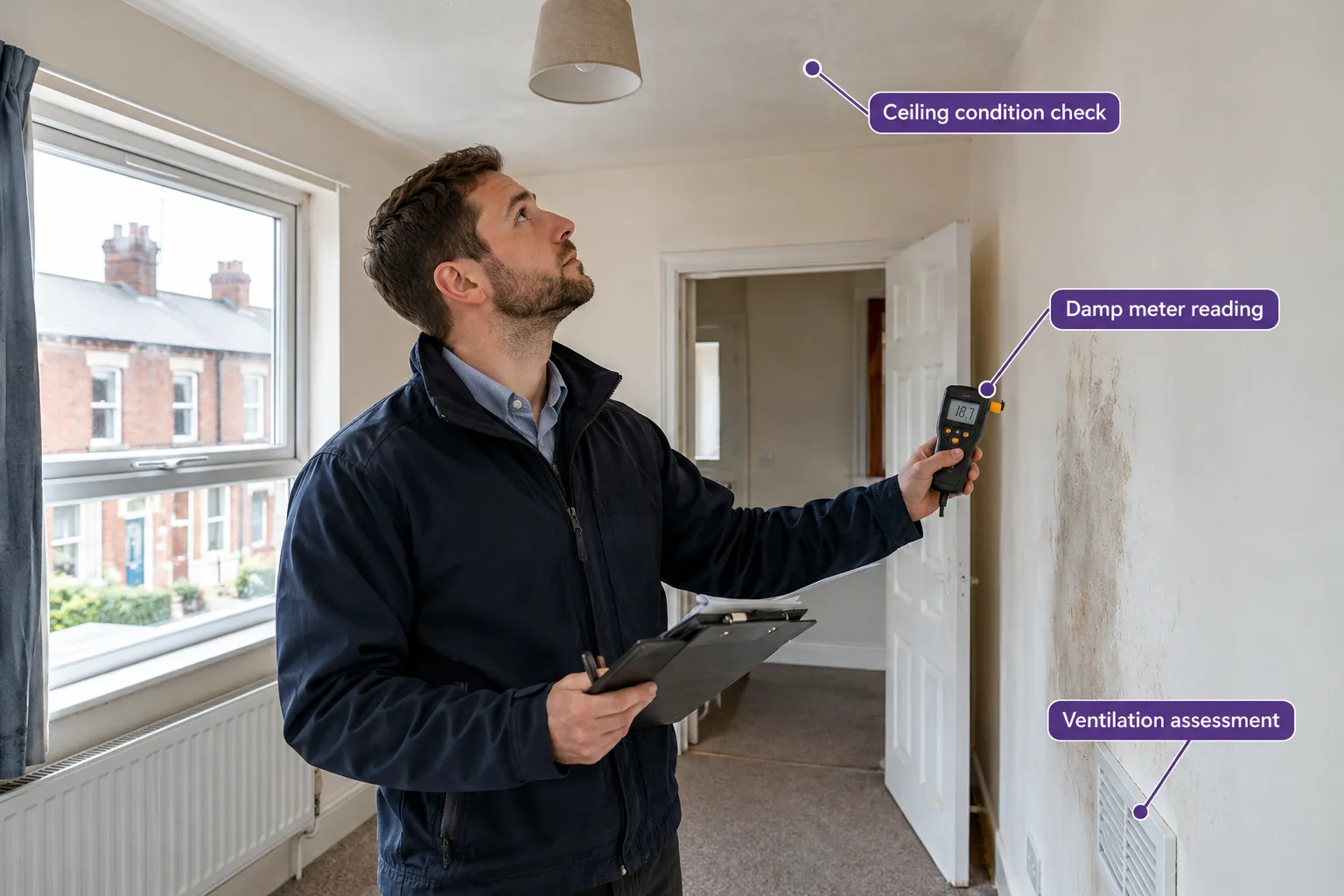
Detailed () image depicting professional surveyor conducting comprehensive Level 3 building survey inspection with multiple

Detection Methodologies and Technical Competencies for Expanded Hazards

Electrical Hazard Detection: Beyond Visual Inspection

The inclusion of electrical hazards in Phase 2 requires surveyors to move beyond visual identification of obvious defects to comprehensive electrical safety evaluation. Building Survey Protocols for Expanded Awaab's Law Hazards: 2026 Surveyor Liability and Detection Checklists must incorporate:[3]

Essential detection equipment:

  • Electrical installation condition reports (EICR) as baseline documentation
  • Socket testers for polarity, earth continuity, and RCD functionality verification
  • Thermal imaging cameras to identify overheating circuits, loose connections, and overloaded systems
  • Insulation resistance testers for cable integrity assessment
  • Earth loop impedance testers for protective device effectiveness

Critical inspection points:

  • Consumer unit condition, age, and compliance with current standards (18th Edition BS 7671)
  • Presence of RCD protection on all circuits
  • Evidence of DIY electrical work or non-compliant additions
  • Adequate earthing and bonding to water and gas services
  • Cable condition, routing, and protection from mechanical damage
  • Outdoor electrical installations and garden equipment supply

Many building surveyors lack specialist electrical qualifications, creating a professional competency gap. RICS chartered building surveyors must either:

  1. Obtain additional electrical inspection training and certification
  2. Establish partnerships with qualified electricians for specialist assessment
  3. Clearly define scope limitations in engagement terms and recommend specialist electrical surveys

The third option carries significant liability risk under Awaab's Law, as landlords expect comprehensive hazard identification within statutory timelines—delays for specialist referral may breach investigation deadlines.

Fire Risk Assessment Integration

Fire hazards represent another expanded category requiring specific technical competencies. Effective Building Survey Protocols for Expanded Awaab's Law Hazards: 2026 Surveyor Liability and Detection Checklists must address:[5]

Fire detection and escape assessment:

  • Smoke alarm presence, positioning, interconnection, and functionality
  • Heat detector installation in appropriate locations (kitchens, garages)
  • Carbon monoxide detector provision near combustion appliances
  • Escape route adequacy, travel distances, and obstruction-free access
  • Fire door presence, condition, and self-closing mechanism functionality
  • Emergency lighting in common areas (HMOs and flats)

Combustible materials and ignition sources:

  • Proximity of combustible materials to heat sources
  • Kitchen extraction and grease accumulation
  • Electrical appliance condition and overloading risks
  • Portable heater usage and positioning
  • Smoking materials storage and disposal

Building fabric fire resistance:

  • Fire-stopping integrity in walls, floors, and service penetrations
  • Cavity barrier presence and condition
  • Compartmentation effectiveness in converted properties
  • External wall system composition (post-Grenfell considerations)

For commercial building surveys, fire risk assessment already forms a standard component. However, residential surveyors conducting Level 2 or Level 3 surveys have historically treated fire safety as a secondary consideration—an approach incompatible with Awaab's Law compliance requirements.

Thermal Performance: Excess Cold and Excess Heat Detection

Temperature-related hazards—both excess cold and excess heat—require thermal performance assessment capabilities that extend beyond traditional damp investigation.[3]

Excess cold detection methodology:

🌡️ Thermal imaging surveys to identify:

  • Heat loss through walls, roofs, floors, and windows
  • Thermal bridging at junctions and structural elements
  • Insulation deficiencies and gaps
  • Air leakage paths and draughts

🌡️ Heating system assessment:

  • Heating provision adequacy for property size and occupancy
  • Boiler condition, efficiency, and safety
  • Radiator sizing and distribution
  • Thermostat presence and functionality
  • Fuel poverty indicators (prepayment meters, heating cost concerns)

🌡️ Building fabric evaluation:

  • Insulation presence and thickness (loft, cavity, solid wall)
  • Window condition, glazing type, and draught-proofing
  • Door seals and threshold weather-stripping
  • Ventilation balance (adequate fresh air without excessive heat loss)

Excess heat detection methodology:

🔥 Overheating risk factors:

  • Excessive glazing area, particularly south and west-facing
  • Inadequate shading (external or internal)
  • Poor cross-ventilation and air circulation
  • Inadequate purge ventilation (openable window area)
  • Dark external finishes increasing solar gain
  • Inadequate insulation in roof spaces creating heat accumulation

🔥 Vulnerable occupant considerations:

  • Bedroom overheating affecting sleep quality
  • Inability to control temperature (fixed glazing, restrictive tenancy terms)
  • Occupant age, health conditions exacerbated by heat
  • Top-floor flat locations with roof heat gain

The 2022 heatwave mortality statistics demonstrate that excess heat represents a genuine health hazard requiring systematic assessment within Building Survey Protocols for Expanded Awaab's Law Hazards: 2026 Surveyor Liability and Detection Checklists.

Structural Collapse and Falls: Engineering Assessment Requirements

The inclusion of structural collapse and falls hazards creates potential overlap with structural engineering surveys and specific defect surveys.

Structural collapse indicators:

  • Progressive or recent cracking in load-bearing elements
  • Deflection or sagging in floors, beams, or roof structures
  • Bulging or leaning walls
  • Foundation movement or settlement
  • Structural alterations without building control approval
  • Removal or alteration of load-bearing walls
  • Timber decay in structural elements
  • Corrosion of steel structural components

Falls hazard assessment:

  • Stair condition, rise/going compliance, and handrail provision
  • Landing guarding and balustrade height/strength
  • Level changes, steps, and trip hazards
  • Window opening restrictors (particularly upper floors with children)
  • Balcony condition and guarding adequacy
  • External access routes and path surfaces
  • Inadequate lighting in circulation areas

For building surveyors without structural engineering qualifications, the challenge lies in distinguishing between:

  • Obvious structural hazards requiring immediate emergency response
  • Potential structural concerns requiring specialist structural engineer referral
  • Minor defects not constituting structural collapse hazards

Clear professional boundaries and scope definitions become essential to manage liability exposure while ensuring statutory investigation timelines are met.

Detailed () image showing close-up of professional surveyor's hands completing detailed inspection report on tablet device

Surveyor Liability Exposure and Risk Management Strategies

Professional Indemnity Insurance Considerations

The expanded scope of Building Survey Protocols for Expanded Awaab's Law Hazards: 2026 Surveyor Liability and Detection Checklists creates new professional indemnity insurance implications:

Increased claims scenarios:

  • Failure to detect newly mandated hazards during survey inspections
  • Misclassification of hazard severity (emergency vs. significant vs. non-urgent)
  • Inadequate investigation not meeting statutory "adequate investigation" standards
  • Missed statutory deadlines for investigation completion or written summaries
  • Incomplete documentation failing to demonstrate compliance with investigation protocols

Surveyors should:

📋 Review professional indemnity insurance policies to confirm coverage for Awaab's Law compliance failures
📋 Increase coverage limits if exposure increases due to expanded hazard scope
📋 Maintain detailed contemporaneous records demonstrating investigation adequacy
📋 Document scope limitations and specialist referrals clearly in engagement terms
📋 Implement quality assurance review processes for statutory deadline compliance

Competency Requirements and Continuing Professional Development

The Royal Institution of Chartered Surveyors (RICS) emphasizes that surveyors must only undertake work for which they possess adequate competence. The expanded hazard categories in Awaab's Law create potential competency gaps for surveyors whose training and experience focused primarily on structural and damp-related defects.

Essential CPD priorities for 2026:

🎓 Electrical safety awareness and EICR interpretation training
🎓 Fire risk assessment fundamentals for residential properties
🎓 Thermal imaging certification and interpretation skills
🎓 Overheating risk assessment methodology
🎓 Person-centred HHSRS assessment techniques
🎓 Awaab's Law statutory timeline compliance procedures
🎓 Digital inspection technology and compliant report generation

Surveyors offering services across the expanded hazard categories without demonstrable competency face both regulatory sanctions from RICS and increased negligence liability exposure.

Documentation Standards and Evidential Requirements

The statutory requirement for written investigation summaries within 3 working days, combined with potential regulatory enforcement and litigation, elevates documentation quality from best practice to legal necessity.[2]

Essential documentation components:

✍️ Contemporaneous site notes with timestamps demonstrating investigation timeline compliance
✍️ Photographic evidence with metadata showing inspection date, time, and location
✍️ Thermal imaging records with temperature scales, emissivity settings, and interpretation notes
✍️ Moisture readings with equipment calibration records and measurement locations
✍️ Electrical testing results from qualified electricians or competent persons
✍️ Occupant vulnerability assessment documenting person-centred risk factors
✍️ Hazard classification rationale explaining emergency/significant/non-urgent determination
✍️ Remediation recommendations with prioritization and urgency indicators

Professional surveyors increasingly adopt digital inspection platforms that capture timestamped data, generate compliant reports automatically, and provide audit trails demonstrating statutory deadline compliance—transforming these systems from optional efficiency tools to compliance necessities.[1]

Technology Integration and Workflow Optimization

Digital Inspection Platforms for Timeline Compliance

Meeting the 3-working-day written summary requirement for significant hazards while maintaining technical accuracy demands streamlined data capture and report generation processes. Traditional approaches involving handwritten site notes, office transcription, and manual report drafting cannot reliably meet statutory deadlines.

Digital platform capabilities:

📱 Mobile data capture with structured inspection checklists
📱 Integrated photography with automatic geolocation and timestamping
📱 Voice-to-text annotation for efficient site note recording
📱 Automated report generation from structured field data
📱 Template libraries for different hazard types and investigation scenarios
📱 Deadline tracking with automated alerts for approaching statutory timelines
📱 Client portal access for immediate written summary delivery

The adoption of such platforms represents a strategic investment in compliance infrastructure rather than discretionary technology enhancement.

Triage Systems for Emergency vs. Significant Hazard Prioritization

The expanded hazard scope and tight statutory deadlines will generate increased urgent inspection requests, requiring surveyors to implement clear triage protocols from first contact.[1]

Effective triage methodology:

🚨 Emergency classification criteria (24-hour response):

  • Exposed live electrical wiring or imminent electrocution risk
  • Blocked or inadequate fire escape routes with immediate occupancy
  • Complete heating system failure in winter with vulnerable occupants
  • Structural collapse indicators with imminent danger
  • Serious fall hazards with immediate injury risk

⚠️ Significant classification criteria (10-day response):

  • Electrical defects without immediate danger but requiring remediation
  • Fire safety deficiencies not creating imminent risk
  • Inadequate heating affecting health and comfort
  • Excess heat causing health impacts
  • Structural concerns requiring investigation but not imminent collapse
  • Fall hazards requiring remediation

📋 Standard classification (non-urgent):

  • Defects not meeting emergency or significant thresholds
  • Maintenance issues without health and safety implications
  • Cosmetic defects and minor wear

Clear triage protocols protect surveyors from liability for prioritization decisions and ensure appropriate resource allocation to meet statutory deadlines.

Specialist Referral Networks and Collaborative Investigation

Given the expanded technical competencies required for comprehensive hazard detection, building surveyors must establish reliable specialist referral networks:[2]

🔧 Qualified electricians for detailed electrical installation condition reports
🔧 Fire risk assessors for complex fire safety evaluations
🔧 Structural engineers for structural collapse investigations
🔧 Thermal performance specialists for detailed overheating assessments
🔧 Ventilation engineers for mechanical ventilation system evaluation
🔧 Asbestos surveyors (Phase 3 preparation)

The challenge lies in coordinating specialist input within statutory investigation timelines. Pre-established service level agreements with defined response times become essential for timeline compliance.

Practical Implementation: Checklist Development for Level 3 Surveys

For surveyors conducting comprehensive Level 3 building surveys, Building Survey Protocols for Expanded Awaab's Law Hazards: 2026 Surveyor Liability and Detection Checklists must integrate seamlessly into existing inspection methodologies.

Comprehensive Phase 2 Hazard Detection Checklist

Electrical Hazards:

  • Consumer unit age, type, and compliance status
  • RCD/RCBO protection on all circuits
  • Socket outlet condition and testing results
  • Visible wiring condition and compliance
  • Earthing and bonding adequacy
  • Evidence of DIY electrical work
  • Outdoor electrical installations
  • Thermal imaging of electrical systems

Fire Risks:

  • Smoke alarm presence, positioning, and interconnection
  • Heat detector provision in appropriate locations
  • Carbon monoxide detector presence
  • Escape route adequacy and obstructions
  • Fire door condition and self-closing mechanisms
  • Combustible material proximity to heat sources
  • Kitchen extraction condition
  • Fire-stopping integrity

Excess Cold:

  • Heating system type, age, and condition
  • Heating provision adequacy for property size
  • Thermostat presence and functionality
  • Loft insulation presence and thickness
  • Cavity wall insulation presence
  • Window condition and glazing type
  • Draught-proofing adequacy
  • Thermal imaging heat loss assessment

Excess Heat:

  • Glazing area and orientation
  • Shading provision (external/internal)
  • Cross-ventilation adequacy
  • Purge ventilation provision
  • Roof insulation and heat accumulation
  • Bedroom overheating risk factors
  • Vulnerable occupant considerations
  • Temperature control options

Structural Collapse:

  • Progressive or recent cracking in load-bearing elements
  • Floor, beam, or roof deflection/sagging
  • Wall bulging or leaning
  • Foundation movement indicators
  • Unauthorized structural alterations
  • Timber decay in structural elements
  • Steel corrosion in structural components
  • Specialist structural engineer referral requirement

Falls Hazards:

  • Stair condition and compliance (rise/going)
  • Handrail provision and condition
  • Landing guarding and balustrade adequacy
  • Level changes and trip hazards
  • Window opening restrictors (upper floors)
  • Balcony condition and guarding
  • External access route condition
  • Circulation area lighting adequacy

Person-Centred Risk Assessment Documentation

For each identified hazard, surveyors must document:

📝 Occupant vulnerability factors:

  • Age of occupants (children, elderly)
  • Known health conditions (respiratory, mobility, immunocompromised)
  • Disability or sensory impairments
  • Pregnancy status
  • Frequency and duration of exposure

📝 Person-centred hazard classification:

  • Standard HHSRS category and score
  • Person-centred classification (emergency/significant/standard)
  • Justification for classification based on occupant circumstances
  • Recommended response timeline

This documentation demonstrates compliance with person-centred assessment requirements and provides defensible evidence for hazard classification decisions.

Conclusion: Strategic Preparation for 2026 Implementation

The expansion of Awaab's Law in 2026 represents the most significant shift in building survey practice since the introduction of HHSRS in 2006. Building Survey Protocols for Expanded Awaab's Law Hazards: 2026 Surveyor Liability and Detection Checklists are no longer optional enhancements but mandatory compliance requirements carrying substantial liability exposure for surveyors who fail to adapt.

Actionable Next Steps for Building Surveyors

Immediate priorities (Q1-Q2 2026):

  1. Audit current competencies against expanded hazard categories and identify training requirements
  2. Review professional indemnity insurance coverage for Awaab's Law compliance failures
  3. Implement digital inspection platforms capable of meeting 3-day written summary deadlines
  4. Establish specialist referral networks with defined response times for collaborative investigation
  5. Develop standardized checklists integrating all Phase 2 hazard categories into survey protocols
  6. Create triage protocols for emergency vs. significant hazard classification from first contact
  7. Update engagement terms clearly defining scope, competency limitations, and specialist referral circumstances

Medium-term preparation (Q3-Q4 2026):

  1. Conduct practice investigations under simulated statutory timelines to identify workflow bottlenecks
  2. Build template libraries for different hazard types and investigation scenarios
  3. Establish quality assurance processes for timeline compliance and documentation standards
  4. Develop client education materials explaining investigation protocols and statutory obligations
  5. Prepare for Phase 3 expansion by building competencies in asbestos, carbon monoxide, and remaining HHSRS hazards

The surveyors who thrive under Awaab's Law will be those who view expanded hazard categories not as burdensome compliance obligations but as opportunities to deliver enhanced value through comprehensive hazard detection, robust documentation, and person-centred risk assessment. By implementing systematic Building Survey Protocols for Expanded Awaab's Law Hazards: 2026 Surveyor Liability and Detection Checklists, building surveyors can protect both their clients and their professional practices in this transformed regulatory environment.

For professional guidance on implementing compliant survey protocols, consider consulting with RICS chartered building surveyors who specialize in residential hazard assessment and regulatory compliance. Whether you require damp surveys, structural assessments, or comprehensive building surveys, working with qualified professionals ensures statutory compliance and protects against liability exposure in the evolving Awaab's Law landscape.


References

[1] Awaabs Law Is Here The Surveyors Guide For Compliance – https://www.surventrix.com/blog/awaabs-law-is-here-the-surveyors-guide-for-compliance

[2] Awaabs Law Private Landlords 2026 – https://www.idealresponse.co.uk/blog/awaabs-law-private-landlords-2026/

[3] Building Surveys And Awaabs Law 2026 Extensions Identifying Electrical Fire And Temperature Hazards In Prs Properties – https://nottinghillsurveyors.com/blog/building-surveys-and-awaabs-law-2026-extensions-identifying-electrical-fire-and-temperature-hazards-in-prs-properties

[4] Awaabs Law Compliance Consequences And Oversight For Social Housing Providers – https://www.penningtonslaw.com/insights/awaabs-law-compliance-consequences-and-oversight-for-social-housing-providers/

[5] Awaabs Law What Property Managers And Surveyors Must Know – https://www.howdengroup.com/uk-en/awaabs-law-what-property-managers-and-surveyors-must-know

Share:

More Posts

Scroll to Top