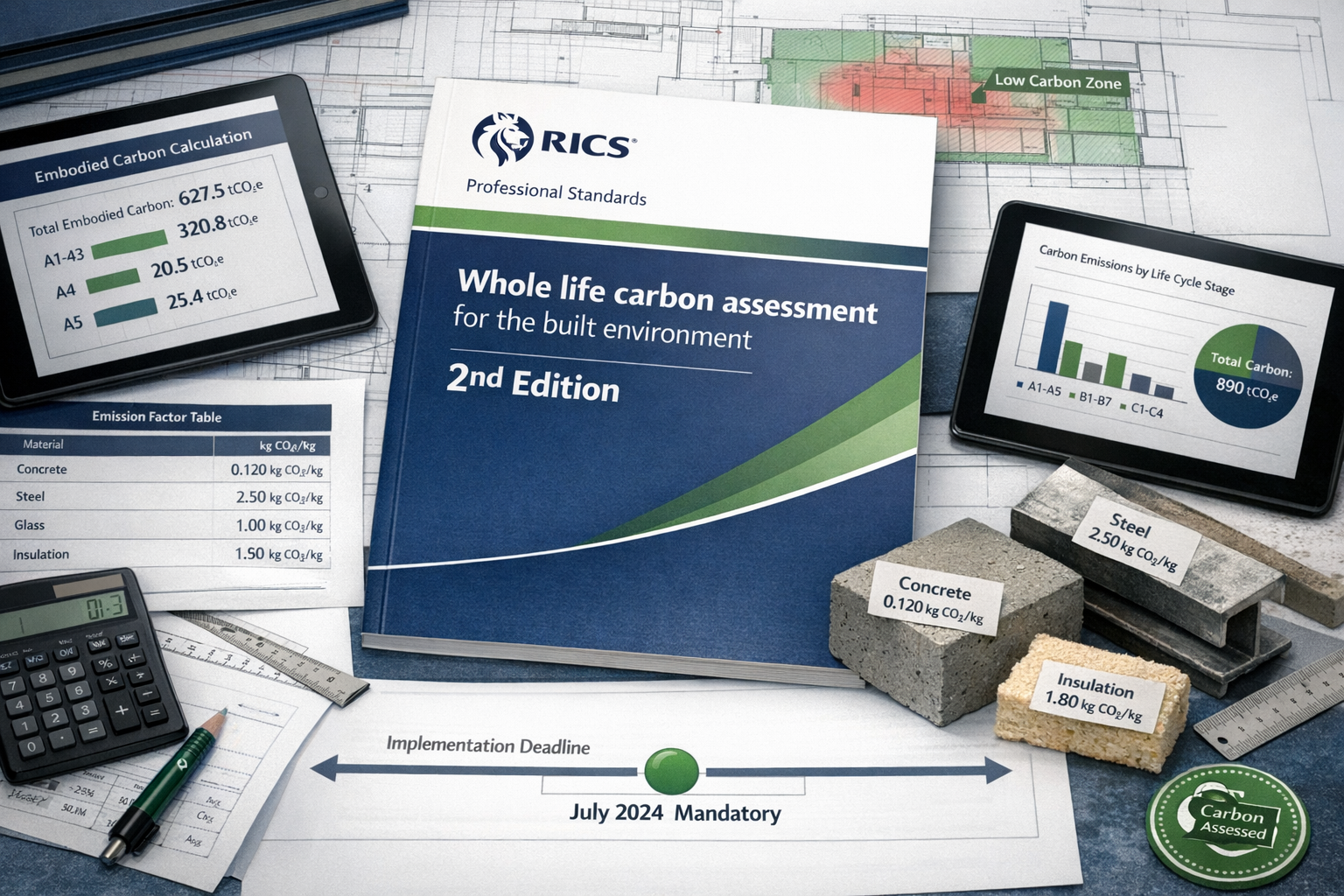
The built environment accounts for nearly 40% of global carbon emissions, yet until recently, property valuations rarely factored in a building's carbon footprint. That changed dramatically on July 1, 2024, when the Royal Institution of Chartered Surveyors (RICS) made its Whole Life Carbon Assessment (WLCA) 2nd edition mandatory for all members globally[1][5]. As we navigate through 2026, Whole Life Carbon Assessment in Building Surveys: RICS 2nd Edition Standards and Valuation Implications for 2026 Surveyors has become a critical competency that directly impacts property values, investment decisions, and the future of sustainable construction.
This seismic shift means that chartered surveyors can no longer treat carbon as an afterthought. Whether conducting a RICS commercial building survey or providing RICS valuations, professionals must now integrate comprehensive carbon data into their assessments. The implications extend far beyond compliance—they reshape how we value buildings, prioritize retrofits, and make investment decisions in an increasingly carbon-conscious market.
Key Takeaways
- ✅ Mandatory compliance: RICS WLCA 2nd edition became compulsory for all members globally from July 1, 2024, fundamentally changing survey and valuation practices[1][5]
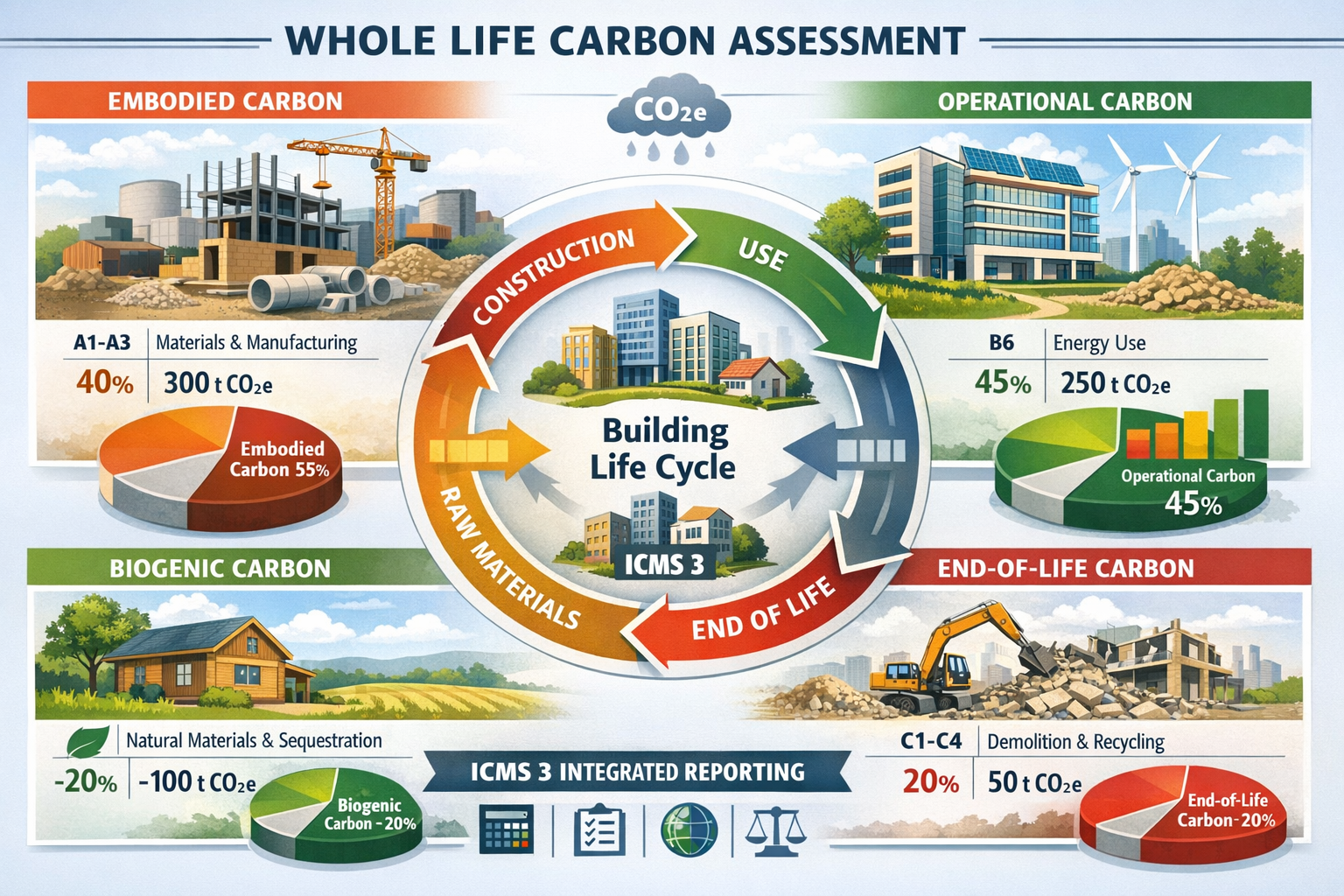
- 🏗️ Comprehensive scope: Assessments must now cover embodied carbon, operational carbon, biogenic carbon, and end-of-life carbon across all building lifecycle stages[3]
- 💰 Valuation impact: Carbon performance directly influences property values, with high-carbon buildings facing depreciation risks and green buildings commanding premiums
- 📊 Integrated approach: The standard connects with International Cost Management Standard (ICMS 3), enabling surveyors to balance carbon reduction with financial viability[3]
- 🎓 Professional development: Surveyors require specialized training through RICS Global Certificate programmes to competently apply the updated standards[4][7]
Understanding the RICS 2nd Edition Standards for Whole Life Carbon Assessment
What Changed in the 2nd Edition
The RICS WLCA 2nd edition, released in November 2023 following consultation with over 1,300 stakeholder comments, represents a substantial evolution from its predecessor[1]. The updated framework provides globally applicable methodology while maintaining UK-specific emissions factors and assumptions due to data availability[8].
Key technical enhancements include:
- Expanded reporting modules with standardized templates
- Detailed element categorization for both buildings and infrastructure
- Defined parameters and emissions factors for consistent calculations
- Transport impact calculations throughout the supply chain
- Uncertainty analysis requirements to acknowledge data limitations
- Decarbonization pathway planning for future carbon reduction[2]
The standard now mandates recording any deviations from prescribed methodology, ensuring transparency and comparability across assessments[1]. This rigor transforms WLCA from a voluntary best practice into a standardized professional requirement.
The Four Carbon Categories Surveyors Must Assess
When conducting RICS building surveys, professionals must now evaluate four distinct carbon categories:
| Carbon Category | Description | Assessment Focus |
|---|---|---|
| Embodied Carbon 🏗️ | Emissions from material extraction, manufacturing, transport, and construction | Material selection, construction methods, supply chain impacts |
| Operational Carbon ⚡ | Emissions from building energy use during occupation | Heating, cooling, lighting, equipment efficiency |
| Biogenic Carbon 🌳 | Carbon stored in natural materials and released at end-of-life | Timber and natural material content, sequestration potential |
| End-of-Life Carbon ♻️ | Emissions from demolition, waste processing, and material disposal | Recyclability, circular economy potential, demolition methods |
This comprehensive framework ensures that surveyors capture the complete carbon picture rather than focusing solely on operational energy—a critical distinction that often reveals surprising insights about building performance[3].
Integration with International Cost Management Standards
One of the most significant advances in the RICS 2nd edition is its integration with the International Cost Management Standard (ICMS 3)[3]. This connection enables surveyors to:
- Link lifecycle costs directly with emissions data
- Evaluate cost-effectiveness of carbon reduction measures
- Present financially viable decarbonization strategies
- Support investment decisions with combined financial and environmental analysis
For professionals providing RICS valuation services, this integration means carbon considerations are no longer separate from financial analysis—they're fundamentally interconnected. A retrofit that reduces operational carbon by 40% can now be evaluated against its capital cost, payback period, and impact on property value simultaneously.
Whole Life Carbon Assessment in Building Surveys: RICS 2nd Edition Standards and Practical Application
Conducting WLCA in Different Survey Types
The application of Whole Life Carbon Assessment in Building Surveys: RICS 2nd Edition Standards and Valuation Implications for 2026 Surveyors varies depending on the survey type and purpose:
Level 3 Building Surveys (Full Structural Surveys)
When conducting comprehensive RICS Building Surveys Level 3, surveyors must now:
- Assess existing building carbon performance across all four categories
- Identify high-carbon materials and systems requiring replacement
- Evaluate embodied carbon implications of recommended repairs
- Consider operational carbon impacts of maintenance recommendations
- Document carbon-intensive building elements for future planning
Commercial Building Surveys
For commercial building surveys, additional considerations include:
- Tenant fit-out carbon impacts
- Commercial equipment operational emissions
- Supply chain transportation for business operations
- Potential for circular economy material recovery
- Compliance with corporate sustainability commitments
Specific Defect Surveys
Even RICS specific defect surveys now require carbon consideration when recommending remediation approaches. For example, choosing between repair and replacement must factor in embodied carbon of new materials versus operational efficiency gains.
Data Collection and Calculation Methodology
The RICS 2nd edition provides structured methodology for data collection and carbon calculation[2][8]:
Primary Data Sources (preferred):
- Manufacturer Environmental Product Declarations (EPDs)
- Actual energy consumption records
- Construction material quantities from specifications
- Transportation distances for materials and equipment
Secondary Data Sources (when primary unavailable):
- Industry-standard emissions factors
- Regional energy grid carbon intensity data
- Typical building performance benchmarks
- Generic material carbon coefficients
"Since 2023, RICS reports 'quite a bit of success' in standard utilization, with assessors now able to estimate carbon emissions over life-cycle stages and deliver against both government and client demands"[3]
The calculation process involves:
- Quantification: Measure material quantities, energy consumption, and activity levels
- Emission factor application: Apply appropriate carbon coefficients to quantities
- Aggregation: Sum emissions across all lifecycle stages and categories
- Uncertainty analysis: Document data quality and confidence levels
- Reporting: Present results in standardized RICS format with clear assumptions
Tools and Software for 2026 Surveyors
Professional surveyors increasingly rely on specialized software to manage the complexity of WLCA calculations. Leading platforms provide:
- Integrated emissions factor databases updated for UK and international contexts
- Automated calculation engines following RICS methodology
- Scenario comparison tools for retrofit and design options
- Standardized reporting templates meeting RICS requirements
- Uncertainty quantification and sensitivity analysis features
When selecting tools, surveyors should verify compatibility with RICS 2nd edition requirements and ensure outputs can be integrated into traditional valuation reports.
Valuation Implications: How Carbon Assessment Affects Property Values in 2026
The Green Premium and Carbon Discount
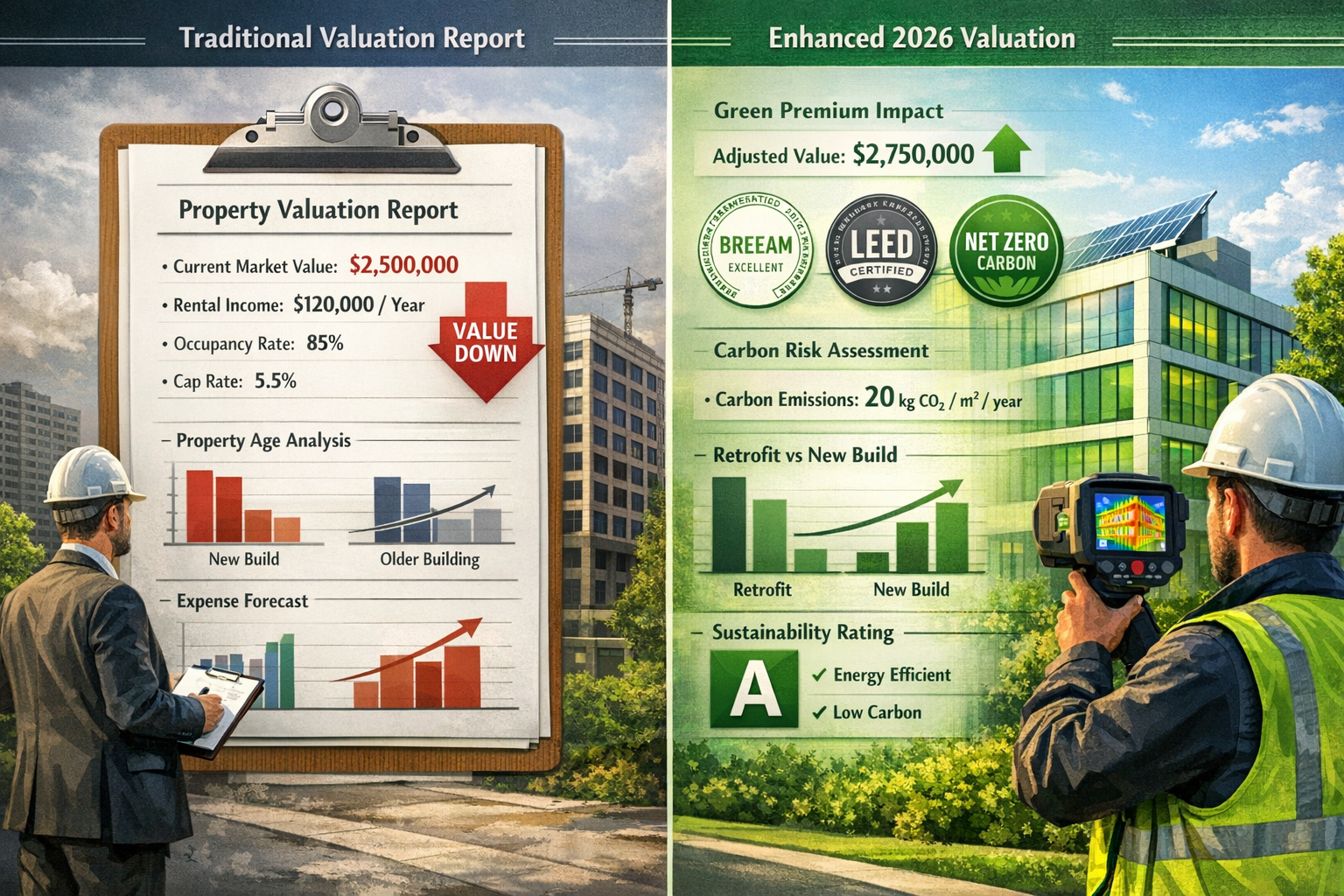
Carbon performance now directly influences property valuations in measurable ways. Research throughout 2024 and 2025 has established clear patterns:
Green Premium 🌿
- Low-carbon buildings command 5-15% valuation premiums in commercial markets
- Energy-efficient residential properties achieve 3-8% higher sale prices
- Buildings with verified carbon reduction pathways attract premium tenants
- Properties with strong sustainability credentials show lower vacancy rates
Carbon Discount ⚠️
- High-carbon buildings face 10-20% depreciation risk as regulations tighten
- Properties with poor energy performance see extended marketing periods
- Buildings requiring significant carbon-reduction retrofits experience value adjustments
- Assets with stranded carbon risk (unable to meet future regulations) face severe devaluation
When conducting RICS Red Book valuations, surveyors must now explicitly consider carbon performance as a material factor affecting market value. This represents a fundamental shift from treating sustainability as a qualitative consideration to quantifying its financial impact.
Retrofit vs. New Build Carbon Considerations
One of the most significant valuation questions in 2026 concerns the carbon comparison between retrofitting existing buildings and new construction:
Retrofit Advantages 🔧
- Embodied carbon savings: Retaining existing structure avoids 50-75% of new-build embodied carbon
- Immediate impact: Operational improvements deliver carbon reductions without construction emissions
- Heritage preservation: Maintains architectural and cultural value
- Reduced waste: Minimizes demolition and landfill impacts
New Build Advantages 🏗️
- Optimal design: Purpose-built low-carbon systems achieve superior performance
- Modern standards: Meets latest building regulations and energy codes
- Lifecycle efficiency: Lower operational carbon over 60+ year lifespan
- Technology integration: Easier incorporation of renewable energy and smart systems
Surveyors must evaluate these trade-offs using WLCA methodology to provide evidence-based recommendations. A structural survey combined with carbon assessment can reveal whether retrofit or replacement delivers better whole-life carbon performance.
Carbon Risk in Investment and Lending Decisions
Financial institutions increasingly incorporate carbon risk into lending and investment decisions, creating direct valuation implications:
Lending Considerations:
- Mortgage providers offer preferential rates for low-carbon properties
- Commercial lenders require carbon assessments for large property portfolios
- Loan-to-value ratios may be adjusted based on carbon performance
- Refinancing opportunities improve for buildings with verified carbon reduction
Investment Analysis:
- Institutional investors screen acquisitions for carbon risk exposure
- Portfolio managers prioritize assets with clear decarbonization pathways
- ESG (Environmental, Social, Governance) criteria include carbon metrics
- Exit strategies consider future buyer carbon requirements
When providing valuations for capital gains tax or probate valuations, surveyors must document carbon performance as it materially affects marketability and future value trajectory.
Training and Certification Requirements for 2026 Surveyors
RICS Global Certificate in Whole Life Carbon Assessment
To competently apply the 2nd edition standards, RICS offers the Global Certificate in Whole Life Carbon Assessment (2026 Edition) training programme[4][7]. This comprehensive course covers:
- Fundamental principles of whole life carbon methodology
- Practical application of RICS 2nd edition requirements
- Data collection and calculation techniques
- Software tools and digital assessment platforms
- Reporting standards and documentation requirements
- Integration with valuation and survey practices
The programme provides structured learning for both experienced surveyors updating their skills and new professionals entering the field. Completion demonstrates competency to clients and meets professional development requirements.
Continuing Professional Development
Beyond initial certification, surveyors must maintain current knowledge through ongoing CPD activities:
- Annual updates on emissions factors and methodology refinements
- Software training as tools evolve and improve
- Regulatory changes affecting carbon assessment requirements
- Case study reviews of successful WLCA applications
- Peer learning through professional networks and forums
RICS Chartered Building Surveyors who maintain current WLCA competency position themselves as essential advisors in an increasingly carbon-conscious property market.
Practical Skills Development
Effective WLCA application requires developing specific practical skills:
Technical Competencies 📊
- Material carbon coefficient interpretation
- Energy modeling and operational carbon forecasting
- Embodied carbon database navigation
- Uncertainty quantification and sensitivity analysis
- Lifecycle stage boundary definition
Professional Judgment 🎯
- Appropriate methodology selection for project scope
- Data quality assessment and limitation documentation
- Proportionate analysis matching project complexity
- Client communication of carbon findings
- Integration of carbon data into valuation conclusions
Software Proficiency 💻
- WLCA calculation platforms
- Building Information Modeling (BIM) integration
- Energy simulation tools
- Carbon reporting and visualization software
- Database management for emissions factors
Government Policy and Regulatory Alignment
UK Policy Support and Future Trajectory
The RICS 2nd edition aligns with broader UK government sustainability objectives. The standard received support from the Department for Transport UK and Zero Waste Scotland, indicating coordination with national policy[1].
Key policy drivers include:
- Net Zero 2050 commitments requiring dramatic carbon reductions across all sectors
- Building regulations updates progressively tightening energy performance standards
- Planning policy increasingly requiring carbon assessments for approvals
- Public procurement requirements mandating WLCA for government projects
- Climate disclosure regulations requiring carbon reporting for listed companies
Surveyors operating in 2026 must understand this policy landscape as it directly affects property values, development viability, and client requirements.
International Applicability and Regional Adaptation
While the RICS standard is globally applicable for members worldwide, the methodology acknowledges regional variations[8]:
Universal Elements:
- Core calculation methodology and lifecycle stage definitions
- Reporting structure and documentation requirements
- Professional standards and ethical obligations
- Quality assurance and verification processes
Regional Adaptations:
- Emissions factors: Must reflect local energy grid carbon intensity
- Material sources: Regional supply chains affect embodied carbon
- Climate conditions: Operational carbon varies with local weather
- Regulatory context: Local building codes and carbon policies
- Data availability: Regional databases and EPD accessibility
Surveyors working internationally must adapt the framework while maintaining methodological consistency. This ensures WLCA results remain comparable across jurisdictions while reflecting local conditions.
Client Communication and Report Integration
Explaining Carbon Findings to Non-Technical Clients
One of the most challenging aspects of Whole Life Carbon Assessment in Building Surveys: RICS 2nd Edition Standards and Valuation Implications for 2026 Surveyors involves communicating complex carbon data to clients without technical backgrounds.
Effective Communication Strategies:
📊 Visual presentation: Use charts, graphs, and infographics to illustrate carbon performance
💰 Financial translation: Convert carbon metrics into cost implications and value impacts
🎯 Benchmarking: Compare property performance to similar buildings and industry standards
🚦 Traffic light systems: Simplify complex data with red/amber/green performance indicators
📈 Future scenarios: Show potential carbon reduction pathways and their implications
When clients understand that high operational carbon translates to elevated energy costs and potential regulatory penalties, the relevance becomes immediately clear. Similarly, demonstrating how embodied carbon reduction can lower project costs makes the concept tangible.
Integrating WLCA into Traditional Survey Reports
RICS surveyors must seamlessly integrate carbon assessment into established report formats without overwhelming readers. Effective integration includes:
Executive Summary Section:
- Key carbon performance metrics highlighted prominently
- Material valuation implications stated clearly
- Critical carbon risks identified upfront
Technical Analysis Section:
- Detailed carbon calculations with methodology explanation
- Lifecycle stage breakdowns showing emission sources
- Comparison to benchmarks and regulatory thresholds
- Uncertainty analysis and data quality statements
Recommendations Section:
- Prioritized carbon reduction opportunities
- Cost-benefit analysis of retrofit options
- Compliance pathway for future regulations
- Value protection and enhancement strategies
For mortgage valuations, carbon information should be proportionate to the valuation purpose, while comprehensive Level 3 surveys warrant detailed carbon analysis.
Common Challenges and Practical Solutions
Data Availability and Quality Issues
Challenge: Limited availability of manufacturer-specific EPDs and actual building performance data.
Solutions:
- Develop relationships with material suppliers who provide comprehensive EPD documentation
- Use industry-standard databases as secondary sources with documented assumptions
- Implement post-occupancy monitoring to gather actual performance data
- Clearly document data quality levels and associated uncertainty
- Update assessments as better data becomes available
Balancing Accuracy with Proportionality
Challenge: Achieving appropriate detail level without excessive time and cost investment.
Solutions:
- Scale assessment complexity to project size and decision significance
- Use simplified methodology for small-scale surveys with clear limitation statements
- Focus detailed analysis on high-impact building elements (typically 80% of emissions from 20% of components)
- Employ screening assessments to identify areas requiring detailed investigation
- Leverage standardized building typologies for preliminary assessments
Retrofit Complexity and Existing Building Constraints
Challenge: Assessing retrofit carbon implications in buildings with limited documentation and complex existing conditions.
Solutions:
- Conduct thorough site investigations to understand existing construction
- Use non-destructive testing to identify concealed materials
- Apply conservative assumptions with documented rationale
- Consider phased retrofit approaches that allow iterative assessment
- Evaluate multiple scenarios to understand sensitivity to uncertain parameters
Future Developments and Emerging Trends
Evolution of Carbon Assessment Standards
The RICS 2nd edition represents current best practice, but the field continues evolving rapidly:
Anticipated Developments:
- Enhanced biogenic carbon methodology as natural materials gain prominence
- Circular economy metrics measuring material reuse and recyclability
- Social carbon accounting incorporating equity and justice considerations
- Digital twins integration enabling real-time carbon monitoring
- AI-assisted assessment automating data collection and calculation
Surveyors committed to professional excellence must stay informed about these developments through continuing education and professional engagement.
Technology Integration and Digital Tools
Emerging technologies are transforming WLCA practice:
Building Information Modeling (BIM): Automated carbon calculation from 3D models with embedded material data
Internet of Things (IoT): Real-time operational carbon monitoring through sensor networks
Blockchain verification: Immutable carbon performance records enhancing credibility
Machine learning: Predictive modeling of building performance under various scenarios
Digital reporting platforms: Interactive dashboards allowing stakeholders to explore carbon data
These technologies enhance accuracy, reduce assessment time, and improve client engagement with carbon information.
Market Transformation and Professional Opportunities
The mandatory WLCA requirement creates significant professional opportunities:
- Specialized consultancy services focused exclusively on carbon assessment
- Retrofit advisory helping clients navigate decarbonization pathways
- Carbon due diligence for property transactions and portfolio management
- Expert witness services for carbon-related disputes and litigation
- Training and education for professionals developing WLCA competency
Surveyors who develop deep expertise in Whole Life Carbon Assessment in Building Surveys: RICS 2nd Edition Standards and Valuation Implications for 2026 Surveyors position themselves at the forefront of industry transformation.
Conclusion
The mandatory implementation of RICS Whole Life Carbon Assessment 2nd edition standards represents a watershed moment for the surveying profession. As we progress through 2026, carbon performance has shifted from a peripheral consideration to a central determinant of property value, investment viability, and professional competency.
Whole Life Carbon Assessment in Building Surveys: RICS 2nd Edition Standards and Valuation Implications for 2026 Surveyors encompasses far more than technical compliance—it fundamentally reshapes how professionals evaluate buildings, advise clients, and contribute to the urgent challenge of decarbonizing the built environment. The comprehensive framework covering embodied, operational, biogenic, and end-of-life carbon provides the tools necessary for evidence-based decision-making that balances environmental responsibility with financial viability.
Actionable Next Steps for Surveyors
✅ Complete RICS certification: Enroll in the Global Certificate in Whole Life Carbon Assessment to gain comprehensive understanding of 2nd edition requirements[4][7]
✅ Invest in appropriate tools: Select and implement WLCA software that integrates with existing survey and valuation workflows
✅ Update report templates: Modify standard survey and valuation reports to incorporate carbon assessment sections and findings
✅ Build data resources: Develop libraries of emissions factors, benchmark data, and calculation templates for common building types
✅ Establish professional networks: Connect with other practitioners to share experiences, challenges, and solutions in WLCA application
✅ Educate clients proactively: Develop clear communication materials explaining carbon assessment value and implications
✅ Monitor regulatory developments: Stay informed about evolving building regulations and carbon policies affecting property values
The integration of whole life carbon assessment into standard surveying practice represents not just regulatory compliance but professional evolution. Surveyors who embrace this transformation, develop genuine expertise, and communicate carbon implications effectively will lead the profession into a more sustainable future while delivering enhanced value to clients navigating an increasingly carbon-conscious property market.
Whether conducting RICS building surveys, providing professional valuations, or advising on complex property decisions, the ability to competently assess and communicate whole life carbon performance has become an essential professional competency. The 2nd edition standards provide the framework—professional commitment to excellence determines the outcome.
References
[1] Rics Whole Life Carbon Assessment 2nd Edition Now In Effect – https://circularecology.com/news/rics-whole-life-carbon-assessment-2nd-edition-now-in-effect
[2] New Rics Whole Life Carbon 2nd Edition – https://support.etool.app/index.php/knowledgebase/new-rics-whole-life-carbon-2nd-edition/
[3] Rics Whole Life Carbon Assessment V2 Whats Working Whats Next – https://oneclicklca.com/en/resources/articles/rics-whole-life-carbon-assessment-v2-whats-working-whats-next
[4] Certificate In Whole Life Carbon Assessment Training Programme – https://www.rics.org/training-events/training-courses/certificate-in-whole-life-carbon-assessment-training-programme
[5] Whole Life Carbon Assessments In 2026 Valuations Rics 2nd Edition Standards For Surveyors – https://nottinghillsurveyors.com/blog/whole-life-carbon-assessments-in-2026-valuations-rics-2nd-edition-standards-for-surveyors
[6] Whole Life Carbon Assessment In Building Surveys Rics Pas 2080 2nd Edition And Valuation Resilience In 2026 – https://nottinghillsurveyors.com/blog/whole-life-carbon-assessment-in-building-surveys-rics-pas-2080-2nd-edition-and-valuation-resilience-in-2026
[7] Wlca Delivering The Future Of Carbon Assessment In The Built Environment – https://www.rics.org/news-insights/wlca-delivering-the-future-of-carbon-assessment-in-the-built-environment
[8] Whole Life Carbon Assessment – https://www.rics.org/profession-standards/rics-standards-and-guidance/sector-standards/construction-standards/whole-life-carbon-assessment