
Nearly one in three property sales in the UK collapse before completion—a staggering failure rate that costs buyers and sellers billions in wasted fees, emotional distress, and lost opportunities each year [6]. The UK government's 2026 homebuying reforms aim to revolutionize this broken system by introducing mandatory upfront property condition assessments, fundamentally shifting when and how building surveys are conducted. This comprehensive guide explores Government Homebuying Reforms 2026: How Mandatory Property Condition Assessments Will Transform Building Survey Demand and what these changes mean for buyers, sellers, and surveying professionals.

Key Takeaways
- 🏠 Mandatory upfront assessments: Sellers will be required to commission property condition assessments before listing, moving surveys from the buyer's responsibility to the seller's pre-marketing phase [1]
- ⏱️ Faster transactions: The reforms aim to reduce the current 5-6 month transaction timeline by front-loading critical information and reducing post-offer complications [6]
- 📊 Surge in survey demand: Building survey professionals should expect significant increases in workload as every property listing will require condition assessments rather than only those where buyers commission surveys
- 💼 Professional standards: Only professionally qualified surveyors will be authorized to conduct mandatory condition assessments, with RICS developing specific codes of practice [6]
- 🔄 Phased implementation: The government acknowledges this represents fundamental change and will introduce requirements gradually following extensive consultation [1]
Understanding the Government Homebuying Reforms 2026
The UK government's consultation on home buying and selling reform represents the most significant overhaul of the property transaction process in decades. At its core, the reform package requires sellers to work with conveyancers and surveyors to complete comprehensive searches and property condition assessments before properties are listed for sale [1].
Why These Reforms Are Necessary
The current homebuying system in England and Wales suffers from critical inefficiencies:
- 33% collapse rate: Nearly one-third of agreed sales fall through before completion, causing deep frustration and financial setbacks [6]
- Extended timelines: Average transactions now take 5-6 months from offer to completion, adding pressure to an already fragile process [6]
- Information asymmetry: Buyers often discover critical property issues only after making offers and paying for surveys, leading to renegotiations or withdrawals
- Wasted costs: Failed transactions result in thousands of pounds in wasted survey, legal, and mortgage fees for both parties
The reforms aim to address these problems by creating transparency from day one of the marketing process.
The Standardized Information Package
Under the proposed reforms, property listings will include a comprehensive upfront information package containing [1]:
| Information Category | Details Required |
|---|---|
| Basic Property Data | Tenure, council tax band, EPC rating, property type, clear floor plans |
| Legal Information | Title information, seller ID verification, leasehold terms (if applicable) |
| Safety & Compliance | Building safety data, planning consents, service charges |
| Environmental Factors | Flood risk assessment, environmental searches |
| Condition Assessment | Property condition assessment tailored to age and type |
| Searches | Local authority, drainage and water, environmental searches |
| Transaction Status | Chain status and position |
The property condition assessment represents the most significant new requirement for the surveying profession, as this will become a mandatory component of every property listing.
For buyers seeking additional peace of mind beyond the seller's assessment, comprehensive RICS building surveys remain available as an independent verification option.
How Mandatory Property Condition Assessments Will Transform Building Survey Demand
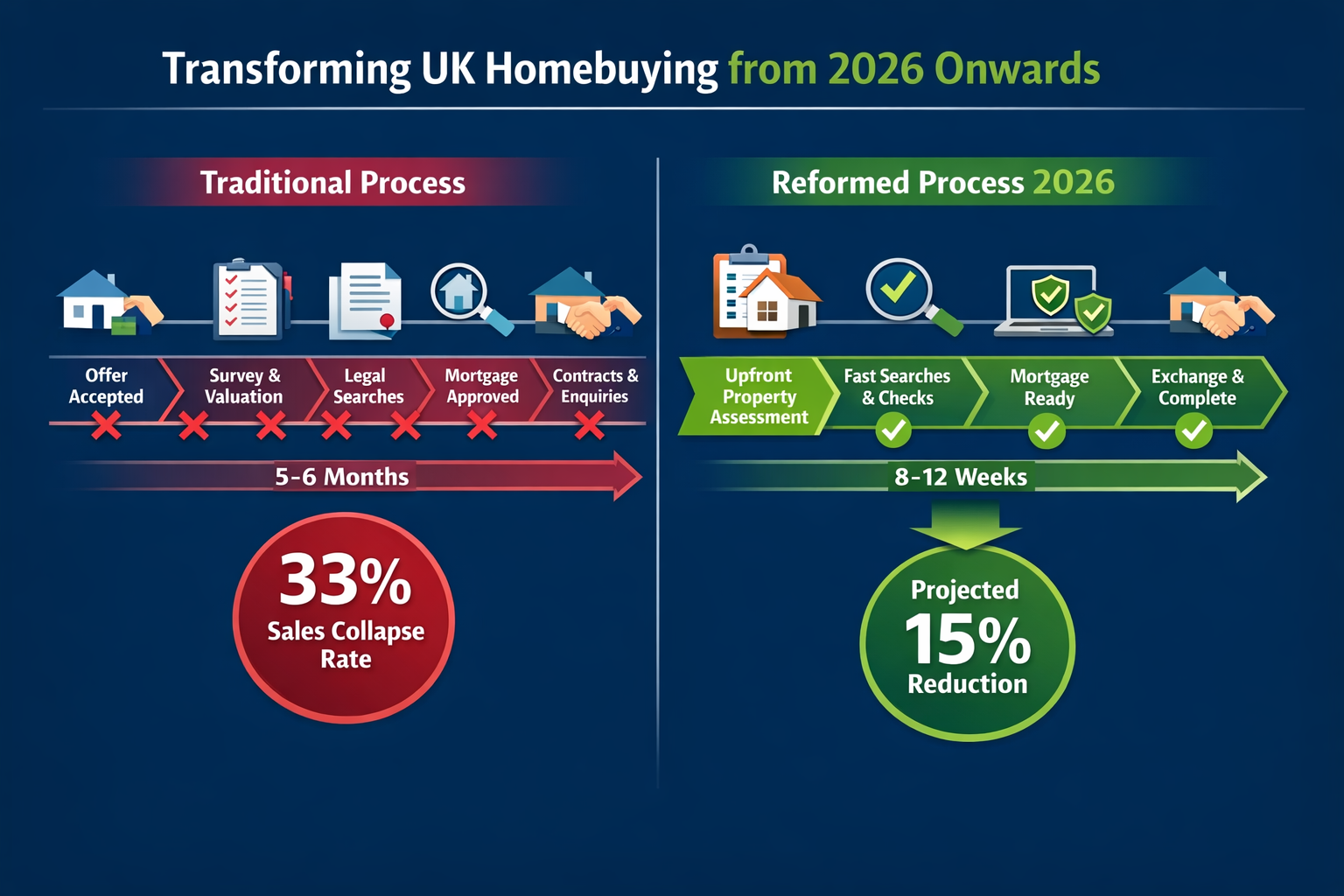
The shift from buyer-commissioned surveys to seller-commissioned mandatory assessments represents a fundamental transformation in how building surveys are procured, conducted, and utilized in property transactions.
From Optional to Mandatory: The Demand Surge
Currently, building surveys are optional and commissioned by buyers, typically only for:
- Older properties (pre-1900s)
- Properties with visible defects
- Unusual construction types
- High-value purchases where buyers want comprehensive information
Industry estimates suggest only 15-25% of property transactions currently involve full building surveys, with many buyers opting for cheaper homebuyer reports or no survey at all.
Under the 2026 reforms, this changes dramatically. Every property listing will require a condition assessment, meaning:
✅ 100% market coverage instead of 15-25%
✅ Estimated 300-400% increase in survey demand across the residential sector
✅ Consistent workflow for surveying practices rather than sporadic instructions
✅ Earlier engagement in the transaction timeline
Timing Shift: Pre-Marketing vs. Post-Offer
The most significant operational change involves when surveys occur in the transaction process:
Traditional Model (Pre-2026):
- Property listed without survey
- Buyer makes offer
- Buyer commissions survey (2-3 weeks)
- Survey reveals issues
- Renegotiation or withdrawal
Reformed Model (2026 Onwards):
- Seller commissions condition assessment
- Property listed with assessment included
- Buyers review assessment before offering
- Offers made with full knowledge
- Reduced renegotiation and fewer collapses
This timing shift means surveying professionals will work directly with sellers and estate agents rather than primarily with buyers, requiring adjustments to client relationships, marketing strategies, and service delivery models.
Tailored Assessments Based on Property Characteristics
The government's proposal specifies that condition assessments should be "tailored to age and type" of property [1]. This suggests a risk-based approach where:
- Modern properties (post-2000) might require basic structural and systems checks
- Mid-century properties (1950-2000) need more detailed assessment of aging components
- Period properties (pre-1950) require comprehensive evaluation including heritage considerations
- Non-standard construction demands specialist knowledge and testing
This tailored approach aligns with existing RICS Building Surveys Level 3 methodologies but will require clear guidance on minimum standards for each property category.
Professional Qualification Requirements
RICS has emphasized that "it is critical that decisions on upfront information, including property condition surveys, be undertaken by those professionally qualified" [6]. The reforms will likely establish:
- Mandatory RICS membership or equivalent professional qualification
- Specific competency standards for mandatory condition assessments
- Code of Practice developed jointly by RICS and The Property Ombudsman [6]
- Quality assurance mechanisms to ensure consistency across the industry
- Professional indemnity insurance requirements
This professional gatekeeping protects consumers while ensuring only qualified practitioners can meet the mandatory assessment requirement. For those seeking qualified professionals, working with RICS-registered valuers ensures compliance with these standards.
Implementation Timeline and Phased Approach for Government Homebuying Reforms 2026
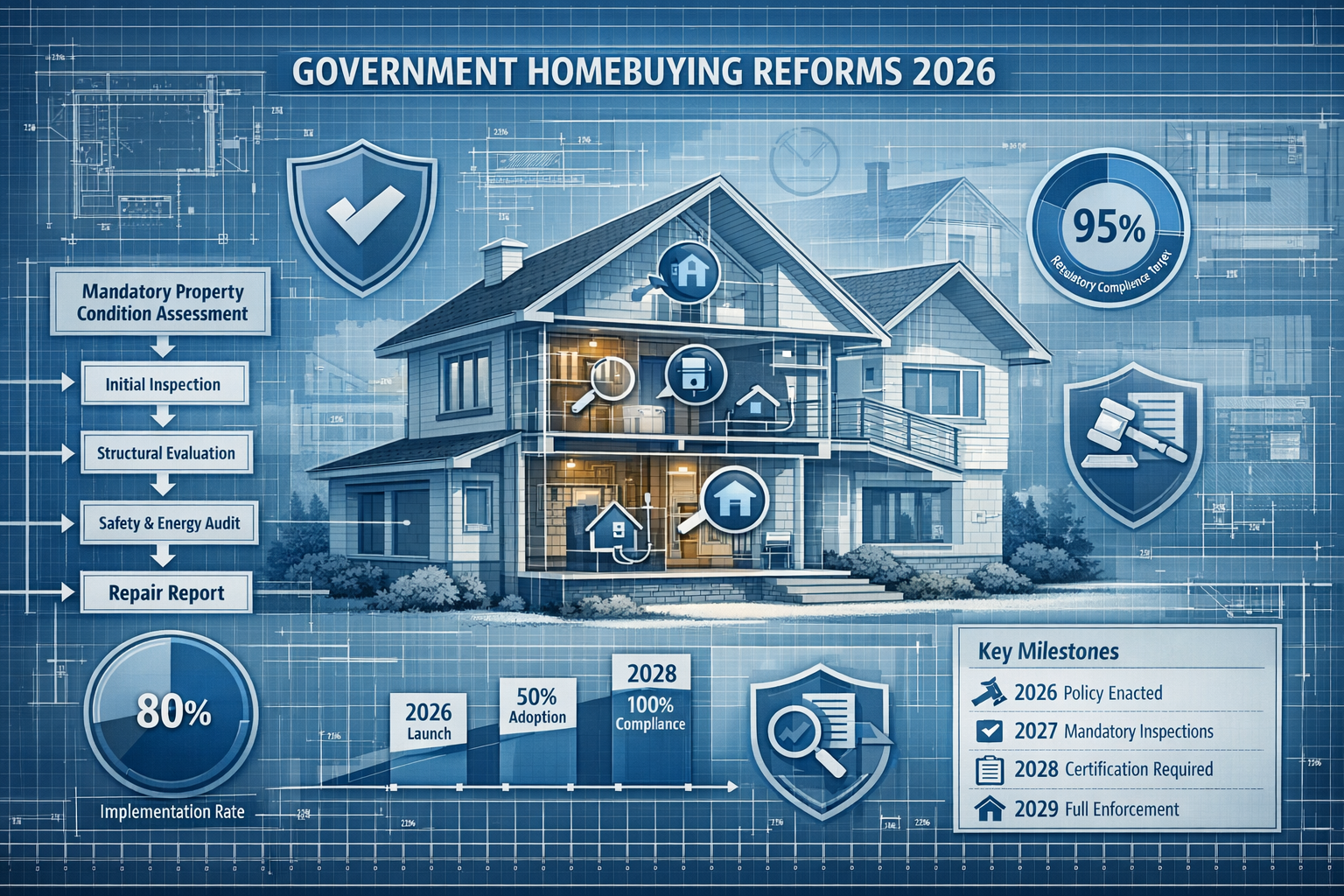
While the reforms are associated with 2026, the government has made clear this represents a phased implementation rather than a sudden switch on January 1st.
Consultation and Legislation Phase (2026-2027)
The government's consultation document acknowledges that "this is a significant change and will not happen immediately" [1]. The implementation roadmap includes:
2026:
- ✏️ Public consultation on detailed implementation proposals
- 📋 Industry working groups to develop standards and codes of practice
- 🏛️ Legislative drafting and parliamentary process
- 💻 Digital infrastructure development
2027:
- 📜 Legislation passed and royal assent obtained
- 📚 Final codes of practice and professional standards published
- 🎓 Training programs launched for surveyors and estate agents
- 🧪 Pilot programs in selected regions
2028 onwards:
- 🚀 Phased rollout beginning with new-build properties
- 📈 Gradual expansion to all property types
- 📊 Monitoring and adjustment based on market feedback
Regional Variations and Pilot Programs
The UK government may adopt a regional pilot approach similar to other major property reforms. Likely scenarios include:
- London and Southeast as early adopters due to high transaction volumes
- Regional cities (Manchester, Birmingham, Leeds) as test markets
- Rural areas implementing later to allow infrastructure development
- Scotland, Wales, and Northern Ireland potentially developing parallel but distinct frameworks
Surveying practices should monitor announcements specific to their operating regions and prepare accordingly.
Digital Infrastructure Requirements
The reforms depend heavily on digital transformation including [6]:
- 📱 Property logbooks: Digital repositories storing all property information throughout its lifecycle
- 🆔 Digital ID verification: Streamlined seller and buyer identity confirmation
- 🔄 Data-sharing platforms: Secure systems allowing surveyors, conveyancers, and agents to share information
- 🤖 AI in conveyancing: Automated document review and risk flagging
RICS published the world's first standard for responsible AI use in surveying in September 2025 [6], positioning the profession to leverage these technologies effectively.
The development and adoption of these digital tools will influence the pace of reform implementation, with technology-ready regions and firms able to participate in earlier phases.
Leasehold and Freehold Reform Act Integration
The reforms also incorporate implementation of the Leasehold and Freehold Reform Act, ensuring leasehold and freehold estate homeowners can "more quickly and affordably source property information necessary to sell homes" [1].
This integration means condition assessments for leasehold properties will need to coordinate with:
- Management company documentation
- Service charge histories
- Building insurance details
- Shared facility condition reports
Surveyors working with leasehold properties should develop relationships with management companies and understand the additional documentation requirements.
Preparing Your Surveying Practice for the 2026 Reforms
The mandatory condition assessment requirement presents both opportunities and challenges for surveying professionals. Forward-thinking practices can position themselves advantageously by preparing now.
Capacity Planning and Resource Allocation
The projected 300-400% increase in survey demand requires strategic capacity planning:
Staffing considerations:
- 👥 Recruit additional qualified surveyors or accelerate trainee development
- 🎯 Develop specialist teams for different property types (period, modern, non-standard)
- 📅 Implement scheduling systems to manage increased workflow
- 🤝 Consider partnership arrangements with complementary practices
Technology investments:
- 📸 Advanced survey equipment (thermal imaging, moisture meters, drone technology)
- 💻 Digital reporting platforms for faster turnaround
- 📊 Practice management software to handle volume increases
- 🔐 Secure data storage and sharing systems
Quality assurance:
- ✅ Standardized inspection checklists and protocols
- 👨🏫 Regular training and competency assessments
- 📋 Peer review processes for complex properties
- 📈 Client feedback systems
For practices offering specialized services like structural surveys or damp surveys, developing clear service tiers will help manage the diverse needs of mandatory assessments.
Client Relationship Shifts: From Buyers to Sellers
The primary client for mandatory condition assessments shifts from buyers to sellers, requiring adjusted marketing and service delivery:
Seller-focused services:
- 🏠 Pre-listing consultation to explain assessment requirements
- 💰 Transparent pricing structures suitable for sellers budgeting upfront costs
- 📝 Clear, accessible reports that support marketing efforts
- 🔧 Recommendations for addressing defects before listing
Estate agent partnerships:
- 🤝 Develop relationships with local estate agents as referral sources
- 📚 Educational materials explaining assessment benefits to agents
- ⚡ Fast-turnaround services to avoid listing delays
- 📦 Package deals for agents with multiple listings
Conveyancer collaboration:
- 🔗 Integrated workflows with conveyancing firms
- 📄 Standardized report formats compatible with legal requirements
- 🔄 Information-sharing protocols
- 👥 Joint client communication strategies
Developing Standardized Assessment Protocols
While awaiting final government guidance, practices should begin developing internal standards for condition assessments:
Property type matrices:
- Define inspection scope for different property ages and types
- Establish minimum investigation requirements
- Create decision trees for when specialist investigations are needed
- Develop pricing models reflecting complexity variations
Report templates:
- Clear, accessible language suitable for non-technical readers
- Standardized condition ratings (good/satisfactory/poor/serious)
- Visual aids including photographs, diagrams, and floor plans
- Executive summaries highlighting key findings
- Recommendations prioritized by urgency and cost
Risk assessment frameworks:
- Systematic evaluation of structural, environmental, and legal risks
- Clear communication of limitations and exclusions
- Recommendations for specialist investigations when needed
- Appropriate disclaimers and professional standards compliance
Practices already offering comprehensive RICS home surveys have a foundation to build upon, adapting existing methodologies to the mandatory assessment framework.
Training and Professional Development
Ensuring all surveyors meet the professional qualification requirements involves:
- 📖 Continuing Professional Development (CPD): Focused on regulatory changes and new standards
- 🎓 Specialist training: For emerging technologies (drones, thermal imaging, AI-assisted analysis)
- 📜 Code of Practice familiarization: Once published by RICS and The Property Ombudsman
- 🧑⚖️ Legal awareness: Understanding liability implications of mandatory assessments
- 💬 Communication skills: Effective report writing and client consultation
Investment in professional development positions practices as quality leaders in the reformed market.
Market Impact and Economic Considerations
The mandatory condition assessment requirement will have significant economic implications across the property market.
Cost Distribution and Affordability Concerns
Shifting survey costs from buyers to sellers raises important questions:
Seller perspective:
- 💸 Additional upfront costs (£400-£1,500+ depending on property)
- ⏰ Time investment coordinating assessments before listing
- 🔧 Potential remediation costs if defects are discovered
- 📊 Possible impact on net proceeds from sale
Buyer perspective:
- ✅ Reduced post-offer costs and uncertainty
- 🔍 Better information for decision-making
- ⚖️ More confident offers with fewer contingencies
- 💰 Potential for faster access to mortgage offers
Market equilibrium:
- 📉 Initial concern about deterring sellers from listing
- 📈 Counterbalanced by faster sales and fewer collapses
- 💡 Likely price adjustments as market adapts
- 🔄 Overall efficiency gains benefiting all parties
The government's phased approach allows time for the market to adjust and for support mechanisms to be developed for sellers who might struggle with upfront costs.
Impact on Property Transaction Volumes
The reforms aim to reduce the 33% collapse rate [6], which could significantly impact market dynamics:
Positive effects:
- ✅ More transactions completing successfully
- ⏱️ Faster completion times (projected 8-12 weeks vs. current 5-6 months)
- 🎯 Increased buyer confidence leading to more market activity
- 📊 Reduced wasted costs encouraging participation
Potential challenges:
- ⚠️ Short-term listing reduction as sellers adjust to new requirements
- 💸 Some sellers delayed by upfront cost requirements
- 📚 Initial confusion and market friction during transition
- 🏗️ Capacity constraints in surveying sector during early phases
Long-term projections suggest increased transaction volumes as the system becomes more efficient and trustworthy, benefiting the entire property ecosystem.
International Comparisons and Lessons
The UK reforms draw inspiration from international models:
France: Mandatory diagnostics (asbestos, lead, termites, energy performance) required before sale
Netherlands: Comprehensive property information packages standard practice
Australia: Building and pest inspections commonly seller-provided in competitive markets
These international examples demonstrate that mandatory assessments can work effectively when properly implemented with appropriate professional standards and consumer protections.
Challenges and Controversies Surrounding the Reforms
While broadly welcomed, the reforms face some criticism and implementation challenges.
Professional Capacity Concerns
The surveying profession must rapidly scale to meet 300-400% increased demand:
- 👥 Current surveyor shortage in some regions
- ⏰ Training pipeline takes years to produce qualified professionals
- 💼 Risk of quality dilution if standards are relaxed to meet demand
- 💰 Potential price increases during transition period
RICS and other professional bodies are working to address these concerns through accelerated training programs and clear competency standards.
Standardization vs. Flexibility Debate
Finding the right balance between standardized requirements and property-specific needs presents challenges:
Standardization advocates argue:
- ✅ Consistent standards protect consumers
- 📊 Comparable information across properties
- ⚖️ Clear liability frameworks
- 💻 Easier digital integration
Flexibility proponents counter:
- 🏘️ Properties are inherently unique
- 🎯 One-size-fits-all approaches miss important details
- 💡 Professional judgment should guide scope
- 🔧 Over-standardization may increase costs unnecessarily
The "tailored to age and type" language in the consultation [1] suggests a middle ground, with standardized frameworks allowing professional discretion.
Liability and Insurance Implications
Mandatory assessments create new liability considerations:
- ⚖️ Who bears responsibility if defects are missed?
- 📄 How long do assessment warranties last?
- 💰 Will professional indemnity insurance premiums increase?
- 🔍 What happens when buyer's independent survey contradicts seller's assessment?
Clear legal frameworks and insurance products will need to evolve alongside the reforms. Surveyors should work closely with insurers and legal advisors to understand and manage these risks.
Concerns About Market Disruption
Some stakeholders worry about unintended consequences:
- 📉 Reduced property listings if sellers are deterred by upfront costs
- ⏸️ Delays during transition period as infrastructure develops
- 🏚️ Particular challenges for older properties with multiple defects
- 💸 Disproportionate impact on lower-value properties where assessment costs represent higher percentage of value
The government's commitment to phased implementation and ongoing consultation aims to identify and address these concerns before they become systemic problems.
The Broader Context: Housing Reform in 2026
The UK's homebuying reforms are part of a global wave of housing policy changes in 2026, though with different focuses across jurisdictions.
UK-Specific Reforms
Beyond mandatory condition assessments, UK reforms include [1][4]:
- 🏛️ Mandatory qualifications and Code of Practice for estate and letting agents
- 📊 Government publication of quality information for estate agents, solicitors, and conveyancers
- 🏢 Leasehold and Freehold Reform Act implementation
- 💻 Digital transformation initiatives including property logbooks
- 🔐 Enhanced consumer protections throughout the transaction process
These complementary reforms create a comprehensive modernization of the property sector.
International Housing Policy Trends
While the UK focuses on transaction efficiency, other jurisdictions address different priorities:
United States (2026):
The 21st Century ROAD to Housing Act, passed March 2, 2026, focuses on [3]:
- 📚 Housing counseling program reforms
- 🏗️ Regulatory barrier reduction for affordable housing construction
- 🏢 Clarification of HUD evaluation authority
State-Level Reforms:
Various US states are implementing [5]:
- 🏘️ Zoning reform to increase housing supply
- 🔨 Accessory dwelling unit (ADU) legalization
- 📋 Streamlined permitting processes
- 🏗️ Reduced parking requirements
These international trends reflect common challenges around housing affordability, transaction efficiency, and regulatory modernization, though solutions vary based on local market conditions and political priorities.
Future Outlook: Beyond 2026
The 2026 reforms represent just the beginning of ongoing transformation in property transactions.
Technology-Driven Evolution
Emerging technologies will continue reshaping building surveys:
Artificial Intelligence:
- 🤖 Automated defect detection from photographs
- 📊 Predictive maintenance recommendations
- 📈 Comparative market analysis integration
- ⚡ Faster report generation
Remote Inspection Technologies:
- 🚁 Drone surveys for roofs and exteriors
- 📹 Virtual reality property tours with condition annotations
- 🌡️ IoT sensors for ongoing condition monitoring
- 📡 Remote thermal imaging and moisture detection
Blockchain and Digital Records:
- 🔐 Immutable property history records
- 📄 Smart contracts for automated compliance
- 🔗 Seamless information sharing across transaction parties
- 🌐 International property transaction facilitation
RICS's September 2025 publication of AI standards [6] positions the profession to adopt these technologies responsibly while maintaining professional judgment and accountability.
Evolving Professional Roles
Surveyors' roles will expand beyond traditional inspection:
- 🎯 Property advisors: Guiding sellers on pre-listing improvements
- 📊 Data analysts: Interpreting historical condition trends
- 🔮 Risk assessors: Evaluating long-term property resilience (climate change, market shifts)
- 🏗️ Project coordinators: Managing specialist investigations and remediation
- 💼 Expert witnesses: Resolving disputes over condition assessments
This evolution creates opportunities for differentiation and specialized service development.
Continuous Regulatory Refinement
The 2026 reforms will be iteratively improved based on:
- 📈 Market data on transaction times and collapse rates
- 💬 Stakeholder feedback from all parties
- 🔍 Identification of unintended consequences
- 🌍 International best practice developments
- 💻 Technological capability advances
Surveying professionals should engage actively in ongoing consultation processes to shape the regulatory environment in which they operate.
Conclusion: Embracing Transformation in Property Transactions
The Government Homebuying Reforms 2026: How Mandatory Property Condition Assessments Will Transform Building Survey Demand represents a watershed moment for the UK property market. By requiring comprehensive condition assessments before properties are listed, the reforms address longstanding inefficiencies that have plagued buyers and sellers for decades.
For surveying professionals, these changes bring both significant opportunities and important responsibilities:
Opportunities:
- 📈 Dramatic increase in survey demand (300-400% growth projected)
- 🤝 New client relationships with sellers and estate agents
- 💼 Expanded service offerings and specialization potential
- 🏆 Enhanced professional status as gatekeepers of mandatory requirements
Responsibilities:
- ✅ Maintaining high professional standards amid volume increases
- 📚 Continuous learning and adaptation to new frameworks
- ⚖️ Managing increased liability and insurance considerations
- 🤝 Collaboration with other transaction professionals
Actionable Next Steps
For Surveying Practices:
- 📊 Assess current capacity and develop scaling plans for 300-400% demand increase
- 💻 Invest in technology including digital reporting, scheduling systems, and advanced equipment
- 🤝 Build relationships with estate agents and conveyancers in your region
- 📖 Monitor regulatory developments through RICS and government consultation channels
- 🎓 Prioritize training for yourself and your team on emerging standards and technologies
- 📝 Develop standardized protocols for different property types and assessment scopes
- 🔍 Review insurance coverage and discuss liability implications with insurers
For Property Professionals:
- 📚 Educate yourself on the reform timeline and requirements
- 🗣️ Communicate changes to clients (buyers and sellers) proactively
- 🔗 Develop partnerships across the transaction ecosystem
- 💡 Consider pilot participation if your region offers early implementation opportunities
For Buyers and Sellers:
- ⏰ Stay informed about implementation timelines in your region
- 💰 Budget appropriately for new upfront costs (sellers) or reduced post-offer costs (buyers)
- 👨💼 Work with qualified professionals including RICS-registered surveyors
- 📄 Understand your rights under the new framework
The transformation of building survey demand through mandatory property condition assessments will create a more transparent, efficient, and trustworthy property market. While implementation challenges exist, the long-term benefits of reduced transaction failures, faster completions, and better-informed decisions will serve all market participants.
Those who prepare proactively—whether surveying professionals scaling their practices, estate agents adapting their processes, or buyers and sellers understanding the new landscape—will be best positioned to thrive in this reformed market.
The journey toward comprehensive homebuying reform continues throughout 2026 and beyond, with mandatory property condition assessments serving as a cornerstone of a modernized, consumer-focused property transaction system. For expert guidance on building surveys and property assessments, consider consulting with qualified RICS professionals who are preparing for these transformative changes.
References
[1] Home Buying And Selling Reform – https://www.gov.uk/government/consultations/home-buying-and-selling-reform/home-buying-and-selling-reform
[2] Homebuying Reform Impacts On Building Surveys Preparing For Mandatory Upfront Condition Assessments In 2026 – https://nottinghillsurveyors.com/blog/homebuying-reform-impacts-on-building-surveys-preparing-for-mandatory-upfront-condition-assessments-in-2026
[3] Whats In The 21st Century Road To Housing Act – https://bipartisanpolicy.org/explainer/whats-in-the-21st-century-road-to-housing-act/
[4] Home Buying Selling Reforms – https://www.lawsociety.org.uk/topics/property/home-buying-selling-reforms
[5] Housing Reform States Menu Options 2026 – https://www.mercatus.org/research/policy-briefs/housing-reform-states-menu-options-2026
[6] Rics Responds To Major Changes In Home Buying And Selling – https://www.rics.org/news-insights/rics-responds-to-major-changes-in-home-buying-and-selling