The buy-to-let landscape in 2026 has transformed dramatically. As recovery markets emerge from recent economic turbulence, institutional investors face unprecedented regulatory scrutiny alongside significant opportunities. Institutional Buy-to-Let Surveys: Risk Protocols for Professional Landlords in Recovery Markets have become essential tools for navigating this complex environment, where thorough due diligence can mean the difference between portfolio success and costly compliance failures.
Recent legislative changes have reshaped how institutional investors approach single-family rental acquisitions. The Senate-passed housing legislation in March 2026 introduced temporary restrictions on large-scale purchases, while simultaneously creating exceptions for build-to-rent and renovate-to-rent programs [1]. Combined with President Trump's January 2026 Executive Order restricting institutional access to government loan programs [2], professional landlords must now implement rigorous survey protocols to ensure their investments align with evolving regulatory frameworks.
Key Takeaways
- Regulatory compliance requires specialized survey protocols that identify properties suitable for build-to-rent and renovate-to-rent exemptions under 2026 legislation
- Comprehensive defect identification through structural surveys protects institutional portfolios from hidden liabilities in recovery markets
- Portfolio-wide due diligence demands standardized assessment frameworks that evaluate risk across multiple properties simultaneously
- Seven-year disposal requirements under new legislation necessitate long-term condition forecasting and maintenance planning [1]
- Professional survey protocols differentiate institutional investors from individual buyers, ensuring compliance and maximizing returns in competitive markets
Understanding Institutional Buy-to-Let Survey Requirements in 2026
The Regulatory Landscape Shaping Survey Protocols
The regulatory environment governing institutional buy-to-let investments has undergone significant transformation in 2026. The bipartisan housing legislation (H.R. 6644) passed by the Senate with an 89-10 vote introduces a temporary ban on large institutional investors purchasing single-family homes, with specific carve-outs for properties destined for build-to-rent or renovate-to-rent programs [1].
This legislative framework creates a critical need for specialized survey protocols that can:
✅ Identify renovation potential that qualifies properties for regulatory exemptions
✅ Document existing conditions to establish baseline property status
✅ Assess structural integrity for long-term rental viability
✅ Evaluate compliance risks with local housing standards
The Executive Order from January 20, 2026, further restricts institutional investors' access to government-backed loan programs and agency asset sales, with the Treasury Secretary defining "Large Institutional Investor" as entities owning more than 100 single-family homes [2]. This threshold makes survey efficiency and standardization paramount for institutional portfolios approaching or exceeding this limit.
Distinguishing Institutional Surveys from Standard Valuations
Many professional landlords mistakenly assume that standard mortgage valuations suffice for institutional acquisitions. However, understanding whether a mortgage valuation is the same as a survey reveals critical gaps in risk assessment.
Mortgage Valuations vs. Institutional Buy-to-Let Surveys:
| Aspect | Mortgage Valuation | Institutional Survey |
|---|---|---|
| Purpose | Lender risk assessment | Comprehensive due diligence |
| Depth | Surface-level inspection | Detailed defect analysis |
| Scope | Market value focus | Condition, compliance, longevity |
| Defect Reporting | Major issues only | All material defects documented |
| Renovation Assessment | Not included | Detailed cost projections |
| Portfolio Integration | Single property | Standardized multi-property protocols |
Professional landlords operating in recovery markets require surveys that go beyond simple valuations. These comprehensive assessments identify hidden defects that could compromise rental income, trigger regulatory violations, or necessitate unexpected capital expenditure.
Key Components of Institutional Survey Protocols
Institutional Buy-to-Let Surveys: Risk Protocols for Professional Landlords in Recovery Markets should encompass several specialized assessment areas:
🏗️ Structural Integrity Analysis
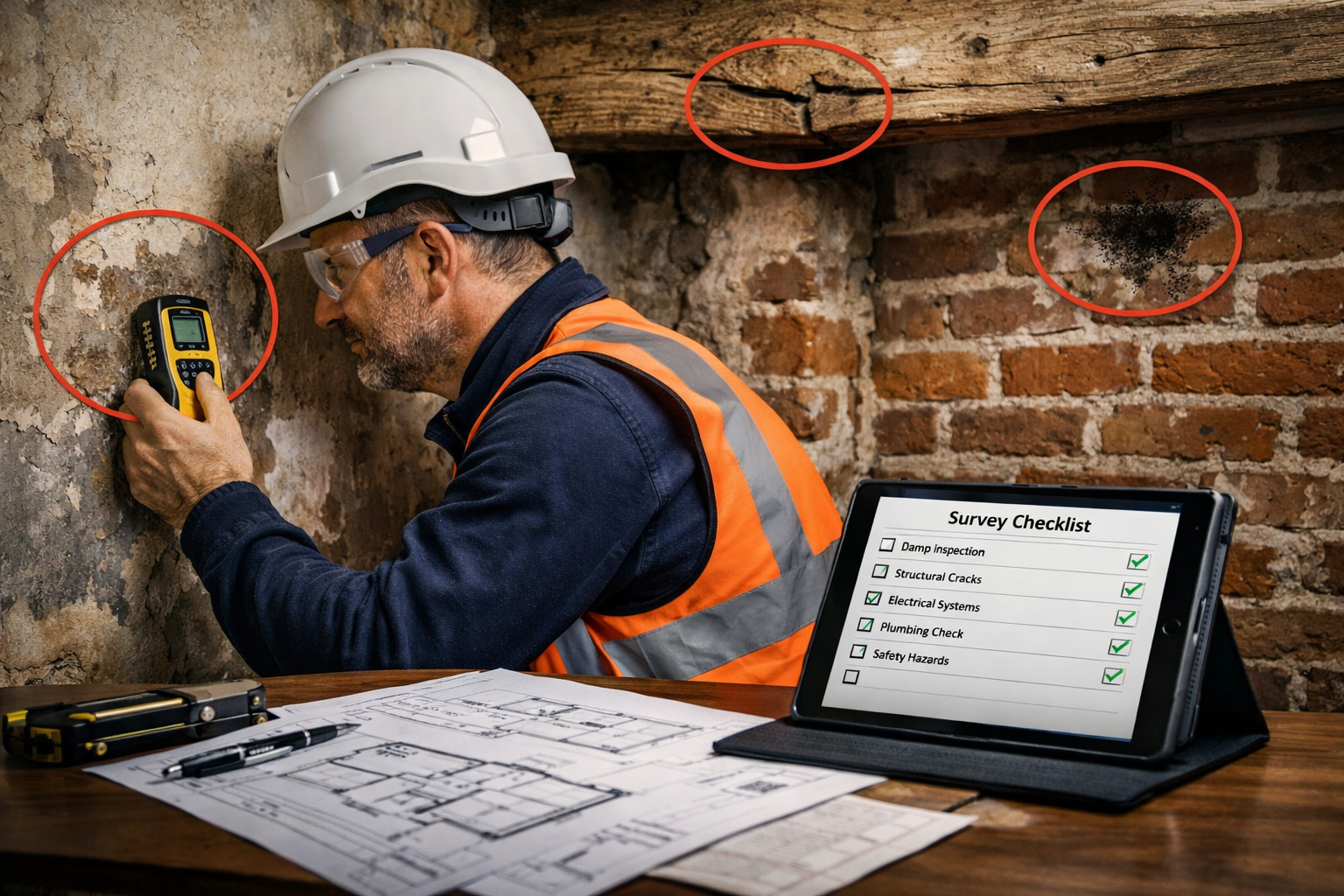
Recovery market properties often present deferred maintenance issues. Comprehensive structural surveys identify foundation problems, load-bearing wall conditions, and structural movement that could escalate into major liabilities.
💧 Water Ingress and Damp Assessment
Moisture-related defects represent the most common hidden risk in buy-to-let portfolios. Specialized assessments detect rising damp, penetrating moisture, and condensation issues that compromise tenant satisfaction and property longevity.
🏠 Roof Condition Evaluation
Roof surveys provide critical intelligence on remaining service life, immediate repair requirements, and long-term replacement planning—essential for accurate portfolio budgeting.
⚠️ Subsidence and Ground Movement
Recovery markets may include properties with historical subsidence issues. Professional subsidence surveys identify active movement, assess repair quality of previous interventions, and evaluate ongoing risk.
🔧 Building Services Assessment
Electrical systems, heating installations, plumbing networks, and drainage infrastructure require thorough evaluation. Drainage surveys using CCTV technology reveal hidden defects in underground systems.
Risk Mitigation Through Specialized Survey Protocols
Portfolio-Wide Due Diligence Frameworks
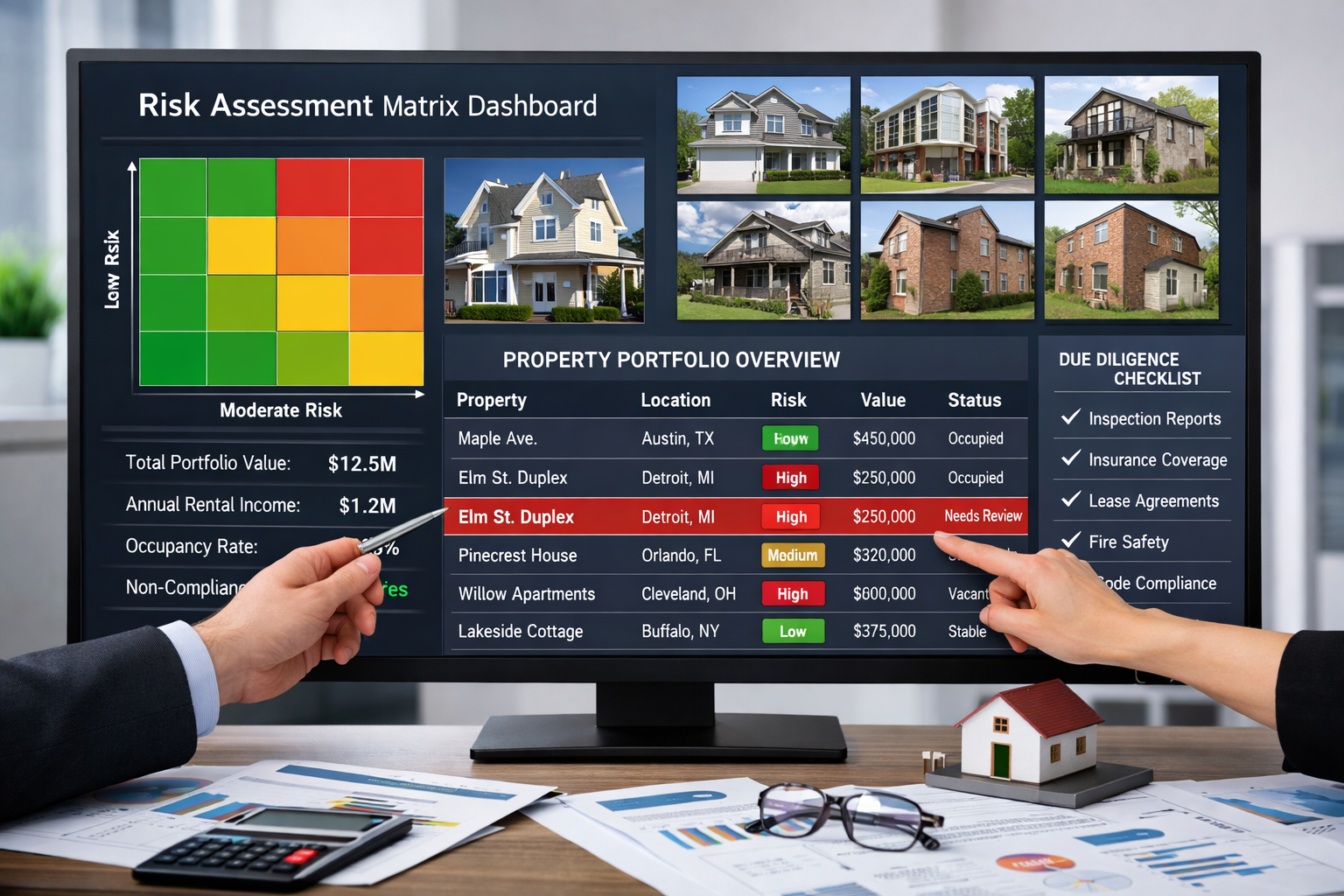
Institutional investors acquiring multiple properties in recovery markets require standardized assessment protocols that enable comparative risk analysis. Unlike individual buyers evaluating single properties, professional landlords need survey frameworks that:
📊 Standardize defect categorization across all properties
📈 Quantify risk levels using consistent metrics
💰 Project remediation costs with portfolio-level accuracy
⏱️ Prioritize intervention timelines based on urgency and impact
This systematic approach transforms individual survey reports into strategic portfolio intelligence. By implementing consistent protocols, institutional investors can identify patterns, allocate capital efficiently, and manage risk proactively across their entire property portfolio.
Compliance Verification for Regulatory Exemptions
The seven-year disposal requirement introduced in the 2026 Senate legislation mandates that institutional investors purchasing build-to-rent or renovate-to-rent properties must sell single-family homes to individual homebuyers within seven years of purchase, with exceptions for active leases up to 36 months [1].
This regulatory framework creates specific survey requirements:
Build-to-Rent Verification:
- Confirm property construction timeline and completion status
- Document that property was purpose-built for rental market
- Verify compliance with local rental housing standards
- Assess long-term durability for extended rental periods
Renovate-to-Rent Qualification:
- Document pre-acquisition property condition comprehensively
- Identify all required renovation work to meet rental standards
- Project renovation costs and timelines accurately
- Establish clear baseline for post-renovation compliance
Professional dilapidation surveys provide the detailed condition documentation necessary to demonstrate renovation scope and justify regulatory exemptions.
Defect Identification and Remediation Planning
Recovery markets present unique challenges for institutional investors. Properties may have experienced periods of neglect, deferred maintenance, or inadequate repairs during economic downturns. Institutional Buy-to-Let Surveys: Risk Protocols for Professional Landlords in Recovery Markets must identify three categories of defects:
Category 1: Immediate Safety Hazards 🚨
Defects requiring urgent intervention to ensure tenant safety and legal compliance. These include structural instability, electrical hazards, gas safety violations, and fire safety deficiencies.
Category 2: Progressive Deterioration ⚠️
Issues that will worsen without intervention, potentially escalating into Category 1 hazards. Examples include minor water ingress, early-stage timber decay, and deteriorating building envelope components.
Category 3: Maintenance and Cosmetic Issues 🔧
Defects affecting property presentation and tenant satisfaction but not posing immediate structural or safety risks. These require planning within maintenance budgets but don't threaten rental viability.
Accurate categorization enables institutional investors to:
- Negotiate acquisition prices based on documented defect remediation costs
- Schedule interventions strategically to minimize rental income disruption
- Allocate capital budgets efficiently across portfolio properties
- Demonstrate regulatory compliance through documented safety standards
Strategic Implementation of Survey Protocols in Recovery Markets
Selecting Qualified Survey Professionals
The complexity of Institutional Buy-to-Let Surveys: Risk Protocols for Professional Landlords in Recovery Markets demands engagement with appropriately qualified professionals. RICS (Royal Institution of Chartered Surveyors) accreditation provides assurance of technical competence and professional standards.
When selecting survey professionals for institutional portfolios, consider:
🎓 RICS Chartered Status
Chartered surveyors maintain professional indemnity insurance, adhere to ethical standards, and undergo continuous professional development.
🏢 Institutional Experience
Surveyors with portfolio assessment experience understand the standardization requirements and comparative analysis needs of professional landlords.
📍 Local Market Knowledge
Recovery markets have unique characteristics. Surveyors with regional expertise identify area-specific risks, from ground conditions to prevalent construction types.
🔬 Technical Specializations
Complex defects may require specialist input. Access to structural engineering expertise, drainage specialists, and other technical consultants enhances survey comprehensiveness.
Integrating Surveys with Valuation Processes
Professional landlords require both condition assessment and market valuation to make informed acquisition decisions. RICS valuations provide independent market value opinions that, when combined with comprehensive survey data, enable sophisticated investment analysis.
Integrated Assessment Framework:
- Initial Market Screening: Identify potential acquisitions in target recovery markets
- Desktop Due Diligence: Review available property information and local market data
- Comprehensive Survey: Commission detailed condition assessment
- Defect Quantification: Project remediation costs with professional accuracy
- Adjusted Valuation: Determine market value accounting for identified defects
- Investment Analysis: Calculate returns based on acquisition cost, remediation investment, and rental yield projections
This integrated approach ensures that institutional investors understand both the physical condition and market positioning of potential acquisitions, enabling data-driven investment decisions.
Technology-Enhanced Survey Protocols
Modern survey technology enhances the efficiency and accuracy of institutional buy-to-let assessments. Professional landlords should expect survey protocols that incorporate:
📱 Digital Reporting Platforms
Cloud-based survey reports enable instant access for investment committees, standardized formatting across portfolios, and efficient data extraction for analysis.
📸 Photographic Documentation
High-resolution imagery provides visual evidence of defects, supports remediation planning, and creates baseline records for future reference.
🎥 Video Survey Technology
Particularly valuable for drainage surveys, video documentation reveals conditions in inaccessible areas and provides compelling evidence of defect severity.
🌡️ Thermal Imaging
Infrared technology identifies heat loss, moisture ingress, and insulation deficiencies invisible to visual inspection alone.
📐 Laser Measurement Systems
Accurate dimensional data supports space planning, renovation design, and compliance verification with minimum room size standards.
Multi-Property Assessment Strategies
Institutional investors acquiring multiple properties simultaneously in recovery markets require survey protocols that balance thoroughness with efficiency. Strategic approaches include:
Phased Assessment Programs:
- Conduct preliminary surveys on all target properties
- Prioritize detailed assessments based on initial findings
- Commission specialist investigations only where material risks identified
Standardized Reporting Templates:
- Implement consistent defect categorization across all properties
- Use uniform risk rating systems for comparative analysis
- Generate portfolio-level summary reports alongside individual property assessments
Coordinated Survey Scheduling:
- Arrange simultaneous assessments where properties are geographically clustered
- Negotiate volume discounts with survey providers
- Minimize transaction timeline delays through efficient coordination
Navigating Party Wall and Boundary Considerations
Institutional buy-to-let portfolios frequently include terraced properties, semi-detached homes, and properties with shared boundaries. These situations create specific survey requirements related to party wall structures and boundary responsibilities.
Party wall considerations become particularly relevant when institutional investors plan renovation work that may affect adjoining properties. Survey protocols should:
🧱 Identify Shared Structures
Document all party walls, party fence walls, and shared foundations that may require formal party wall procedures.
📋 Assess Existing Conditions
Establish baseline condition records for shared structures before commencing any works, protecting against future disputes.
⚖️ Evaluate Renovation Implications
Determine whether planned improvements trigger party wall notice requirements under relevant legislation.
🤝 Document Boundary Responsibilities
Clarify maintenance obligations for boundary walls, fences, and shared access areas to prevent future disputes with neighbors or tenants.
Professional landlords expanding buy-to-let portfolios through property modifications should understand that party wall awards may be necessary when undertaking certain types of work [3].
Long-Term Portfolio Management and Survey Cycles

Establishing Ongoing Assessment Programs
Institutional Buy-to-Let Surveys: Risk Protocols for Professional Landlords in Recovery Markets shouldn't be viewed as one-time acquisition tools. Professional portfolio management requires cyclical reassessment to:
🔄 Monitor Condition Evolution
Properties deteriorate over time. Regular surveys identify emerging defects before they escalate into major problems.
📊 Update Capital Expenditure Forecasts
Periodic reassessment refines long-term maintenance budgets and capital replacement schedules.
✅ Verify Regulatory Compliance
Building regulations and rental property standards evolve. Regular surveys ensure ongoing compliance with changing requirements.
💡 Optimize Disposal Timing
The seven-year disposal requirement for certain institutional purchases [1] necessitates condition monitoring to identify optimal sale timing that maximizes returns while meeting regulatory obligations.
Integrating Surveys with Asset Management Systems
Sophisticated institutional investors integrate survey data into comprehensive asset management platforms that track:
- Property condition scores trending over time
- Maintenance intervention histories linked to specific defects
- Capital expenditure actuals compared to survey projections
- Tenant satisfaction metrics correlated with property condition
- Regulatory compliance status across entire portfolio
This integration transforms survey reports from static documents into dynamic portfolio intelligence that informs strategic decision-making.
Planning for the Seven-Year Disposal Cycle
The Senate legislation's seven-year disposal requirement [1] creates unique planning considerations for institutional investors. Survey protocols should support this timeline by:
Year 0-1 (Acquisition Phase):
- Comprehensive baseline survey documenting all defects
- Detailed renovation planning for renovate-to-rent exemptions
- Compliance verification for regulatory qualification
Year 2-4 (Stabilization Phase):
- Mid-cycle condition assessment
- Refinement of long-term maintenance plans
- Identification of value-enhancement opportunities
Year 5-6 (Pre-Disposal Phase):
- Comprehensive pre-sale survey
- Remediation of defects affecting marketability
- Documentation preparation for individual buyer sales
Year 7 (Disposal Phase):
- Final condition certification
- Transfer of survey documentation to purchasers
- Compliance verification with disposal requirements
This structured approach ensures that institutional investors maintain property condition throughout the ownership cycle while positioning assets optimally for disposal to individual homebuyers.
Specialized Survey Considerations for Different Property Types
Victorian and Edwardian Terraces in Recovery Markets
Recovery markets often feature substantial stocks of Victorian and Edwardian terraced properties. These period homes present specific survey considerations:
🏛️ Historical Construction Methods
Solid wall construction, lime mortar, and traditional timber joinery require specialized assessment techniques and appropriate remediation approaches.
⚓ Subsidence Vulnerability
Shallow foundations and clay subsoils make these properties susceptible to ground movement. Subsidence surveys provide essential risk intelligence.
🌡️ Thermal Performance
Period properties typically lack cavity wall insulation and feature single-glazed windows, creating energy efficiency challenges that affect rental appeal and regulatory compliance.
🔥 Fire Safety Considerations
Terraced properties require particular attention to fire separation, escape routes, and detection systems—especially when configured as Houses in Multiple Occupation (HMOs).
Post-War Housing Stock
Mid-20th century properties dominate many recovery market areas. Survey protocols for these homes should address:
🏗️ Non-Standard Construction
Some post-war properties feature unconventional construction methods that affect mortgageability and insurance availability. Non-standard construction surveys identify these issues.
⚡ Aging Building Services
Electrical systems, heating installations, and plumbing approaching end-of-life require assessment and replacement planning.
🪟 Envelope Deterioration
Flat roofs, metal windows, and concrete components may exhibit age-related deterioration requiring intervention.
Modern Developments and New-Build Rentals
Institutional investors increasingly target modern properties and new-build developments for build-to-rent portfolios. Survey considerations include:
📋 Warranty Coverage
NHBC or similar warranty provisions affect risk profiles and survey scope requirements.
🏗️ Defect Liability Periods
New-build properties may still be within developer defect liability periods, requiring surveys that identify issues for timely notification.
⚙️ Modern Building Services
Complex heating systems, smart home technology, and renewable energy installations require specialized technical assessment.
Cost-Benefit Analysis of Comprehensive Survey Protocols
Investment in Survey Quality vs. Hidden Defect Risks
Professional landlords sometimes question whether comprehensive survey protocols justify their costs compared to basic assessments. The financial case for thorough surveys becomes clear when considering:
Scenario Analysis: £250,000 Terraced Property Acquisition
| Survey Approach | Survey Cost | Hidden Defect Discovery | Remediation Cost | Total Investment |
|---|---|---|---|---|
| Basic Valuation | £400 | Post-purchase | £35,000 | £285,400 |
| Standard Survey | £650 | Pre-purchase | £35,000 | £250,650 (negotiated price reduction) |
| Comprehensive Institutional Survey | £950 | Pre-purchase with detailed costing | £28,000 | £243,950 (negotiated reduction + efficient remediation) |
This simplified analysis demonstrates how comprehensive survey investment enables:
💰 Informed Price Negotiation
Documented defects provide objective evidence supporting price reductions.
📉 Reduced Remediation Costs
Detailed defect identification enables competitive tendering and efficient remediation planning.
⏱️ Minimized Timeline Delays
Pre-purchase defect knowledge prevents post-acquisition surprises that delay rental income commencement.
🛡️ Risk Transfer
Comprehensive surveys may identify defects severe enough to justify acquisition withdrawal, protecting institutional capital from problematic assets.
Portfolio-Level Return on Survey Investment
When evaluated at portfolio scale, comprehensive survey protocols deliver additional benefits:
- Standardized risk assessment enables data-driven capital allocation across multiple properties
- Predictive maintenance planning reduces emergency repair costs and tenant disruption
- Regulatory compliance assurance minimizes enforcement action risks and associated costs
- Enhanced disposal values through documented maintenance histories and condition certification
Professional landlords managing portfolios of 50+ properties typically achieve survey cost recovery within 18-24 months through these combined benefits.
Future-Proofing Institutional Buy-to-Let Investments
Anticipating Regulatory Evolution
The 2026 legislative changes [1][2] represent the current regulatory environment, but professional landlords should anticipate continued evolution. Survey protocols that document comprehensive property data create flexibility to adapt to future requirements in areas such as:
🌱 Energy Efficiency Standards
Progressive tightening of minimum Energy Performance Certificate (EPC) ratings for rental properties requires baseline assessment and improvement planning.
♿ Accessibility Requirements
Potential future regulations mandating accessibility features in rental housing necessitate surveys that evaluate adaptation feasibility.
🏗️ Building Safety Regulations
Evolving fire safety and structural safety requirements following recent building safety reforms require ongoing compliance verification.
🌍 Climate Resilience
Increasing focus on flood risk, overheating potential, and climate adaptation may drive new survey requirements for rental properties.
Sustainability and ESG Considerations
Institutional investors increasingly face Environmental, Social, and Governance (ESG) expectations from stakeholders. Survey protocols should incorporate:
Environmental Assessment:
- Energy efficiency evaluation and improvement potential
- Renewable energy installation feasibility
- Sustainable materials assessment for renovation projects
- Carbon footprint baseline establishment
Social Considerations:
- Tenant health and wellbeing factors (damp, ventilation, natural light)
- Accessibility and inclusive design features
- Community integration and local amenity access
Governance Factors:
- Regulatory compliance documentation
- Transparent condition reporting
- Ethical procurement for remediation works
Surveys that address these dimensions position institutional portfolios favorably for evolving investor expectations and potential future disclosure requirements.
Conclusion
Institutional Buy-to-Let Surveys: Risk Protocols for Professional Landlords in Recovery Markets have evolved from optional due diligence to essential strategic tools in 2026's transformed regulatory landscape. The Senate-passed housing legislation introducing temporary purchase restrictions and seven-year disposal requirements [1], combined with Executive Order limitations on government program access [2], demands unprecedented rigor in property assessment protocols.
Professional landlords who implement comprehensive survey frameworks gain decisive advantages: informed acquisition pricing, regulatory compliance assurance, efficient capital allocation, and optimized disposal timing. The integration of structural surveys, specialized defect investigations, and standardized portfolio assessment protocols transforms property due diligence from reactive risk management to proactive strategic planning.
Recovery markets present both opportunities and risks for institutional investors. Properties emerging from economic downturns may offer attractive yields, but deferred maintenance, hidden defects, and compliance gaps can quickly erode returns. Comprehensive survey protocols identify these issues before acquisition, enabling either informed negotiation or strategic withdrawal from problematic assets.
Actionable Next Steps for Professional Landlords
✅ Audit Current Survey Protocols: Review existing assessment procedures against the comprehensive frameworks outlined in this guide, identifying gaps in defect categorization, compliance verification, or portfolio standardization.
✅ Engage RICS-Qualified Professionals: Establish relationships with chartered surveyors experienced in institutional portfolio assessment and recovery market property evaluation.
✅ Implement Standardized Reporting: Develop consistent survey templates that enable comparative risk analysis across multiple properties and support data-driven investment decisions.
✅ Integrate Survey Data: Connect survey findings with asset management systems, financial modeling, and strategic planning processes to maximize intelligence value.
✅ Plan for Regulatory Compliance: Ensure survey protocols capture the documentation necessary to demonstrate build-to-rent or renovate-to-rent qualification under current legislation [1].
✅ Establish Cyclical Reassessment: Move beyond acquisition-only surveys to implement ongoing condition monitoring that supports long-term portfolio management and optimal disposal timing.
The institutional buy-to-let sector in 2026 rewards professional landlords who approach property acquisition with sophisticated due diligence protocols. As recovery markets mature and regulatory frameworks continue evolving, comprehensive survey methodologies will increasingly differentiate successful institutional investors from those who struggle with unexpected defects, compliance failures, and suboptimal returns.
For professional landlords seeking to build resilient, compliant, and profitable buy-to-let portfolios in recovery markets, investment in rigorous survey protocols represents not an optional expense but a strategic imperative. The question is no longer whether to implement comprehensive assessment frameworks, but how quickly institutional investors can adapt their due diligence processes to meet the demands of 2026's transformed regulatory and market environment.
References
[1] Us Senate Advances Housing Legislation That Includes A Ban On Institutional Investors Purchasing Single Family Homes – https://www.mayerbrown.com/en/insights/publications/2026/03/us-senate-advances-housing-legislation-that-includes-a-ban-on-institutional-investors-purchasing-single-family-homes
[2] Fact Sheet President Donald J Trump Stops Wall Street From Competing With Main Street Homebuyers – https://www.whitehouse.gov/fact-sheets/2026/01/fact-sheet-president-donald-j-trump-stops-wall-street-from-competing-with-main-street-homebuyers/
[3] Party Wall Awards For Buy To Let Expansions In 2026 Protocols Amid Institutional Landlord Surge – https://nottinghillsurveyors.com/blog/party-wall-awards-for-buy-to-let-expansions-in-2026-protocols-amid-institutional-landlord-surge