The discovery of widespread Reinforced Autoclaved Aerated Concrete (RAAC) across UK buildings has transformed property surveying practices in 2026. With approximately 3.5 million RAAC panels sold predominantly during the 1960s-1990s, and government-mandated removal timelines now in effect, understanding Building Survey Protocols for RAAC Remediation in 2026: Level 3 Insights Post-Reform has become essential for property professionals, buyers, and building owners. As homebuying reforms increasingly mandate upfront surveys, chartered surveyors must deploy rigorous RICS Level 3 protocols to identify, assess, and value RAAC risks across schools, offices, hospitals, and residential properties.
Key Takeaways
- 🏗️ Government removal deadlines are active: NHS estates must eliminate RAAC by 2035, with all affected schools targeted for completion ahead of the 2029 general election
- 📋 Level 3 surveys now essential: RICS protocols require inspection of at least 10% of RAAC panels with comprehensive structural assessment, typically completed within 3 weeks
- 💰 Remediation costs are substantial: Residential properties face realistic costs of £50,000-£150,000, creating significant financial implications for property valuations
- ⚖️ Legal claims face limitation barriers: Most RAAC installations from the 1960s-1990s are beyond liability periods, requiring public grants or self-funding for remediation
- 🎯 Risk classification follows IStructE guidance: Surveyors examine water leaks, cracking, bearing lengths, deflections, corrosion, and concrete spalling to determine immediate safety concerns
Understanding RAAC: The Material Behind the Crisis
Reinforced Autoclaved Aerated Concrete represents one of the most significant structural challenges facing UK property markets in 2026. This lightweight, pre-cast concrete material gained popularity between the 1960s and mid-1990s due to its ease of installation and cost-effectiveness. However, its inherent weaknesses—particularly susceptibility to moisture damage and structural degradation—have created urgent safety concerns across diverse property types.
RAAC is believed to be more common in schools, hospitals, and public buildings, but has also been discovered in courts, theatres, sports halls, public toilets, and various non-domestic buildings. [3] Isolated examples have even been identified in domestic properties, particularly in Scotland, expanding the scope of required surveying beyond traditional public sector estates.
Key Characteristics of RAAC
The material exhibits several distinctive features that surveyors must recognize:
- Aerated structure: Contains air bubbles making it significantly lighter than traditional concrete
- Reduced strength: Approximately 30-50% of conventional concrete strength
- Moisture vulnerability: Highly susceptible to water ingress leading to accelerated deterioration
- Limited lifespan: Originally designed for 30-year service life, now frequently exceeding intended use
- Reinforcement corrosion: Steel reinforcement bars prone to rusting when moisture penetrates
Understanding these characteristics forms the foundation for effective RICS Level 3 building surveys focused on RAAC identification and risk assessment.
Building Survey Protocols for RAAC Remediation in 2026: Current Government Timelines and Progress
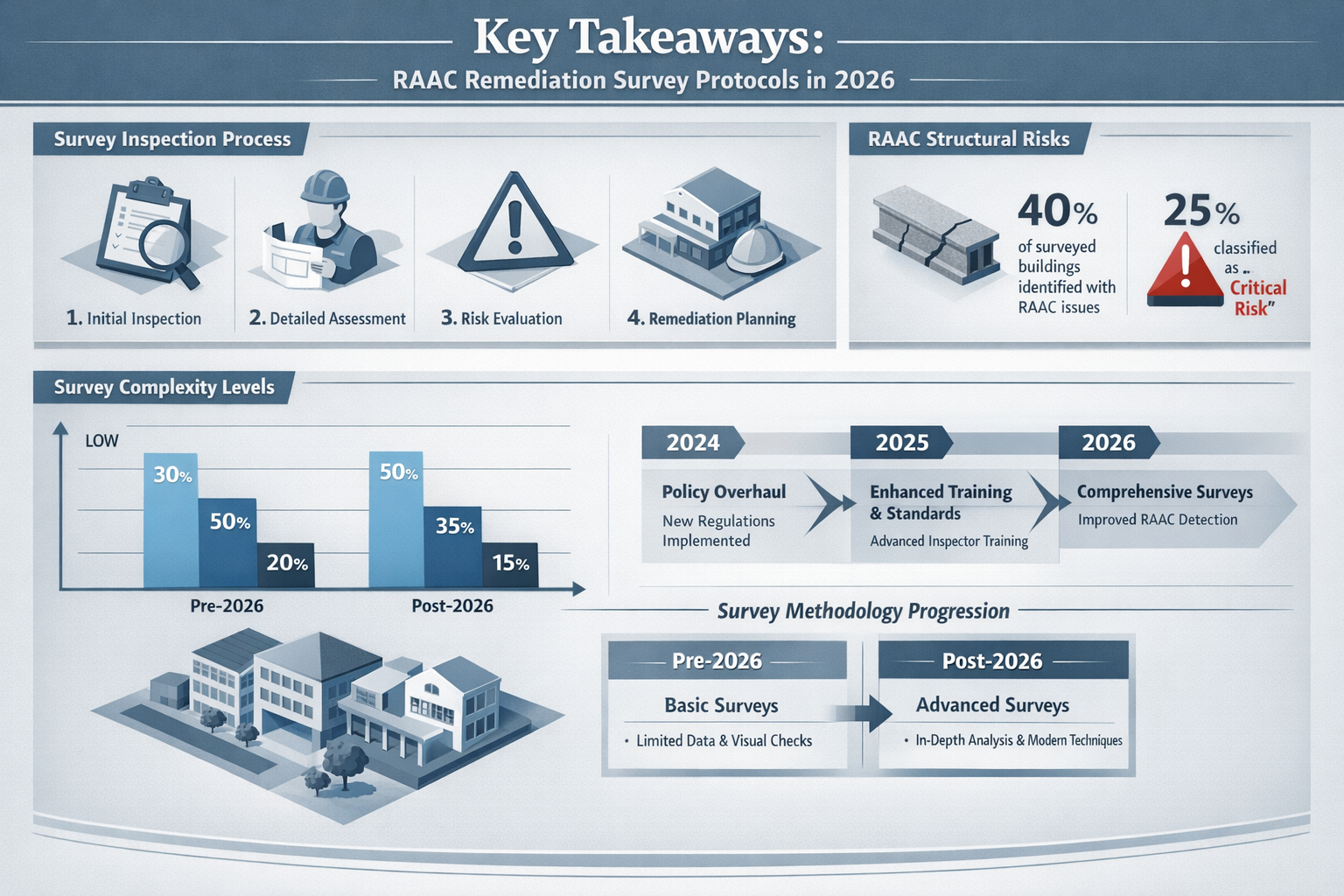
The UK government has established clear removal timelines that directly impact survey priorities and property valuations. The government has pledged to eliminate RAAC from NHS estates by 2035 and from all affected schools ahead of the 2029 general election. [1] These commitments create urgency for comprehensive building surveys across affected sectors.
NHS Hospital Remediation Milestones
As of March 2026, significant progress has been achieved in healthcare facilities. Twelve NHS hospitals are on track to complete RAAC removal by the end of March 2026, building on the progress of seven additional hospitals that eradicated RAAC in 2025 with up to £440 million in government funding support. [1] This accelerated timeline demonstrates both the scale of investment required and the technical complexity of remediation projects.
For surveyors conducting structural engineering assessments, these hospital projects provide valuable case studies in systematic RAAC removal, temporary propping requirements, and phased remediation strategies that minimize operational disruption.
School Sector Progress
The education sector has seen notable achievements in RAAC elimination. RAAC has been permanently removed from 62 schools as of September 2025, with the government targeting elimination from all 237 affected schools and colleges in England; over 42,000 pupils are now learning in RAAC-free classrooms. [1] This progress illustrates the feasibility of complete removal when adequate funding and project management resources are deployed.
Key statistics for school remediation:
| Metric | Status (2026) |
|---|---|
| Total affected schools | 237 schools and colleges |
| Schools with RAAC removed | 62 (as of Sept 2025) |
| Pupils in RAAC-free classrooms | 42,000+ |
| Target completion | Before 2029 general election |
| Government funding commitment | Ongoing multi-year program |
RICS Level 3 Survey Protocols: Comprehensive RAAC Assessment Methodology
When conducting RICS building surveys for RAAC identification, surveyors must follow rigorous protocols that exceed standard inspection procedures. Building Survey Protocols for RAAC Remediation in 2026: Level 3 Insights Post-Reform require multi-stage assessment processes combining visual inspection, technical analysis, and risk classification.
Standard Assessment Timeline
Building surveys for RAAC identification typically follow a 3-week options appraisal period, which includes structural assessment and site condition analysis with stakeholder engagement to determine priorities. [2] This timeline breaks down into distinct phases:
- Initial site inspection (1-2 days): Physical examination of accessible areas
- Detailed panel assessment (2-3 days): Focused inspection of identified RAAC elements
- Engineering calculations (3-5 days): Structural analysis and load-bearing capacity review
- Report preparation (5-7 days): Comprehensive documentation with recommendations
- Stakeholder consultation (ongoing): Engagement with building owners, occupants, and authorities
Inspection Methodology Standards
Current protocols require inspection of at least 10% of RAAC panels to develop adequate engineering data for risk assessment, with on-site inspection work typically taking 1-2 days followed by calculations and reporting within approximately one week. [2] This sampling approach balances thoroughness with practical constraints, though higher-risk buildings may warrant 100% panel inspection.
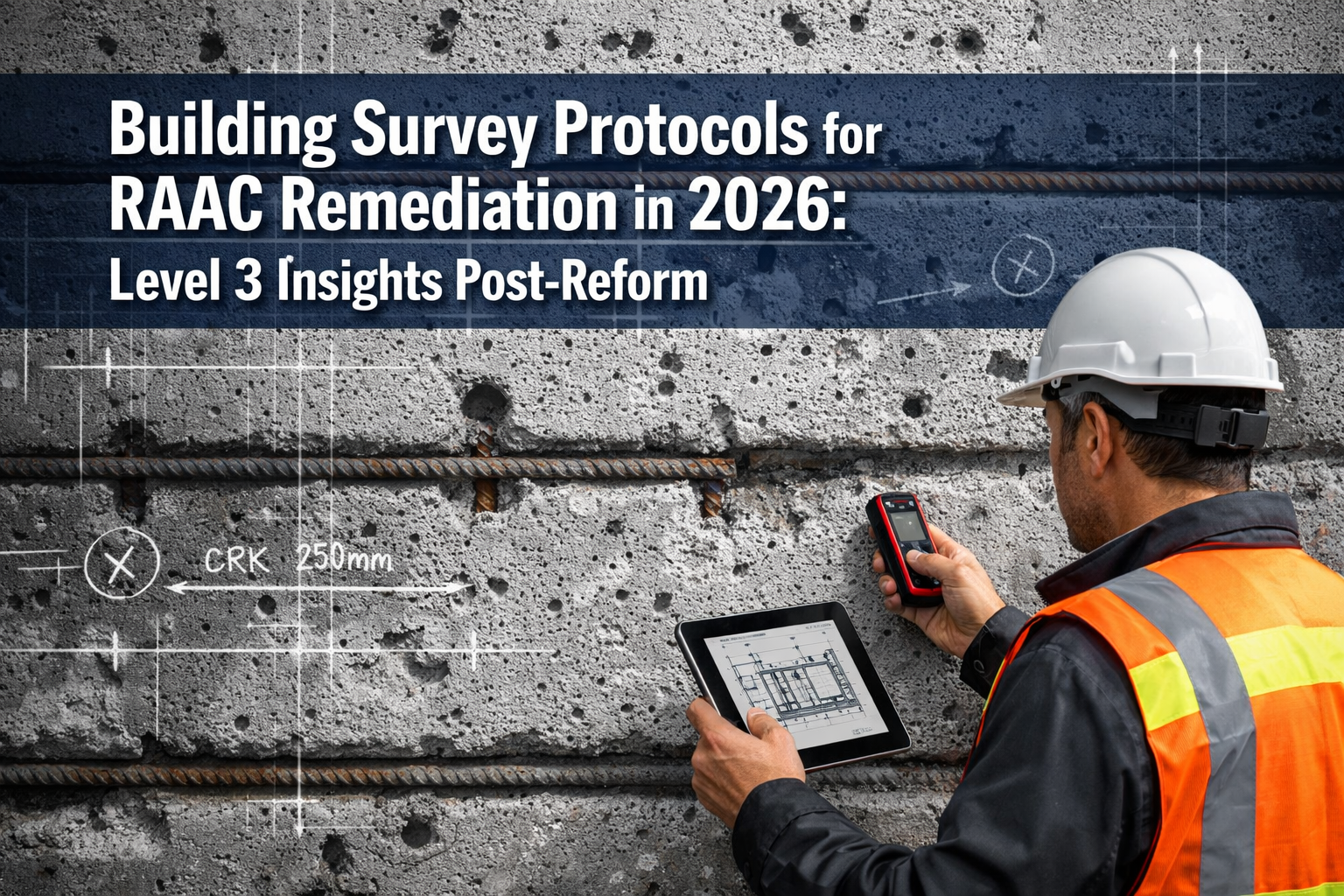
Essential inspection techniques include:
- 🔍 Visual examination: Identifying characteristic RAAC appearance, texture, and panel configurations
- 📏 Dimensional measurement: Recording panel sizes, spans, and bearing conditions
- 💧 Moisture detection: Using thermal imaging and moisture meters to identify water ingress
- 🔨 Non-destructive testing: Employing rebound hammers and ultrasonic equipment to assess concrete quality
- 📸 Photographic documentation: Creating comprehensive visual records of all panels and defects
For properties requiring specific defect reports, RAAC identification demands particular attention to ceiling voids, roof structures, and floor systems where panels are commonly installed.
Risk Classification Framework
Surveyors follow IStructE guidance to determine risk classification, examining for water leaks (past and present), cracking, inadequate bearing lengths, deflections, corrosion, and spalling of concrete. [2] This framework categorizes RAAC into distinct risk levels that determine appropriate remediation responses:
Risk Category 1 – Critical Risk:
- Immediate structural concerns requiring building closure or area restriction
- Visible deflection, significant cracking, or active water ingress
- Corrosion of reinforcement bars or concrete spalling
- Inadequate bearing lengths threatening panel stability
Risk Category 2 – High Risk:
- Evidence of historical water damage with potential ongoing deterioration
- Minor cracking or deflection requiring monitoring
- Panels approaching or exceeding design lifespan
- Inadequate maintenance history or unknown installation details
Risk Category 3 – Medium Risk:
- RAAC present but no immediate defects identified
- Adequate bearing lengths and no visible deterioration
- Requires ongoing monitoring and preventative maintenance
- Remediation planning recommended within 2-5 years
Risk Category 4 – Low Risk:
- RAAC panels in protected environments with minimal exposure
- Comprehensive maintenance records demonstrating good condition
- Regular monitoring protocols already established
- Long-term remediation planning appropriate
Individual RAAC survey reports are typically issued within one week of assessment completion, with immediate notification protocols in place if surveyors identify RAAC presenting an identified risk. [2] This rapid reporting ensures building occupants and owners can take swift action when safety concerns arise.
Financial Implications: Remediation Costs and Property Valuations
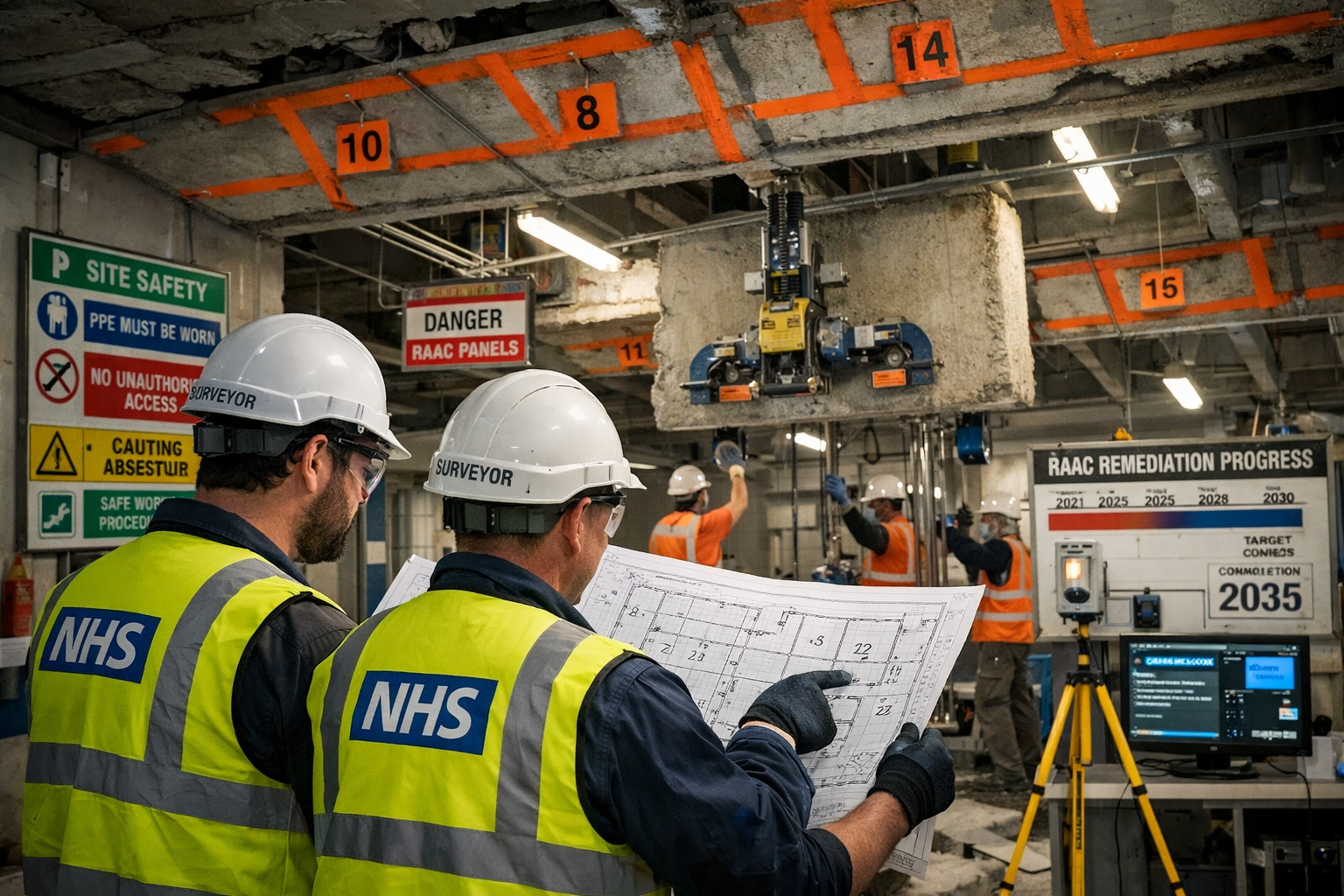
The financial impact of RAAC discovery extends far beyond immediate remediation costs, affecting property valuations, insurance premiums, and long-term ownership liabilities. Understanding these implications is crucial for buyers, sellers, and lenders navigating the 2026 property market.
Residential Property Remediation Costs
RAAC remediation costs can realistically exceed £50,000-£150,000 for residential properties depending on building-specific factors, reflecting the significant financial burden on private property owners. [4] These costs vary based on:
- Extent of RAAC installation: Number and location of affected panels
- Accessibility challenges: Requirement for scaffolding, temporary propping, or occupant relocation
- Structural complexity: Integration with other building elements requiring simultaneous repair
- Regulatory compliance: Building control requirements and safety certifications
- Professional fees: Surveying, structural engineering, project management, and monitoring surveys
For properties requiring comprehensive assessment, engaging chartered building surveyors early in the transaction process helps buyers understand true ownership costs and negotiate appropriate price adjustments.
Legal Limitation Barriers for Private Claims
A significant challenge facing property owners is the limitation on legal recourse. Latent defect liability periods run for 6-15 years depending on claim type, meaning most RAAC installed between the 1960s-1990s is now beyond liability limitation periods, requiring remediation to rely on public sector grants or self-funding rather than legal claims. [1]
This legal reality creates particular challenges for:
- Residential property owners: Limited options for cost recovery from original builders or developers
- Commercial property investors: Unexpected capital expenditure impacting investment returns
- Leaseholders: Disputes over responsibility allocation between landlords and tenants
- Social housing providers: Balancing tenant safety with constrained budgets
Responsibility Framework for Remediation
Determining who pays for RAAC remediation depends on property ownership structure. For freehold properties, owners are responsible for ensuring building safety; for leaseholders, responsibility depends on lease terms, though significant structural repairs typically fall to landlords unless specifically transferred to tenants. [1]
Responsibility matrix:
| Property Type | Primary Responsibility | Typical Cost Bearer |
|---|---|---|
| Freehold residential | Owner | Owner (self-funded) |
| Leasehold flat | Freeholder/landlord | Service charge (potentially) |
| Commercial lease | Depends on repairing covenant | Landlord or tenant per lease |
| Social housing | Housing provider | Provider (grant-funded) |
| Public buildings | Public body | Government funding |
When commissioning comparing different types of survey, buyers should specifically request RAAC assessment to understand potential future liabilities before completing property purchases.
Case Studies: RAAC Remediation Projects Across UK Property Types
Examining real-world remediation projects provides valuable insights into practical challenges and effective solutions that inform current survey protocols.
Case Study 1: Secondary School Complete Removal (2025-2026)
A secondary school in the Midlands identified RAAC in roof panels across three classroom blocks affecting approximately 400 students. The remediation project involved:
- Initial survey: 3-week comprehensive Level 3 assessment identifying 180 RAAC panels
- Risk classification: Category 1 critical risk due to visible deflection and water staining
- Immediate response: Temporary classroom relocation and structural propping installation
- Remediation approach: Complete panel removal and replacement with traditional concrete beams
- Project duration: 14 months including summer holiday intensive work periods
- Total cost: £2.8 million (government-funded)
- Outcome: Full structural certification and 50-year design life for replacement structure
Key lesson for surveyors: Early identification through routine building surveys could have enabled planned remediation before emergency measures became necessary, reducing disruption and potentially lowering costs through phased work.
Case Study 2: NHS Hospital Phased Remediation (2024-2026)
A district general hospital discovered RAAC in multiple buildings during routine maintenance investigations. The project demonstrated effective phased remediation:
- Survey scope: Hospital-wide assessment across 12 buildings spanning 40 years of construction
- RAAC identification: 450 panels identified in operating theatres, wards, and administrative areas
- Risk-based prioritization: Category 1 areas (operating theatres) addressed first, followed by patient accommodation
- Operational continuity: Phased approach maintained hospital services throughout remediation
- Funding allocation: £18 million over 24-month period from NHS capital budget
- Completion status: On track for March 2026 completion as part of national program
Key lesson for surveyors: Systematic risk-based prioritization enables continued building use during remediation, particularly important for critical infrastructure that cannot be fully vacated.
Case Study 3: Residential Property Discovery (2025)
A Victorian-era home with 1970s extension revealed RAAC during pre-purchase survey, illustrating challenges for private buyers:
- Discovery context: Level 3 building survey identified RAAC panels in flat roof extension
- Extent: 12 panels covering 35 square meters of roof structure
- Risk assessment: Category 2 high risk due to evidence of historical water ingress
- Purchase impact: Buyer negotiated £75,000 price reduction to cover remediation costs
- Remediation timeline: 8-week project during summer months
- Actual costs: £68,000 including structural engineering, removal, replacement, and building control fees
- Outcome: Successful remediation with enhanced property value upon completion
Key lesson for surveyors: Thorough pre-purchase surveys identifying RAAC enable informed negotiation and proper financial planning, protecting buyers from unexpected liabilities.
Post-Reform Survey Requirements: Integration with 2026 Homebuying Reforms
The evolving regulatory landscape in 2026 has elevated the importance of comprehensive building surveys, with RAAC assessment becoming a standard component of property transactions. While specific homebuying reform implementation varies by region, the trend toward mandatory upfront surveys creates new expectations for surveying professionals.
Enhanced Due Diligence Expectations
Buyers, lenders, and conveyancers now routinely expect RAAC-specific commentary within building survey reports. This reflects broader market awareness of the material's risks and the substantial remediation costs involved. Surveyors must explicitly address:
- RAAC presence or absence: Clear statement confirming whether RAAC has been identified
- Inspection limitations: Transparency about areas not accessible during survey
- Recommendation for specialist assessment: Guidance on when further investigation is warranted
- Impact on property value: Commentary on how RAAC affects market valuation
- Insurance implications: Potential effects on building insurance availability and premiums
Integration with Other Survey Priorities
RAAC assessment integrates with broader survey objectives including subsidence surveys, damp investigations, and structural defect identification. Surveyors must balance comprehensive RAAC protocols with other critical building pathology assessments to deliver holistic property evaluations.
Integrated survey checklist for 2026:
✅ RAAC identification in roof structures, floors, and walls
✅ Cladding safety assessment post-Grenfell reforms
✅ Structural movement and subsidence indicators
✅ Damp and moisture ingress pathways
✅ Building services condition and compliance
✅ Energy efficiency and retrofit potential
✅ Planning compliance and building regulation adherence
✅ Access and disability compliance requirements
Regional Variations: RAAC Distribution Across UK Property Markets
RAAC prevalence varies significantly across UK regions, influenced by construction practices, building types, and historical development patterns. Understanding these regional variations helps surveyors target assessment resources effectively.
High-Prevalence Areas
Certain regions show elevated RAAC presence due to specific construction periods and building types:
- Scotland: Higher incidence in residential properties, particularly in developments from the 1970s-1980s
- Southeast England: Significant presence in schools and public buildings constructed during rapid expansion periods
- Northern industrial cities: Commercial and industrial buildings from modernization programs
- New towns: Comprehensive use in rapid development projects including Milton Keynes, Stevenage, and Telford
For properties in these regions, surveyors should maintain heightened awareness during inspections, particularly when examining buildings constructed between 1960-1995.
Building Type Risk Profiles
Different property categories show varying RAAC risk levels:
High Risk:
- Educational facilities (schools, colleges, universities)
- Healthcare buildings (hospitals, clinics, health centres)
- Public buildings (libraries, civic centres, leisure facilities)
- Light industrial units and warehouses
Medium Risk:
- Commercial offices constructed 1960s-1990s
- Retail units with flat roof construction
- Residential extensions and conversions from target period
- Agricultural buildings and farm structures
Lower Risk:
- Traditional residential housing (pre-1960s construction)
- Modern residential developments (post-1995)
- Heritage buildings and listed structures
- Properties with pitched roof construction
Surveyors operating across London, Surrey, Hertfordshire, and other regions should adapt survey protocols based on local building stock characteristics and known RAAC prevalence patterns.
Practical Recommendations: Implementing Effective RAAC Survey Protocols
For surveyors, property professionals, and building owners seeking to implement robust RAAC assessment protocols in 2026, several practical recommendations emerge from current best practices and ongoing remediation projects.
For Chartered Surveyors
Enhance technical competence:
- Complete CPD training on RAAC identification and assessment techniques
- Study IStructE guidance documents and risk classification frameworks
- Develop relationships with structural engineers for specialist support
- Maintain updated knowledge of government remediation programs and funding
Refine survey methodologies:
- Incorporate RAAC-specific checklists into standard Level 3 survey templates
- Invest in appropriate inspection equipment (moisture meters, thermal cameras, measurement tools)
- Develop clear reporting templates that communicate RAAC risks effectively to non-technical clients
- Establish protocols for immediate risk notification when critical defects are identified
Manage professional liability:
- Ensure professional indemnity insurance adequately covers RAAC-related claims
- Document inspection limitations clearly when access restrictions prevent full assessment
- Recommend specialist structural engineering input when RAAC is suspected but not definitively confirmed
- Maintain detailed records of inspection methodology and decision-making processes
For Property Buyers and Owners
Prioritize comprehensive surveys:
- Commission Level 3 building surveys for properties constructed 1960-1995, particularly those with flat roofs or known extensions
- Explicitly request RAAC assessment within survey instructions
- Budget for potential follow-up specialist investigations if RAAC is identified
- Consider survey findings when negotiating purchase prices and timelines
Plan for potential remediation:
- Obtain multiple quotes from specialist contractors if RAAC is confirmed
- Explore available grant funding for eligible property types
- Factor remediation costs into long-term property ownership budgets
- Maintain comprehensive insurance coverage throughout remediation projects
Understand legal responsibilities:
- Review lease terms carefully to understand repair obligations for leasehold properties
- Consult property lawyers regarding responsibility allocation for RAAC remediation
- Document all RAAC-related communications with landlords, managing agents, or tenants
- Consider impact on property saleability and future transaction timelines
For Building Managers and Landlords
Implement proactive assessment programs:
- Commission building-wide RAAC surveys for properties within target construction periods
- Develop risk-based prioritization for multi-building portfolios
- Establish monitoring protocols for identified RAAC pending remediation
- Maintain transparent communication with occupants regarding RAAC status and remediation plans
Prepare financial strategies:
- Develop multi-year capital expenditure plans incorporating potential remediation costs
- Explore available government funding programs and grant opportunities
- Consider insurance implications and premium adjustments related to RAAC presence
- Evaluate impact on property valuations and investment returns
Future Outlook: RAAC Remediation Beyond 2026
As remediation programs progress toward government-mandated completion dates, the property surveying profession continues adapting to evolving challenges and emerging best practices.
Anticipated Developments
Technology integration:
- Increased use of drone surveys for roof-level RAAC inspection
- Advanced thermal imaging and moisture detection technologies
- Digital twin modeling for remediation planning and monitoring
- AI-assisted RAAC identification from photographic evidence
Regulatory evolution:
- Potential mandatory RAAC disclosure requirements in property transactions
- Enhanced building control oversight for remediation projects
- Standardized certification frameworks for RAAC-free buildings
- Integration with broader building safety reforms post-Grenfell
Market adaptation:
- Development of specialist RAAC remediation insurance products
- Emergence of standardized remediation cost benchmarks
- Enhanced transparency in property listings regarding RAAC status
- Refinement of valuation methodologies accounting for RAAC presence
Long-Term Implications
The RAAC crisis has fundamentally altered awareness of latent defects in UK building stock. This heightened consciousness will likely persist beyond complete remediation, influencing:
- Survey standards: Permanent elevation of inspection thoroughness expectations
- Construction practices: Enhanced scrutiny of modern materials and long-term durability
- Regulatory frameworks: Stricter oversight of building material approvals and monitoring
- Professional liability: Increased expectations for defect identification and risk communication
Conclusion: Navigating RAAC Challenges Through Comprehensive Survey Protocols
Building Survey Protocols for RAAC Remediation in 2026: Level 3 Insights Post-Reform represent a critical evolution in property surveying practice, responding to one of the most significant structural challenges facing UK buildings in recent decades. With government removal timelines now firmly established—NHS estates by 2035 and schools ahead of the 2029 general election—the urgency of comprehensive RAAC assessment cannot be overstated.
The financial implications are substantial, with residential remediation costs realistically ranging from £50,000-£150,000, creating significant impacts on property valuations and transaction dynamics. The legal limitation barriers preventing most historical claims mean property owners must plan for self-funded or grant-supported remediation rather than cost recovery through litigation.
For surveyors, the integration of rigorous RAAC assessment protocols within Level 3 building surveys has become standard practice in 2026. Following IStructE guidance to examine water leaks, cracking, bearing lengths, deflections, corrosion, and concrete spalling enables accurate risk classification that protects building occupants and informs remediation planning. The requirement to inspect at least 10% of RAAC panels, combined with comprehensive reporting within one week of assessment completion, establishes clear professional standards that balance thoroughness with practical timelines.
Actionable Next Steps
For property buyers:
- Commission comprehensive RICS Level 3 building surveys for properties constructed 1960-1995
- Explicitly request RAAC assessment within survey instructions
- Budget for potential remediation costs when evaluating purchase decisions
- Negotiate appropriate price adjustments if RAAC is identified
For building owners:
- Arrange proactive RAAC surveys for properties within target construction periods
- Develop risk-based remediation plans aligned with government timelines
- Explore available grant funding and financial support programs
- Maintain transparent communication with occupants and stakeholders
For property professionals:
- Enhance technical competence through specialized RAAC training and CPD
- Refine survey methodologies to incorporate comprehensive RAAC protocols
- Develop clear reporting frameworks that communicate risks effectively
- Stay informed about evolving government programs and regulatory requirements
The RAAC challenge underscores the vital importance of thorough building surveys in protecting property buyers, occupants, and owners from unexpected structural risks. By implementing robust assessment protocols, maintaining professional standards, and communicating findings clearly, chartered surveyors play an essential role in navigating this complex building pathology challenge throughout 2026 and beyond.
For expert RAAC assessment and comprehensive building surveys, contact qualified RICS chartered surveyors who understand the specialized protocols required for effective identification and risk evaluation in 2026's evolving property landscape.
References
[1] Reinforced Autoclaved Aerated Concrete Raac – https://www.brownejacobson.com/insights/2026-horizon-scanning-in-construction/reinforced-autoclaved-aerated-concrete-raac
[2] Faqs – https://rcs-services.co.uk/faqs
[3] Raac Advice And Faqs – https://www.rics.org/news-insights/current-topics-campaigns/raac-advice-and-faqs
[4] Building Survey Priorities In 2026 Market Recovery Raac Cladding And Latent Defects For Stabilising Prices – https://nottinghillsurveyors.com/blog/building-survey-priorities-in-2026-market-recovery-raac-cladding-and-latent-defects-for-stabilising-prices