Nearly half of all party wall disputes that reach a formal award stage do so because the adjoining owner, the neighbour affected by the works, was unsure of their rights and ended up either paying fees they should not have, or missing costs they could have recovered. Understanding party wall surveyor fees for adjoining owners, who pays, what is recoverable and how to control cost is not just a matter of saving money; it directly shapes how well the statutory process protects you.
The Party Wall etc. Act 1996 sets out a clear framework, but the fee rules within it are widely misunderstood by both homeowners and, occasionally, by less experienced practitioners [1].
Key Takeaways
- As a general rule, the building owner (the one carrying out the works) pays the adjoining owner's surveyor fees.
- That rule is not absolute, cost can shift where the adjoining owner's own actions or requests drive up expense.
- An agreed surveyor appointment is the most reliable way to reduce total fees without losing statutory protection.
- Fees must be "reasonable" under the Act; there is no statutory cap, but surveyors can be challenged on excessive charges.
- Scope creep, surveyors expanding the instruction beyond what the Act requires, is the single biggest driver of inflated bills.
How the Party Wall etc. Act 1996 Allocates Fees
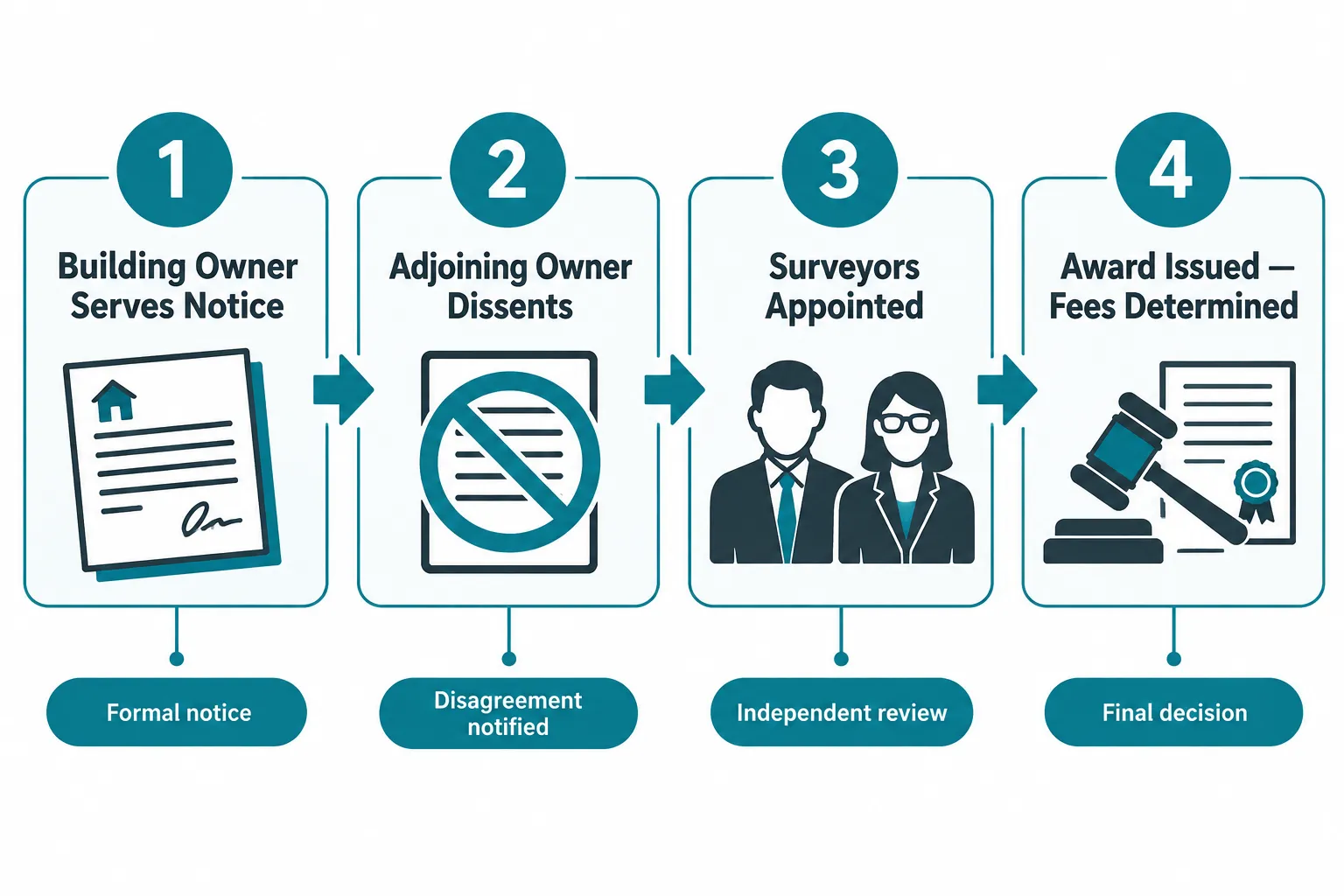
The starting point is section 10(13) of the Party Wall etc. Act 1996, which gives surveyors the power to determine by whom and in what proportion their fees are to be paid [3]. In practice, the default position across English and Welsh case law and professional guidance is that the building owner pays the reasonable fees of the adjoining owner's surveyor [1].
The rationale is straightforward: the building owner has chosen to carry out works that trigger the Act. The adjoining owner has not chosen to be involved and should not be financially penalised for asserting their statutory rights [2].
This default applies in the most common scenarios:
- Loft conversions affecting the party wall (see our guide on loft conversions and party wall obligations)
- Rear extensions requiring a party wall notice
- Excavations near the boundary (covered in detail in our excavation notice for party wall guide)
- Structural alterations to a shared wall
The building owner's surveyor and the adjoining owner's surveyor jointly produce the party wall award. The building owner pays for that process in its entirety unless the surveyors determine otherwise in the award itself [1].
When the Adjoining Owner May Have to Contribute
There are recognised exceptions where some or all of the adjoining owner's costs may fall to them:
-
The adjoining owner requests additional works for their own benefit. If the adjoining owner asks the building owner to carry out remedial or improvement works to the party wall that go beyond what the building owner originally proposed, the cost of those extras, including any additional surveyor time, can be apportioned to the adjoining owner [1][3].
-
The adjoining owner's unreasonable conduct inflates costs. Where an adjoining owner refuses to engage, delays inspections without cause, or raises objections that have no merit under the Act, surveyors may reflect this in the fee award.
-
Shared repair or maintenance works. Where both owners have a shared obligation to repair a party wall, for example, where both sides have contributed to deterioration, costs may be split proportionately [1].
-
The adjoining owner appoints a surveyor who charges disproportionately. The building owner is only obliged to meet "reasonable" fees. An adjoining owner who instructs a surveyor charging significantly above market rates may find the building owner challenges the award, and any excess falls to the adjoining owner themselves.
What Costs Are Recoverable: The Scope of "Reasonable Fees"

The Act does not define "reasonable fees" with a fixed figure. RICS guidance and professional practice treat reasonableness as a function of the complexity of the works, the time genuinely required, and the rates charged by competent surveyors in the relevant market [2][5].
Typical Fee Ranges in 2026
The table below reflects current market practice. These are indicative ranges only; actual fees depend on location, complexity and the surveyor instructed.
| Instruction Type | Typical Fee Range (2026) |
|---|---|
| Adjoining owner's surveyor, straightforward works | £700, £1,200 |
| Adjoining owner's surveyor, moderate complexity | £1,200, £2,000 |
| Third surveyor referral fee | £500, £1,500 per referral |
| Schedule of condition (standalone) | £300, £700 |
Sources: RICS consumer guidance [2] and market practice data [6][7].
What Is Recoverable
The following are generally recoverable from the building owner:
- The adjoining owner's surveyor's fee for reviewing the notice and draft award
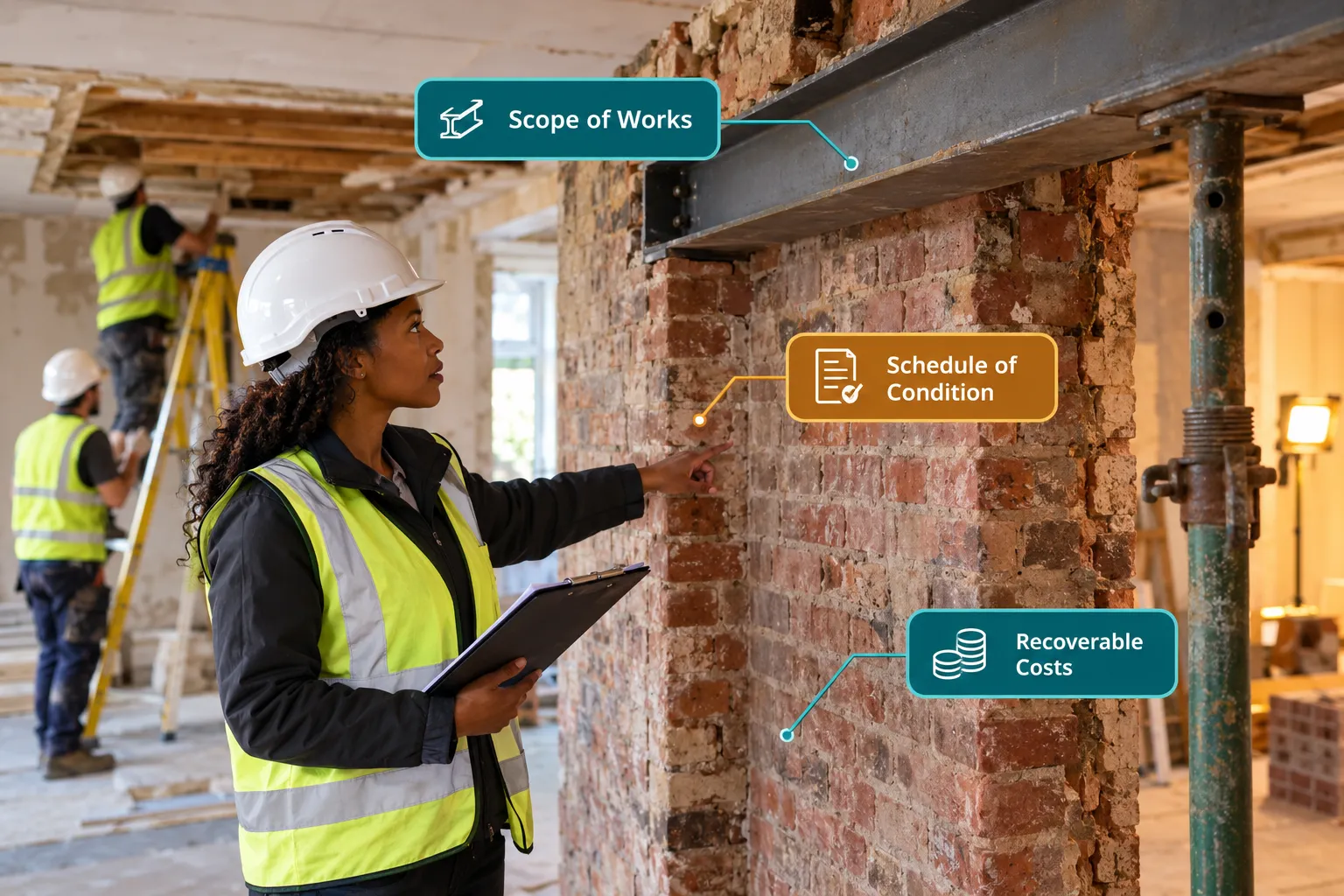
- Attendance at the property to prepare or review a schedule of condition
- Correspondence and negotiation with the building owner's surveyor
- Preparation and service of the party wall award
- Post-award inspections during the works (where proportionate)
What Is Not Recoverable
- Legal advice obtained by the adjoining owner (unless the award specifically provides for it, which is rare)
- Costs arising from the adjoining owner's own delay or non-cooperation
- Fees for works or investigations entirely outside the Act's scope
- Any premium above a reasonable market rate
For a broader view of how surveyor costs are structured across different instruction types, the building survey cost guide provides useful context on market rates.
Controlling Cost: Practical Strategies for Adjoining Owners
The most effective cost-control tool available under the Act is the agreed surveyor appointment. Under section 10(1)(b), both the building owner and the adjoining owner may jointly appoint a single surveyor to act for both parties [3]. This is distinct from the building owner's surveyor acting alone, the agreed surveyor must be genuinely independent and acceptable to both sides.
Agreed Surveyor: Pros and Cons
| Factor | Agreed Surveyor | Separate Surveyors |
|---|---|---|
| Total cost | Lower, one fee | Higher, two fees |
| Impartiality | Single professional, must be neutral | Each surveyor advocates for their client |
| Speed | Generally faster | Can be slower if surveyors disagree |
| Third surveyor risk | No third surveyor needed unless agreed surveyor is replaced | Third surveyor may be needed to resolve disputes |
| Suitable for | Straightforward, low-risk works | Complex works or where adjoining owner has significant concerns |
For straightforward works, a standard rear extension or a loft conversion with no unusual structural elements, an agreed surveyor is often the most sensible approach. Both parties pay less, and the award is produced more quickly.
For more complex matters, or where the adjoining owner has genuine concerns about damage or structural risk, appointing a separate surveyor provides a dedicated advocate. The cost is higher, but the protection is greater.
Avoiding Scope Creep
Scope creep, where a surveyor's instruction expands well beyond what the Act requires, is the primary driver of unexpectedly high bills. Common examples include:
- Commissioning structural engineering reports that are not necessary for the award
- Conducting multiple site visits when one or two would suffice
- Raising extensive legal arguments in correspondence that belong in a courtroom, not a party wall process
- Producing schedules of condition that cover parts of the property entirely unaffected by the notifiable works
Adjoining owners should ask their surveyor at the outset to confirm the scope of the instruction in writing, the likely number of site visits, and the basis on which fees will be charged (hourly rate or fixed fee). This is not adversarial; it is good professional practice.
The party wall award guidance page sets out what a properly scoped award should contain, which gives adjoining owners a useful benchmark.
Challenging Unreasonable Fees
If the building owner considers the adjoining owner's surveyor's fees to be unreasonable, the matter can be referred to the third surveyor under section 10(11) of the Act [3]. The third surveyor, selected from a list agreed at the start of the process, makes a binding determination on the fee dispute.
This is a genuine safeguard, but it adds cost and time. Both parties are better served by transparent fee agreements at the outset.
The party wall disputes: who pays surveyor fees page covers the dispute resolution mechanics in more detail.
Adjoining Owner Rights and the Fee Framework
Understanding fee liability sits within the broader context of adjoining owner rights under the Party Wall Act. The Act gives adjoining owners the right to dissent from a notice and trigger the formal surveyor process, and that right is only meaningful if exercising it does not create a financial burden on the adjoining owner.
The government's explanatory booklet confirms this principle: the building owner is responsible for the costs of the party wall process they have initiated [1]. RICS consumer guidance reinforces it [2].
One practical point that is often overlooked: an adjoining owner who consents to a notice without appointing a surveyor gives up the right to a formal schedule of condition and a binding award. If damage occurs during the works, proving the building owner's liability becomes significantly harder without a pre-works condition record. The small cost of a surveyor at the outset is almost always justified.
For works involving party wall consent and the decision whether to consent or dissent, the implications for fee liability are worth understanding before responding to any notice.
Frequently Asked Questions
Does the adjoining owner ever pay their own surveyor's fees?
Rarely, but it can happen. The most common situation is where the adjoining owner's own requests or conduct have driven up costs beyond what the works themselves required. The award will set out who pays what [1][3].
Can the building owner refuse to pay the adjoining owner's surveyor?
The building owner cannot simply refuse. Fees are determined in the award, which is a binding legal document. Non-payment can be enforced through the courts [3].
What if the adjoining owner's surveyor charges more than the market rate?
The building owner can refer the fee to the third surveyor for determination. Only the "reasonable" portion of the fee is recoverable from the building owner [2][5].
Is there a cap on party wall surveyor fees?
No statutory cap exists. RICS guidance and the "reasonableness" test under the Act are the operative controls [2][5]. As of 2026, no legislative reform introducing fee caps has been enacted, though professional bodies continue to encourage transparency in fee-setting.
What is a schedule of condition and who pays for it?
A schedule of condition is a photographic and written record of the adjoining owner's property before works begin. It is a standard part of the party wall process and its cost is recoverable from the building owner as part of the surveyor's fee [1][7].
Can the adjoining owner instruct a solicitor and recover those costs?
Generally no. Legal costs are not recoverable through the party wall process unless the award specifically provides for them, which is unusual. The Act is designed to be a self-contained, surveyor-led process [1][3].
What happens if the building owner simply starts work without serving a notice?
This is a civil wrong. The adjoining owner can seek an injunction and claim damages. In that scenario, the building owner may face far higher costs than the party wall process would have generated. See our serving a party wall notice guide for the risks of non-compliance.
Conclusion
The fee framework under the Party Wall etc. Act 1996 is designed to protect adjoining owners from bearing the cost of a process they did not choose to enter. As a default, the building owner pays, and that default holds in the vast majority of cases.
Where costs do shift, it is almost always because of something the adjoining owner or their surveyor has done to inflate the instruction beyond its proper scope. The practical steps to avoid this are clear: appoint a surveyor with a defined, written scope; consider an agreed surveyor for straightforward works; and engage promptly and cooperatively with the process.
If you receive a party wall notice, the party wall FAQ is a useful first reference. If you have concerns about the works proposed, appointing your own RICS-registered surveyor early, before the award is drafted, gives you the strongest position both on protection and on cost control.
The Act exists to allow building owners to carry out legitimate works while protecting neighbours. Used properly, it does exactly that, and the fee structure reflects that balance.
References
[1] The Party Wall Etc Act 1996 Explanatory Booklet – gov.uk
[2] Party Walls – rics.org
[3] Party Wall etc. Act 1996 – legislation.gov.uk
[4] Party Walls Consumer Guide 2022 – rics.org
[5] Party Wall Legislation and Procedure 7th Edition – rics.org
[6] Party Wall Surveyor Cost – hoa.org.uk
[7] Who Pays For A Party Wall Surveyor – ansteyhorne.co.uk
[8] If You Can't Agree – gov.uk
[9] Who Pays The Party Wall Surveyor Fees: A Guide For Building And Adjoining Owners – tpwp.co.uk
[10] Adjoining Owner Information – stokemont.com