Roughly one in three party wall disputes in the UK stems not from a disagreement about the building work itself, but from a notice that was served late, addressed to the wrong person, or drafted on an informal letter rather than a proper statutory form. With GOV.UK guidance pages updated in August 2026, there has never been a clearer moment to understand exactly what the law requires, and what happens when those requirements are ignored. This guide covers everything property owners, developers, and their advisers need to know about serving a party wall notice in 2026: updated timelines, common mistakes and legal risks included.
Key Takeaways
- Statutory notice periods have not changed in 2026, but updated GOV.UK guidance re-emphasises the precise timelines: one month for Section 1 and Section 6 works, two months for Section 2 party structure works.
- A neighbour who does not respond within 14 days is legally treated as having dissented, triggering the surveyor appointment process automatically.
- Notices must be served on all adjoining owners, including leaseholders with more than 12 months remaining on their lease, missing even one recipient can invalidate the process.
- Using an informal letter instead of a properly structured notice is one of the most common and costly errors identified in 2026 professional guidance.
- Proceeding with notifiable works without a valid award or written consent exposes the building owner to injunctions, damages claims, and project delays.
What the Party Wall Etc Act 1996 Actually Requires
The Party Wall Etc Act 1996 remains the governing statute for all party wall matters in England and Wales [8]. It places a legal duty on any building owner who intends to carry out certain types of work to notify affected neighbours, referred to as "adjoining owners", before work begins. The Act distinguishes between three categories of work, each with its own notice type and minimum notice period.
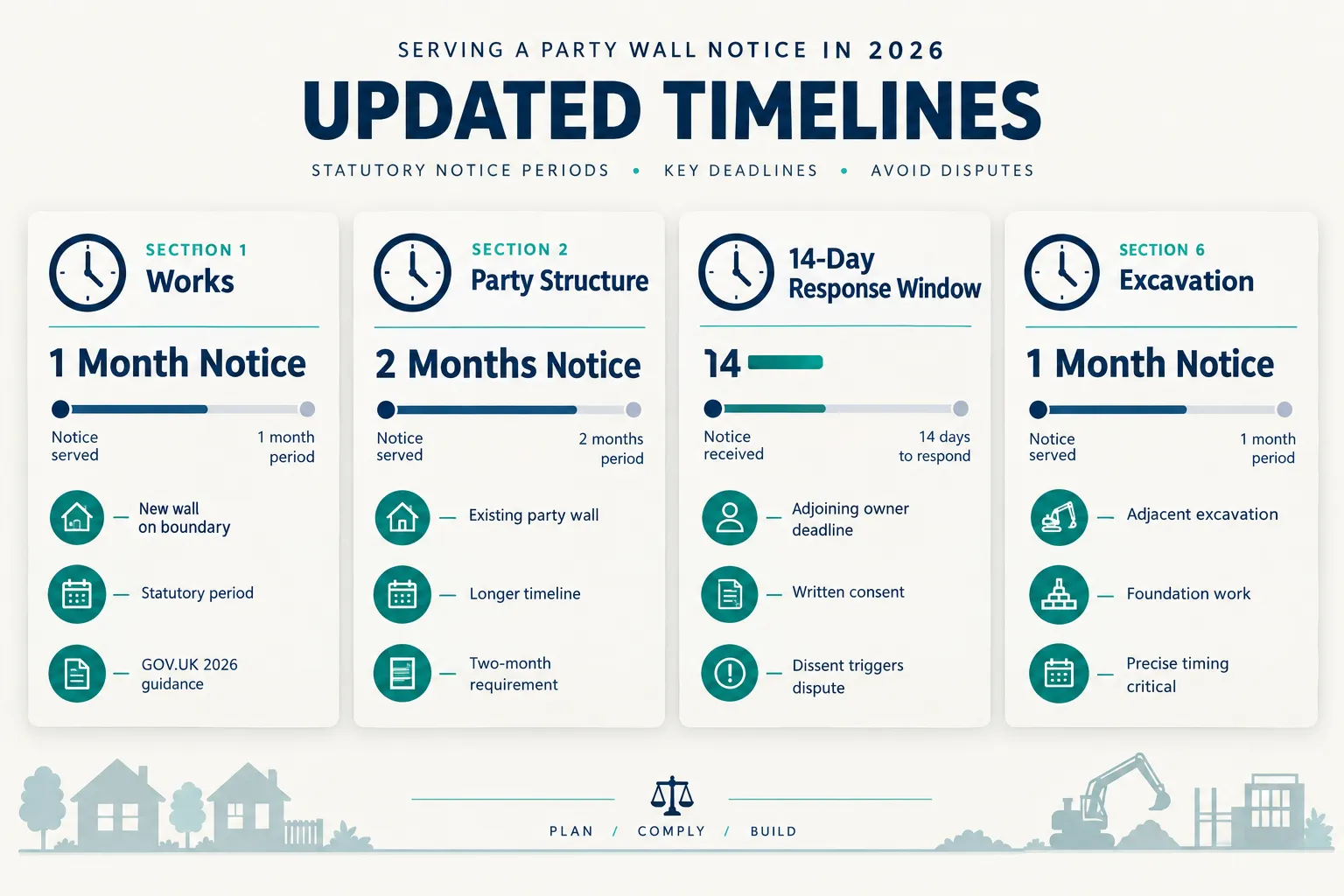
The three notice types and their timelines are:
| Notice Type | Relevant Section | Minimum Notice Period | Typical Trigger |
|---|---|---|---|
| Party Structure Notice | Section 2 | 2 months | Work to an existing party wall or floor |
| Line of Junction Notice | Section 1 | 1 month | New wall at or astride the boundary |
| Adjacent Excavation Notice | Section 6 | 1 month | Excavation within 3 m or 6 m of neighbour's foundations |
These timelines are not suggestions. They are statutory minimums, and the 2026 GOV.UK guidance update re-emphasises that the clock starts from the date the notice is received by the adjoining owner, not the date it is sent [1]. A notice posted on the last possible day, which then takes two or three days to arrive, can render an entire project programme invalid.
The Act also specifies that a notice must remain valid for a maximum of 12 months. If work does not begin within that window, a fresh notice must be served [10]. This is a detail that catches many homeowners off guard when projects are delayed by planning permission processes or contractor availability.
Updated 2026 Timelines: What Has Changed and What Has Not
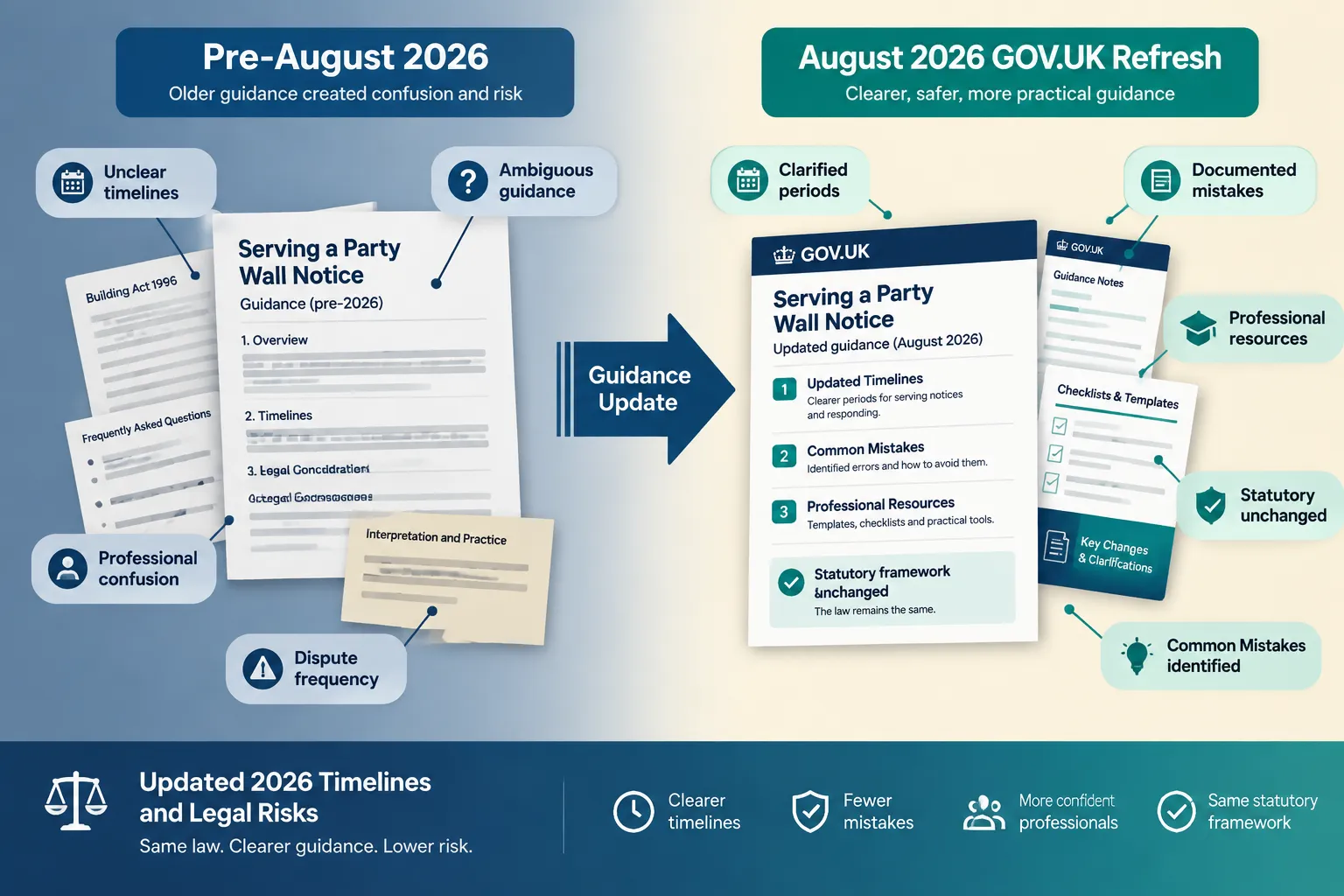
Serving a party wall notice in 2026 involves timelines, common mistakes and legal risks that are now more clearly documented than at any previous point. The statutory periods themselves are unchanged, but the August 2026 GOV.UK guidance refresh has clarified several areas of ambiguity that previously led to disputes.
What remains the same:
- Two months' minimum notice for Section 2 party structure work [1][10]
- One month's minimum notice for Section 1 line of junction work [3]
- One month's minimum notice for Section 6 excavation work [3]
- The 14-day window for an adjoining owner to respond with consent or dissent [4]
What the 2026 guidance clarifies:
The updated practice guides now explicitly address how notice periods interact with project planning sequences. For example, a building owner planning a loft conversion that involves both Section 2 work to an existing party wall and Section 6 excavation for new foundations must serve both notice types simultaneously, and the longer two-month period governs the overall start date. The guidance also clarifies that the notice period cannot be shortened by mutual agreement in writing, a common misconception among homeowners who believe a friendly neighbour can simply waive the statutory period [5].
The 2026 guidance also reinforces that a notice served before planning permission is granted is still valid, provided work begins within the 12-month validity window [3]. This allows building owners to run the party wall process in parallel with the planning process, avoiding unnecessary delays.
"The notice period exists to give adjoining owners a genuine opportunity to consider the works and seek independent advice, it is not a formality that can be compressed or bypassed.", GOV.UK Explanatory Booklet [10]
Common Mistakes When Serving Party Wall Notices in 2026
The most damaging errors in party wall practice are almost always procedural rather than technical. The 2026 professional and homeowner guidance identifies a consistent set of mistakes that derail projects and generate legal disputes [5][6].
Failing to Identify All Adjoining Owners
The Act requires notice to be served on every "adjoining owner," a term that is broader than most people assume. It includes:
- The freeholder of any adjoining property
- Any leaseholder with more than 12 months remaining on their lease at the time the notice is served [5][3]
- Mortgagees in possession, where applicable
Missing a leaseholder, particularly in a converted Victorian terrace where the ground-floor flat is leasehold, is one of the most common errors. If a leaseholder with sufficient tenure is not served, the notice is defective, the surveyor appointment may be challenged, and any award issued could be unenforceable. The building owner may then face an injunction stopping work entirely.
Practical fix: Before serving any notice, obtain official copies of the title register from HM Land Registry for every adjoining property. This will reveal all registered interests and confirm who must be served.
Using an Informal or Incomplete Letter
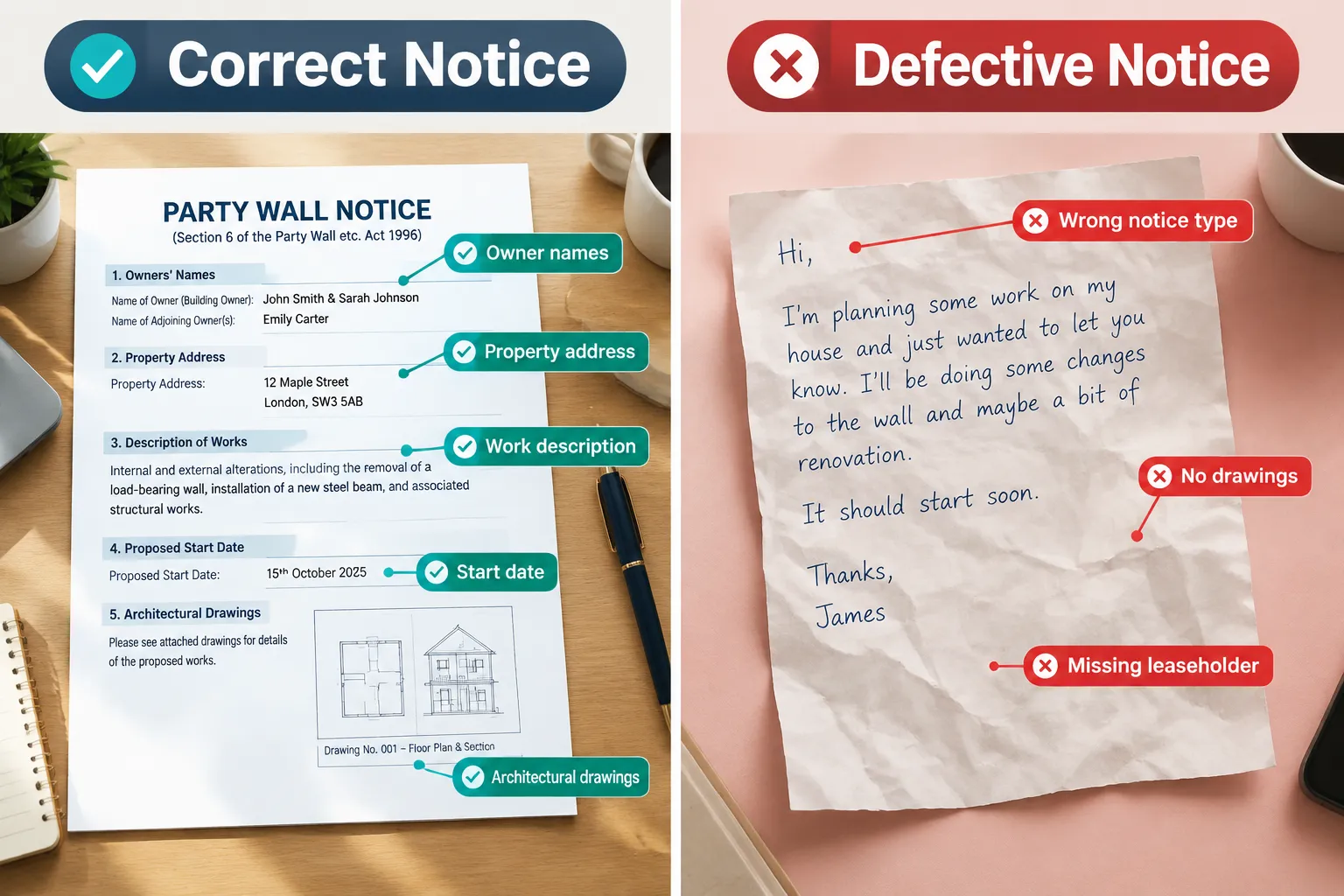
The Act does not prescribe a single mandatory form, but it does specify the information that a valid notice must contain [10]:
- The building owner's full name and address
- The adjoining owner's full name and address
- A clear description of the proposed works
- Relevant drawings or plans
- The proposed start date
An informal letter, even a polite, detailed one, that omits any of these elements is not a valid notice under the Act [5][6]. In 2026, professional guidance strongly recommends using a structured template that mirrors the requirements set out in the GOV.UK explanatory booklet, rather than drafting a notice from scratch [10].
Serving the Wrong Type of Notice
Serving a Section 1 line of junction notice when the work actually involves cutting into an existing party wall (which requires a Section 2 party structure notice) is a fundamental error. The two notices carry different legal rights and obligations. An adjoining owner served with the wrong notice type has not been properly informed of the works, and any subsequent award may be challenged [3].
Similarly, serving only a party structure notice when excavation works also fall within the Section 6 three-metre or six-metre zones means the building owner has no legal authority to carry out the excavation element of the project [3].
Practical fix: Map every element of the proposed works against the three sections of the Act before serving any notice. Where works engage more than one section, serve all relevant notice types simultaneously.
Miscalculating the Notice Period
The notice period is calculated in calendar months, not working days or weeks. One month from 31 January is 28 February (or 29 February in a leap year), not 31 days later. Two months from 30 November is 30 January. These distinctions matter when a project start date is tightly programmed [3].
A further miscalculation error occurs when building owners count from the date they post the notice rather than the date it is received. First-class post is generally assumed to arrive the following business day, but recorded delivery provides proof of receipt, which is strongly recommended in 2026 guidance [1].
Treating Non-Response as Consent
Perhaps the most legally dangerous mistake of all: assuming that a neighbour who does not reply within 14 days has consented to the works. The opposite is true. Under the Act, non-response is treated as dissent, which triggers the dispute resolution procedure and requires the appointment of a surveyor or surveyors [5][4].
Building owners who proceed with notifiable works after a neighbour fails to respond, without appointing surveyors and obtaining a party wall award, are acting unlawfully. They expose themselves to injunctions, claims for damages, and the cost of undoing completed work.
The 14-Day Response Window and Dispute Resolution
Once a valid notice is served, the adjoining owner has 14 days to respond in writing. There are three possible outcomes:
- Written consent, the adjoining owner agrees to the works. The building owner may proceed, though it is advisable to record the consent formally.
- Written dissent, a dispute is deemed to have arisen. Surveyors must be appointed to draw up a party wall award.
- No response, legally equivalent to dissent. The same surveyor appointment process applies [4][10].
The surveyor appointment process involves either an agreed surveyor (appointed jointly by both parties) or two separate surveyors (one appointed by each party), who may then appoint a third surveyor to resolve any deadlock. The resulting party wall award sets out the rights and responsibilities of each party, the manner in which works are to be carried out, and any protective measures for the adjoining property [4].
The 2026 guidance emphasises that the agreed surveyor route is generally faster and less expensive, but both parties must genuinely consent to the appointment. A building owner cannot appoint an agreed surveyor unilaterally [7].
Legal Risks of Getting It Wrong
The legal consequences of a defective or missing party wall notice are serious and well-documented in case law and statutory guidance [8][10].
Key legal risks include:
- Injunctions: An adjoining owner can apply to the county court for an injunction to stop notifiable works that have begun without a valid notice or award. Courts have granted such injunctions even where significant work has already been completed.
- Damages: If an adjoining owner suffers loss, structural damage, disruption, or diminution in property value, as a result of works carried out without proper authority, the building owner is liable for damages.
- Cost of reinstatement: In extreme cases, courts have ordered building owners to undo completed work and restore the adjoining property to its original condition.
- Surveyor costs: Where a building owner's failure to serve a valid notice forces an adjoining owner to seek legal advice or appoint a surveyor defensively, the building owner may be ordered to pay those costs [4].
- Project delays: Even where no injunction is sought, a dispute arising from a defective notice can add weeks or months to a project programme while the surveyor process runs its course.
The 2026 guidance is explicit: there is no shortcut around the Act, and the cost of getting it right at the outset is always lower than the cost of resolving a dispute after work has begun [5][10].
Practical Steps for Serving a Valid Notice in 2026
The following checklist reflects current best practice as set out in the 2026 GOV.UK guidance and professional resources:
- Identify all notifiable works, review the project against Sections 1, 2, and 6 of the Act to determine which notice types apply.
- Identify all adjoining owners, obtain official title register copies for every affected property and confirm all freeholders and qualifying leaseholders.
- Prepare a properly structured notice, include all required information: names, addresses, description of works, drawings, and proposed start date.
- Serve the notice with proof of delivery, use recorded delivery or personal service, and retain proof of the date of receipt.
- Calculate the notice period correctly, count calendar months from the date of receipt, not the date of posting.
- Wait for the response window to expire, do not assume consent if no response is received within 14 days; treat non-response as dissent.
- Appoint surveyors if required, if dissent is received or assumed, appoint surveyors promptly to avoid further delays.
- Do not begin notifiable works until a valid award or written consent is in place [1][5][10].
Conclusion
Serving a party wall notice in 2026, with its updated timelines, common mistakes and legal risks now more clearly documented than ever, is a process that rewards careful preparation and penalises shortcuts. The statutory framework has not changed, but the August 2026 GOV.UK guidance update has removed many of the grey areas that previously allowed errors to go unchallenged.
The most important actions any building owner can take are straightforward: identify every adjoining owner correctly, use a properly structured notice, serve it with proof of delivery, and respect the statutory timelines without exception. If a neighbour does not respond within 14 days, appoint surveyors immediately rather than assuming consent.
For complex projects involving multiple sections of the Act, or where the relationship with a neighbour is uncertain, engaging a qualified party wall surveyor before serving any notice is money well spent. The cost of professional advice at the outset is a fraction of the cost of an injunction, a damages claim, or a project brought to a standstill by a defective notice.
The law is clear, the guidance is current, and the risks of non-compliance are real. Act accordingly.
References
[1] When How Tell Them – gov.uk
[2] Building Regulations Divisional Circular Letters – gov.uk
[3] Uk Party Wall Agreement Guide 2026 – calchub.uk
[4] Preventing And Resolving Disputes In Relation To Party Walls – gov.uk
[5] Party Wall Agreement Uk 2026 – pg-construction.co.uk
[6] Party Wall Agreement – hoa.org.uk
[7] Rics 8th Edition Party Wall Guidance – hudsonpartywallsurveyors.co.uk
[8] legislation.gov.uk – legislation.gov.uk
[9] Building Regulations Circulars – gov.uk
[10] The Party Wall Etc Act 1996 Explanatory Booklet – gov.uk