The buy-to-let market in 2026 presents a complex landscape where professional landlords must navigate heightened tax burdens, evolving compliance requirements, and tightening lending criteria. Despite these challenges, savvy investors continue to identify opportunities in the rental sector—but success now depends more than ever on thorough due diligence. Building Surveys for Buy-to-Let Properties in 2026: Assessing Risks Amid Landlord Tax Pressures has become essential for landlords who need to understand the true condition and compliance status of potential investments before committing capital in an increasingly challenging financial environment.
The stakes have never been higher. With mortgage interest relief restricted to basic-rate tax credit and compliance costs mounting, every pound spent on unexpected repairs directly impacts already-squeezed profit margins. A comprehensive building survey provides the critical intelligence needed to avoid costly surprises and make informed investment decisions that account for both immediate structural concerns and long-term regulatory obligations.
Key Takeaways
- 📋 EICR certificates issued in 2021 expire in 2026, requiring landlords to budget for mandatory electrical safety renewals alongside annual gas safety checks
- 💷 Tax relief restrictions have fundamentally changed buy-to-let economics, making accurate assessment of repair costs and compliance expenses crucial for calculating true investment returns
- 🏢 Portfolio landlords (four or more mortgaged properties) face enhanced lender scrutiny requiring detailed property condition documentation and business plans
- 🔍 Building surveys identify hidden costs that can transform an apparently profitable investment into a financial burden under current tax and compliance pressures
- ✅ Regulatory compliance verification through professional surveys protects landlords from enforcement action and supports mortgage applications in a tightened lending environment
Understanding the 2026 Buy-to-Let Investment Climate

The Tax Landscape Reshaping Landlord Decisions
The buy-to-let sector in 2026 operates under significantly different financial parameters compared to previous decades. The restriction of mortgage interest relief to a basic-rate tax credit has fundamentally altered investment calculations, particularly for higher-rate taxpayers who previously enjoyed full tax deductions on their financing costs.
This tax change means that landlords must now generate higher gross yields to achieve the same net returns they once enjoyed. For a higher-rate taxpayer with a £200,000 mortgage at 5% interest, the annual interest cost of £10,000 now provides only £2,000 in tax relief (20% basic rate) rather than the £4,000 (40% higher rate) available under the previous system. This £2,000 annual difference compounds over time and must be recovered through either higher rents or lower acquisition costs.
The implications for building surveys are profound. Every structural defect, compliance issue, or deferred maintenance item identified in a survey directly impacts the investment's viability. What might have been an acceptable repair cost in a more favorable tax environment can now render a property financially unworkable.
Compliance Cost Pressures Creating Survey Urgency
Beyond taxation, landlords in 2026 face an expanding array of mandatory compliance requirements that create ongoing cost obligations:
Electrical Safety Requirements 🔌
- Electrical Installation Condition Reports (EICRs) must be renewed every 5 years
- Many certificates issued in 2021 are expiring in 2026, creating a renewal wave[1]
- Non-compliance can result in fines up to £30,000 and invalidate insurance coverage
Gas Safety Obligations 🔥
- Annual Gas Safety Certificates remain mandatory for all properties with gas appliances
- Inspection costs typically range from £60-£90 per property annually
- Failure to maintain current certificates is a criminal offense
Energy Performance Standards ⚡
- Minimum EPC rating of 'E' required for new tenancies and renewals
- Properties below this standard cannot be legally let
- Upgrading from 'F' or 'G' ratings can cost £5,000-£15,000 depending on property type
A comprehensive building survey from an RICS chartered surveyor identifies not only structural issues but also compliance gaps that will require immediate investment before a property can generate rental income.
Building Surveys for Buy-to-Let Properties in 2026: What Professional Landlords Need to Know
Types of Surveys and Their Relevance to Buy-to-Let Investments
Understanding which survey level provides appropriate due diligence is critical for buy-to-let investors balancing thoroughness against cost efficiency.
| Survey Type | Typical Cost | Best For | Key Benefits for BTL Investors |
|---|---|---|---|
| RICS Home Survey Level 1 (Condition Report) | £300-£500 | Modern properties in good condition | Basic overview, identifies obvious defects, least detailed |
| RICS Home Survey Level 2 (HomeBuyer Report) | £400-£800 | Standard properties built post-1900 | Highlights significant issues, provides condition ratings, includes valuation |
| RICS Home Survey Level 3 (Building Survey) | £600-£1,500+ | Older properties, unusual construction, planned renovations | Comprehensive analysis, detailed defect descriptions, repair cost guidance |
| Specialist Surveys | £200-£800 each | Properties with specific concerns | Targeted investigation of subsidence, damp, structural issues |
For buy-to-let investors in 2026, the Level 3 Building Survey typically offers the best value despite higher upfront costs. The comprehensive nature of this survey provides:
✅ Detailed assessment of structural integrity and building fabric
✅ Identification of compliance-related defects affecting lettability
✅ Repair cost estimates that inform negotiation and investment calculations
✅ Evidence supporting mortgage applications to increasingly cautious lenders
✅ Documentation for portfolio landlord business plans and lender requirements
Many investors make the costly mistake of assuming a mortgage valuation is equivalent to a survey. Mortgage valuations assess lending risk only—they do not provide the detailed defect analysis landlords need to understand true property condition and compliance status.
Critical Elements in Building Surveys for Buy-to-Let Properties in 2026
A comprehensive building survey for buy-to-let investment should address specific concerns relevant to rental property management and current regulatory requirements:
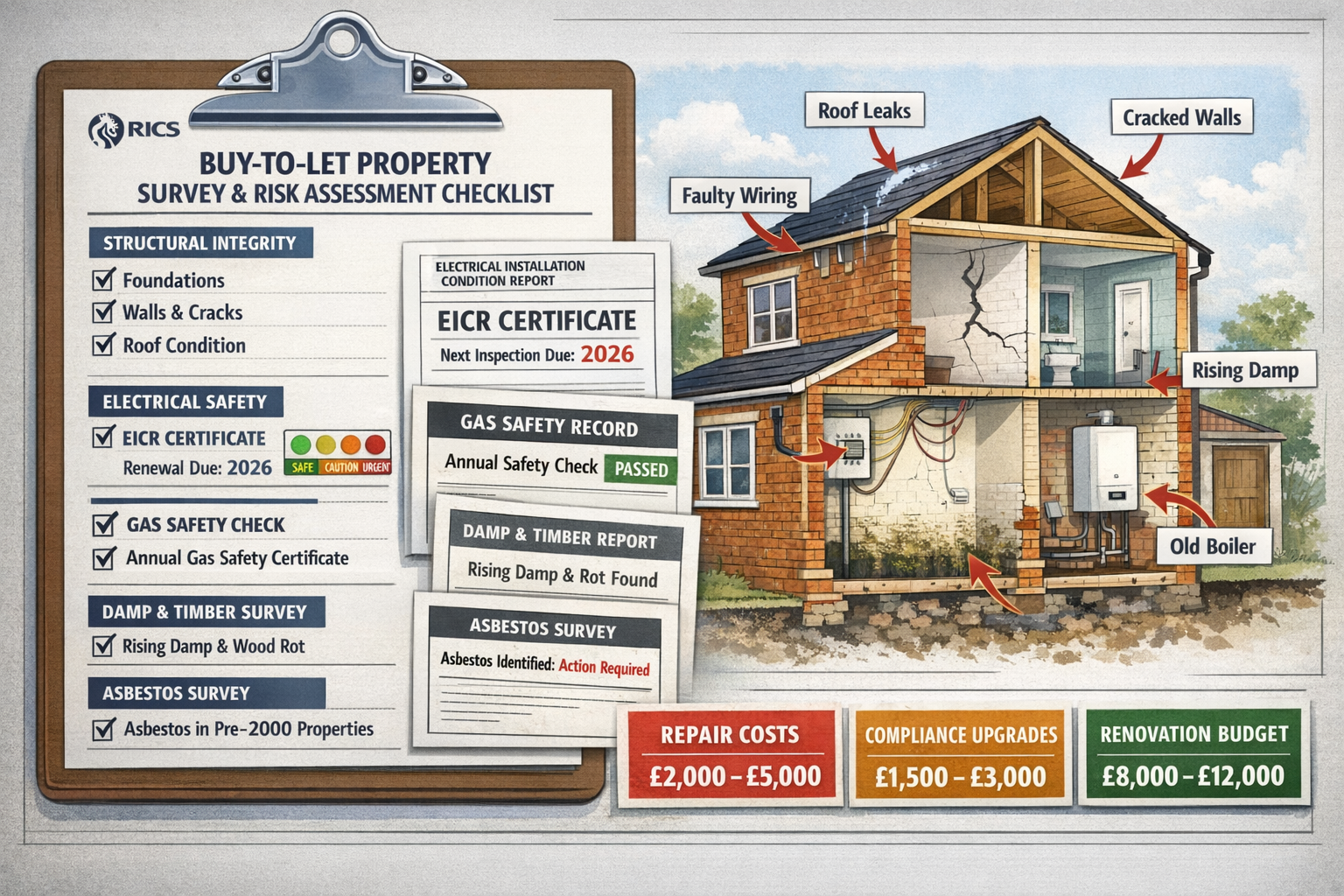
Structural Integrity Assessment 🏗️
The foundation of any building survey examines the property's structural soundness. For landlords, structural issues represent the most significant financial risk:
- Foundation and subsidence concerns: Subsidence surveys identify movement patterns that could require underpinning costing £10,000-£50,000+
- Wall condition: Cracking, bulging, or leaning walls may indicate serious structural problems
- Roof structure: Roof surveys assess timber condition, covering integrity, and remaining lifespan
- Floor integrity: Sagging, bouncing, or damaged floors may require extensive remedial work
Electrical and Gas Safety Evaluation ⚡
Given the 2026 EICR renewal deadline for certificates issued in 2021, surveys should specifically assess:
- Age and condition of electrical installation and consumer unit
- Whether the property has had an EICR within the past 5 years
- Presence of outdated wiring systems (rubber, fabric-covered cables)
- Gas appliance condition and flue integrity
- Estimated costs for bringing systems to current safety standards
Damp, Timber, and Environmental Hazards 💧
Moisture-related issues remain among the most common and costly problems in rental properties:
- Rising damp, penetrating damp, and condensation issues
- Timber decay, wet rot, and dry rot in structural elements
- Asbestos presence in pre-2000 properties requiring management or removal
- Ventilation adequacy affecting condensation and mold risk
Professional damp surveys use moisture meters and thermal imaging to identify hidden problems that visual inspection alone might miss.
Energy Efficiency and EPC Compliance 🌡️
With minimum EPC standards enforced, surveys should evaluate:
- Current insulation levels in loft, walls, and floors
- Window and door efficiency (single vs. double glazing)
- Heating system age, efficiency, and control mechanisms
- Estimated costs to achieve minimum 'E' rating or higher bands
Assessing Investment Risks Through Building Survey Findings
Quantifying Repair Costs Against Landlord Tax Pressures
The true value of a building survey emerges when findings are translated into financial implications within the current tax environment. Professional landlords in 2026 must approach this analysis systematically:
Step 1: Categorize Survey Findings by Urgency
- Immediate/Pre-letting: Issues preventing legal letting (electrical safety, gas safety, EPC compliance)
- Short-term (1-2 years): Deteriorating conditions requiring attention to prevent escalation
- Medium-term (3-5 years): Anticipated replacement or renewal items (boiler, roof covering)
- Long-term (5+ years): Major structural works or system replacements
Step 2: Obtain Detailed Cost Estimates
Generic survey estimates should be refined through contractor quotations for significant items. This provides negotiating leverage and accurate investment modeling.
Step 3: Calculate Tax-Adjusted Investment Returns
Under current tax rules, repair costs are generally deductible, but capital improvements are not. Understanding this distinction affects both immediate tax treatment and long-term investment strategy.
"In the current tax environment, a £15,000 repair bill identified in a building survey isn't just a £15,000 cost—for a higher-rate taxpayer, it represents approximately £18,750 in pre-tax rental income that must be generated to cover the expense. This fundamentally changes negotiation strategies and investment viability assessments."
Step 4: Adjust Purchase Offer or Walk Away
Armed with accurate cost data, landlords can:
- Negotiate purchase price reductions reflecting true property condition
- Request vendor completion of specific repairs as a condition of sale
- Decline to proceed if total costs render the investment unviable
Portfolio Landlord Considerations and Lender Requirements
Landlords with four or more mortgaged properties face additional scrutiny from lenders in 2026, making building survey documentation particularly valuable. Portfolio landlord criteria now typically require:
📊 Comprehensive Property Schedules
- Current condition of all properties in the portfolio
- Outstanding maintenance or compliance issues
- Planned capital expenditure across the portfolio
📈 Business Plans and Cash Flow Forecasts
- Realistic projections accounting for void periods and maintenance costs
- Evidence of adequate reserves for unexpected repairs
- Demonstration of portfolio management capability
🏢 Individual Property Due Diligence
- Building survey reports for new acquisitions
- Evidence of compliance with all regulatory requirements
- Professional valuations supporting loan-to-value calculations
Professional building surveys provide the documentation lenders require to assess both individual property risk and overall portfolio quality. This can mean the difference between mortgage approval and rejection in an increasingly cautious lending environment.
HMO Properties and Enhanced Survey Requirements
Houses in Multiple Occupation face stricter regulatory requirements in 2026, making comprehensive building surveys essential:
Mandatory HMO Licensing Criteria
- Fire safety measures (doors, detection, emergency lighting)
- Room size minimums and occupancy calculations
- Kitchen and bathroom facility requirements
- Property condition standards exceeding standard residential lettings
Enhanced Survey Focus Areas for HMOs
- Fire compartmentation and escape route integrity
- Electrical installation capacity for multiple occupants
- Plumbing system adequacy for increased usage
- Structural suitability for conversion or intensified use
A building survey for a potential HMO investment should explicitly address licensing requirements and identify any works needed to achieve or maintain licensed status. The costs of bringing a property to HMO standard can easily reach £20,000-£50,000, making this assessment critical to investment viability.
Strategic Use of Building Survey Intelligence in Buy-to-Let Investment Decisions
Negotiation Leverage and Purchase Price Adjustment
A detailed building survey transforms the negotiation dynamic from subjective assessment to objective evidence. Professional landlords in 2026 use survey findings strategically:
Evidence-Based Price Reduction Requests
Rather than requesting arbitrary discounts, present surveyors' findings with associated cost estimates:
"The building survey has identified £18,000 in necessary electrical upgrades, roof repairs, and damp remediation. Given current landlord tax pressures and compliance requirements, I'm requesting a £20,000 price reduction to reflect these immediate costs."
Vendor Remediation as Sale Condition
For critical compliance issues, requiring vendor completion before exchange can be more effective than price reduction:
- EICR certification and remedial electrical works
- Gas safety certification and boiler servicing
- Essential roof repairs preventing water ingress
- Damp-proofing works with insurance-backed guarantees
Walk-Away Threshold Identification
Building surveys prevent emotional investment decisions by establishing clear financial boundaries. If total acquisition cost (purchase price + identified repairs) exceeds the property's investment value under current tax conditions, professional landlords walk away regardless of time invested.
Long-Term Maintenance Planning and Reserve Fund Calculations
Beyond immediate purchase decisions, building surveys inform ongoing portfolio management:
Creating Property-Specific Maintenance Schedules
Survey findings enable proactive maintenance planning:
- Year 1-2: Address immediate compliance and safety issues
- Year 3-5: Planned replacements (boiler, windows, heating system)
- Year 6-10: Major works (roof replacement, external decoration)
- Year 10+: Structural renewals (bathroom/kitchen refits, system upgrades)
Reserve Fund Calculations
Professional landlords maintain reserves for each property based on survey-identified future requirements. A typical calculation:
- Immediate repairs identified: £12,000
- 5-year anticipated works: £8,000
- 10-year major items: £15,000
- Total 10-year requirement: £35,000
- Annual reserve allocation: £3,500
This disciplined approach prevents cash flow crises and ensures properties remain compliant and lettable throughout ownership.
Insurance and Risk Management Implications
Building survey findings directly affect insurance coverage and premium calculations:
Disclosure Requirements ⚠️
Landlord insurance policies typically require disclosure of known defects. Failing to disclose survey-identified issues can void coverage:
- Structural movement or subsidence
- Previous flood or water damage
- Electrical or gas safety concerns
- Roof condition issues
Premium Impact Assessment
Certain survey findings may increase premiums or require specialist coverage:
- Properties with subsidence history
- Non-standard construction (timber frame, steel frame, concrete)
- Flood risk areas
- Properties requiring significant remedial work
Risk Transfer Through Remediation
Addressing survey-identified issues before letting can reduce insurance premiums and improve coverage terms. The cost-benefit analysis should consider:
- Premium reduction over holding period
- Improved coverage quality and claim acceptance likelihood
- Reduced void periods from tenant complaints
- Enhanced property value and saleability
Selecting the Right Building Surveyor for Buy-to-Let Investment Properties
RICS Accreditation and Specialist Experience
Not all building surveyors offer equal value for buy-to-let investors. Selection criteria should prioritize:
RICS Chartered Status ✅
RICS chartered building surveyors operate under professional standards and indemnity insurance requirements that protect clients. They must:
- Maintain continuing professional development
- Adhere to RICS professional conduct standards
- Carry professional indemnity insurance
- Follow standardized reporting formats
Buy-to-Let and Investment Property Experience
Surveyors with specific buy-to-let experience understand:
- Regulatory compliance requirements for rental properties
- Common issues affecting lettability and tenant satisfaction
- Realistic repair cost estimates for investment calculations
- Lender requirements for portfolio landlord applications
Local Market Knowledge
Surveyors familiar with the local area bring valuable context:
- Regional construction methods and common defects
- Local contractor costs and availability
- Area-specific issues (mining subsidence, flood risk, soil conditions)
- Comparative property values and investment potential
Survey Scope and Specification for Maximum Value
When commissioning a building survey for buy-to-let investment, specify requirements clearly:
Essential Inclusions for Landlord Investors
- Explicit compliance assessment (electrical, gas, EPC)
- Repair cost estimates with ranges (minimum, likely, maximum)
- Urgency categorization for identified defects
- Specific commentary on rental market suitability
- Photographic evidence of key defects
- Recommendations for specialist surveys if needed
Additional Investigations to Consider
Depending on property type and age, commission specialist surveys alongside the main building survey:
- Subsidence investigation for properties with movement evidence
- Asbestos survey for pre-2000 properties
- Drainage survey for older properties or those with reported issues
- Timber and damp specialist report for properties with moisture concerns
Survey Timing and Access Arrangements
Optimal survey timing maximizes value:
- Schedule after offer acceptance but before exchange
- Ensure full access including loft spaces, outbuildings, and all rooms
- Arrange for utilities to be connected for testing
- Request vendor presence or agent access for questions
Conclusion: Building Surveys as Essential Risk Management in 2026's Challenging Buy-to-Let Environment
The buy-to-let landscape in 2026 demands a fundamentally different approach to property investment. With mortgage interest relief restrictions squeezing margins, compliance costs mounting, and lender scrutiny intensifying, professional landlords cannot afford the luxury of incomplete due diligence. Building Surveys for Buy-to-Let Properties in 2026: Assessing Risks Amid Landlord Tax Pressures represents not an optional extra but an essential risk management tool that protects capital and ensures investment viability.
The convergence of expiring EICR certificates from 2021, ongoing gas safety requirements, EPC standards enforcement, and portfolio landlord lending criteria creates a perfect storm where property condition directly determines both lettability and profitability. A comprehensive building survey provides the intelligence needed to navigate these challenges successfully.
Actionable Next Steps for Buy-to-Let Investors
Before Your Next Property Purchase:
- Budget appropriately for a Level 3 Building Survey (£600-£1,500) as a standard acquisition cost
- Engage an RICS chartered surveyor with specific buy-to-let and investment property experience
- Specify your requirements clearly, emphasizing compliance assessment and repair cost estimates
- Commission specialist surveys where the building survey identifies specific concerns
- Build survey findings into negotiations with evidence-based price adjustments or vendor remediation requirements
For Your Existing Portfolio:
- Review EICR expiry dates across all properties and schedule 2026 renewals proactively
- Conduct building condition assessments on older properties to identify deferred maintenance
- Calculate reserve requirements based on anticipated repairs and replacements
- Document property conditions to support portfolio landlord mortgage applications
- Address compliance gaps before they result in enforcement action or insurance issues
When Selecting Professional Support:
- Prioritize RICS chartered status over cost savings from unqualified inspectors
- Verify buy-to-let experience through references and portfolio landlord client testimonials
- Request sample reports to assess detail level and reporting clarity
- Confirm insurance coverage and professional indemnity limits
- Establish ongoing relationships with trusted surveyors for portfolio growth
The buy-to-let sector remains viable for professional landlords who approach investment with rigorous due diligence and realistic financial modeling. Building surveys provide the foundation for this disciplined approach, transforming property acquisition from speculation to calculated investment backed by comprehensive condition intelligence.
In an environment where every unexpected repair directly impacts already-compressed margins, the cost of a thorough building survey represents exceptional value—potentially saving tens of thousands of pounds in avoided poor investments or negotiated price reductions. For landlords serious about building sustainable rental portfolios in 2026's challenging tax and regulatory environment, comprehensive building surveys aren't optional—they're essential.
Get a quote for a professional building survey today and protect your buy-to-let investment from costly surprises.
References

[1] Surveying The 2026 Buy To Let Boom Building Survey Protocols For Institutional Landlord Investments – https://nottinghillsurveyors.com/blog/surveying-the-2026-buy-to-let-boom-building-survey-protocols-for-institutional-landlord-investments