}
Nearly one in five homebuyers who commission a survey later discover that their surveyor missed a significant defect, and a substantial proportion of those cases involve professionals whose credentials were never properly verified before instruction. Engaging a qualified building surveyor in the UK is not simply a matter of finding someone with a plausible website and a reasonable fee. It requires a structured check of formal credentials, regulatory registers, insurance documentation, and demonstrable local knowledge before any contract is signed.
This guide goes beyond generic hiring advice. It provides a technical checklist of the formal requirements that govern building surveyors in 2026, explains the regulatory changes that have raised the bar for professional indemnity cover, and identifies the red-flag behaviours that should prompt a client to walk away.
Key Takeaways
- A legitimate building surveyor in the UK must hold RICS membership or work within an RICS-regulated firm, verify this directly on the RICS online register before instructing.
- From 1 July 2026, new PI insurance requirements mandate RICS-listed insurers and approved minimum policy wording; always request written evidence of compliant cover.
- The Home Survey Standard 2nd edition is in active review; ask which edition and which measurement basis your surveyor currently works to.
- Local experience is not a soft preference, regulatory and leasehold reforms mean that surveyors unfamiliar with a specific property type or region carry measurable risk.
- Red-flag behaviours, including vague insurance answers, reluctance to confirm RICS registration, or no evidence of recent CPD, are grounds to decline instruction.
What "Qualified" Actually Means: RICS Membership and Chartership Pathways
The word "surveyor" is not legally protected in the UK. Anyone can, in theory, call themselves a surveyor. What is regulated is membership of the Royal Institution of Chartered Surveyors (RICS) and the right to use the designations MRICS (Member) or FRICS (Fellow). These designations are earned through a structured assessment process and maintained through ongoing obligations [3].
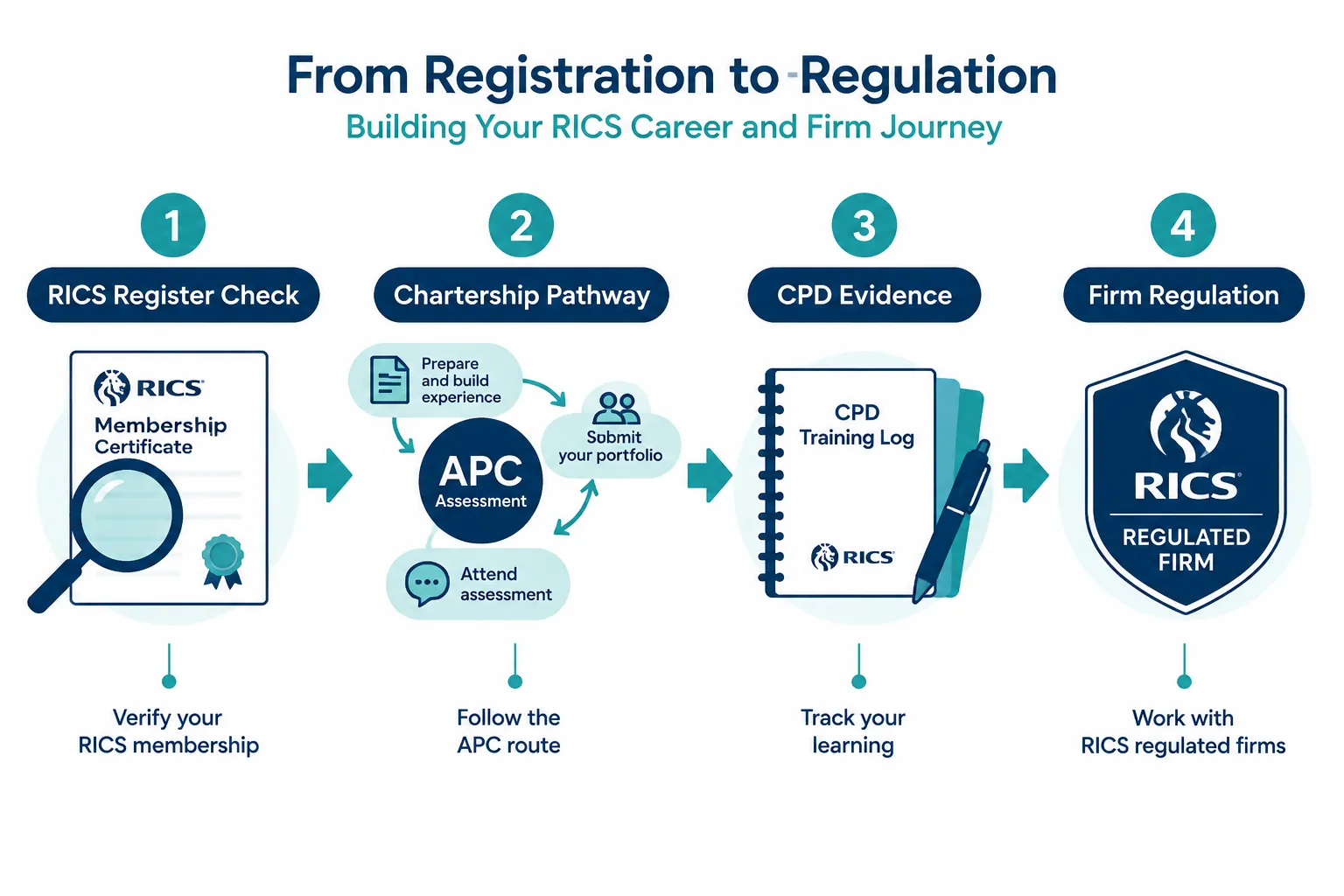
The primary route to chartership is the Assessment of Professional Competence (APC), a structured programme that combines structured training, a period of qualifying experience, and a final assessment interview conducted by trained assessors [6]. Candidates must demonstrate competence across mandatory, core, and optional competencies relevant to their chosen pathway, for building surveyors, this includes construction technology, defect analysis, inspection, and legal and regulatory compliance [9].
What to check on the RICS register:
- The individual's full name and current membership status (MRICS or FRICS)
- Whether the firm itself is an RICS-regulated firm (a separate designation that imposes firm-level obligations)
- Whether any disciplinary findings are recorded against the individual or firm
The RICS online register is publicly accessible and takes under two minutes to use. There is no legitimate reason a prospective surveyor should object to a client performing this check.
Designations at a glance:
| Designation | Meaning | Achieved Via |
|---|---|---|
| AssocRICS | Associate member | Structured training + assessment |
| MRICS | Full member (Chartered) | APC assessment |
| FRICS | Fellow | Senior professional recognition |
| RICS Regulated Firm | Firm-level regulation | Firm registration + compliance obligations |
A surveyor working under the supervision of an MRICS or FRICS professional may be at an earlier career stage. This is acceptable for some survey types, but for a full structural or Level 3 building survey, the lead signatory should hold full chartership [5].
PI Insurance Requirements in 2026: What Has Changed and What to Ask
Professional indemnity (PI) insurance is the financial safety net that protects clients when a surveyor's negligence causes a loss. Without adequate PI cover, a successful negligence claim may result in nothing more than a judgment against an individual with insufficient assets to pay it.
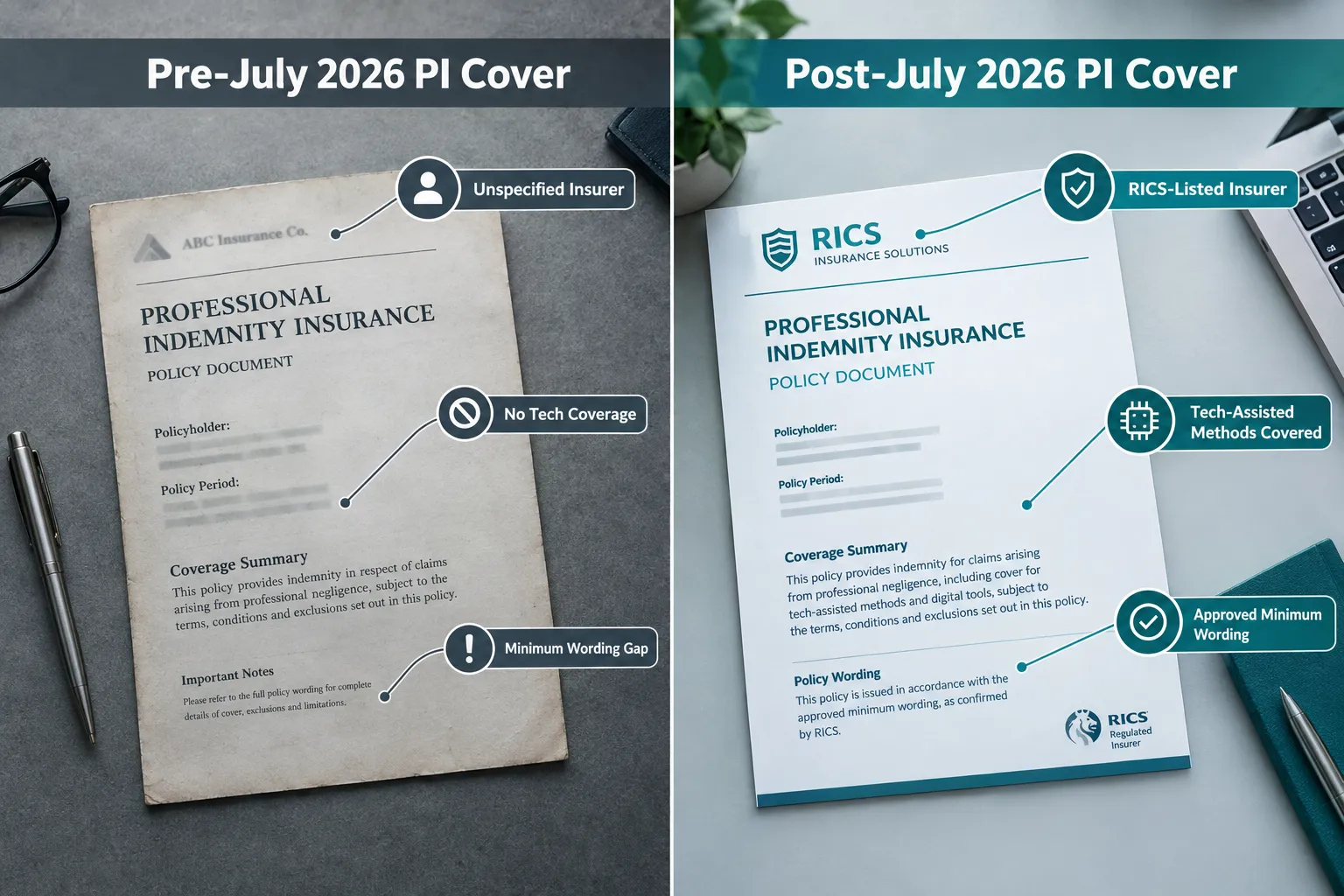
From 1 July 2026, RICS has introduced tightened requirements for PI insurance held by its members and regulated firms in the UK. The key changes are:
- RICS-listed insurers only: PI policies must now be placed with insurers on the RICS-approved list. Policies with non-listed insurers will not satisfy the regulatory requirement [2].
- Approved minimum wording mandatory: RICS has prescribed minimum policy wording. Bespoke or stripped-down policies that deviate from this wording are non-compliant [2].
- Higher limits for FCA-related work: Firms that carry out insurance distribution activities or undertake work regulated by the Financial Conduct Authority must hold PI limits above the standard minimum [2].
- Technology-assisted inspection methods covered: As drone surveys, thermal imaging, and other technology-assisted inspection methods become more common, PI policies must explicitly cover these activities. A policy written before this requirement was introduced may contain exclusions that leave clients unprotected [2].
"A PI certificate alone is not sufficient verification. Clients should request the full schedule, confirm the insurer appears on the RICS-approved list, and check that the indemnity limit is proportionate to the property value and the fee being charged."
The right questions to ask before instructing:
- Can you provide written evidence of PI insurance that meets the RICS July 2026 minimum wording requirement?
- Which insurer holds your policy, and are they on the RICS-approved list?
- What is your indemnity limit per claim, and is it adequate relative to the property value?
- Does your policy explicitly cover any technology-assisted inspection methods you intend to use on this survey?
- Is your run-off cover in place if you retire or close the firm?
A surveyor who hesitates, provides only a certificate without a schedule, or cannot name their insurer should be treated as a red flag. Legitimate professionals carry this documentation as a matter of routine [2].
Indemnity limits: a rough guide
There is no single correct limit, but as a general principle the indemnity limit should be sufficient to cover the cost of remedying the most serious defect that could have been missed, plus legal costs. For a residential property worth £500,000, a per-claim limit of at least £1 million is a reasonable minimum to request. For commercial properties or complex structures, limits should be discussed explicitly.
Home Survey Standards, Measurement Bases, and Local Experience
Knowing that a surveyor is RICS-registered and PI-compliant is necessary but not sufficient. The third pillar of due diligence is confirming that the surveyor works to current professional standards and has genuine, demonstrable experience of the specific property type and locality [4].
The Home Survey Standard: Which Edition Applies?
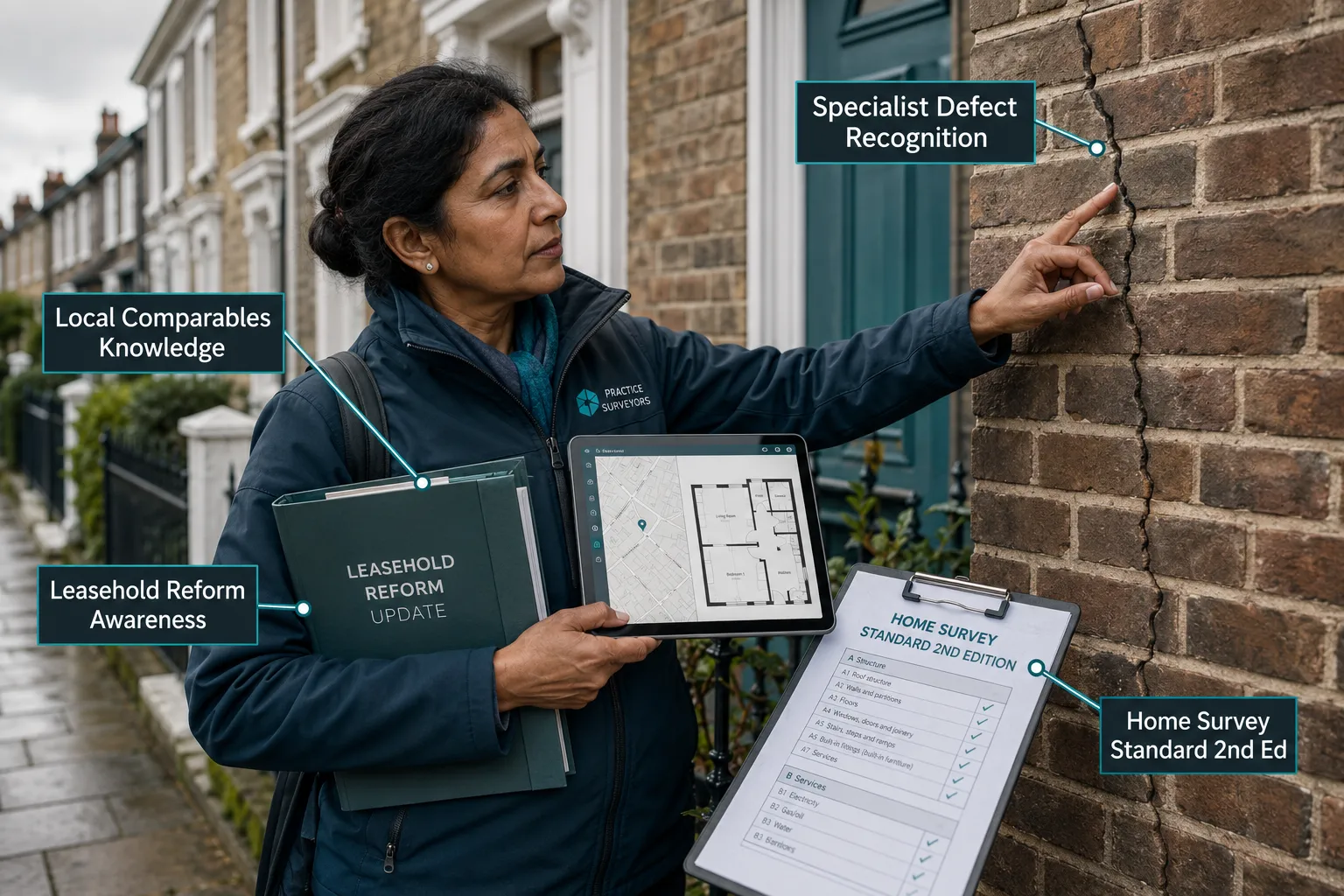
RICS publishes the Home Survey Standard, which governs how residential surveys are conducted and reported. The 2nd edition of this standard has been in active development and consultation through 2025 and into 2026, with RICS publishing an April 2026 update confirming the timeline and scope of revisions [7]. Surveyors should be working to the most current edition and should be able to state clearly which edition governs their current practice [4][8].
Ask directly: "Which edition of the Home Survey Standard do you currently work to, and has your firm updated its templates and reporting to reflect the latest version?" A surveyor who cannot answer this question, or who is unaware that a new edition is in development, is demonstrating a gap in their continuing professional development.
Survey levels under the Home Survey Standard:
- Level 1 (Condition Report): Basic condition rating; suitable for newer, standard-construction properties in good condition
- Level 2 (HomeBuyer Report): More detailed; includes advice on defects and maintenance; suitable for conventional properties
- Level 3 (Building Survey): Comprehensive structural inspection; essential for older, unusual, or significantly altered properties
Measurement Standards and the Archiving of Older Guidance
RICS property measurement standards have also undergone revision. The older RICS Property Measurement guidance has been archived, and surveyors working to superseded measurement bases risk producing reports that are inconsistent with current market practice. This matters most in commercial valuations and leasehold assessments, but it is relevant to any survey that includes floor area calculations [5].
Why Local Experience Is a Formal Risk Factor in 2026
Regulatory reform has elevated local experience from a soft preference to a measurable risk consideration. The leasehold and freehold reform agenda progressing through UK legislation in 2025 and 2026 has introduced new obligations around service charge transparency, enfranchisement valuations, and building safety assessments. A surveyor without current knowledge of how these reforms apply in a specific local market, or to a specific property type such as a purpose-built flat, a converted Victorian terrace, or a new-build under a developer warranty, may produce a report that is technically competent but practically incomplete.
Specific questions to establish local and specialist experience:
- How many surveys have you conducted on properties of this type (age, construction method, tenure) in the past 12 months?
- Are you familiar with the local authority's planning constraints and conservation area designations that apply to this property?
- Have you completed CPD relating to the Building Safety Act 2022 and its implications for residential buildings?
- Do you have experience with the specific defect profiles common to this property type, for example, mundic block in Cornwall, prefabricated reinforced concrete in post-war estates, or sulfate attack in inter-war properties?
RICS supports ongoing professional development through its training events, including the annual Building Surveying Conference, which covers emerging technical and regulatory topics [1]. A surveyor who attends such events and can reference recent CPD is demonstrating active engagement with the profession [10].
Red-Flag Behaviours: When to Walk Away
A checklist of positive credentials is only half the picture. The following behaviours, observed during initial enquiries or on receipt of documentation, should prompt serious reconsideration.
Credential red flags:
- Cannot confirm RICS membership number or asks why it matters
- Firm is not listed as an RICS-regulated firm despite claiming to operate as one
- Designations used on marketing materials do not match the RICS register
Insurance red flags:
- Provides only a one-page certificate without a policy schedule
- Cannot confirm the insurer's name or whether it is on the RICS-approved list
- Policy was issued before July 2026 and surveyor cannot confirm it has been updated to meet new minimum wording requirements
- No mention of technology-assisted inspection coverage despite proposing to use drone or thermal imaging equipment
Standards and competence red flags:
- Unaware of the Home Survey Standard 2nd edition or its consultation process [7][8]
- References archived measurement guidance as current practice
- Cannot name the survey level they are proposing to deliver or explain the difference between levels
- No evidence of CPD activity in the past 12 months
- Reluctance to provide written terms of engagement before the survey is booked
Conduct red flags:
- Quotes a fee significantly below market rate without explanation (may indicate reduced scope or uninsured work)
- Pressures the client to instruct quickly without time to verify credentials
- Declines to provide references from recent clients on comparable properties
A Pre-Instruction Checklist
Before signing any instruction letter or paying a deposit, work through the following verification steps.
Step 1, Verify RICS status
Search the RICS online register using the surveyor's full name and firm name. Confirm membership grade, regulated firm status, and absence of disciplinary findings [3].
Step 2, Confirm survey standard and level
Ask which edition of the Home Survey Standard governs the proposed survey, and confirm the survey level is appropriate for the property [4][8].
Step 3, Request PI insurance documentation
Obtain the full policy schedule (not just the certificate). Confirm the insurer is on the RICS-approved list, the minimum wording requirement is met, the indemnity limit is proportionate, and any technology-assisted methods are covered [2].
Step 4, Assess local and specialist experience
Ask specific questions about the surveyor's experience with this property type, age, construction method, and locality. Request evidence of relevant CPD [1][9].
Step 5, Review the terms of engagement
Confirm the scope of the survey in writing, the fee, the delivery timeline, and the complaints procedure. RICS-regulated firms are required to have a complaints-handling procedure in place.
Conclusion
Instructing a building surveyor is one of the most consequential professional decisions made during a property transaction. The regulatory landscape governing qualified building surveyors in the UK has become more demanding in 2026, with tighter PI insurance requirements, evolving survey standards, and a more complex legislative environment around leasehold and building safety. These changes raise the stakes for clients who skip the verification steps.
Actionable next steps:
- Before making contact with any surveyor, use the RICS online register to confirm membership status independently.
- Prepare a written list of the PI insurance questions set out above and request documentary evidence, not just verbal assurance.
- Ask explicitly which edition of the Home Survey Standard the surveyor works to and whether their practice has been updated to reflect the July 2026 PI requirements.
- Treat any reluctance to answer credential or insurance questions as a disqualifying red flag, regardless of how competitive the fee appears.
- For older, unusual, or high-value properties, prioritise a surveyor with documented, recent experience of that specific property type in that specific locality.
A few hours of structured due diligence before instruction is a small investment relative to the cost of a missed defect, an unenforceable claim, or a negligence dispute against an inadequately insured professional.
References
[1] RICS Building Surveying Conference – rics.org
[2] PII in the UK – rics.org
[3] RICS – rics.org
[4] Home Survey Standards – rics.org
[5] Profession Standards – rics.org
[6] RICS Candidates Assessment Applications UK – rics.org
[7] Home Survey Standard 2nd Edition April 2026 Update – rics.org
[8] RICS Launches Consultation Updated Home Survey Standard – rics.org
[9] Specialisms: Building Surveying – ww3.rics.org
[10] RICS Latest News – rics.org