Nearly 40% of global carbon emissions originate from the built environment, yet until recently, most UK commercial property valuations treated sustainability data as a footnote rather than a core input. That gap is now closing fast. The Royal Institution of Chartered Surveyors (RICS) has published its updated fourth edition of the ESG and sustainability standard for commercial property valuation, and for UK practitioners, applying it is no longer optional. This guide provides a practical framework for embedding EPC data, BREEAM ratings, and wider ESG metrics into Red Book-compliant valuations using the latest RICS sustainability guidance, covering ESG and Sustainability in UK Property Valuations: Applying 2026 RICS Guidance Step by Step from instruction to final report.
Key Takeaways
- The RICS fourth edition ESG and sustainability standard is a mandatory global standard for commercial property valuers, directly integrated with the Red Book and aligned with IVS 2026.
- UK valuers must now address environmental, social, and governance factors across a structured four-module insert in every relevant Red Book report.
- EPC ratings, BREEAM scores, physical climate risk, and ESG-linked capital expenditure must all be considered as valuation-relevant inputs, not optional commentary.
- Stranded asset risk and green premiums are increasingly evidenced in UK market data and must be reflected where market evidence supports them.
- RICS has published supporting materials, including isurv guides and training resources, to help practitioners implement the standard in day-to-day practice.
What the 2026 RICS ESG Standard Requires and Why It Is Mandatory
The RICS fourth edition of the ESG and Sustainability in Commercial Property Valuation standard represents a significant escalation in expectations for UK valuers [1]. Published as a global professional standard, it is mandatory for RICS members conducting commercial property valuations under the Red Book framework [2]. This means non-compliance is not a stylistic choice, it carries professional liability implications.
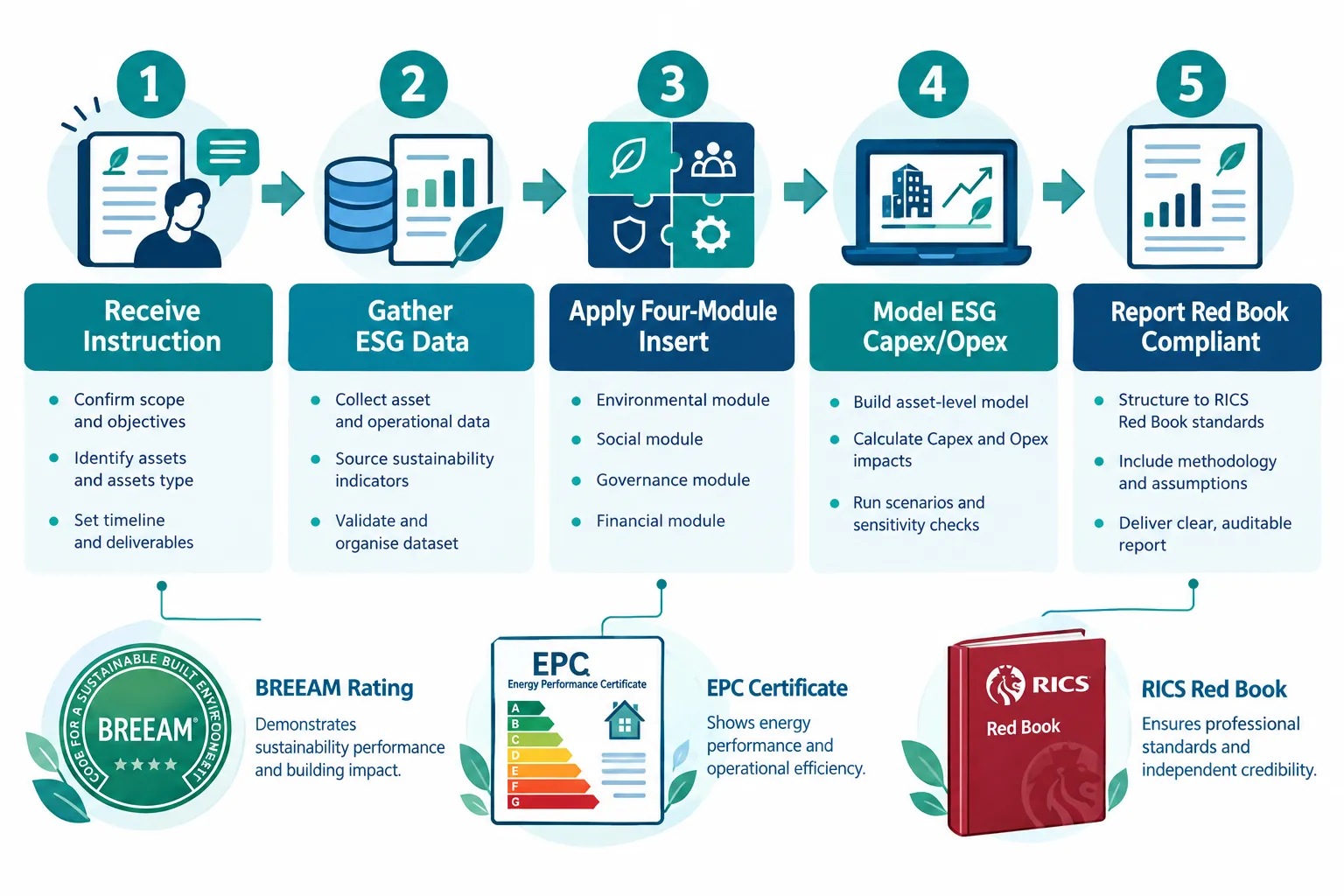
The standard's scope is deliberately broad. It applies to all commercial property asset classes, including offices, retail, industrial, logistics, and mixed-use schemes. Residential investment portfolios and build-to-rent assets are also within scope where Red Book conditions apply [3]. The standard requires valuers to consider ESG factors not merely as risk disclosures but as inputs that can materially affect market value, investment value, and worth.
Why mandatory status matters: Prior editions of RICS sustainability guidance were largely advisory. The shift to mandatory status signals that the profession, and the market, now treats sustainability as a valuation-relevant variable, not a corporate responsibility add-on [2]. Lenders, institutional investors, and occupiers are already pricing ESG performance into their decision-making, and the standard brings valuation methodology into alignment with that market reality.
The standard also aligns with the broader RICS Red Book Global Standards (2024 edition, updated through 2026), ensuring that UK practitioners operate within a coherent international framework [8][9]. Valuers who have not reviewed their standard terms of engagement, report templates, and data-gathering processes in light of this guidance should treat 2026 as the year to do so.
Scope of Coverage: What Must Now Be Addressed in UK Valuations
Understanding the full scope of ESG and Sustainability in UK Property Valuations: Applying 2026 RICS Guidance Step by Step begins with knowing exactly which factors must be considered and documented.
The standard organises required coverage into three broad ESG pillars, each with specific sub-factors relevant to property:
Environmental factors:
- Energy performance certificates (EPC ratings) and minimum energy efficiency standards (MEES) compliance
- BREEAM, LEED, or equivalent sustainability certification ratings
- Carbon footprint and net-zero pathway alignment
- Physical climate risks: flood risk, overheating, wind exposure, and coastal erosion
- Water efficiency and biodiversity net gain obligations
Social factors:
- Health, wellbeing, and indoor air quality certifications (e.g., WELL, Fitwel)
- Accessibility and inclusive design standards
- Community impact and social value metrics
- Occupier satisfaction and tenant engagement data
Governance factors:
- Green lease provisions and landlord-tenant sustainability obligations
- ESG reporting frameworks adopted by the asset owner (e.g., GRESB, TCFD)
- Supply chain transparency in construction and refurbishment
"Valuers are now expected to consider whether ESG factors affect the pricing behaviour of market participants, and to document their reasoning either way."
This is a significant expansion from previous practice. Where data is unavailable, the standard does not permit valuers simply to ignore the issue. Instead, they must note the absence of data, explain its potential significance, and flag it as a limitation of the valuation [3].
The Four-Module ESG Insert: A Practical Checklist for Red Book Reports
The most operationally significant element of the updated standard is the four-module ESG insert now expected within Red Book-compliant valuation reports [3][10]. This structured framework gives valuers a repeatable, auditable process for documenting ESG considerations.
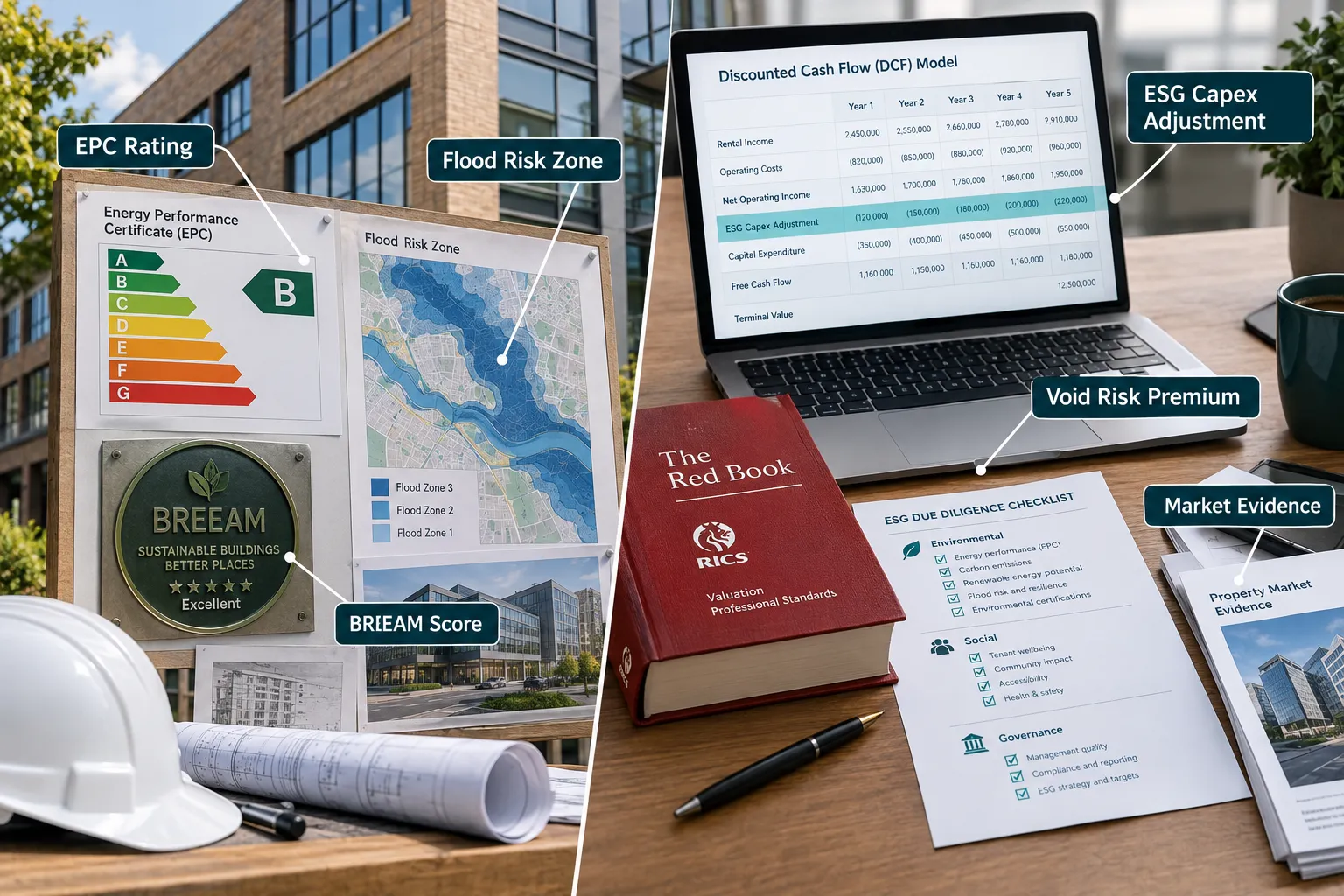
Module 1: Data Collection and Verification
The first module requires the valuer to gather and verify ESG-relevant data at the point of instruction. Key data points include:
- Current EPC rating and certificate expiry date
- BREEAM or equivalent certification status and score
- Planning conditions relating to sustainability (e.g., biodiversity net gain requirements)
- Known capital expenditure requirements to meet future MEES thresholds
- Any green lease clauses in existing occupational agreements
Valuers should request this data from clients as part of the standard instruction process. Where data is absent or unverified, this must be recorded as an assumption or special assumption in the report.
Module 2: Market Evidence and Pricing Impact
The second module requires valuers to consider whether ESG factors are reflected in comparable market evidence. This involves:
- Identifying whether green premiums or brown discounts are observable in the relevant sub-market
- Adjusting comparable evidence to account for material differences in ESG performance
- Documenting the basis for any adjustment, or the basis for concluding no adjustment is warranted
UK market evidence is increasingly supporting a measurable green premium for best-in-class assets. Studies of London office transactions have shown EPC A/B-rated buildings achieving rental premiums over lower-rated stock, and institutional investors are applying explicit ESG filters to acquisition criteria [2].
Module 3: Physical and Transition Risk Assessment
Module three requires explicit consideration of both physical climate risks and transition risks:
Physical risks include flooding (fluvial, pluvial, and coastal), overheating under future climate scenarios, and subsidence linked to changing ground conditions. The Environment Agency's flood risk data, alongside climate scenario modelling tools, should be referenced where available.
Transition risks include the cost of upgrading assets to meet future regulatory requirements, most immediately, the trajectory of MEES regulations that are expected to require EPC B or above for commercially let properties within the medium term. Assets that cannot economically achieve compliance face stranded asset risk, which must be reflected in the valuation.
Module 4: Reporting and Disclosure
The fourth module governs how ESG considerations are reported. Valuers must:
- State explicitly whether ESG factors have been considered
- Confirm which data sources were used and their reliability
- Note any material limitations arising from data gaps
- Where ESG factors affect value, quantify the impact or explain why quantification is not possible
This four-module structure creates a clear audit trail, essential for valuers managing professional indemnity exposure and for clients managing fund-level ESG reporting obligations [10].
Treating ESG-Linked Capital and Operating Expenditure in Valuation Models
One of the most technically demanding aspects of ESG and Sustainability in UK Property Valuations: Applying 2026 RICS Guidance Step by Step is the correct treatment of ESG-related costs in income-based valuation models.
Capital expenditure considerations:
| ESG Capex Item | Valuation Treatment |
|---|---|
| EPC upgrade works (e.g., insulation, glazing) | Deducted from gross value or modelled as a year-one cost in DCF |
| BREEAM refurbishment certification costs | Included in development appraisal or refurbishment cost plan |
| Renewable energy installation (solar PV, heat pumps) | May offset future opex; model net present value of savings |
| Flood defence or resilience works | Risk-adjusted deduction where flooding is a material threat |
Operating expenditure considerations:
Energy costs, service charge obligations under green leases, and ongoing sustainability certification fees all affect net income. Where a building's energy performance is materially below market standard, higher void periods, increased incentive packages, and lower achievable rents should be reflected in the income assumptions.
Conversely, where an asset demonstrates strong ESG credentials, valuers should consider whether a rental premium or reduced void allowance is supportable by market evidence. The standard is clear that both positive and negative ESG impacts on value must be considered [3].
Physical Climate Risk as a Valuation Input
The explicit recognition of physical climate risk as valuation-relevant is one of the most significant conceptual shifts in the updated standard. Previously, climate risk was largely treated as a planning or insurance matter. Under the current RICS framework, it is a direct input into the valuation [3].
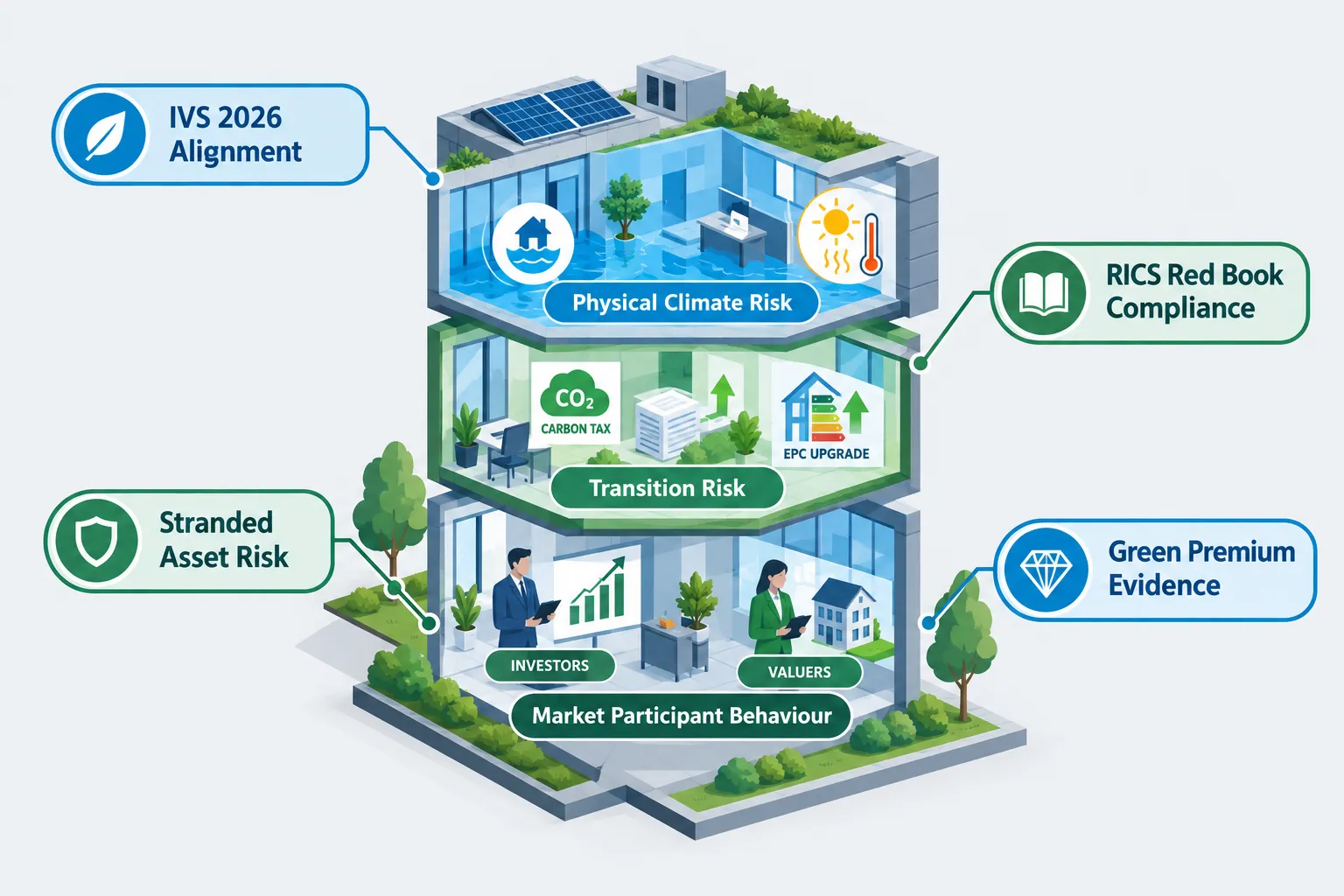
Key physical risks to consider in UK valuations:
- Flood risk: The UK has approximately 5.2 million properties at risk of flooding. For commercial assets in high-risk zones, insurability, lender appetite, and occupier demand are all affected.
- Overheating: Urban heat island effects and projected temperature increases under IPCC scenarios are increasingly relevant to office and residential valuations, particularly in dense urban areas.
- Subsidence: Changing soil moisture conditions linked to drought cycles are raising subsidence risk across clay-rich areas of southern England.
Valuers are not expected to conduct full climate risk assessments themselves, but they are expected to reference available data, note material risks, and reflect them in their assumptions. Where a client has commissioned a formal climate risk assessment, this should be reviewed and referenced in the valuation report.
Alignment with IVS 2026 and Market-Participant Behaviour
The RICS standard is designed to be consistent with the International Valuation Standards (IVS) 2026 framework [5]. This alignment is important for UK valuers working on cross-border mandates or advising international investors active in the UK market.
IVS 2026 reinforces the principle that valuations must reflect the behaviour of market participants. If institutional investors, who now represent the majority of buyers for prime commercial assets, are systematically applying ESG filters, then a valuation that ignores those filters does not accurately reflect market value [5].
What market-participant behaviour looks like in 2026:
- Major UK pension funds and REITs have published net-zero commitments with specific asset-level targets
- Lenders are increasingly applying ESG covenants to green loan facilities, affecting refinancing risk
- Occupiers, particularly large corporates with Scope 3 reporting obligations, are prioritising EPC A/B space and penalising lower-rated stock with shorter lease commitments
- International capital flows into UK real estate are increasingly conditional on GRESB ratings and TCFD-aligned disclosures
These are not predictions, they are documented market behaviours that valuers must account for when forming opinions of market value [2][4].
Supporting Materials and Training for UK Practitioners
RICS has recognised that the shift to mandatory ESG integration requires practical support for practitioners. Several resources are available to UK valuers implementing the standard [6][7]:
isurv: The RICS online knowledge platform has been updated with sustainability guidance, including worked examples and data-gathering checklists relevant to UK practice [6]. Practitioners should ensure they are accessing the most current versions of these materials.
RICS fourth edition PDF standard: The full text of the standard is available for download and should be read alongside the Red Book Global Standards [3][9]. Key annexes include guidance on data sources, market evidence methodology, and report language.
RICS training and CPD: RICS has signalled that ESG competency will be increasingly embedded in APC pathways and CPD requirements. Firms should audit their team's current ESG knowledge and identify training gaps.
Third-party tools: Several commercial platforms now offer RICS-aligned ESG data aggregation and report-insert tools. These can help smaller practices implement the four-module structure without building bespoke systems from scratch [10].
Impact on UK Market Practice and Professional Liability
The mandatory nature of the updated standard has direct implications for professional liability. A valuation report that fails to address ESG factors, or that addresses them superficially without evidencing the reasoning, is now potentially non-compliant with RICS professional standards [1][2].
Practical risk management steps for UK valuation firms:
- Review and update standard terms of engagement to include ESG data requests
- Update report templates to incorporate the four-module insert structure
- Establish a data-gap protocol so all valuers know how to handle missing ESG information
- Document market evidence searches for green premiums and brown discounts in the relevant sub-market
- Ensure PI insurance cover is reviewed in light of expanded ESG liability exposure
Firms advising on portfolios for institutional clients face additional scrutiny, as fund managers are themselves subject to SFDR, TCFD, and UK SDR disclosure obligations that depend on asset-level ESG data sourced from valuations.
Conclusion
The integration of ESG factors into UK property valuations is no longer a forward-looking aspiration, it is a current professional obligation. For practitioners ready to act, the following steps provide a clear path forward:
- Download and read the RICS fourth edition ESG standard in full, alongside the Red Book Global Standards, to understand the mandatory requirements and their scope.
- Audit existing report templates against the four-module ESG insert structure and update them before the next instruction cycle.
- Revise standard instruction letters to request EPC certificates, BREEAM ratings, green lease terms, and any known ESG capex requirements as a matter of routine.
- Build a market evidence log for ESG pricing impacts in the asset classes and geographies where the practice operates, updated quarterly.
- Invest in CPD covering physical climate risk assessment, ESG data interpretation, and DCF modelling of sustainability-linked costs and benefits.
- Engage with isurv and RICS training resources to stay current as guidance evolves through 2026 and beyond.
The market is already pricing ESG performance. The regulatory framework has caught up. UK valuers who embed these practices now will not only meet their professional obligations, they will deliver more accurate, defensible, and market-relevant valuations for their clients.
References
[1] ESG and Sustainability in Commercial Property Valuation – rics.org
[2] RICS Publishes Updated Global Standard ESG Sustainability Commercial Property Valuation – rics.org
[3] ESG Sustainability Commercial Valuation 4th Edition – rics.org
[4] RICS Launches New Global Sustainability Guide and UN Global Compact Report – rics.org
[5] Finalised IVS Consultation Response – rics.org
[6] Sustainability for Surveyors – isurv.com
[7] Neo Pagkosmio Protypo tis RICS gia ESG kai – web.tee.gr
[8] Valuation Standards – rics.org
[9] Red Book Global – rics.org
[10] RICS 4th Edition ESG Checklist – plinthos.io