One in three UK property transactions collapsed before completion in 2024, and late-discovered structural defects were among the leading causes. That statistic alone explains why the conversation around seller-side building surveys in the UK is shifting from niche curiosity to mainstream practice, and why pre-listing condition reports are becoming the new normal for sellers who want to protect their asking price and their timeline.
For decades, the default assumption in England and Wales has been simple: the buyer pays for the survey, the buyer absorbs the risk, and the seller waits. Scotland broke that mould years ago with its mandatory Home Report system. Now, a combination of government reform, evolving estate agency guidance, and hard commercial logic is pushing English and Welsh sellers to follow suit, voluntarily, for now.
Key Takeaways
- As of late 2026, commissioning a pre-listing survey is voluntary in England and Wales, but government policy now explicitly supports making it mandatory in future legislation.
- Scotland's Home Report system is the established UK precedent, demonstrating that seller-provided condition information reduces transaction uncertainty.
- Pre-sale surveys can reduce fall-throughs, limit price renegotiations, and shorten transaction timelines by surfacing defects before an offer is agreed.
- RICS Level 1, 2, and 3 formats are all available to sellers, with costs ranging from roughly £300 to £1,500 depending on property size and complexity.
- Industry analysts project that mandatory upfront surveys could increase demand for surveying services in England by around 40%, making this a significant commercial opportunity for surveyors.
The Policy Landscape: Where the Law Currently Stands
Understanding seller-side building surveys in the UK requires a clear-eyed view of what is law, what is policy intention, and what is market trend, because in 2026, these three things are at very different stages.
The current legal position in England and Wales is unambiguous: there is no requirement for a seller to commission a property survey before listing. The buyer remains responsible for arranging and funding their own survey [1][7][9]. This has been the position for generations, and it has not changed as of September 2026.
Scotland operates differently. Sellers in Scotland must provide a Home Report, which includes a single survey, an energy performance certificate, and a property questionnaire, before a property can be marketed. This makes Scotland the main domestic precedent for seller-side condition reporting within the UK, and its track record is frequently cited by reformers in England and Wales as evidence that the system works [9][11].
The 2026 government roadmap marks a significant shift in direction, even if not yet in law. On 19 June 2026, the UK Government published a home buying and selling reform roadmap committing to legislate for a mandatory pre-listing sales pack that includes a property condition report [1][2][3][4]. This is the clearest signal yet from Westminster that seller-provided upfront information is the intended direction of travel for this Parliament.
However, several important caveats apply:
- The legislation has not been enacted. No commencement date is confirmed.
- Implementation is dependent on parliamentary time and may not take effect until after 2028 [1][3][4].
- At least one commercial source has cited December 2026 as a deadline for mandatory upfront assessments, but more authoritative commentary confirms that no such law currently exists, and this timetable should be treated as speculative [1][3][6].
- Surveyor commentary notes it is reasonable to "bet against" truly mandatory upfront surveys in England and Wales in the near term, despite the policy commitment [3].
The practical conclusion for sellers and surveyors in 2026: these reports are voluntary but officially endorsed, and the direction of travel is clear even if the timetable is not.
"Industry analyses of the 2026 roadmap emphasise that, during 2026, any sales pack and condition report remain voluntary, even though they are now explicitly supported by government policy and expected to become standard practice over time." [1][3][4]
What a Seller-Side Survey Actually Is, and Why It Differs From a Buyer's Survey
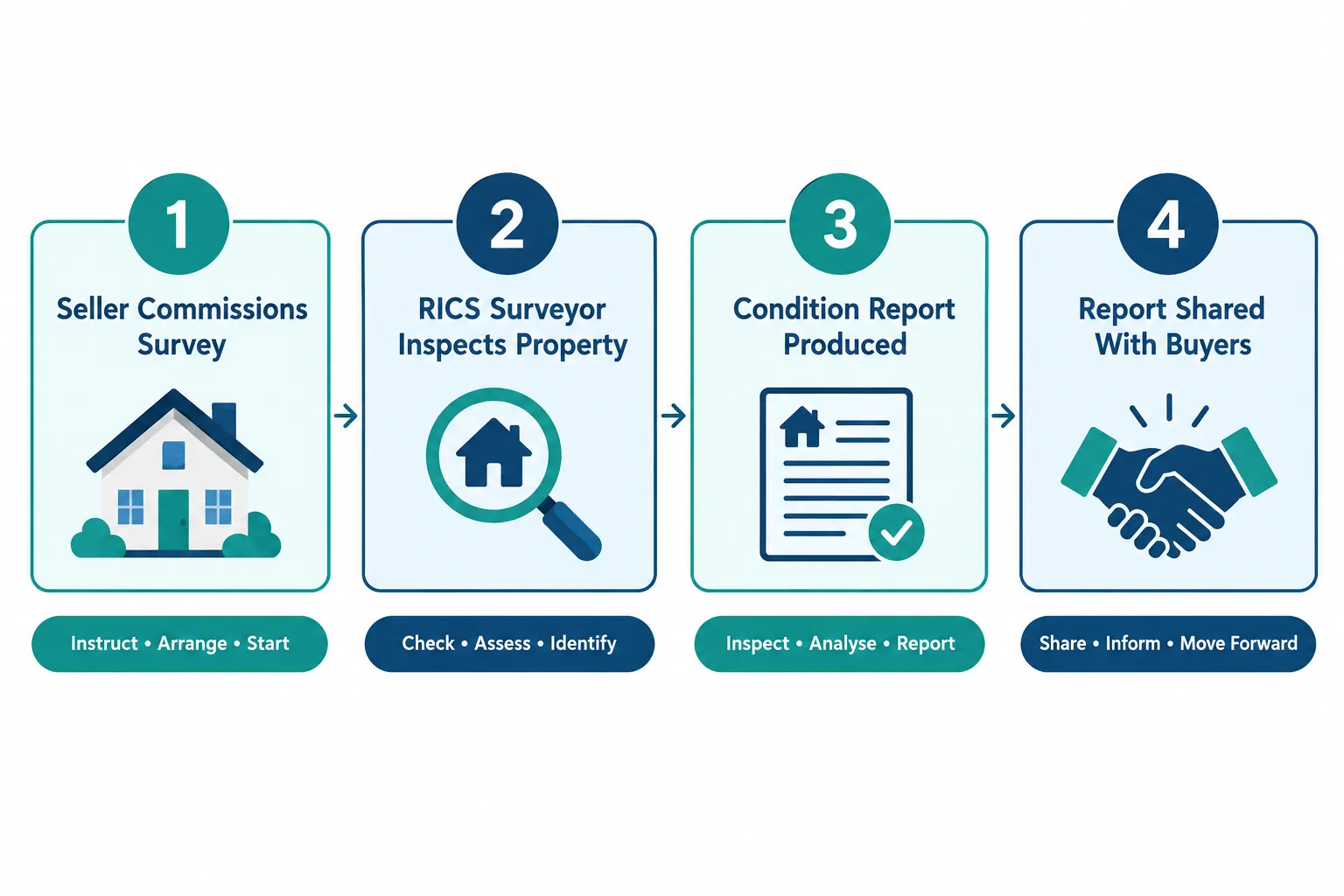
A seller-commissioned survey, also called a pre-sale survey, vendor survey, or pre-marketing survey, is a full property condition report paid for by the seller before the property goes to market [5][8][11][13]. The report is then shared with prospective buyers as part of the listing information, demonstrating transparency and giving buyers early confidence about the property's condition.
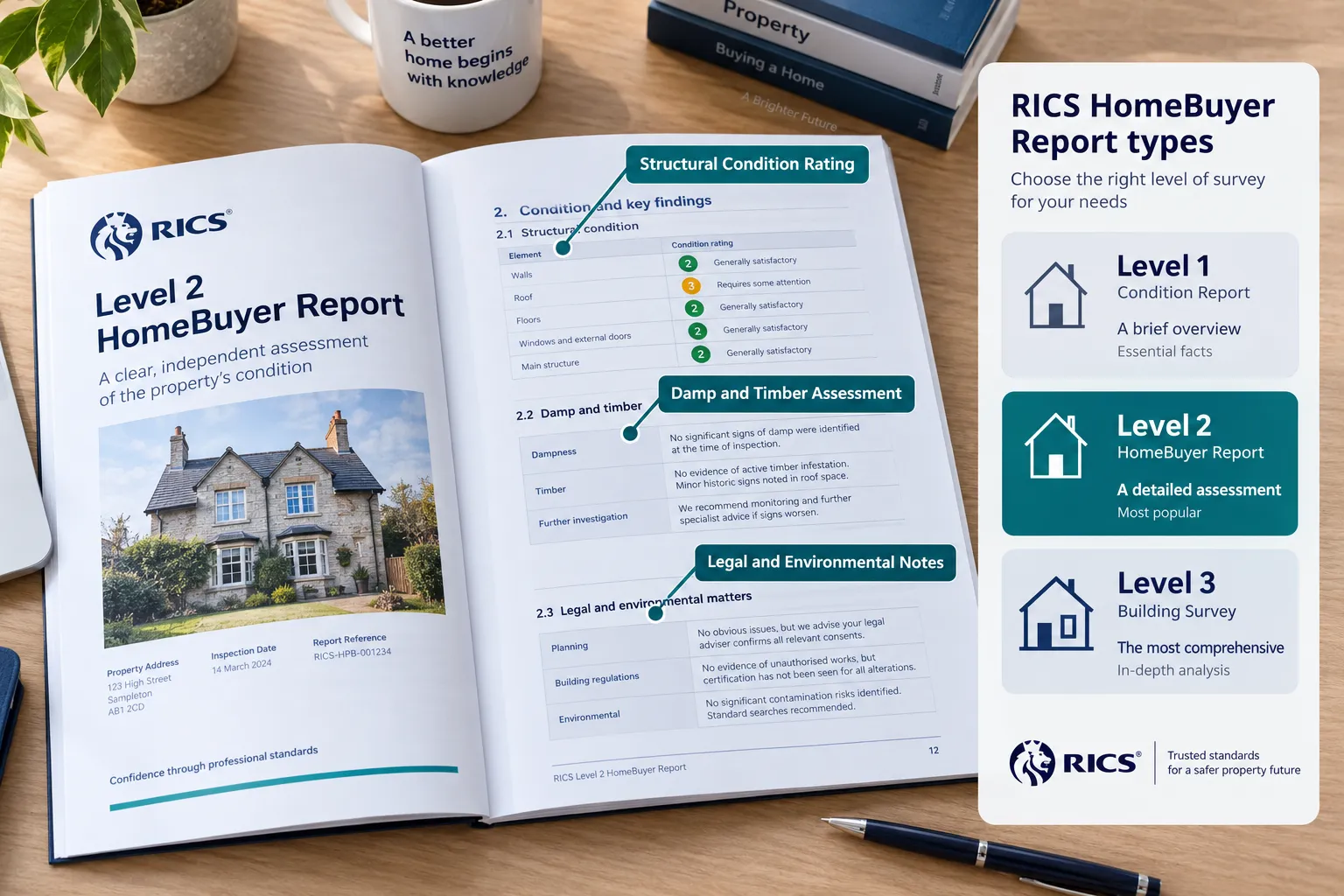
The format is not proprietary. Sellers use the same RICS-standardised report types that buyers have always commissioned:
| Survey Level | Report Name | Best Suited For |
|---|---|---|
| RICS Level 1 | Condition Report | Modern, well-maintained properties |
| RICS Level 2 | HomeBuyer Report | Standard construction, some age |
| RICS Level 3 | Building Survey | Older, altered, or complex properties |
The key distinction from a buyer's survey is who controls the information and when. In the traditional model, a buyer's survey is carried out after an offer has been accepted. Any defects discovered at that stage give the buyer leverage to renegotiate the price or, in the worst case, withdraw entirely. A seller-commissioned survey inverts this dynamic: the seller knows what the report will say before any offer is made, and can either address defects proactively or price the property to reflect them accurately [5][8][11][13].
Material information obligations are also evolving in ways that make pre-sale surveys increasingly relevant. Upcoming reforms are expected to expand what sellers must disclose about structural condition, known defects, legal encumbrances, and leasehold costs at or before listing [4][10][13]. Sellers who have already commissioned a formal condition report will be better positioned to meet these obligations as portal standards tighten.
The Commercial Case: Fewer Fall-Throughs, Less Renegotiation
The strongest argument for seller-side building surveys in the UK is not regulatory compliance, it is commercial self-interest. Pre-listing condition reports are becoming the new normal in part because sellers who use them are reporting tangible transactional advantages.

Industry commentary in 2026 consistently links pre-sale surveys to three measurable benefits [8][11][12]:
1. Reduced fall-throughs. When a buyer's surveyor discovers a significant defect after an offer has been agreed, the transaction is at risk. The buyer may withdraw, lenders may decline to lend against the property, or protracted negotiations may stall completion. A pre-sale survey surfaces these issues before any offer is made, removing the element of surprise.
2. Fewer price renegotiations. "Gazundering", where a buyer reduces their offer shortly before exchange, is often triggered by a surveyor's report. Sellers who can demonstrate they already know the condition of their property, and have priced accordingly, give buyers less ammunition for late-stage chipping.
3. Shorter transaction timelines. When both parties enter negotiations with the same baseline information about the property's condition, the due diligence phase is faster. There is less back-and-forth between solicitors, fewer requests for specialist reports, and fewer delays waiting for a buyer's surveyor to be instructed.
Surveyors and estate agents now actively position "pre-sale property health checks" as a way to protect the agreed price and avoid the delays that late-discovered defects routinely cause [8][11][12].
Which Properties Benefit Most
Not every property needs a Level 3 Building Survey before listing. Expert guidance in 2026 identifies a clear profile of properties where a pre-sale survey is most likely to pay for itself [2][8][11][12][15]:
- Properties built before 1930, where construction standards and materials differ significantly from modern norms
- Homes with extensions, conversions, or structural alterations, where planning compliance and structural integrity may be questioned
- Properties with a known or suspected history of damp, subsidence, roof problems, or drainage issues
- Non-standard construction, timber frame, prefabricated concrete, steel frame, which lenders and buyers approach with greater caution
- Higher-value properties where the financial stakes of renegotiation are proportionally larger
For a recently built, standard-construction property in good condition, a Level 1 Condition Report may suffice. For a Victorian terrace with a rear extension and a history of damp, a full Level 3 Building Survey is likely the more prudent choice.
Survey Costs, Service Packaging, and the Surveyor Opportunity
For surveyors and property professionals, the shift toward seller-side instructions represents a significant commercial opportunity, one that is worth understanding in terms of both pricing and service design.
Typical Cost Ranges in 2026
Seller-side surveys are priced on the same basis as buyer surveys, since the product is identical [2][8][11][15]:
- RICS Level 1 Condition Report: approximately £300,£500
- RICS Level 2 HomeBuyer Report: approximately £400,£700, with market averages around £560
- RICS Level 3 Building Survey: approximately £600,£1,500, with market averages around £786 [7][9]
These figures vary by property size, location, and complexity. A large detached property in a high-cost area will sit at the upper end of these ranges; a compact flat in a regional market will sit lower.
How Surveyors Can Package Pre-Sale Services
The framing of a seller-side survey as a "pre-sale property health check" or "pre-marketing condition assessment" is more than marketing language, it signals a different client relationship. The seller is not a distressed buyer seeking reassurance after an offer; they are a vendor making a strategic decision about how to present their asset to the market.
Surveyors can differentiate their pre-sale offering by:
- Providing a prioritised remediation summary alongside the standard report, helping sellers understand which defects are worth fixing before listing and which can simply be disclosed
- Offering a re-inspection service at a reduced rate after remedial works are completed, so the seller can demonstrate improvements to prospective buyers
- Structuring the report for dual readership, written to be informative for buyers as well as instructive for the seller, reducing the risk that the report itself becomes a source of buyer concern
The Scale of Expected Demand Growth
One widely-cited industry study projected that making surveys mandatory as part of sales packs could increase demand for surveys by around 40% in England [14][10]. This projection is framed as an analyst expectation rather than a confirmed outcome, given that legislation details and timing remain unresolved [1][3][14]. Nevertheless, firms that build seller-side survey capacity and client relationships now will be better placed when, and if, the regulatory environment catches up with current market trends.
The expansion of material information obligations is also expected to push more sellers toward formal condition reports organically, as listing portals and conveyancers increasingly expect verified structural and condition information to accompany a property to market [4][10][13].
Scotland's Home Report: The Proof of Concept
Any serious discussion of seller-side building surveys in the UK must engage with Scotland's experience, because Scotland has been running a mandatory seller-provided condition reporting system for over fifteen years.
The Scottish Home Report requires sellers to commission a single survey, an energy report, and a property questionnaire before marketing. The survey element is carried out by a RICS-qualified surveyor and is shared with all prospective buyers. Buyers may commission their own additional survey if they wish, but the seller's report provides the baseline.
The Scottish system demonstrates several things that are directly relevant to the English and Welsh debate [9][11]:
- Sellers adapt quickly. The initial resistance to upfront costs dissipated as the market normalised the expectation.
- Buyers benefit from consistent information. All parties in a transaction are working from the same condition baseline, reducing information asymmetry.
- The system is operationally deliverable. Surveyors absorbed the increased instruction volume, and the market continued to function effectively.
Scotland's model is not a perfect template for England and Wales, the two markets differ in scale, legal framework, and transaction structure, but it is the most compelling domestic evidence that seller-provided condition reporting works.
Practical Guidance for Sellers Considering a Pre-Listing Survey
For sellers weighing whether to commission a report before listing in 2026, the decision framework is straightforward:
Commission a pre-sale survey if:
- The property is older than 30 years or has had significant alterations
- There is any known or suspected history of structural issues, damp, or subsidence
- The property is non-standard construction
- The asking price is above the local average, making renegotiation risk proportionally higher
- The seller wants to demonstrate transparency and differentiate the listing in a competitive market [11][13]
A pre-sale survey is less critical if:
- The property is a modern, standard-construction flat or house in good condition
- A recent buyer's survey from a previous sale attempt is already available
- The seller has recent professional assessments of specific concerns (e.g., a recent damp-proofing certificate or structural engineer's report)
Sellers should instruct a RICS-qualified surveyor and confirm in advance how the report will be formatted for sharing with buyers. The report should be presented as part of the listing pack, not withheld until after an offer, its value lies entirely in its upfront availability.
Conclusion
The trajectory is clear. Seller-side building surveys in the UK are moving from an unusual precaution to an expected part of listing preparation, driven by government policy direction, evolving material information requirements, and the hard commercial logic of reducing fall-throughs and protecting agreed prices. Pre-listing condition reports are becoming the new normal not because the law demands it yet, it does not, but because the market is increasingly rewarding sellers who provide them.
Actionable next steps for sellers: Assess whether your property falls into the higher-risk categories outlined above. If it does, instruct a RICS-qualified surveyor for a Level 2 or Level 3 report before marketing begins. Use the report to make informed decisions about remedial works and pricing, and share it openly with prospective buyers as part of your listing pack.
Actionable next steps for surveyors and agents: Begin positioning pre-sale survey services explicitly in your client-facing materials. Develop service packages that include remediation summaries and re-inspection options. Build capacity now for the demand increase that mandatory legislation, when it arrives, will accelerate.
The sellers and professionals who treat upfront condition reporting as standard practice today will be well ahead of the curve when the regulatory environment formalises what the market is already beginning to expect.
References
[1] Mandatory Seller Surveys 2026 Reform – propelr.co.uk
[2] Should I Get A Survey On My Own House Before Selling Uk 2026 – valuq.co.uk
[3] Pre Marketing Surveys Desirable Or Disaster – surveyors-uk.com
[4] Housing Reform 2026 Key Changes – cjbloor.co.uk
[5] Seller Commissioned Survey Explained – propelr.co.uk
[6] Uk Home Buying Reform 2026 – findmysurveyor.com
[7] Survey For Selling House – surveyorlocal.co.uk
[8] Pre Sale Survey Worth It – propelr.co.uk
[9] Survey Costs What Sellers Should Know – getpine.co.uk
[10] Rics Homebuying Reforms 2026 How Mandatory Upfront Surveys Will Reshape Chartered Surveyor Workflows – princesurveyors.co.uk