Nearly one in three UK property transactions collapsed in 2023 before completion, with structural surprises and undisclosed defects among the leading causes. That persistent failure rate is precisely what has driven the government's push toward mandatory property condition assessments, a reform that promises to shift the burden of disclosure from buyer to seller and fundamentally restructure how building surveys and valuations are commissioned, delivered, and used.
Understanding the proposed Mandatory Property Condition Assessments in the UK: How They Will Change Building Surveys and Valuations in 2026 is now essential reading for RICS surveyors, valuers, estate agents, and anyone buying or selling a home in the current market. The policy debate has moved fast, the terminology is contested, and the practical consequences for professionals are significant regardless of whether full legislation arrives this year or later in the Parliament.
Key Takeaways
- No national mandatory requirement for property condition assessments is yet in force in the UK as of 2026; the government has committed to legislating "before the end of this Parliament," with implementation most likely post-2028.
- Proposed reforms would require sellers to commission and provide an upfront condition report as part of a standardised sales pack before marketing a property.
- The shift to seller-commissioned surveys will change the workflow, fee structures, and professional liability landscape for RICS building surveyors.
- Valuations and condition reports are expected to become more clearly separated under the new framework, with lenders and buyers receiving distinct documents.
- Market-driven "quasi-mandatory" adoption is already emerging ahead of legislation, with some estate agents and conveyancers treating upfront reports as standard practice.
The Current Legal Position: What Is Actually Mandatory in 2026
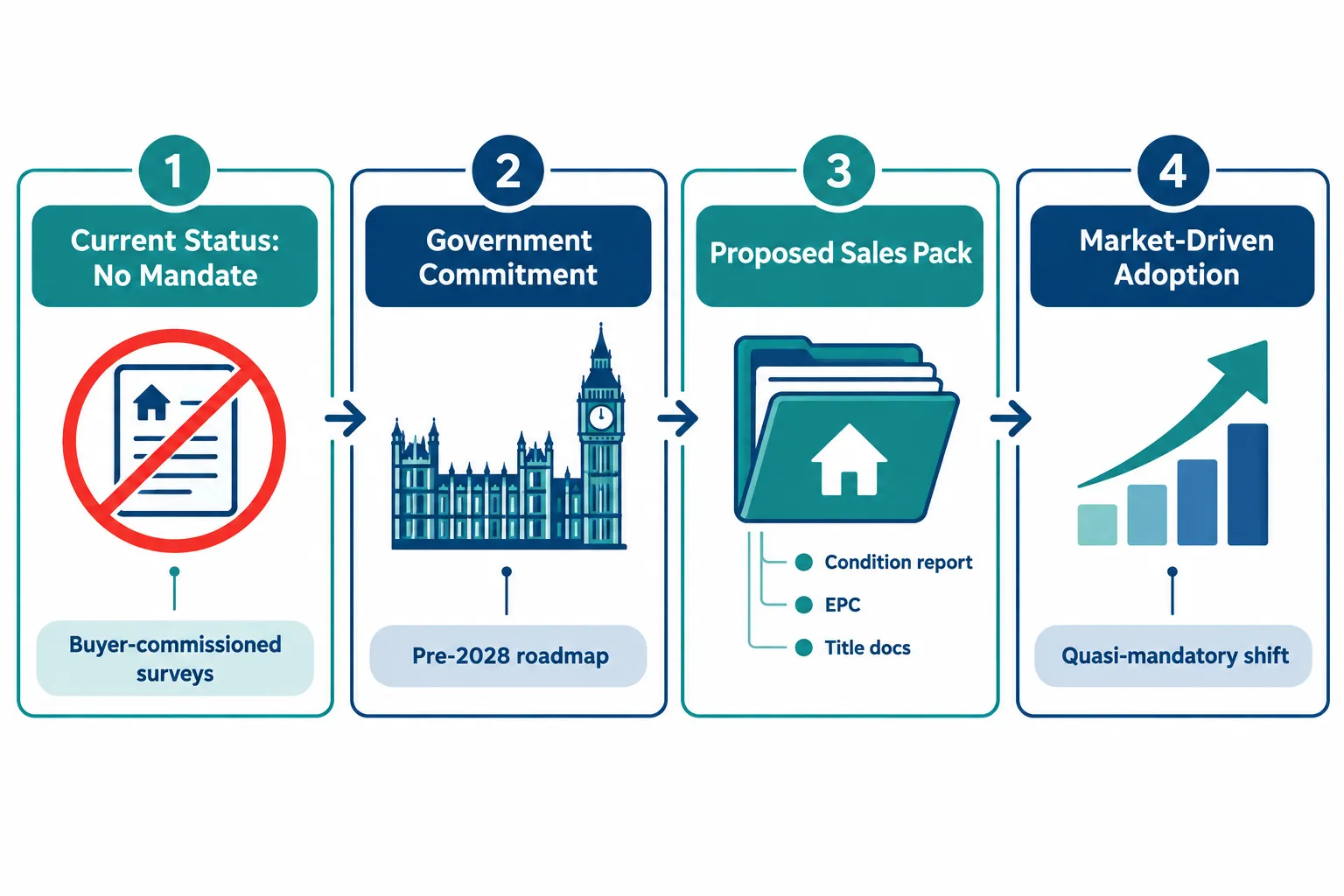
Despite a wave of headlines claiming that mandatory seller surveys will be "required from June 2026" or "in force by December 2026," the legal reality is more cautious [2]. As of 2026, there is no statutory requirement for sellers to commission a property condition assessment before listing a home in England, Wales, Scotland, or Northern Ireland [9].
What does exist is a clear government commitment. The current administration has stated it will introduce legislation requiring upfront property information, including a standardised condition report, before the end of this Parliament [7]. That timeline, realistically interpreted, points toward 2028 or later for full implementation. The conflicting "2026 mandatory" claims circulating in trade press and online guides appear to conflate the government's stated ambition with actual enacted law, or to describe market-driven adoption rather than legal compulsion [4].
Why does this distinction matter?
- Surveyors and valuers need to understand their current professional obligations versus anticipated future duties.
- Sellers and agents acting on premature claims risk misaligned expectations and potential disputes.
- Lenders and conveyancers setting policy now need to distinguish between voluntary best practice and statutory compliance.
That said, the direction of travel is unambiguous. The proposed framework is detailed, the RICS has updated its standards in anticipation, and market pressure is already nudging the industry toward upfront disclosure [3]. Treating the reform as a distant abstraction would be a strategic error for any surveying practice.
"The question for surveyors in 2026 is not whether mandatory property condition assessments will arrive, but how to position their practice for a market that is already moving in that direction."
What the Proposed Mandatory Property Condition Assessment Framework Looks Like

The proposed reform centres on a standardised sales pack that sellers would be required to assemble and provide to prospective buyers before or at the point of marketing [10]. This concept echoes the Home Information Pack (HIP) regime that ran from 2007 to 2010, but with important structural differences designed to address the criticisms that killed HIPs.
Core Components of the Proposed Sales Pack
The anticipated sales pack would include the following elements [4] [7]:
| Component | Description |
|---|---|
| Property Condition Report | Standardised RICS-aligned assessment of the building's physical state |
| Energy Performance Certificate | Already mandatory; retained and updated |
| Title and Ownership Documents | Land Registry data and legal title summary |
| Building Safety Information | Fire safety, cladding status, and relevant compliance records |
| Leasehold/Freehold Details | Service charges, ground rent, and lease length where applicable |
The Property Condition Report is the centrepiece. Unlike the old HIP, which relied on a Home Condition Report that was optional in practice, the new proposal envisages a report with genuine teeth, produced by a qualified surveyor, standardised in format, and shared with all parties including the buyer's lender [5].
How This Differs from the Home Information Pack
The HIP failed partly because mortgage lenders refused to accept its Home Condition Report as a substitute for their own valuation, rendering the survey element redundant. The new framework explicitly separates the condition report from the lender valuation, acknowledging that the two serve different purposes [8]. A condition report describes the physical state of the building for the benefit of buyers and sellers. A mortgage valuation assesses the security value of the asset for the lender. Conflating them was a structural flaw; the proposed reform attempts to resolve it by keeping both but making each fit for its specific purpose.
How Mandatory Property Condition Assessments in the UK Will Change Building Surveys and Valuations in 2026 and Beyond
The practical consequences for RICS building surveyors and valuers are substantial, whether or not full legislation is in place. The shift in who commissions the survey, from buyer to seller, changes almost every aspect of how surveys are ordered, conducted, reported, and paid for [5].
The Shift to Seller-Commissioned Surveys
Under the current model, a buyer typically commissions a Level 2 or Level 3 RICS Home Survey after their offer is accepted. The surveyor's client is the buyer; the report is written for the buyer's benefit; and the seller has no formal involvement in the process.
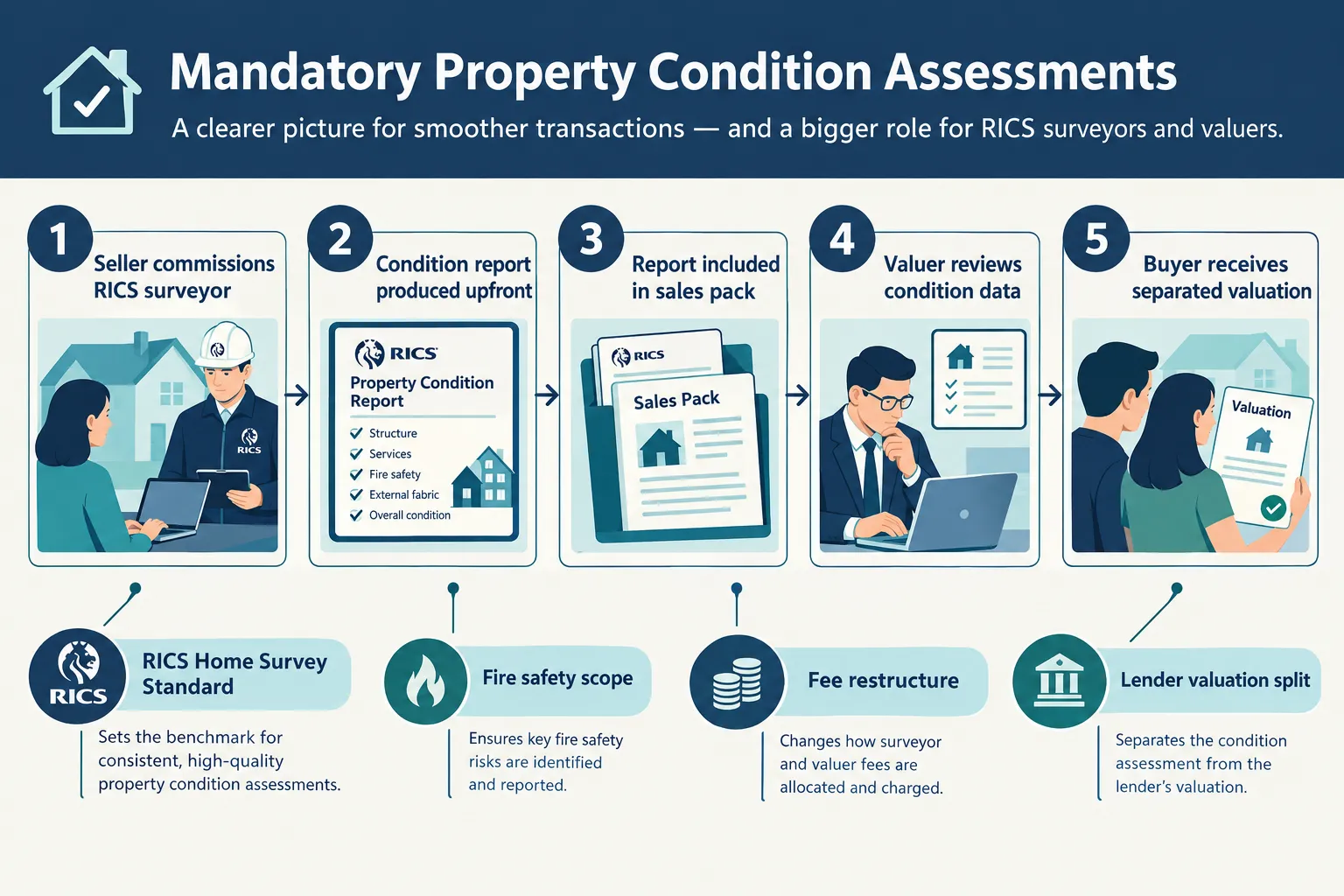
Under the proposed model, the seller commissions the condition report before the property is even listed [2]. This reversal has several knock-on effects:
- Client relationship changes: The surveyor's primary client becomes the seller, but the report must be usable by the buyer and their lender. This creates a dual-audience document that requires careful drafting.
- Timing shifts earlier: Surveys move from post-offer to pre-listing, compressing the pre-sale preparation phase and potentially reducing the time between offer and exchange.
- Liability questions arise: If a seller-commissioned report fails to identify a defect that later causes loss to the buyer, questions of professional liability become more complex. RICS guidance will need to address this explicitly [6].
Changes to RICS Home Survey Standards
The RICS 2nd Edition Home Survey Standard, published in 2025 and implemented across practices in 2026, provides the professional framework that underpins the anticipated mandatory regime [3]. Key updates relevant to the reform include:
- Expanded scope for building safety: Surveyors are now expected to address fire safety, cladding, and building safety compliance within condition assessments, reflecting the post-Grenfell regulatory environment [1].
- Clearer condition rating definitions: The three-tier condition rating system (1, 2, 3) has been refined to improve consistency across practitioners and reduce ambiguity in reports that will be shared with multiple parties.
- Standardised reporting templates: Updated templates align with the format anticipated for the statutory sales pack, making the transition to mandatory reporting smoother for compliant practices [3].
- Digital delivery requirements: Reports are expected to be machine-readable and compatible with digital property logbook platforms, supporting the government's broader ambition for a digital property market [10].
Separation of Condition Reports and Valuations
One of the most significant structural changes anticipated under Mandatory Property Condition Assessments in the UK: How They Will Change Building Surveys and Valuations in 2026 is the formal separation between condition assessment and mortgage valuation [8].
Currently, many buyers rely on a combined Level 2 survey and valuation, or assume that a lender's valuation provides meaningful information about the property's condition. Neither assumption is reliable. The proposed framework makes the distinction explicit:
- The condition report (seller-commissioned, upfront) describes physical defects, maintenance needs, and safety compliance.
- The mortgage valuation (lender-commissioned, post-offer) assesses market value for lending purposes and remains a separate instruction.
This separation is good news for valuers who have long argued that mortgage valuations are misunderstood by consumers. It is also good news for building surveyors, whose condition reports will carry greater weight in the transaction process rather than being seen as optional extras.
Fee and Cost Implications
The cost of upfront condition reports will fall initially on sellers, representing a new pre-sale expense that does not currently exist in most transactions [2]. Estimated costs for a seller-commissioned RICS condition report in 2026 range from approximately £400 for a standard Level 2 report on a typical terraced house to over £1,000 for a Level 3 building survey on a larger or older property [5].
For buyers, the reform could reduce costs if the seller's report is accepted in lieu of a separate buyer-commissioned survey, though many buyers and their solicitors are likely to seek independent verification for high-value or complex properties regardless.
For surveying practices, the reform creates both opportunity and pressure:
- Increased demand for pre-listing surveys represents a significant volume opportunity.
- Fee competition may intensify as sellers seek the lowest-cost compliant report.
- Practices that invest in standardised, digitally delivered reports aligned with RICS templates will be better positioned to win volume instructions from estate agents and developers [9].
Scope Expansion: Fire Safety, Building Safety, and Regulatory Compliance
The proposed condition assessment framework is not limited to traditional structural and maintenance concerns. Post-Grenfell legislation, including the Building Safety Act 2022 and associated secondary legislation, has expanded the scope of what a responsible condition report must address [5].
Surveyors conducting assessments under the new framework will be expected to comment on:
- Cladding and external wall systems for properties in scope of the Building Safety Act
- Fire door compliance and compartmentation where accessible
- Electrical installation condition (EICR status)
- Gas safety certification currency
- Asbestos-containing materials in properties of relevant age
- Damp, condensation, and ventilation issues that have regulatory as well as structural implications
This expanded scope increases the professional knowledge demands on surveyors and raises the time required to complete a thorough assessment. It also increases the value of the report to all parties, provided surveyors are properly trained and insured to cover the wider range of issues [6].
Market-Driven Adoption: The "Quasi-Mandatory" Reality of 2026
Even without legislation, significant market pressure is already pushing the industry toward upfront condition reporting. Several major estate agency groups have begun requiring sellers to provide a condition report or property information questionnaire before listing [7]. Conveyancers are increasingly requesting upfront material information to comply with National Trading Standards guidance on property listings.
This market-driven adoption creates a de facto quasi-mandatory environment in which sellers who do not provide upfront information face longer marketing periods, more conditional offers, and higher fall-through rates [4]. For practical purposes, the distinction between "legally required" and "commercially necessary" is narrowing rapidly.
For RICS surveyors, this means the volume of pre-listing survey instructions is already growing in 2026, regardless of the legislative timetable. Practices that have aligned their workflows, report templates, and client communications with the anticipated mandatory framework are capturing this demand now rather than waiting for the statute book to catch up [9].
Conclusion
The proposed Mandatory Property Condition Assessments in the UK: How They Will Change Building Surveys and Valuations in 2026 represent the most significant structural reform to the home buying process in over a decade. While full statutory implementation remains on the horizon rather than in force today, the direction is clear and the market is already moving.
Actionable next steps for professionals and property owners:
-
RICS surveyors and valuers should review the 2nd Edition Home Survey Standard now and align their reporting templates, scope of inspection, and client engagement letters with the anticipated mandatory framework. Early adopters will be better placed to win pre-listing instructions.
-
Estate agents and conveyancers should update their seller onboarding processes to recommend or require upfront condition reports, reducing fall-through risk and demonstrating compliance with National Trading Standards material information guidance.
-
Sellers planning to list in 2026 or 2027 should budget for a seller-commissioned RICS condition report as part of their pre-sale costs and treat it as a marketing asset rather than a compliance burden, a clean, professionally produced report can accelerate sales and reduce renegotiation risk.
-
Buyers should not assume that a seller-provided condition report replaces independent advice for high-value or complex properties. A separate Level 3 building survey remains prudent for older, larger, or non-standard properties.
-
Surveying practices should invest in digital delivery infrastructure and building safety training now, as both will be non-negotiable requirements under any future mandatory regime.
The reform is coming. The practices, agents, and sellers who prepare now will be the ones who benefit most when the legislation finally arrives.
References
[1] Revised Rics Property Measurement Guidance Impacts On Building Surveys And Valuations In Q2 2026 – princesurveyors.co.uk
[2] Mandatory Seller Surveys 2026 Reform – propelr.co.uk
[3] Rics 2nd Edition Home Survey Standard 2025 Key Updates And Implementation Roadmap For Building Surveyors In 2026 – princesurveyors.co.uk
[4] Home Information Packs Sales Pack 2026 – findmysurveyor.com
[5] Building Surveys Under Rics Home Buying Reforms 2026 What Surveyors Need To Know For Mandatory Upfront Assessments – princesurveyors.co.uk
[6] Profession Standards – rics.org
[7] Uk Home Buying Reform 2026 – findmysurveyor.com
[8] Residential Valuations – rics.org
[9] Homebuying Process Reforms 2026 How Building Surveys Become Mandatory For Uk Buyers And Surveyors – princesurveyors.co.uk
[10] Property Condition Report Sales Pack Uk – logbook.co.uk