A single surveyor, one report, and a court that reads it as the definitive technical word on a dispute, that is the practical reality of the single joint expert (SJE) regime that governs most low-to-mid-value property cases in England and Wales. Understanding what is a joint expert report in a property dispute, how single joint experts are instructed, and what court procedure demands of them is not optional knowledge for anyone facing litigation over a boundary, a valuation, or building defects.
Key Takeaways
- A single joint expert is appointed by both parties but owes an overriding duty to the court, not to either side.
- Civil Procedure Rules Part 35 governs expert evidence in England and Wales; courts actively encourage SJE appointments to control costs.
- Both parties must send their instructions to the expert at the same time, and those instructions must be copied to the other side.
- The expert's report must follow a prescribed format and include a statement of truth and a declaration of independence.
- Parties may ask written questions of the SJE after the report is filed, but unilateral private contact is strictly prohibited.
The Legal Framework: CPR Part 35 and the Expert's Duty to the Court
Expert evidence in civil property disputes is regulated by Civil Procedure Rules Part 35 [3]. The rules set a clear hierarchy: the expert's overriding duty is to the court, and that duty takes precedence over any obligation to the party who instructed or is paying for the expert [3].
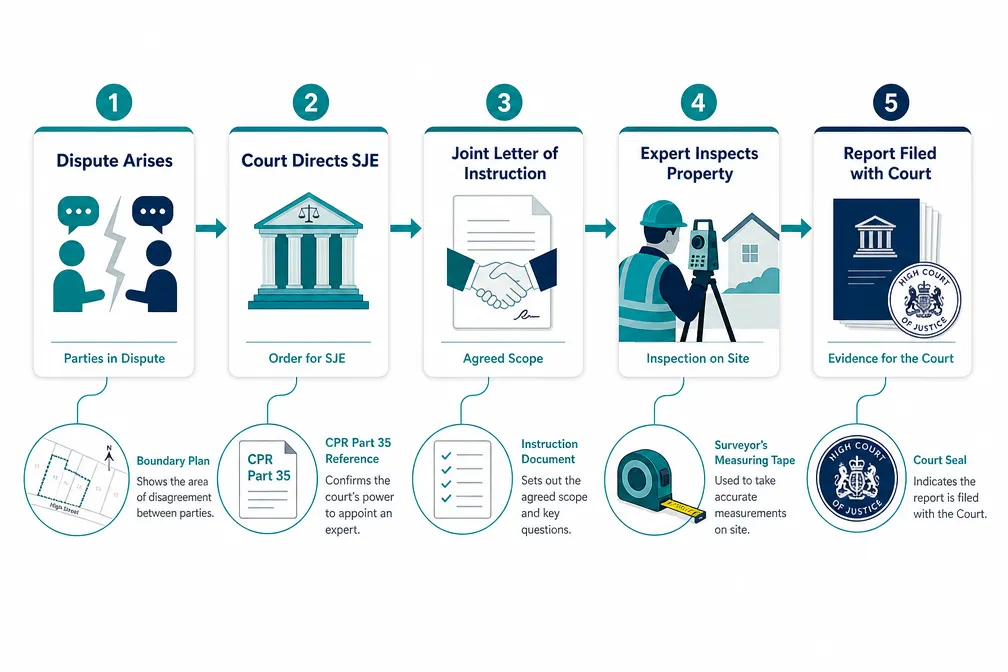
CPR 35.7 gives the court power to direct that a single joint expert be instructed rather than allowing each party to appoint their own witness [3]. In practice, courts exercise this power frequently in property cases where the technical question is relatively contained, a boundary measurement, a market valuation, or the cause of a damp defect. The court's aim is proportionality: one competent expert costs far less than two adversarial ones, and it removes the risk of a "battle of experts" that inflates costs without improving the quality of the decision [5].
The Practice Direction to Part 35 sets out the content requirements for every expert report. The report must [3]:
- state the substance of all material instructions (written or oral) on which it is based
- include a summary of conclusions
- contain a statement that the expert understands their duty to the court and has complied with it
- be verified by a statement of truth
Failure to comply with these requirements can lead the court to refuse to admit the report or to order the expert to produce a supplementary statement [5].
For a broader comparison of when a surveyor is the right expert choice versus a structural engineer, see this guide to expert witness surveyor vs structural engineer for defect and valuation disputes.
What Is a Joint Expert Report in a Property Dispute? Defining the SJE Role
A single joint expert is a person instructed by two or more parties to a dispute to provide independent expert evidence on a question that requires specialist knowledge [4]. In property disputes, that specialist is almost always a chartered surveyor, RICS-qualified and experienced in the relevant discipline, whether valuation, building pathology, boundary surveying, or dilapidations.
The RICS Dispute Resolution Service distinguishes clearly between three roles that are often confused [4]:
| Role | Appointed by | Duty owed to | Partisan? |
|---|---|---|---|
| Party-appointed expert witness | One party | Court (overriding), instructing party | No, must be independent |
| Single joint expert (SJE) | Both parties jointly | Court | No, must be independent |
| Independent expert (IE) | Agreement or contract | Parties (as agreed) | Depends on terms |
An independent expert appointed under a lease or contract, for example to determine a rent review, is a different creature from an SJE appointed under CPR Part 35. The IE's decision is usually final and binding between the parties without recourse to the court, whereas the SJE's report is evidence that the court weighs alongside other material [4].
The SJE is not a mediator or arbitrator. The expert does not decide the dispute; the court does. The expert provides an objective technical opinion that the court can rely upon without having to choose between competing hired guns.
For property valuation disputes specifically, a valuation dispute expert witness brings the RICS Red Book methodology and market evidence that courts expect to see applied consistently.
How Single Joint Experts Are Instructed: Transparency and the Letter of Instruction
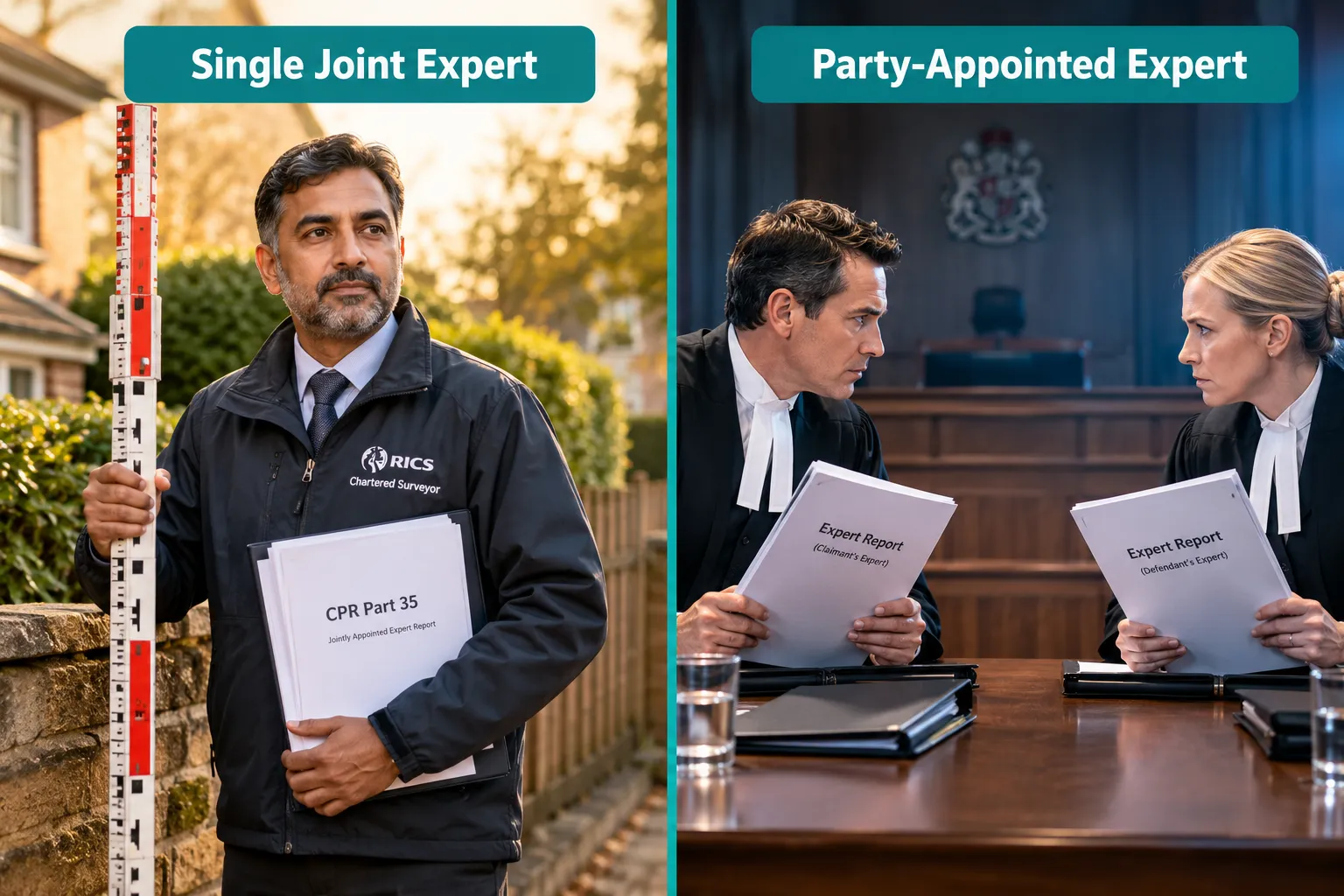
The letter of instruction is the document that defines the scope of the SJE's work. Getting it right matters: an ambiguous or one-sided instruction letter can lead to a report that fails to answer the court's questions, or worse, to satellite litigation about whether the expert exceeded their remit.
Who Drafts the Instructions?
Both parties' solicitors should agree the letter of instruction before it is sent. Where they cannot agree on every question, the standard practice is to send a single letter that identifies the agreed questions and flags any disputed additions, leaving the court to resolve the disagreement if necessary [3].
CPR 35.8(1) states that where parties cannot agree on instructions, each party may give separate instructions, but those instructions must be copied to the other party at the time of sending [3]. This copying requirement is absolute. An expert who receives instructions that have not been copied to the other side should flag the issue immediately.
What Must the Letter Cover?
A well-drafted letter of instruction to an SJE in a property dispute should address:
- The precise question(s) for the expert, for example, "What is the open market value of the property at [address] as at [date]?" or "Where does the legal boundary between the two properties lie, and does the fence erected in [year] encroach upon it?"
- The documents to be provided, title plans, Land Registry entries, historic photographs, previous survey reports, correspondence
- The site access arrangements, dates, who will be present, any health and safety considerations
- The format and length of the report, courts often specify this in directions
- The timetable, the date by which the report must be filed and served
- Fee arrangements, how the expert's costs will be shared and invoiced (see the costs section below)
- Confirmation that the expert is instructed jointly, the letter should make clear that the expert is not acting for either party alone
The letter must not contain without-prejudice material, admissions, or anything that would be inadmissible if shown to the court [5].
Restrictions on Unilateral Contact
Once an SJE is appointed, neither party may contact the expert privately to discuss the substance of the case [3]. All communications must be copied to the other side. This rule protects the expert's independence and prevents any suggestion that the report has been shaped by one party's private lobbying.
If a party wants to ask the expert a question after the report is delivered, CPR 35.6 permits written questions to be put to the expert within 28 days of service of the report, but only for the purpose of clarification [3]. Those questions and the expert's answers become part of the expert's report for the purposes of the proceedings.
Structure and Content of the Joint Expert Report
The Report Format
A joint expert report in a property dispute will typically follow this structure:
- Introduction, the expert's qualifications, the scope of instruction, the documents reviewed, and the site visit details
- Summary of facts, a neutral account of the property, its history, and the factual background to the dispute
- Analysis, the expert's methodology, the evidence considered, and the reasoning applied
- Conclusions, clear answers to each question posed in the letter of instruction
- Statement of truth, signed by the expert
- Declaration of independence, confirming the expert understands their duty to the court
The report must not be a vehicle for advocacy. An expert who uses the report to argue a party's case rather than to answer the court's questions risks having the report excluded and faces potential criticism in the court's costs order [5].
The Statement of Truth
Every expert report filed under CPR Part 35 must contain a statement in the following form: "I confirm that I have made clear which facts and matters referred to in this report are within my own knowledge and which are not. Those that are within my own knowledge I confirm to be true. The opinions I have expressed represent my true and complete professional opinions on the matters to which they refer." [3]
This is not a formality. An expert who signs a false statement of truth faces proceedings for contempt of court.
Costs, Fees, and Proportionality
How Costs Are Shared
The default position under CPR 35.8(5) is that the parties share the SJE's fees equally unless the court orders otherwise [3]. In practice, the letter of instruction will set out the billing arrangement. Common approaches include:
- Equal split from the outset, each party pays 50% of invoices as they fall due
- Claimant pays, recovers on judgment, the claimant funds the expert and seeks recovery in costs if successful
- Payment into a joint account, both parties pay their share into a designated account before the expert begins work
Courts have wide discretion to depart from equal sharing where one party's conduct has made the expert's task significantly more complex or expensive [5].
Fee Levels in 2026
SJE fees in property disputes vary considerably by discipline and complexity. As a rough guide for England and Wales in 2026:
| Dispute type | Typical SJE fee range |
|---|---|
| Residential valuation dispute | £800, £2,500 |
| Boundary dispute survey | £1,500, £4,000 |
| Building defect / dilapidations | £2,000, £6,000+ |
| Commercial property valuation | £3,000, £10,000+ |
These figures are indicative only and depend on property size, complexity, and the expert's seniority. For dilapidations disputes in particular, the scope of inspection and the schedule of condition required can push fees toward the upper end of the range. A dilapidations expert witness will typically provide a fee estimate before accepting the instruction.
When Courts Appoint an SJE and When They Do Not
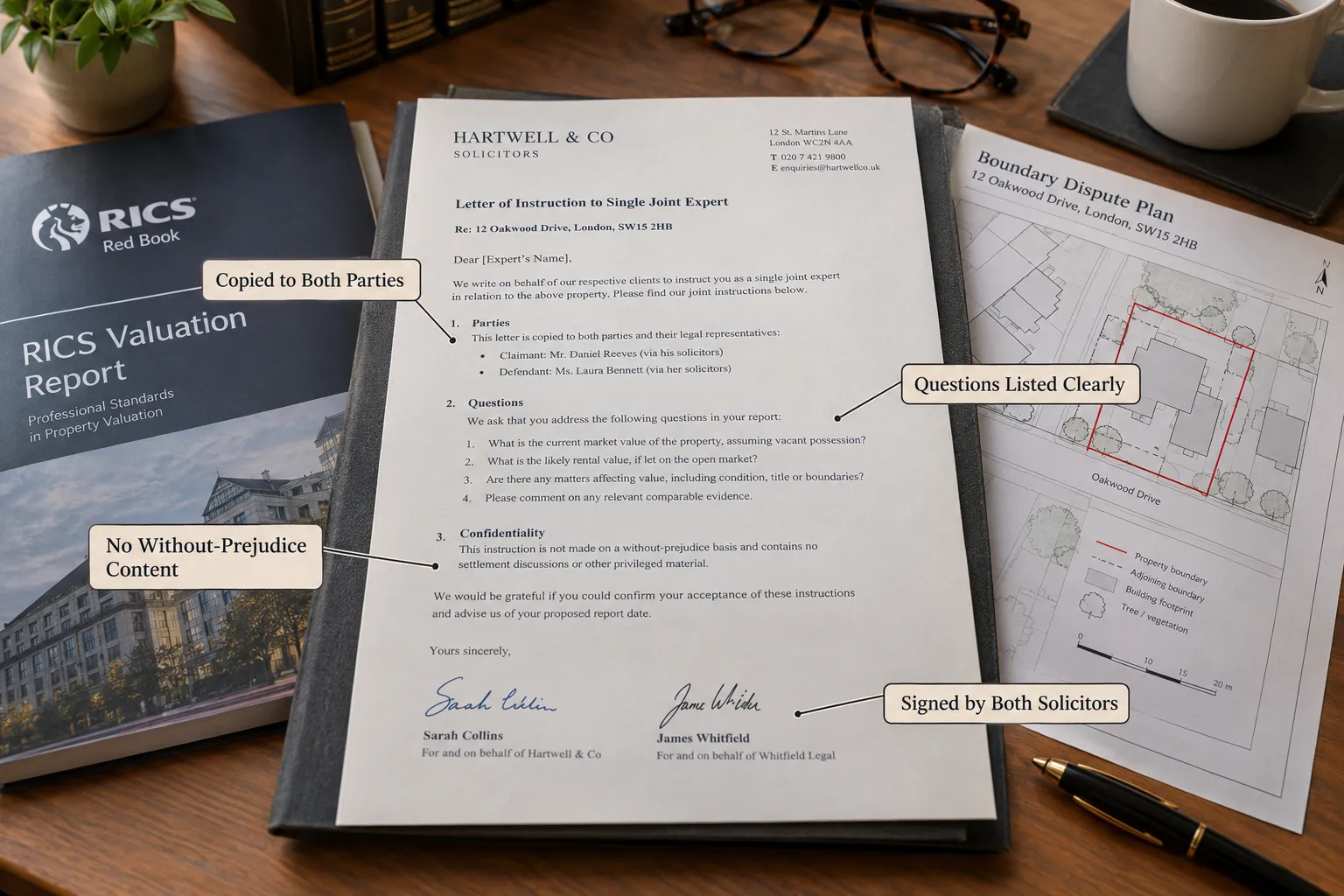
Courts are most likely to direct a single joint expert where [3] [5]:
- the case is allocated to the small claims track or fast track
- the technical question is narrow and well-defined
- the parties' own experts have already produced reports that are broadly consistent
- the cost of two experts would be disproportionate to the value of the claim
Courts are less likely to insist on an SJE where:
- the technical issues are genuinely complex or contested on multiple fronts
- the case involves significant public interest
- the parties' experts have reached fundamentally different conclusions that require the court to choose between competing methodologies
In multi-track cases, the court may allow each party a party-appointed expert but will still require those experts to meet, produce a joint statement identifying areas of agreement and disagreement, and give concurrent evidence (sometimes called "hot-tubbing") [7]. This is distinct from the SJE regime but shares the same underlying goal: reducing adversarial posturing and focusing the court's attention on genuine technical disagreements.
For boundary disputes in particular, the technical complexity of interpreting historic conveyancing plans, aerial photographs, and physical features on the ground often justifies a party-appointed boundary dispute expert witness rather than an SJE, though the court retains discretion.
Party wall matters that escalate to court proceedings may also require expert evidence. The interaction between the Party Wall etc. Act 1996 surveyor regime and CPR Part 35 is a specialist area; a party wall expert witness can advise on how the two frameworks interact.
Practical Guidance for Solicitors and Property Owners
If you are a solicitor or a property owner facing a dispute where an SJE may be directed, the following steps will help manage the process effectively:
-
Agree the expert's identity early. Disputes about who should act as SJE waste time and money. Agree a shortlist of RICS-qualified candidates and check each one's relevant experience and availability before proposing them to the other side.
-
Draft the questions precisely. Vague questions produce vague reports. Each question should be answerable with a specific factual or opinion-based conclusion.
-
Provide complete documentation. An expert who has to chase documents will take longer and charge more. Compile the title register, title plan, any previous survey reports, photographs, and relevant correspondence before sending the letter of instruction.
-
Do not attempt to influence the expert privately. Any communication that is not copied to the other side risks the report being excluded and a wasted costs order against the offending party.
-
Read the report carefully before the deadline for questions. The 28-day window for CPR 35.6 questions is the only formal opportunity to seek clarification. Missing it can be costly.
For housing disrepair claims, where the technical evidence about condition and causation is often central to liability, a housing disrepair expert witness will be familiar with the specific inspection and reporting standards courts expect.
Frequently Asked Questions
Can a party refuse to accept the SJE's conclusions?
Yes. The SJE's report is evidence, not a binding determination. A party may challenge the conclusions by putting written questions under CPR 35.6, by calling their own expert (if the court grants permission), or by cross-examining the SJE at trial. In practice, courts give significant weight to an SJE's report, and challenging it successfully requires strong grounds.
What happens if the SJE's report contains an error?
The first step is to raise the issue through written questions under CPR 35.6. If the error is material and the expert's clarification does not resolve it, the affected party can apply to the court for permission to rely on their own expert instead.
Can the SJE decline to answer a question?
An expert can decline to answer a question that falls outside their expertise or that requires them to make a legal determination rather than a technical one. The expert should explain the reason in writing.
Who pays if the SJE's fee exceeds the agreed estimate?
The expert should notify both parties before incurring costs that exceed the agreed budget. Both parties must consent to additional expenditure, or the matter may need to go back to the court for directions.
Is the SJE regime used in tribunal proceedings?
The First-tier Tribunal (Property Chamber) has its own procedural rules, but the principles of independence and joint instruction are broadly similar. RICS guidance on expert witnesses applies across most tribunal and court settings [4].
Does the SJE need to be RICS-qualified?
There is no statutory requirement, but courts expect experts to have appropriate professional qualifications and experience. In property disputes, RICS membership and relevant post-qualification experience are the accepted standard.
Conclusion
The single joint expert regime exists because courts recognise that property disputes are rarely won or lost on technical evidence alone, but that disproportionate expert costs can make litigation uneconomic for both sides. A properly instructed SJE, working within the CPR Part 35 framework, provides the court with objective technical evidence at a fraction of the cost of two competing experts.
For anyone entering this process, whether as a property owner, landlord, leaseholder, or solicitor, the practical priorities are clear: agree the expert's identity and instructions early, keep all communications transparent, frame questions with precision, and treat the expert's independence as non-negotiable.
If you need a RICS-qualified expert witness for a property dispute in the North West, an expert witness in Manchester can advise on whether a single joint expert appointment is appropriate for your case and assist with drafting compliant instructions.
References
[1] CPR Part 35 – irp-cdn.multiscreensite.com
[2] What Is A Single Joint Expert – surveymerchant.com
[3] Part 35 – justice.gov.uk
[4] Expert Witnesses Single Joint Experts And Independent Experts – rics.org
[5] CPR 35 Explained Part 35 And Practice Direction 35 – alldoq.com
[6] Litigation Expert Witness – blakessurveyors.com
[7] Issue 39 – fenwickelliott.com