Removing a chimney breast is one of the most structurally sensitive alterations a homeowner can make, and in terraced or semi-detached properties, it is also one of the most legally misunderstood. A significant number of homeowners proceed without serving any notice, only to face disputes, injunctions, or costly remedial work once the damage to a neighbour's structure becomes apparent. This article explains the Party Wall Notice for Chimney Breast Removal: When the Act Applies and What Surveyors Assess, covering the precise legal triggers, the notice procedure, and the technical matters a party wall surveyor will examine before any steel goes in.
Key Takeaways
- The Party Wall etc. Act 1996 is triggered when chimney breast removal involves cutting into, or removing support from, a party wall, this is governed by Section 2(2)(g).
- A two-month notice must be served on the adjoining owner before work begins; failure to do so can result in an injunction stopping the works.
- Party wall surveyors assess structural engineer calculations, wall thickness, bearing capacity, and the neighbour's retained chimney stack before agreeing to any Award.
- A Schedule of Condition of the neighbour's property must be prepared before works start to protect both parties if damage is later alleged.
- Not every chimney breast removal triggers the Act, works entirely within your own property and not touching the party wall may fall outside its scope, though building regulations still apply.
When the Party Wall etc. Act 1996 Applies to Chimney Breast Removal
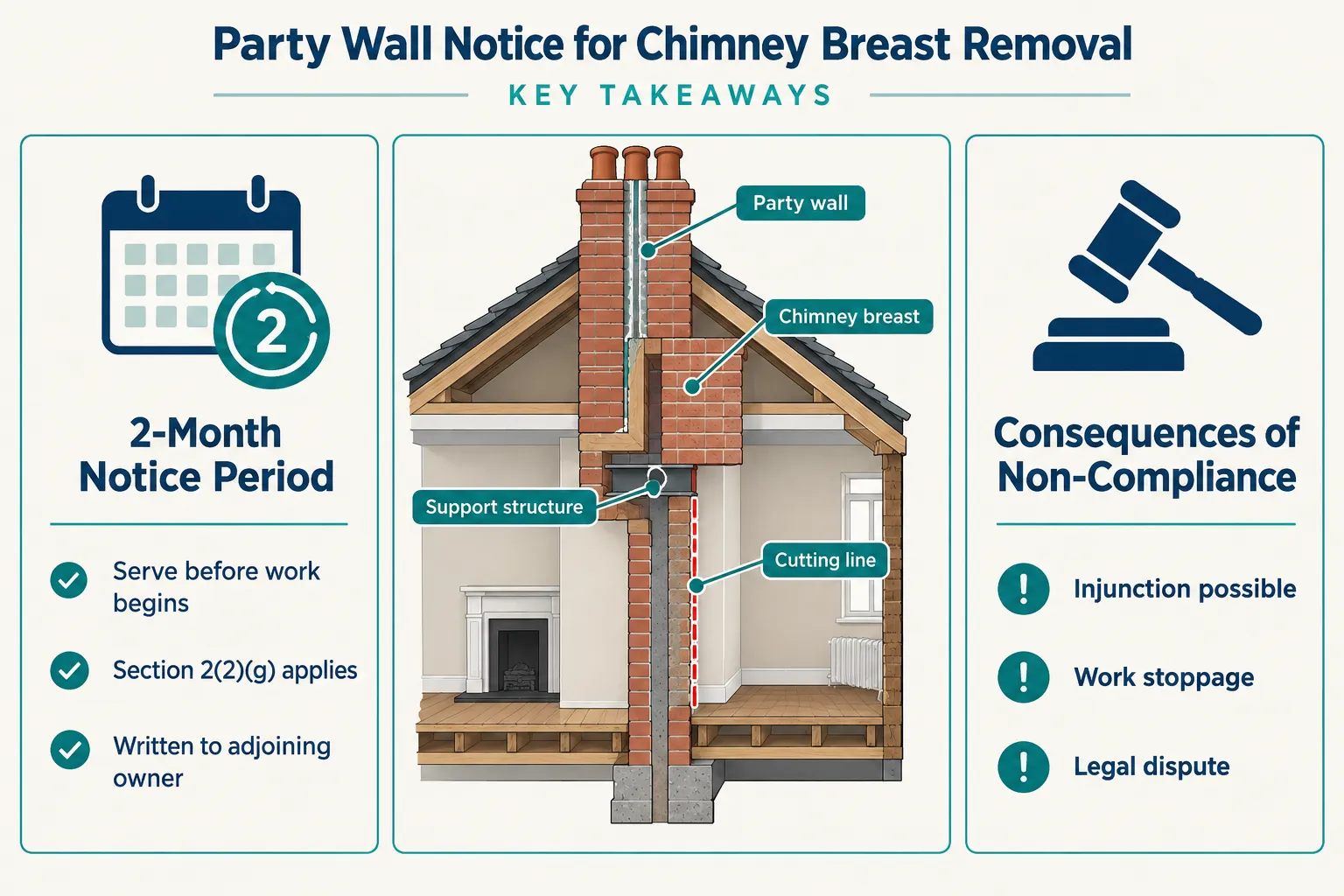
The Party Wall etc. Act 1996 does not apply to every internal alteration. The critical question is whether the chimney breast is physically connected to, or forms part of, the party wall shared with a neighbour [2][9].
In most Victorian and Edwardian terraced or semi-detached houses, the chimney breast sits against or within the party wall. Removing it almost always requires cutting into that wall to install a steel gallows bracket, padstone, or other support to carry the weight of the chimney stack above. That act of cutting into the party wall is the legal trigger [3][7].
Section 2(2)(g) of the Act specifically covers cutting away from a party wall any chimney breast, jamb, or flue. Once that section is engaged, the building owner must serve a Party Wall Notice before any work begins [9].
Three conditions will typically engage the Act [7][8]:
- The chimney breast is attached to or forms part of the party wall.
- The removal involves cutting into the party wall to install steel beams, gallows brackets, or padstones.
- Any alteration affects the structural support shared with the neighbour.
What if the chimney breast is on an external wall only?
If the chimney breast sits entirely on an external wall with no connection to the party wall, and the removal does not affect any shared structure, the Act is unlikely to apply. Building regulations and planning rules may still be relevant, but the party wall procedure is not triggered. This distinction matters, and a chartered surveyor can confirm which side of the line your project falls on before you commit to a contractor.
If you are unsure whether your project needs a notice, the guidance at Do I Need a Party Wall Agreement? sets out the general test clearly.
The Notice Procedure: Timescales and Neighbour Rights
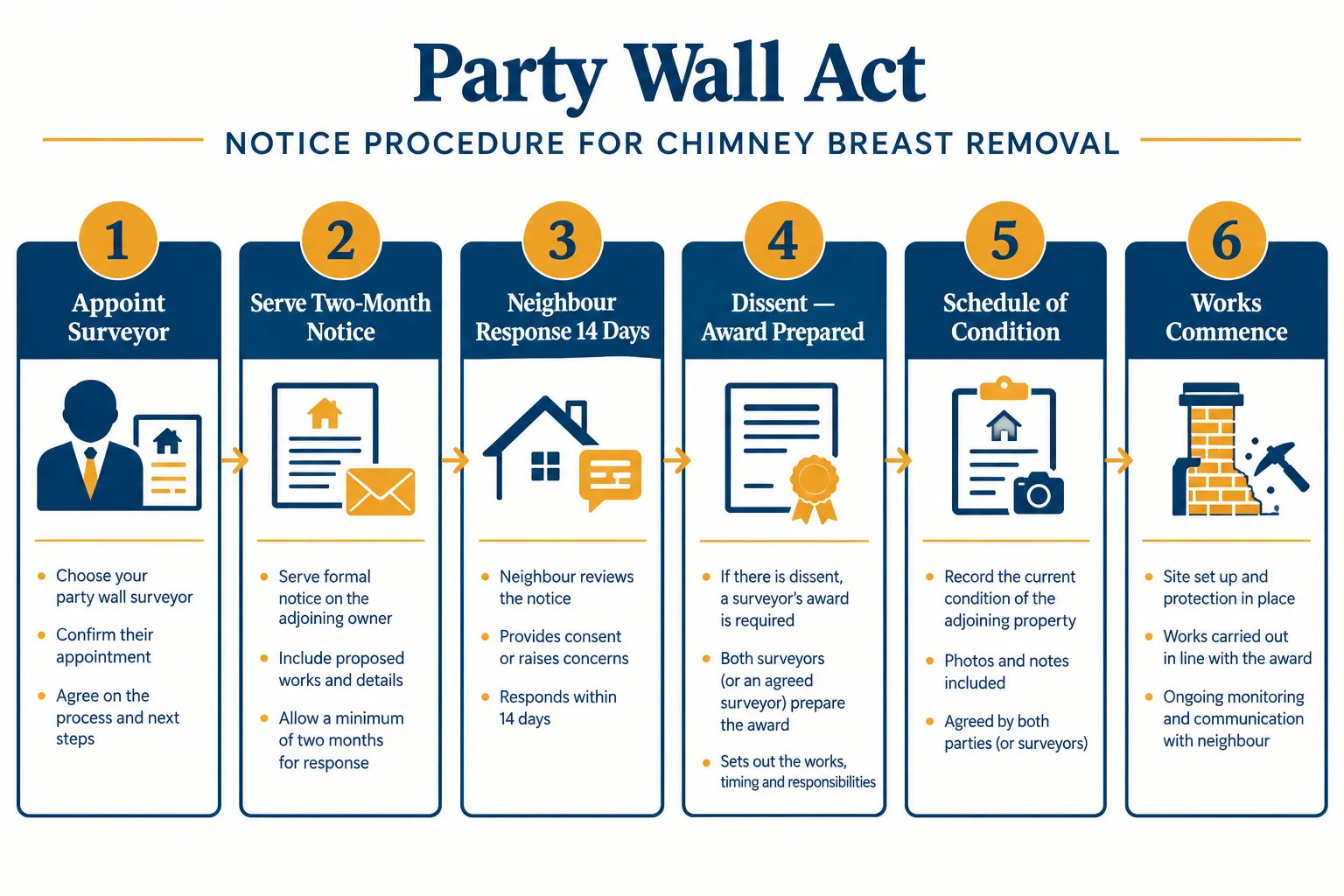
Once it is established that the Act applies, the building owner must serve a written Party Wall Notice on every adjoining owner at least two months before the planned start date [2]. The notice must describe the works clearly, state the proposed start date, and be signed by the building owner or their surveyor.
The adjoining owner then has 14 days to respond in one of three ways [2]:
| Response | Outcome |
|---|---|
| Written consent | Works may proceed without a formal Award |
| Dissent, appointing a surveyor | A Party Wall Award is prepared |
| No response within 14 days | Deemed dissent; surveyor appointments are triggered |
Where the neighbour dissents or fails to respond, both parties appoint surveyors, either separately or jointly as an Agreed Surveyor, who then prepare a Party Wall Award. The Award sets out the manner and timing of the works, the protective measures required, and the rights of access for inspection [2][5].
The Award is a legally binding document. For a detailed explanation of what it contains and why it matters, see Party Wall Awards UK: What They Contain and Why You Need One.
What happens if no notice is served?
Proceeding without notice is not a minor procedural oversight. The adjoining owner can apply to court for an injunction to halt the works, and the building owner may be liable for any damage caused [8]. If works have already started, a notice can be served retrospectively, but the neighbour retains the right to appoint a surveyor and seek an Award even after the fact. The process for dealing with this situation is explained in What If You Do Not Have A Party Wall Agreement.
What Party Wall Surveyors Assess for Chimney Breast Removal
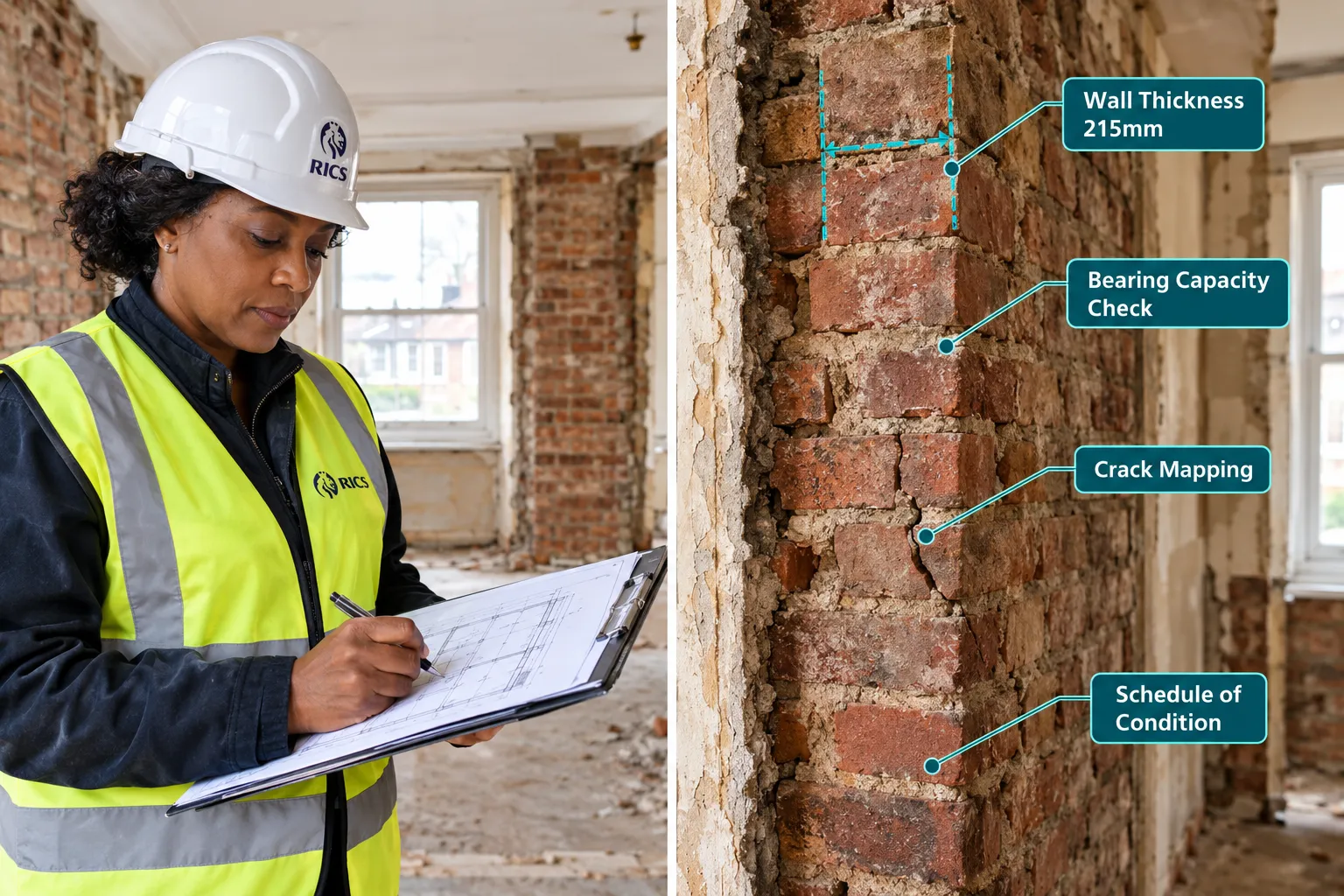
The party wall surveyor's role is not simply administrative. For chimney breast removal, the technical assessment is detailed and property-specific. The surveyor must satisfy themselves, and the adjoining owner, that the proposed works are safe and that the neighbour's property will not be harmed [1][5].
Structural Engineer's Calculations and Drawings
The surveyor will require a structural engineer's calculations and drawings before agreeing to any Award. These must show:
- The loads being transferred from the chimney stack above to the new support structure.
- The specification and sizing of the gallows bracket, steel beam, or padstone.
- The bearing details, how the new support sits on or into the party wall.
Without approved structural drawings, no competent party wall surveyor should proceed to an Award [7].
Party Wall Thickness and Condition
A minimum wall thickness is needed to accept the bearing of a gallows bracket safely. For most domestic chimney breast removals, the party wall must be at least 215 mm thick (a single-brick wall in stretcher bond) to provide adequate bearing [3][7]. The surveyor will check:
- The actual thickness of the wall at the point of bearing.
- The condition of the brickwork, cracking, spalling, or previous repairs that might reduce load capacity.
- Whether the wall has been altered previously in a way that affects its structural integrity.
Support for the Neighbour's Retained Chimney Breast and Stack
This is the most frequently overlooked issue. In a terrace, the neighbour may have their own chimney breast on the other side of the party wall. Removing your chimney breast can alter the load path through the shared wall, potentially destabilising the neighbour's retained stack [5][8].
The surveyor will assess:
- Whether the neighbour's chimney breast is still present and in use.
- How the neighbour's stack is currently supported and whether that support is affected by the proposed works.
- Whether any temporary propping or permanent remedial works are needed to maintain the neighbour's structure.
Temporary Works and Protection
The Award will specify any temporary propping required during the works, the sequence of operations, and the hours during which noisy or disruptive work may be carried out. This protects both the building owner (by setting clear parameters for the contractor) and the adjoining owner (by limiting disruption and risk) [1][2].
Schedule of Condition
Before any work begins, the surveyor prepares a Schedule of Condition, a photographic and written record of the adjoining owner's property, covering walls, ceilings, floors, and any existing cracks or defects [2][5]. This document is attached to the Award and serves as the baseline for any future damage claim.
If the neighbour later alleges that a crack in their ceiling was caused by the chimney breast removal, the Schedule of Condition is the evidence that determines whether the claim is valid. Without it, the building owner has no defence against pre-existing damage being attributed to their works.
For guidance on what a full Party Wall Award contains once all these assessments are complete, see Party Wall Award Guidance.
Chimney Breast Removal vs Ordinary Internal Alteration
Not every chimney breast removal is a party wall matter. The table below sets out the key differences.
| Scenario | Party Wall Act Triggered? | Notice Required? |
|---|---|---|
| Chimney breast on party wall; gallows bracket cuts into shared wall | Yes, Section 2(2)(g) | Two-month Party Wall Notice |
| Chimney breast on party wall; breast removed but stack supported independently without cutting party wall | Possibly, surveyor assessment needed | Seek professional advice |
| Chimney breast on external wall only; no shared structure affected | No | Not under the Act (building regs still apply) |
| Chimney breast in mid-terrace, neighbour's stack still present above | Yes, structural interdependency | Two-month Party Wall Notice |
The distinction between an ordinary internal alteration and a notifiable party wall matter is not always obvious from looking at the property. A structural engineer's inspection and a party wall surveyor's initial advice will confirm which category applies [7][8].
Costs and Who Pays
Party wall surveyor fees for a chimney breast removal Award are typically borne by the building owner, since they are the party carrying out the works [2]. Where both parties appoint separate surveyors, the building owner usually pays both sets of fees, unless the Award determines otherwise.
Typical fee ranges in 2026 for a chimney breast party wall matter:
- Agreed Surveyor (single surveyor acting for both parties): £800, £1,500 for a straightforward case.
- Two surveyors (one per party): £1,200, £2,500 total, depending on complexity.
- Third surveyor (if the two appointed surveyors cannot agree): Additional fees apply.
These figures are indicative. Fees vary by location, complexity of the structural works, and whether the neighbour's retained stack requires additional assessment.
Frequently Asked Questions
Does removing a chimney breast always require a Party Wall Notice?
No. The notice is only required where the works affect the party wall, typically by cutting into it to install a support. If the chimney breast is on an external wall with no connection to a shared structure, the Act does not apply [3][7].
Can I use an Agreed Surveyor rather than two separate surveyors?
Yes. Both parties can appoint a single Agreed Surveyor who acts impartially for both. This is often quicker and less expensive, provided both parties trust the surveyor to act fairly [2].
What if my neighbour refuses to engage with the process?
If the adjoining owner fails to respond within 14 days of the notice, they are deemed to have dissented. The building owner can then appoint a surveyor on the neighbour's behalf if they continue to refuse to appoint one themselves [2][9].
Is a Schedule of Condition always prepared?
It is standard practice and strongly advisable. Without it, any pre-existing defects in the neighbour's property cannot be distinguished from damage caused by the works. A surveyor acting properly will insist on it [1][5].
Do I need building regulations approval as well?
Yes. Party wall procedures and building regulations are separate. Chimney breast removal requires building regulations approval regardless of whether the Party Wall Act applies, because it involves structural alterations [3].
What if my neighbour is carrying out chimney breast removal without serving notice on me?
You have the right to appoint a party wall surveyor at the building owner's expense and seek an Award. The situation is covered in detail at Neighbour is carrying out Works without Party Wall Agreement.
Conclusion
The Party Wall Notice for Chimney Breast Removal: When the Act Applies and What Surveyors Assess is not a bureaucratic formality, it is a structured process designed to protect both the building owner and their neighbour from structural harm and legal dispute. The key steps are straightforward: establish whether the Act applies, serve the correct notice with adequate lead time, and appoint a qualified party wall surveyor to prepare a proper Award backed by structural engineer drawings and a Schedule of Condition.
Practical next steps:
- Instruct a structural engineer to assess the chimney breast and confirm whether cutting into the party wall is required.
- Consult a RICS-accredited party wall surveyor at the earliest stage, before appointing a contractor.
- Serve the Party Wall Notice at least two months before the planned start date.
- Ensure a Schedule of Condition is prepared and attached to the Award before any work begins.
- Keep copies of all notices, responses, and the Award throughout the project.
Acting early avoids injunctions, protects against damage claims, and gives both parties confidence that the works will be carried out safely.
References
[1] Pw Guide Revf – fpws.org.uk
[2] The Party Wall Etc Act 1996 Explanatory Booklet – gov.uk
[3] Chimney Breasts Removal – redbridge.gov.uk
[5] Removing A Chimney Breast And Why You Need A Party Wall Agreement – stokemont.com
[7] Do I Need Party Wall Agreement For Chimney Breast Removal – peterbarry.co.uk
[8] Party Wall Act Rules For Removing Chimney Breasts – charrettelaw.co.uk
[9] legislation.gov.uk – legislation.gov.uk