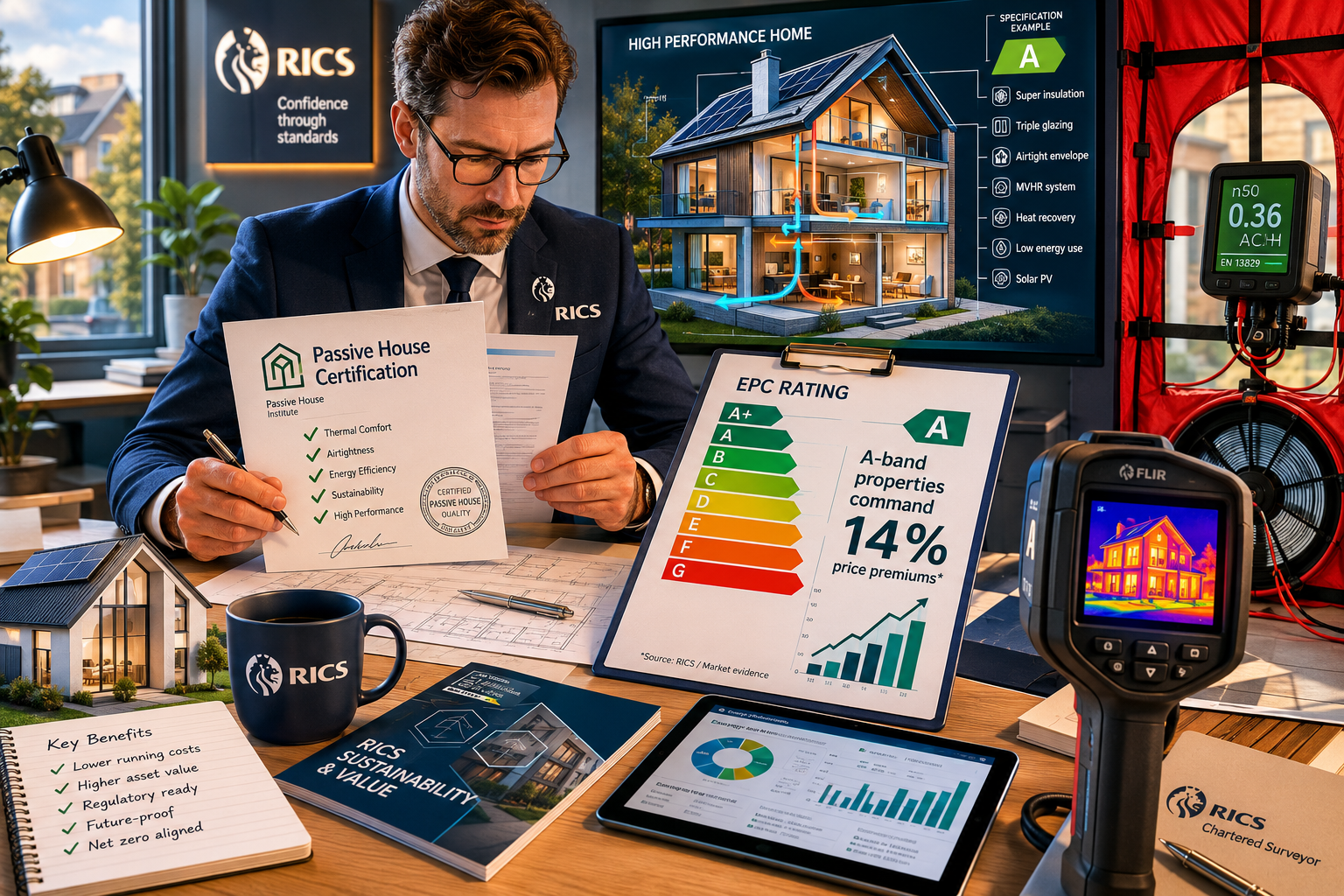
Properties rated EPC A or B are now selling for up to 14% more than comparable homes rated D or below — a gap that has widened considerably as energy costs remain volatile and buyer awareness grows [1]. For RICS surveyors, this shift is no longer a footnote in a valuation report. It is a central factor that shapes how ultra-low energy homes, particularly those built to Passive House standards, are assessed, compared, and priced in today's market.
Valuing Properties with Passive House Standards in 2026: Surveyor Insights on Premiums and Certification Risks is a topic that sits at the intersection of technical building science, regulatory compliance, and market dynamics. This article examines how chartered surveyors approach these assessments, what certification pitfalls can erode value, and what buyers, sellers, and investors need to understand before transacting on a Passive House property.
Key Takeaways
- Passive House properties can command measurable price premiums, but only when certification is valid, documented, and verifiable by a qualified surveyor.
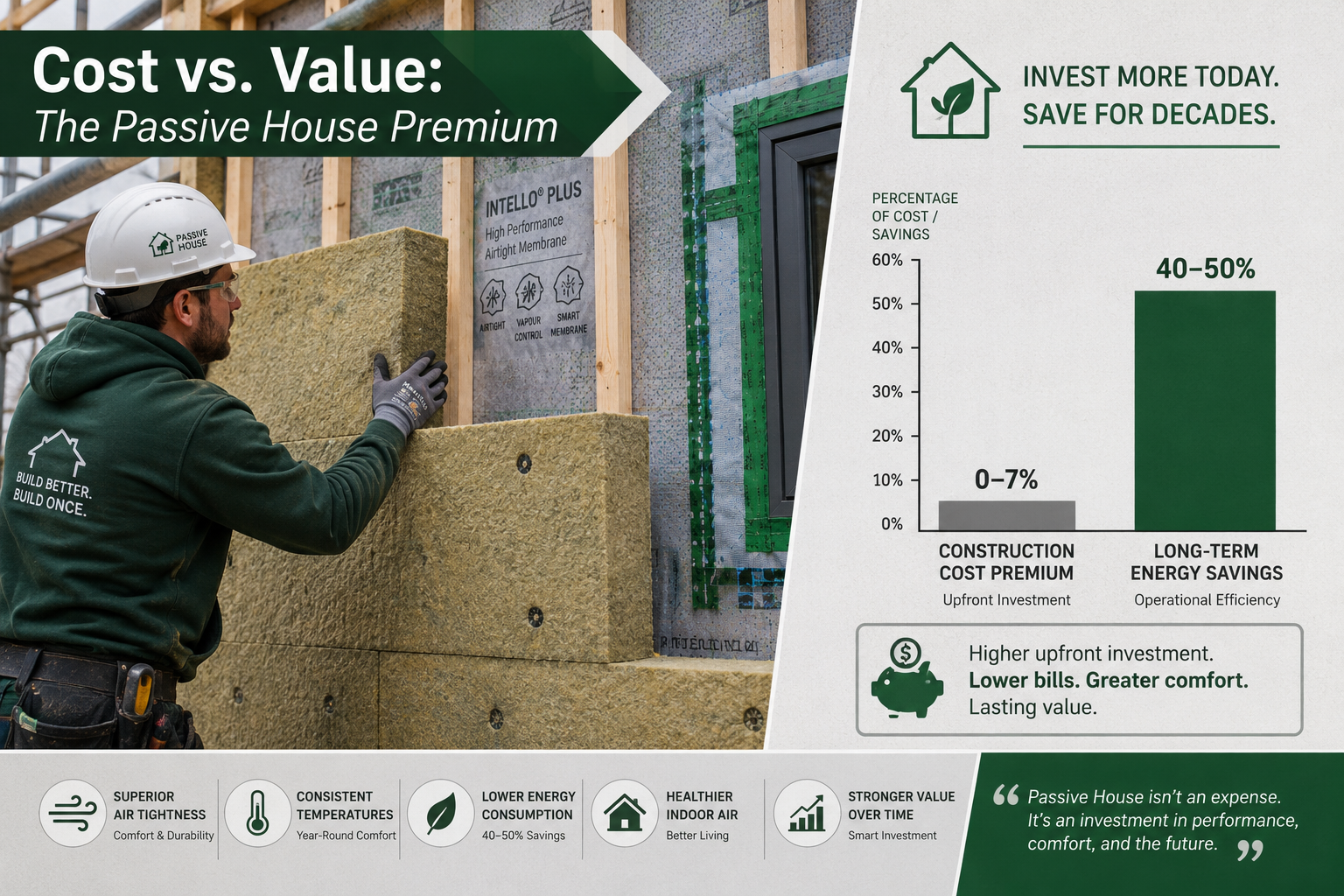
- The construction cost premium for Passive House buildings now ranges from 0% to 7% above standard builds, while operational savings of 40% to 50% are achievable over the building's lifespan [2].
- RICS surveyors are required to assess and report on energy performance features as part of updated valuation guidance, making technical literacy in Passive House systems increasingly important.
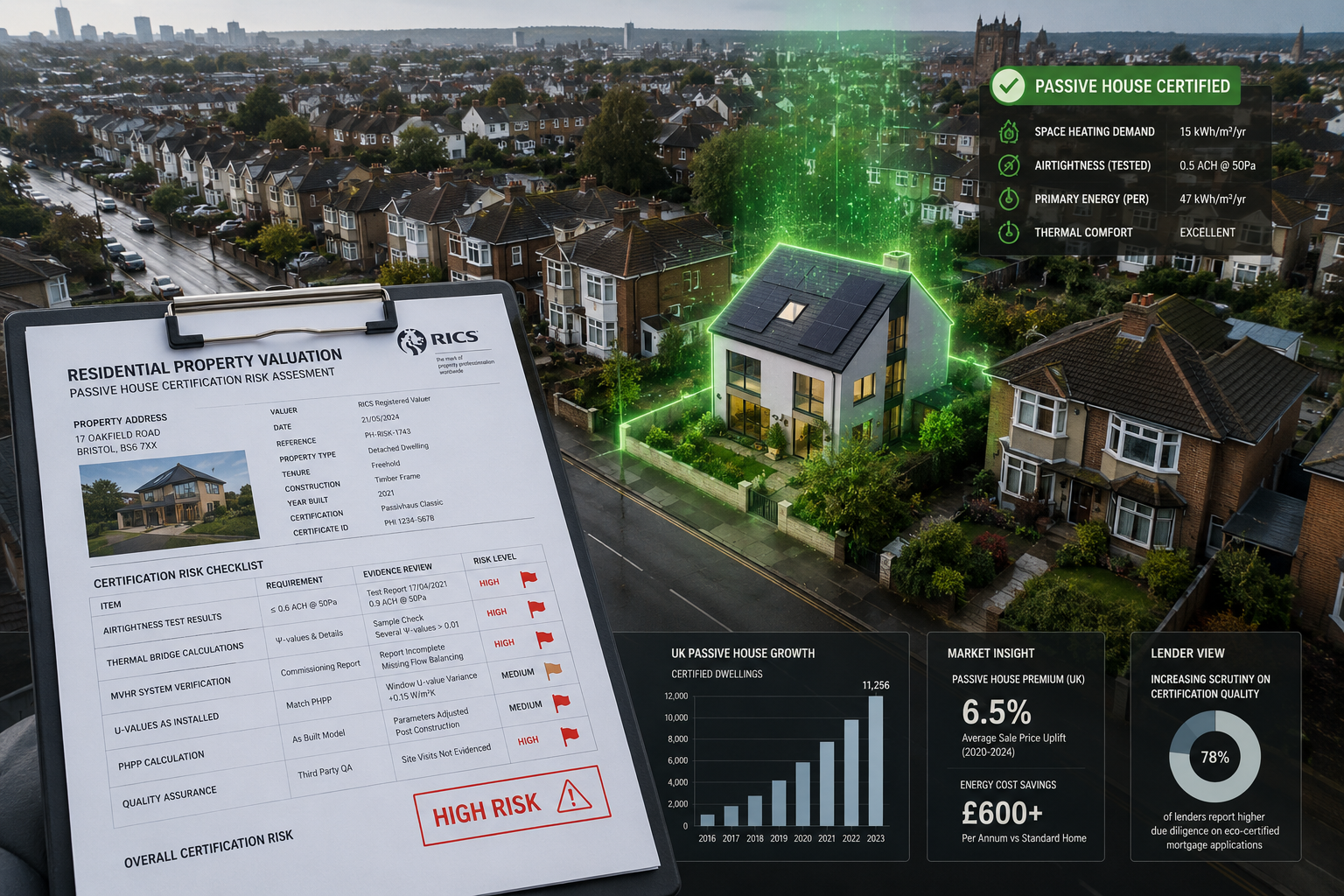
- Certification risks — including failed airtightness tests, incomplete documentation, and unverified mechanical ventilation systems — can significantly reduce or eliminate any valuation uplift.
- Market demand for energy-efficient homes is growing, but comparable sales evidence for certified Passive House properties remains thin in many UK regions, creating valuation challenges.
What Passive House Standards Actually Mean for Surveyors
The term "Passive House" (or Passivhaus in its German-origin form) refers to a rigorous, performance-based building standard rather than a design style. A certified Passive House must meet specific thresholds:
- Space heating demand: No more than 15 kWh per square metre per year
- Primary energy demand: No more than 120 kWh per square metre per year
- Airtightness: No more than 0.6 air changes per hour at 50 Pascals pressure (n50)
- Thermal comfort: All internal surfaces must remain above 17°C in winter conditions
These are not aspirational targets — they are pass/fail criteria verified through independent testing and third-party certification [4]. For a surveyor, this distinction matters enormously. A property marketed as "built to Passive House principles" without formal certification carries a very different risk profile from one holding a valid certificate issued by a recognised body such as the Passive House Institute (PHI) or the UK's Passivhaus Trust.
The Certification Process and Why It Matters
Achieving certification involves detailed energy modelling using the Passive House Planning Package (PHPP), construction oversight by a qualified verifier, and a post-completion airtightness test [4]. Each stage creates a paper trail that a surveyor can interrogate. When that trail is absent or incomplete, the claimed performance — and therefore the claimed value — becomes difficult to substantiate.
RICS guidance updated in recent years now requires surveyors to assess and report on energy efficiency features and their impact on market value [1]. This means surveyors working on Passive House properties must understand not just what the certificate says, but whether the building actually performs as certified. A certificate issued at completion does not automatically confirm ongoing performance, particularly if the building has been modified since.
For those seeking a Red Book valuation on a Passive House property, the surveyor's ability to interpret certification documentation and cross-reference it with physical inspection findings is critical to producing a defensible, market-reflective figure.
How Surveyors Assess Premiums: The Evidence Challenge
Valuing Properties with Passive House Standards in 2026: Surveyor Insights on Premiums and Certification Risks requires confronting a fundamental problem in the UK market: comparable sales evidence is sparse. Unlike EPC ratings, which now appear on millions of property records, certified Passive House completions in the UK number in the thousands rather than hundreds of thousands. This makes the comparable evidence method — the primary tool in residential valuation — difficult to apply with confidence.
What the Market Data Shows
Despite the evidence gap, the direction of travel is clear:
| Property Feature | Estimated Market Premium |
|---|---|
| EPC A or B rating | Up to 14% above EPC D [1] |
| Certified Passive House (residential) | 5% to 15% depending on location and buyer profile [3] |
| Near-Passive House (uncertified) | 2% to 8%, subject to evidence |
| Standard new build (EPC C) | Baseline |
These figures are indicative rather than absolute. Premiums vary significantly by location, buyer demographic, and the quality of supporting documentation. In urban markets with environmentally aware buyers — London, Bristol, Manchester — premiums tend to be stronger. In rural or lower-value markets, the premium may be harder to extract because buyers are less willing to pay above the local ceiling price regardless of energy performance.
Energy price volatility amplifies the premium. In regions where heating costs have risen sharply, the operational savings from a Passive House — typically 40% to 50% better than a standard building — translate directly into lower running costs that buyers are willing to pay for upfront [2][6]. A surveyor who ignores this dynamic risks undervaluing a property in a market where buyers are actively factoring energy costs into their offers.
The Surveyor's Inspection Checklist
When inspecting a property presented as Passive House certified, a thorough surveyor will examine the following:
- Airtightness test certificate: Dated, signed, and showing a result at or below 0.6 ACH at 50Pa
- PHPP energy model: Confirming design-stage compliance
- Construction verifier's report: Documenting site inspections during build
- MVHR (Mechanical Ventilation with Heat Recovery) system: Commissioning records, filter maintenance logs, and current operational status
- Window and door specifications: Confirming triple-glazing and certified frame performance
- Thermal bridge calculations: Evidence that junctions between structural elements were designed and built to minimise heat loss
- PHI or Passivhaus Trust certificate: With unique reference number that can be verified against the issuing body's records
A Level 3 Building Survey is the appropriate survey type for most Passive House properties, given the complexity of the building systems involved and the financial stakes of the premium being assessed.
Certification Risks That Can Erode Valuation Uplifts
The most significant risks in valuing properties with Passive House standards in 2026 relate not to the standard itself, but to failures in the certification process, post-completion modifications, and the surveyor's ability to verify claims. Each risk category can reduce or eliminate the premium a seller expects.
Risk 1: Failed or Missing Airtightness Tests
The airtightness test is the most objective performance verification in the Passive House process. A blower door test pressurises the building and measures air leakage. If a property cannot produce a valid test certificate, or if the result was above the 0.6 ACH threshold, the building does not meet the standard regardless of how it was designed or marketed.
Surveyors should request the original test certificate and check the date. A test conducted years ago does not confirm current performance, particularly if the building envelope has been penetrated for new services, extensions, or renovations since completion.
Risk 2: MVHR System Failures
A Passive House without a functioning MVHR system is not performing to standard. The MVHR unit provides fresh air, removes moisture, and recovers heat that would otherwise be lost through ventilation. If the system has not been maintained — filters blocked, heat exchanger degraded, ducts disconnected — the building's actual energy performance will be significantly worse than certified.
Surveyors should request commissioning records and maintenance logs. Where these are absent, a specialist mechanical inspection may be warranted before a valuation can be finalised. This is particularly relevant for older Passive House properties where original owners have moved on and maintenance records have not been transferred.
Risk 3: Post-Completion Modifications
Extensions, new penetrations through the airtight layer, replacement windows with lower specifications, or alterations to the thermal envelope can all compromise Passive House performance without invalidating the original certificate. The certificate reflects the building as it was at completion, not as it stands today.
A surveyor conducting a structural survey on a Passive House property should look for evidence of modifications and assess whether they are likely to have affected the building's performance. Where significant alterations are found, the surveyor may need to note that the certified performance can no longer be assumed, which directly affects the justification for any premium.
Risk 4: Certification Body Credibility
Not all Passive House certification is equal. The PHI (Passive House Institute) and the UK's Passivhaus Trust are the recognised authorities. Some properties are marketed with reference to other standards — AECB Silver, EnerPHit (for retrofits), or proprietary low-energy labels — that do not meet the same criteria. Surveyors must distinguish between these and apply appropriate adjustments to any premium assessment.
Risk 5: Limited Comparable Evidence
As noted earlier, the thin market for certified Passive House properties creates valuation uncertainty. Where a surveyor cannot identify sufficient comparable sales, they must rely on adjustments from the broader energy-efficient homes market, which introduces subjectivity. This uncertainty should be clearly communicated in the valuation report, along with the assumptions made and the sensitivity of the figure to those assumptions.
For properties requiring a RICS Home Survey rather than a full valuation, surveyors should still flag certification status and any identified risks, even if a formal premium calculation is outside the scope of the instruction.
Market Demand Drivers in 2026
The demand side of the Passive House premium equation is being shaped by several converging forces in 2026.
ESG investment criteria are pushing institutional and private investors toward properties with demonstrable energy performance credentials [2]. A certified Passive House building aligns well with Environmental, Social, and Governance frameworks, making it attractive to a buyer pool that extends beyond owner-occupiers to include build-to-rent operators and impact investors.
Mortgage lender incentives for energy-efficient homes have expanded, with several UK lenders offering preferential rates for properties rated EPC A or B. While Passive House certification is not yet a standard mortgage product category, the EPC A rating that typically accompanies certification qualifies for these products, reducing the buyer's borrowing costs and supporting a higher purchase price.
Regulatory trajectory matters too. The UK government's continued push toward net-zero buildings and the planned tightening of minimum EPC requirements for rental properties create a forward-looking case for Passive House investment. Buyers who understand this trajectory are willing to pay a premium today to avoid retrofit costs tomorrow.
Energy price sensitivity remains a powerful driver [6]. Households that have experienced high energy bills are increasingly motivated by the prospect of near-zero heating costs. The operational savings from a Passive House — which can amount to several hundred pounds per year in a typical UK home — are a tangible financial benefit that buyers can model and quantify.
For chartered surveyors in the North West and other regions where energy costs have hit lower-income households hardest, this demand driver is particularly pronounced. Similarly, chartered surveyors in London are seeing increasing buyer interest in certified low-energy homes, particularly in new-build developments where Passive House is becoming a differentiator.
Long-Term Financial Case for Passive House Properties
Despite an initial construction cost premium of 0% to 7% above standard builds — a figure that has fallen substantially as the supply chain and professional expertise have matured [2] — the long-term financial case for Passive House is strong. The 40% to 50% improvement in operational efficiency translates into lower energy bills, reduced maintenance demands on heating systems, and a more resilient asset in a market increasingly focused on running costs [2][3].
Resale evidence, where available, suggests that certified Passive House properties sell faster than comparable standard homes, indicating genuine market demand rather than a theoretical premium [3]. For investors, this combination of higher sale price and shorter time on market improves the overall return profile.
The key financial variables a surveyor should consider when assessing long-term value include:
- Remaining certification validity and whether recertification would be required after any modifications
- MVHR system age and replacement cost, typically every 15 to 25 years
- Window and door longevity, given the higher specification and cost of certified Passive House glazing
- Insurance implications, as some insurers are unfamiliar with Passive House construction and may require specialist cover
For RICS valuations of Passive House properties, these factors should be weighed against the premium being sought and clearly documented in the valuation rationale.
Conclusion
Valuing Properties with Passive House Standards in 2026: Surveyor Insights on Premiums and Certification Risks is not a niche concern — it is a mainstream valuation challenge that will only grow as the UK housing stock transitions toward higher energy performance requirements. Surveyors who develop technical literacy in Passive House systems, certification processes, and airtightness testing will be better positioned to produce defensible valuations and serve clients effectively.
Actionable next steps for buyers, sellers, and surveyors:
- Sellers should compile a full certification pack before marketing, including the PHI or Passivhaus Trust certificate, airtightness test results, PHPP model, MVHR commissioning records, and any subsequent maintenance logs.
- Buyers should instruct a surveyor with demonstrable experience in energy-efficient buildings and request a Level 3 Building Survey that explicitly addresses Passive House certification status and system condition.
- Surveyors should invest in continuing professional development on Passive House standards, maintain awareness of emerging comparable evidence in their local markets, and apply RICS guidance on energy performance in every relevant valuation instruction.
- Investors should factor certification risk into due diligence, recognising that an uncertified or poorly documented property cannot reliably command the premium associated with a fully verified Passive House.
The premium is real, the demand is growing, and the risks are manageable — but only for those who approach these properties with the right knowledge and the right level of scrutiny.
References
[1] Energy Performance Standards In Valuations Surveyor Checklists For Epc Upgrades And 2026 Market Premiums – https://princesurveyors.co.uk/blog/energy-performance-standards-in-valuations-surveyor-checklists-for-epc-upgrades-and-2026-market-premiums/?utm_source=openai
[2] Frequently Asked Questions – https://passivehousenetwork.org/frequently-asked-questions/?utm_source=openai
[3] biobuilds – https://www.biobuilds.com/blog/passivhaus/roi?utm_source=openai
[4] Learning Targets Constructionverifier En 2021020 – https://cms.passivehouse.com/media/filer_public/03/0d/030d9d96-5615-4533-a2fa-4cf406cc45e5/learning_targets_constructionverifier_en_2021020.pdf?utm_source=openai
[5] What Is Passive House – https://gbdmagazine.com/what-is-passive-house/?utm_source=openai
[6] 404029392 Sustainability Driven Price Premiums Market Response To Eco Friendly Residential Upgrades – https://www.researchgate.net/publication/404029392_Sustainability-Driven_Price_Premiums_Market_Response_to_Eco-Friendly_Residential_Upgrades?utm_source=openai