More than 30% of all party wall disputes in England and Wales involve foundation works on Victorian-era properties — a statistic that underscores just how much structural complexity surveyors inherit from the nineteenth century. For anyone planning foundation underpinning on a Victorian terrace in 2026, the legal, structural, and professional stakes could not be higher. Party Wall Awards for Foundation Underpinning in Victorian Terraces: Surveyor Risk Mitigation in 2026 sits at the intersection of century-old building stock, evolving RICS protocols, and a legal framework that demands precision at every stage.
This guide is written for building owners, adjoining owners, and the surveyors who serve them. It covers the legal triggers under the Party Wall etc. Act 1996, the specific risks that Victorian construction presents, how to draft a robust Party Wall Award, and the monitoring and compensation clauses that protect all parties throughout 2026.
Key Takeaways
- Underpinning in Victorian terraces triggers both Section 2(2)(a) and Section 6 of the Party Wall etc. Act 1996, making formal notice and a Party Wall Award mandatory.
- A well-drafted Award must include vibration monitoring thresholds, compensation clauses, insurance obligations, and a clear dispute resolution pathway.
- 2026 RICS metrics place heightened emphasis on tiered risk assessment before any notice is served on subsidence-prone older stock.
- A Schedule of Condition prepared before work begins is the single most effective tool for resolving post-works damage claims.
- Security for expenses under Section 12 of the Act can be invoked to protect adjoining owners where financial risk is significant.
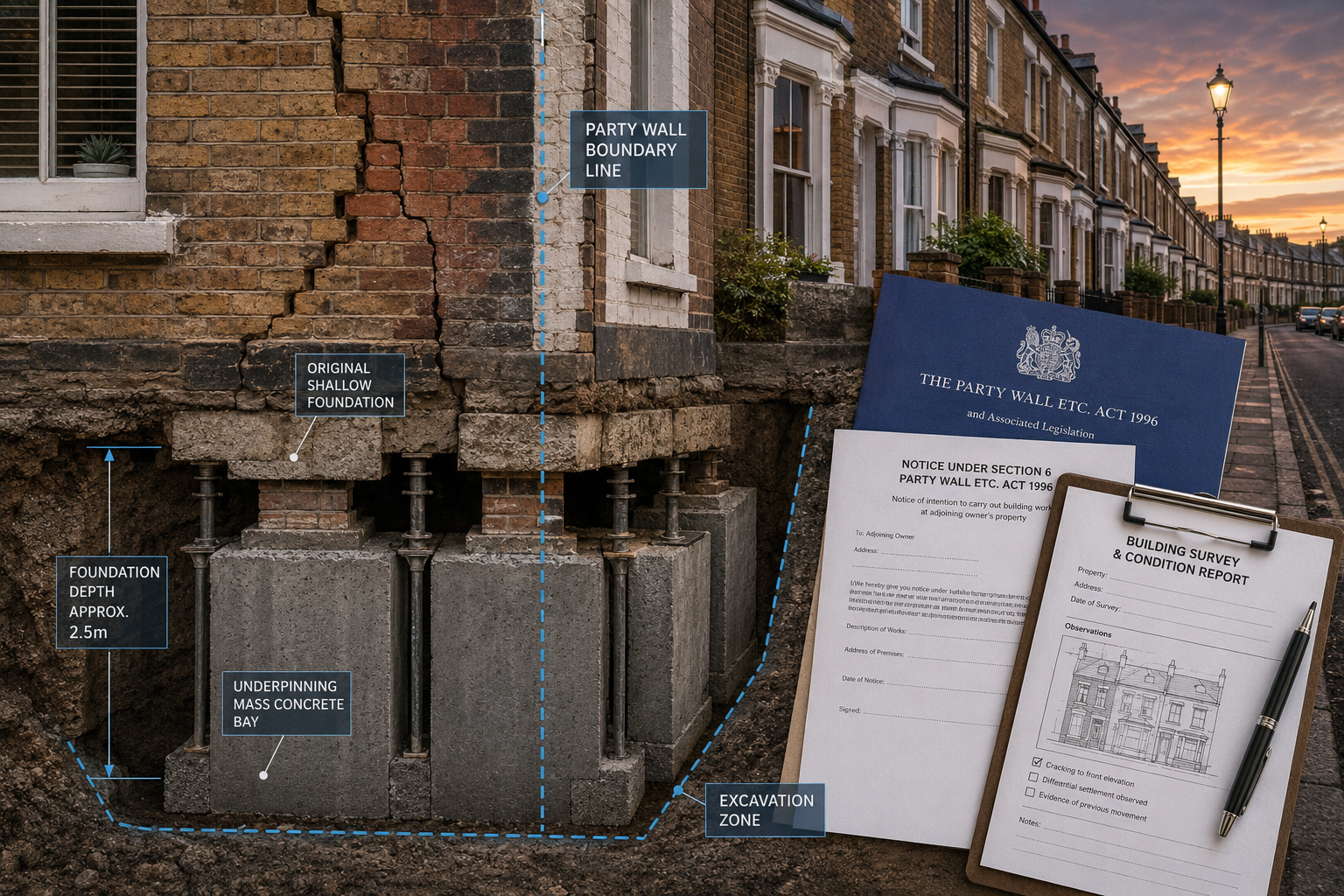
Why Victorian Terraces Demand Special Attention Under the Party Wall Act
Victorian terraced houses — built predominantly between 1837 and 1901 — share a set of structural characteristics that make underpinning works uniquely hazardous compared to modern construction. Their foundations are typically shallow, often no more than 600mm to 900mm deep, set in lime mortar on brick footings that have settled and shifted over more than a century. The party walls themselves are load-bearing, frequently carrying floor joists from both properties simultaneously. Clay subsoils, common across London and many northern cities, shrink and swell seasonally, compounding the risk of differential settlement when any excavation disturbs the ground nearby [6].
When a building owner proposes to underpin — whether to address subsidence, create a basement, or extend downward — the Party Wall etc. Act 1996 is immediately engaged. Underpinning is expressly notifiable under the Act and is considered one of the highest-risk categories of work it covers [1]. Two distinct sections apply:
- Section 2(2)(a): Covers the underpinning, thickening, or raising of a party wall or party fence wall.
- Section 6: Applies to adjacent excavation within 3 metres of a neighbouring structure where the excavation goes deeper than the neighbour's foundations, or within 6 metres where the excavation cuts a 45-degree line drawn from the base of the neighbour's foundation.
Both sections can apply simultaneously on a single Victorian terrace project, meaning the surveyor must address two distinct legal obligations within a single, coherent Award document.
Failure to serve notice before works begin can expose a building owner to injunctions and compensation claims. If a neighbour discovers that works have already started without proper notice, they have strong grounds for legal action — a scenario explored in detail in our guide on what to do when a neighbour carries out works without a party wall agreement.
The Legal Framework: Notices, Consent, and the Award Process
Serving Notice Correctly
A Party Wall Notice for underpinning must be served at least two months before the proposed start date for Section 2 works, and at least one month before for Section 6 excavation works. The notice must describe the proposed works with sufficient detail that an adjoining owner can make an informed decision about whether to consent or dissent.
An adjoining owner has three options upon receipt of a notice:
- Consent in writing — works may proceed, but no Award is produced and the building owner loses the formal protection that an Award provides.
- Dissent and appoint a surveyor — triggering the Award process.
- Do nothing for 14 days — which is deemed dissent, again triggering the Award process.
For underpinning works in Victorian terraces, dissent is almost always the appropriate response from an adjoining owner's perspective. The risks are too significant to rely on goodwill alone. Full guidance on the consent process is available through our party wall consent overview.
Appointing Surveyors
Once dissent is registered, each party appoints a surveyor — or both parties may agree to appoint a single agreed surveyor. For high-risk underpinning projects, separate surveyors are generally preferable, as each surveyor owes a duty to the process rather than to their appointing owner, but the practical independence of separate appointments provides an additional layer of scrutiny.
The two surveyors then produce the Party Wall Award — a legally binding document that governs how the works are carried out, what monitoring is required, and what remedies are available if damage occurs.
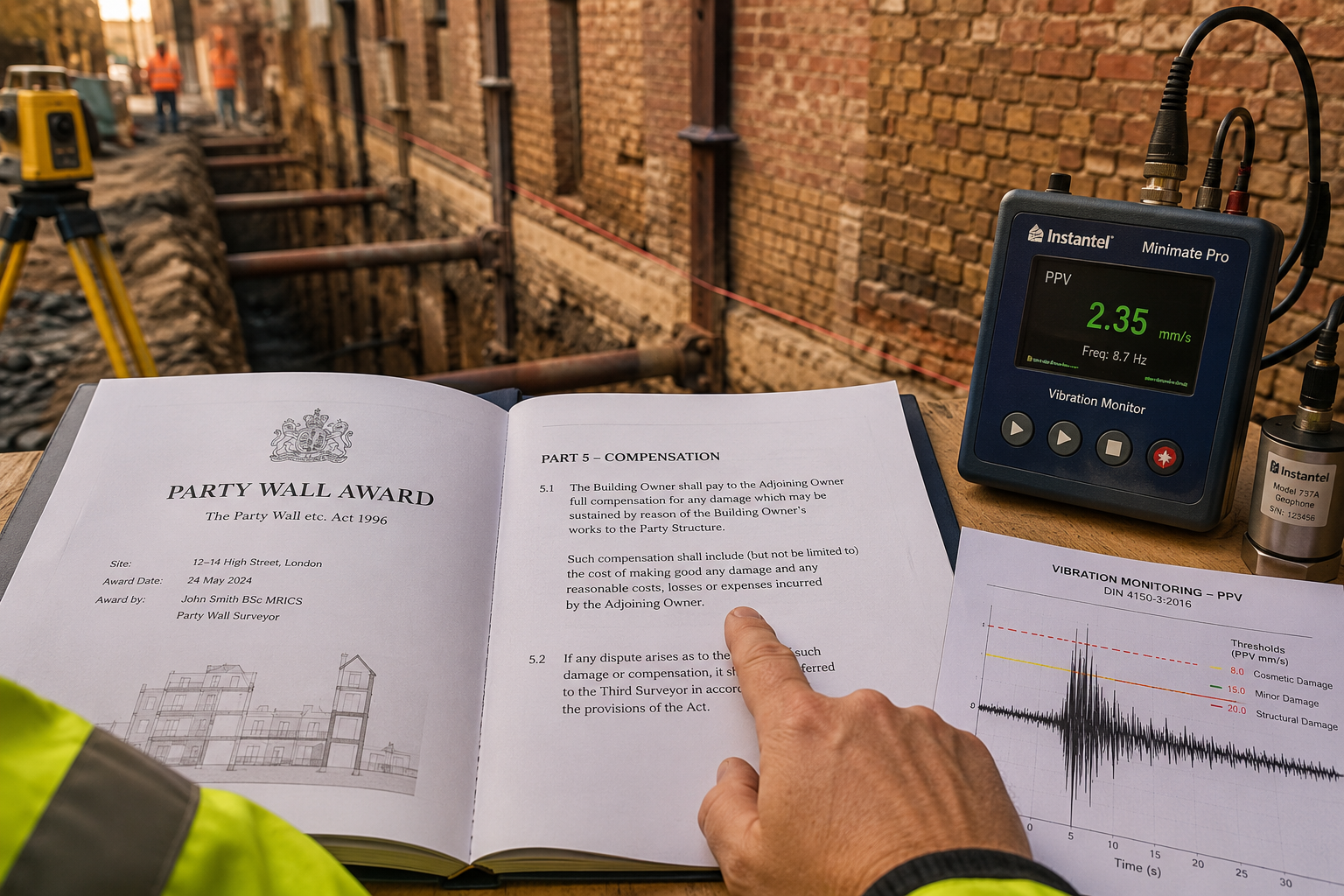
Drafting the Party Wall Award: Vibration Monitoring and Compensation Clauses
This is where Party Wall Awards for Foundation Underpinning in Victorian Terraces: Surveyor Risk Mitigation in 2026 becomes most technically demanding. A poorly drafted Award leaves both parties exposed. A well-drafted one anticipates every foreseeable risk and provides a clear mechanism for resolution.
Essential Components of a Robust Award
A Party Wall Award for underpinning works in a Victorian terrace should contain all of the following elements [4]:
| Component | Purpose |
|---|---|
| Full description of works | Defines the scope so deviations are identifiable |
| Working hours restrictions | Limits noise and vibration impact on neighbours |
| Monitoring regime | Specifies instruments, frequency, and data access |
| Access rights | Allows surveyors to inspect at reasonable notice |
| Remediation obligations | Sets out who repairs damage and within what timeframe |
| Insurance requirements | Mandates adequate cover before works begin |
| Dispute resolution pathway | Provides a mechanism if the Award itself is disputed |
| Security for expenses | Protects the adjoining owner financially |
Vibration Monitoring: The 2026 Standard
Vibration damage is one of the most contested issues in party wall disputes involving underpinning. In 2026, best practice requires continuous vibration monitoring at the party wall face throughout the excavation phase, with data logged and made available to the adjoining owner's surveyor on request [3].
The Award should specify Peak Particle Velocity (PPV) thresholds. For residential masonry — the category that covers virtually all Victorian terraces — the standard threshold is 5mm/s. The Award must include a clear protocol requiring immediate work stoppage if this threshold is exceeded, followed by a structural review before works resume [3].
Monitoring equipment should be:
- Fixed at the party wall face, not at a remote location
- Calibrated before works begin and at regular intervals
- Capable of producing timestamped, tamper-evident logs
- Accessible to both surveyors throughout the works
"Vibration monitoring is not a box-ticking exercise. In 2026, surveyors who fail to specify PPV thresholds in the Award are exposing their clients — and themselves — to disputes that could have been avoided with a single clause."
Compensation Clauses: Drafting for Clarity
The Award should distinguish between two types of compensation obligation:
-
Damage remediation: If works cause measurable damage to the adjoining property, the building owner is liable to repair it or pay the cost of repair. The Award should specify the standard of repair (like-for-like), the timeframe for completion, and the process for agreeing costs if disputed.
-
Consequential loss: In some cases, damage may render part of the adjoining property uninhabitable or unusable. The Award can include provision for reasonable consequential loss, though this is more commonly addressed through the building owner's insurance policy.
One often-overlooked liability concerns the accuracy of underpinning concrete. If concrete underpinning extends beyond the building owner's land — even marginally — and the adjoining owner later excavates for their own works, they may be entitled to claim the cost of trimming or removing the projecting concrete [5]. This liability can arise years after the original works are completed. The Award should require the structural engineer to certify that all underpinning remains within the building owner's title boundary.
Waterproofing and Drainage Risks
Where underpinning forms part of a basement conversion, waterproofing systems introduce an additional risk. Tanked basement systems and cavity drain membranes can redirect groundwater laterally if not designed with neighbouring drainage patterns in mind [3]. The Award should reference the structural engineer's drainage design explicitly and require that any changes to groundwater flow patterns are assessed for their impact on the adjoining property.
Security for Expenses Under Section 12
Section 12 of the Party Wall Act gives the adjoining owner the right to require the building owner to deposit a sum of money in an escrow account for the duration of the risk [5]. This money is accessible only through the party wall surveyors and can be used to fund repairs or complete abandoned works. For significant underpinning projects in Victorian terraces, invoking Section 12 is a legitimate and prudent step — particularly where the building owner is a developer rather than an owner-occupier.
RICS Risk Mitigation Protocols for Party Wall Awards for Foundation Underpinning in Victorian Terraces: Surveyor Risk Mitigation in 2026
The Tiered Risk Assessment Framework
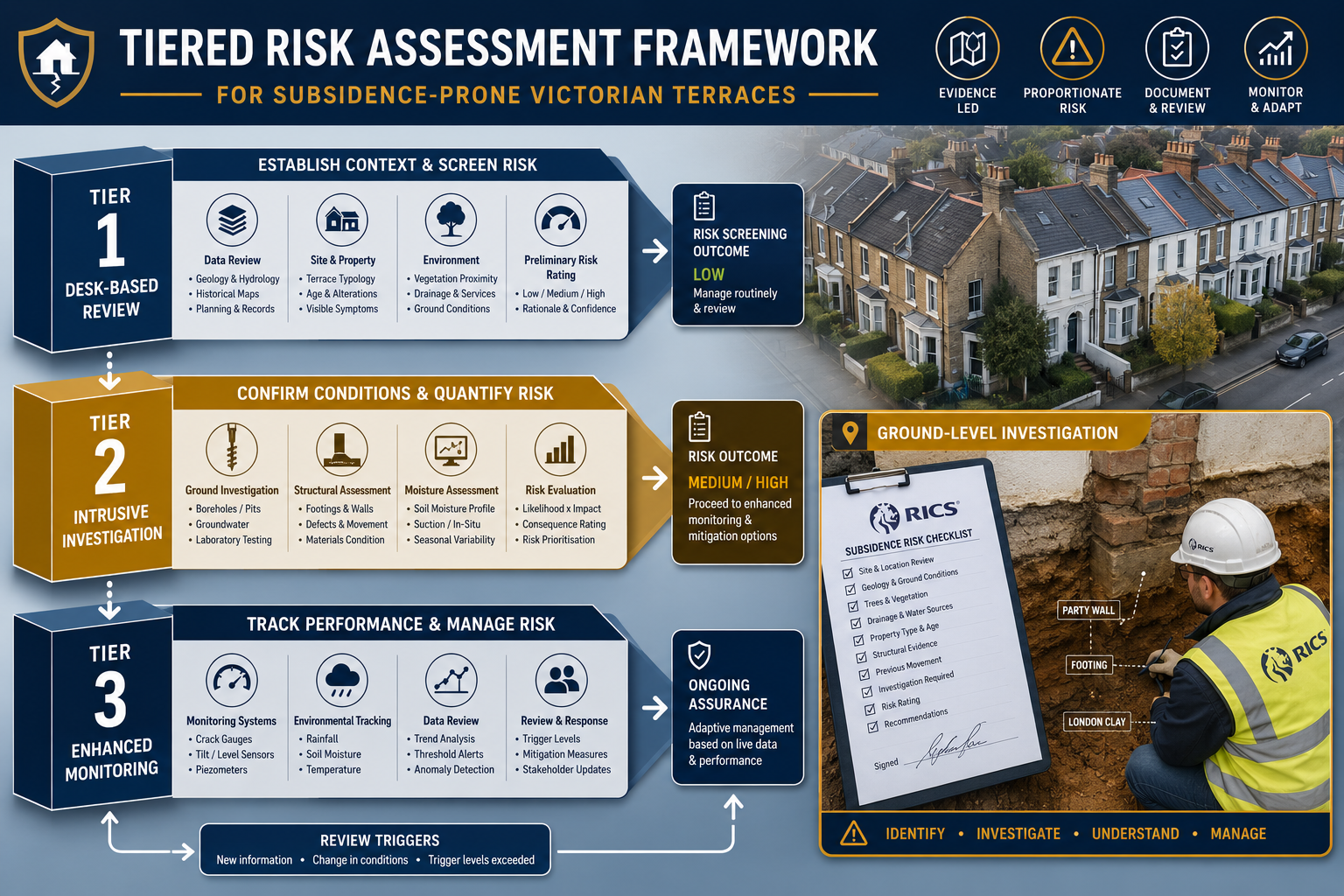
Before any notice is served, surveyors are expected in 2026 to apply a tiered risk assessment framework [4]:
Tier 1 — Desk-Based Risk Assessment
- Review of historical maps and building records
- Assessment of soil type and known subsidence history
- Identification of nearby trees (a major factor with Victorian clay subsoils)
- Review of any previous party wall awards affecting the property
Tier 2 — Intrusive Investigation
- Trial pits to establish existing foundation depth and condition
- Soil sampling and laboratory analysis where clay shrinkage is suspected
- Structural engineer's assessment of the party wall's current load-bearing condition
Tier 3 — Enhanced Monitoring Protocols
- Reserved for high-risk projects where Tier 1 or Tier 2 findings indicate elevated risk
- Includes pre-works crack monitoring, settlement monitoring pins, and groundwater level recording
- Monitoring continues throughout works and for an agreed period after completion
The 2026 RICS metrics place strong emphasis on this framework, particularly for basement excavations and underpinning in areas with known subsidence history [2]. Surveyors who bypass Tier 1 and proceed directly to Award drafting without adequate investigation are increasingly exposed to professional negligence claims.
The Schedule of Condition: Non-Negotiable
A Schedule of Condition is a photographic and written record of the adjoining property's condition before works begin. For underpinning in Victorian terraces, this document is not optional — it is the primary evidence base for any post-works damage claim.
The Schedule should cover:
- All internal rooms adjacent to the party wall
- External brickwork and pointing
- Ceilings, cornices, and plasterwork (Victorian properties often have ornate detailing that is expensive to reinstate)
- Floors, particularly timber floors which can be sensitive to ground movement
- Drains and drainage connections
If damage does occur, the party wall damage claims process relies heavily on the pre-works Schedule to establish causation. Without it, disputes about whether a crack existed before works began can become protracted and costly.
Temporary Works Design
The design of underpinning is often straightforward in principle, but the method of execution — the Temporary Works Design — is where risk concentrates [5]. The design engineer must visit the site personally to assess the adjoining structures, not work solely from drawings. Victorian terraces frequently contain modifications, extensions, and repairs that are not reflected in any available documentation. A site visit by the engineer before finalising the underpinning sequence is a requirement that the Award should make explicit.
Phased underpinning — where mass concrete bays are excavated and poured in a sequence that avoids undermining the party wall at any single point — is standard practice. The Award should specify the maximum bay width and the minimum time between adjacent bays to allow concrete to achieve adequate strength before neighbouring excavation begins.
Insurance Requirements
Given the scale of risk, the Award should mandate that the building owner holds adequate insurance before works begin [5]. Two types of cover are relevant:
- Contractor's All Risks (CAR) insurance: Covers damage caused during the works themselves.
- Non-negligence (Section 6) liability insurance: Covers damage that arises from the works but is not caused by negligence — for example, settlement caused by the proximity of excavation to the adjoining foundation, even where all reasonable care was taken.
Surveyors should request evidence of both policies before issuing the Award and should confirm that the adjoining owner is noted as an interested party on the non-negligence policy.
Practical Guidance for Building Owners and Adjoining Owners
For Building Owners
- Engage a structural engineer and a party wall surveyor before any design work is finalised. The underpinning sequence will affect the design, and late changes are expensive.
- Budget for a Schedule of Condition and vibration monitoring as fixed project costs, not optional extras.
- Do not begin any excavation — even trial pits — before the notice period has elapsed and the Award has been agreed.
- If the adjoining owner has not been served a notice and work has already started, seek legal advice immediately. The consequences of failing to serve a party wall notice can include injunctions that halt works mid-excavation.
For Adjoining Owners
- Appoint your own surveyor as soon as you receive a notice. The building owner pays your surveyor's reasonable fees in most cases.
- Request a full copy of the structural engineer's underpinning design and temporary works methodology before the Award is finalised.
- Consider invoking Section 12 to require a security deposit if the building owner is a developer or if the financial risk to your property is significant.
- Keep a personal photographic record of your property's condition before works begin, in addition to the formal Schedule of Condition.
Surveyors working across London and the surrounding areas can find location-specific support through resources for chartered surveyors in South East London, North London, and South West London, where Victorian terraced stock is particularly concentrated.
For a broader overview of the party wall process and how Awards fit within it, the party wall services hub provides a comprehensive starting point.
Conclusion
Party Wall Awards for Foundation Underpinning in Victorian Terraces: Surveyor Risk Mitigation in 2026 demands a level of technical rigour and legal precision that goes well beyond standard party wall practice. The combination of shallow Victorian foundations, clay subsoils, shared load-bearing walls, and the complexities of modern underpinning methods creates a risk environment where a poorly drafted Award can result in structural damage, protracted disputes, and significant financial loss for all parties.
The actionable steps are clear:
- Serve notice early and correctly — engage a party wall surveyor before the structural engineer finalises the underpinning design.
- Commission a tiered risk assessment — desk-based review, intrusive investigation, and enhanced monitoring where indicated by RICS 2026 protocols.
- Draft a comprehensive Award — one that specifies PPV thresholds, phased underpinning sequences, insurance obligations, and a clear compensation framework.
- Prepare a detailed Schedule of Condition — covering all areas of the adjoining property that could be affected by ground movement or vibration.
- Consider Section 12 security — particularly where the building owner is a developer or where the adjoining property carries significant value.
- Maintain continuous vibration monitoring — with data accessible to both surveyors throughout the works.
Victorian terraces are irreplaceable assets. Protecting them — and the people who live in them — through rigorous party wall practice is not just a legal obligation. In 2026, it is the professional standard.
References
[1] partywallspecialists – https://partywallspecialists.com/?p=24124&utm_source=openai
[2] Party Wall Awards Under New 2026 Rics Matrics Essentials For Basement Conversions In Recovering Markets – https://www.canterburysurveyors.com/blog/party-wall-awards-under-new-2026-rics-matrics-essentials-for-basement-conversions-in-recovering-markets/?utm_source=openai
[3] Party Wall Act Compliance For Basement Developments 2026 Surveyor Best Practices – https://partywallsurveyorlondon.uk/blogs/party-wall-act-compliance-for-basement-developments-2026-surveyor-best-practices/?utm_source=openai
[4] Underpinning Foundations And Party Wall Notices 2026 Surveyor Protocols For Structural Stability And Neighbor Protection – https://partywallsurveyorlondon.uk/blogs/underpinning-foundations-and-party-wall-notices-2026-surveyor-protocols-for-structural-stability-and-neighbor-protection/?utm_source=openai
[5] Basements – https://www.partywall.info/basements.html?utm_source=openai
[6] Victorian Terraced Party Wall Houses – https://www.surveyofpartywall.co.uk/victorian-terraced-party-wall-houses/?utm_source=openai