
A single development project in central London can generate rights of light claims from dozens of neighbouring properties simultaneously — and a surveyor's methodology, measured to fractions of a percent sky factor, can determine whether a developer pays thousands or millions in damages. The field of expert witness valuations in right of light disputes: 2026 case law and surveyor measurement standards has never carried higher professional stakes, particularly following the High Court's landmark ruling in Cooper v Ludgate House Ltd; Powell v Ludgate House Ltd [2025] EWHC 1724 (Ch), which reset the benchmark for both technical measurement and damages quantification.
For surveyors preparing to act as expert witnesses in 2026, the message from the courts and from RICS is consistent: rigorous, documented, defensible methodology is non-negotiable.
Key Takeaways
- The Waldram 50% rule remains the primary legal test for actionable interference with rights of light, reaffirmed by the High Court in 2025.
- The Cooper/Ludgate decision capped the developer profit "pot" at 12.5%, significantly reducing ransom-style damages awards.
- RICS "Rights of Light" 3rd edition (March 2024) is now the mandatory professional standard governing inspection, measurement, and expert reporting.
- Modern daylight modelling tools such as Radiance-based analysis support but do not replace Waldram analysis in litigation.
- Detailed inspection notes, photographs, and transparent assumptions are essential for surviving cross-examination.
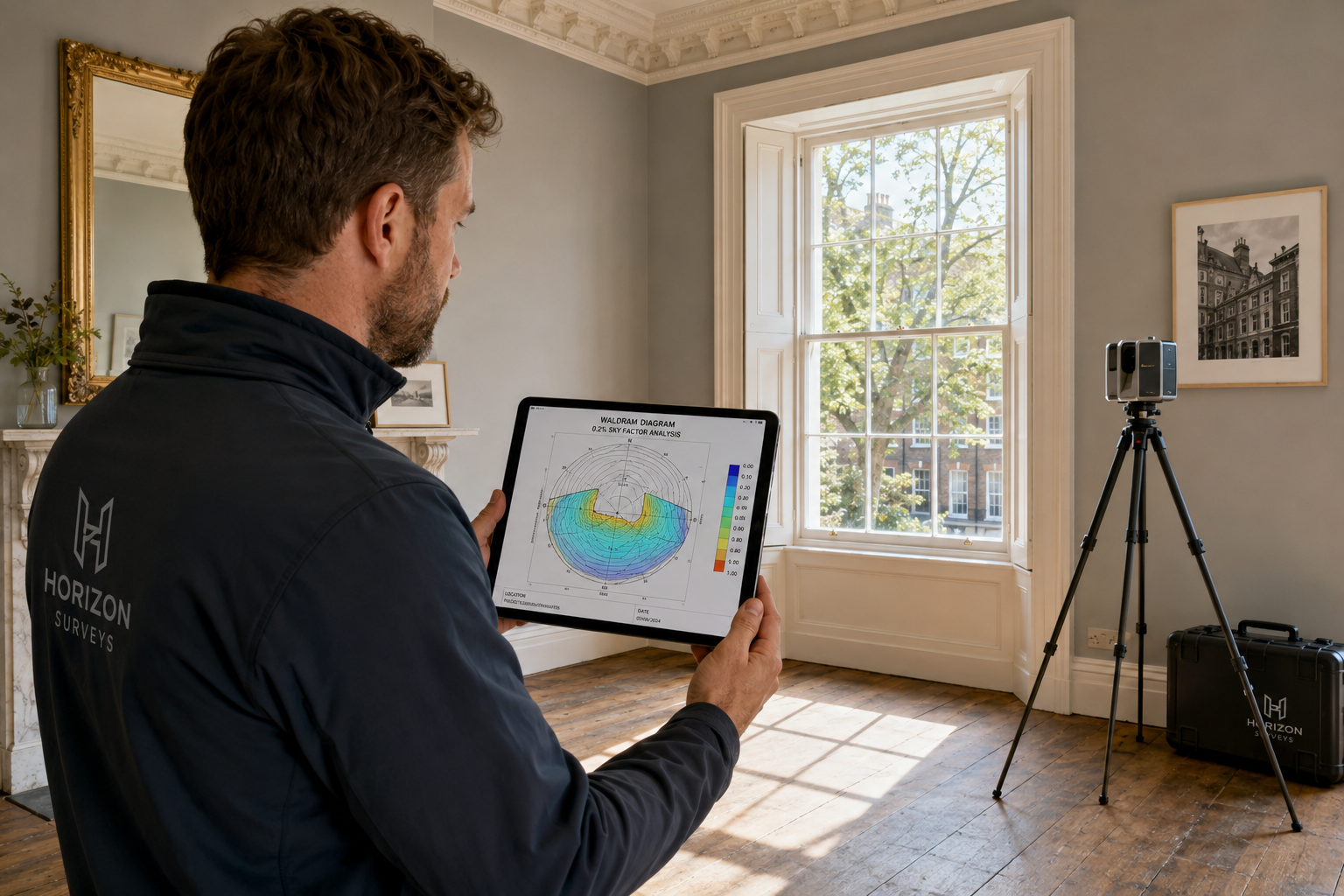
The Waldram Method: Still the Legal Yardstick in 2026
Despite being developed in the 1920s, the Waldram diagram method continues to define how courts assess whether a right of light has been actionably infringed. The method works by calculating the percentage of the sky visible from a working plane inside a room — typically set at desk height, 850mm above floor level. A sky factor of 0.2% or above is classified as "well-lit." The established rule of thumb is that a room retains adequate light when at least 50% of its floor area receives that 0.2% sky factor [2].
The Cooper v Ludgate House Ltd judgment in 2025 re-endorsed this standard with considerable force. The court confirmed that even a small reduction below the 50% threshold can constitute an actionable nuisance — the loss does not need to be perceptible to the average occupier [2]. This is a critical point for surveyors: the legal test is mathematical, not experiential.
What this means for expert witnesses in practice:
- Waldram contour plans must be produced to a high standard of accuracy
- The 0.2% sky factor threshold must be applied consistently across all affected rooms
- Any deviation from standard assumptions (room depth, glazing ratios, internal reflectance) must be explicitly justified in the expert report
Taylor Wessing's August 2025 briefing confirmed that courts regard Waldram as the "correct approach for now," while acknowledging that modern tools such as Radiance-based analysis and BRE daylight and sunlight guidance may be used as supporting or sensitivity analyses [6]. Stevens & Bolton's 2025 year-in-review similarly noted increasing judicial scrutiny of the assumptions behind expert models, including room use, glazing specifications, and internal layout [7].
For surveyors acting in loft conversion and extension disputes — where affected rooms are often irregular in shape, have rooflights, or have been reconfigured — the need to justify every modelling assumption in writing is especially acute.
"Courts are continuing to rely on traditional Waldram contours, but there is an evolution in technical assessments and increasing scrutiny of the assumptions behind expert models." — Stevens & Bolton, 2025 [7]
RICS Professional Standards: What the 2024 Guidance Requires of Expert Witnesses
The RICS "Rights of Light" 3rd edition, published in March 2024, is now the mandatory framework for any RICS member undertaking rights of light work, including litigation support and expert witness roles. Understanding its requirements is central to any discussion of expert witness valuations in right of light disputes: 2026 case law and surveyor measurement standards.
The standard sets out mandatory requirements across four key areas:
| Area | Key Requirement |
|---|---|
| Inspection | Detailed and legible site notes; photographs at every stage |
| Measurement | Waldram analysis as primary method; assumptions documented |
| Recording | Photographic record described as "a vital record" for cross-examination |
| Reporting | Full transparency of methodology, data sources, and limitations |
The emphasis on photography and contemporaneous notes is directly linked to the demands of cross-examination. A surveyor who cannot produce detailed records of their site visit — showing the condition of windows, room dimensions, furniture layout, and obstructions — is vulnerable to challenge on the reliability of their model inputs.
Surveyors engaged in expert witness work should also be familiar with the broader obligations under CPR Part 35, which governs expert evidence in civil proceedings. The duty to the court overrides any duty to the instructing party, and the RICS standard reinforces this by requiring that expert reports present balanced, objective analysis.
For those seeking to understand how expert witness services operate within the broader surveying context, the expert witness services provided by qualified chartered surveyors offer a useful reference point for the scope and standards expected in practice.
Inspection and Measurement: The Practical Checklist
Before any software is opened, a compliant expert witness inspection should capture:
- Room dimensions — measured to millimetre accuracy, not estimated
- Window dimensions and positions — including sill height, head height, and any obstructions such as reveals or external fins
- Internal layout — furniture, partitions, and any features affecting the working plane
- Existing light levels — photographic evidence of pre-development conditions where available
- Neighbouring development — precise heights, setbacks, and angles confirmed against planning drawings
Failure to record any of these elements at the time of inspection creates gaps that opposing experts will exploit. The RICS standard's insistence on photographs as a "vital record" reflects hard experience from cases where surveyors have been unable to defend their assumptions under cross-examination [2].
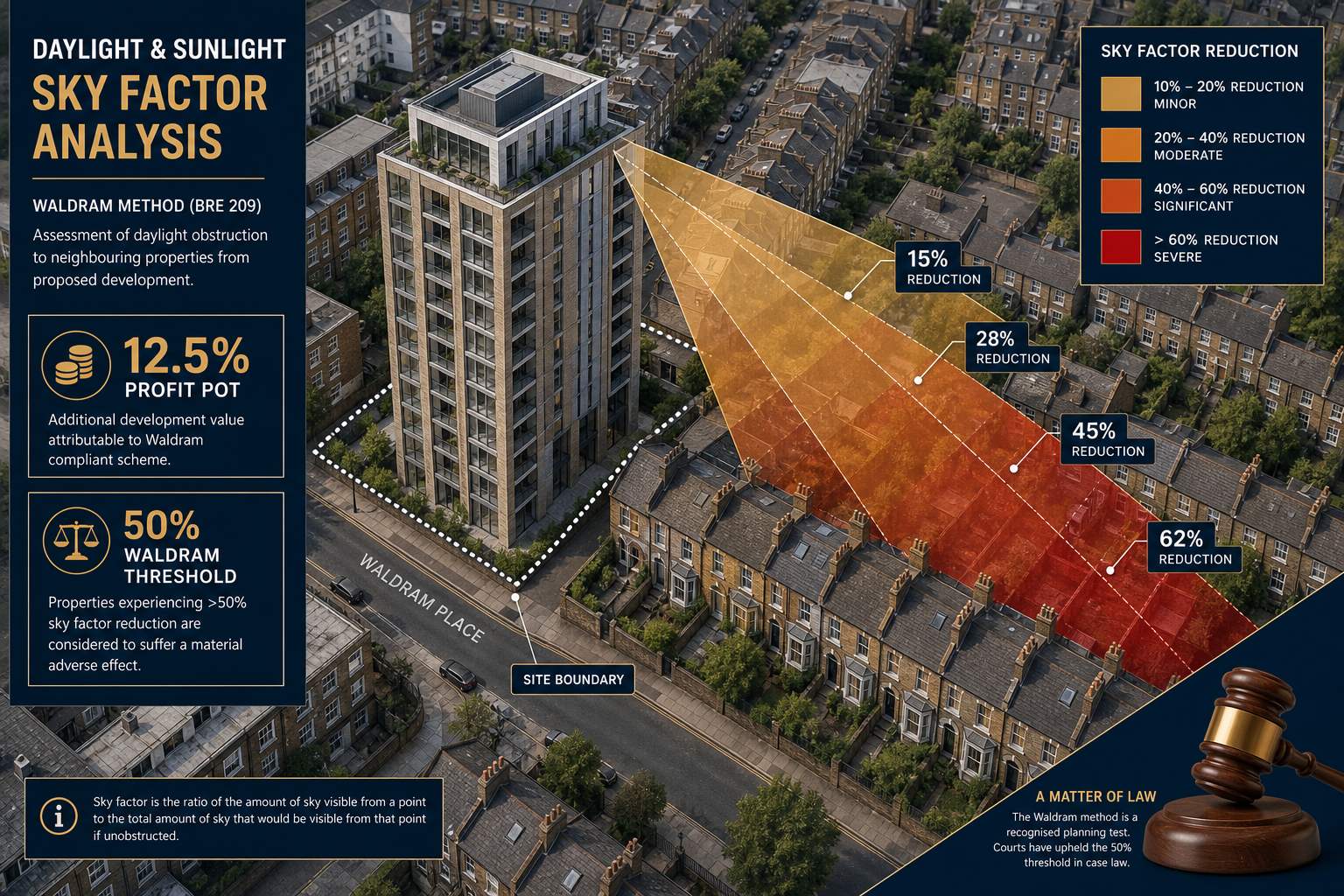
Damages Quantification: How Cooper/Ludgate Changed the Calculus
The technical measurement of light loss is only half the expert witness's task. Once actionable interference is established, the court must determine the appropriate remedy — and in most cases, this means quantifying damages on the basis of a hypothetical negotiation between the developer and the affected neighbour.
The Cooper v Ludgate House Ltd decision introduced a significant recalibration of how that negotiation is modelled [2][3]. Earlier case law, including Tamares (Vincent Square) Ltd v Fairpoint Properties [2007], had used figures of up to one-third of development profit as the starting "pot" from which affected neighbours would negotiate their share. The Cooper/Ludgate court restricted this to 12.5% of development profit, reflecting the high-risk nature of the particular scheme and the relatively modest degree of interference suffered by individual claimants [2].
Individual neighbour awards were then assessed at between 30% and 50% of the value of their respective flats, illustrating the court's preference for a profit-linked, hypothetical negotiation model rather than a simple diminution-in-value approach [2][3].
Key implications for expert valuers in 2026:
- The profit pot is not fixed at one-third; it must be justified by reference to the specific development's risk profile and the degree of interference
- Individual awards must be proportionate to the claimant's actual loss, not simply a formulaic share of the pot
- Expert valuers must be able to model multiple scenarios — injunction risk, negotiation leverage, and residual value — to provide the court with a complete picture
This shift has practical consequences for developers and their advisers. As Trowers & Hamlins noted in their July 2025 analysis, the Cooper/Ludgate decision provides developers with a clearer framework for assessing liability exposure, but it also demands more sophisticated expert evidence to justify the profit pot figure adopted [3].
For surveyors working on commercial property disputes, an understanding of commercial property valuation principles provides essential context for modelling development profit and residual value in the hypothetical negotiation framework.
The Role of Injunction Risk in Valuation
One factor that expert valuers must address explicitly is the risk of injunction. Where a court might have granted an injunction to prevent the infringing development, the hypothetical negotiation must reflect the claimant's leverage — the ability to halt a project worth tens or hundreds of millions of pounds.
In practice, courts have become more reluctant to grant injunctions where development is substantially complete, applying the Shelfer criteria with increasing pragmatism. However, the threat of injunction at an earlier stage remains a legitimate factor in the negotiation model, and expert valuers who fail to address it risk producing an incomplete analysis.
Software Tools, Modern Modelling, and the Limits of Technology
The growing availability of sophisticated daylight modelling software — including Radiance-based tools, VELUX Daylight Visualizer, and proprietary BRE-compliant platforms — has created both opportunity and risk for expert witnesses. These tools can produce visually compelling outputs, including false-colour sky factor maps and animated shadow studies, that are highly persuasive to lay judges and juries.
However, as Taylor Wessing's 2025 briefing makes clear, these tools do not replace Waldram analysis for the purposes of establishing legal liability [6]. Their value lies in:
- Sensitivity testing — showing how the result changes under different assumptions
- Communication — helping courts visualise the impact of development
- Cross-checking — identifying potential errors in manual Waldram calculations
The danger is that an expert who leads with modern modelling outputs, without anchoring them to Waldram methodology, may find their evidence dismissed or heavily discounted. Courts have shown a consistent preference for the established legal test, and departures from it require explicit justification.
For loft conversion and extension disputes specifically, where the affected spaces are often small and the interference marginal, the precision of the modelling matters enormously. A difference of 2 or 3 percentage points in the well-lit area calculation can determine whether a claim succeeds or fails. This makes the quality of input data — particularly window dimensions and room geometry — critical.
Surveyors preparing expert reports should also be aware that opposing experts will scrutinise every assumption. The RICS standard's requirement for transparent documentation of methodology is not merely good practice; it is a defence against the kind of targeted cross-examination that has undermined expert evidence in several recent cases [1].
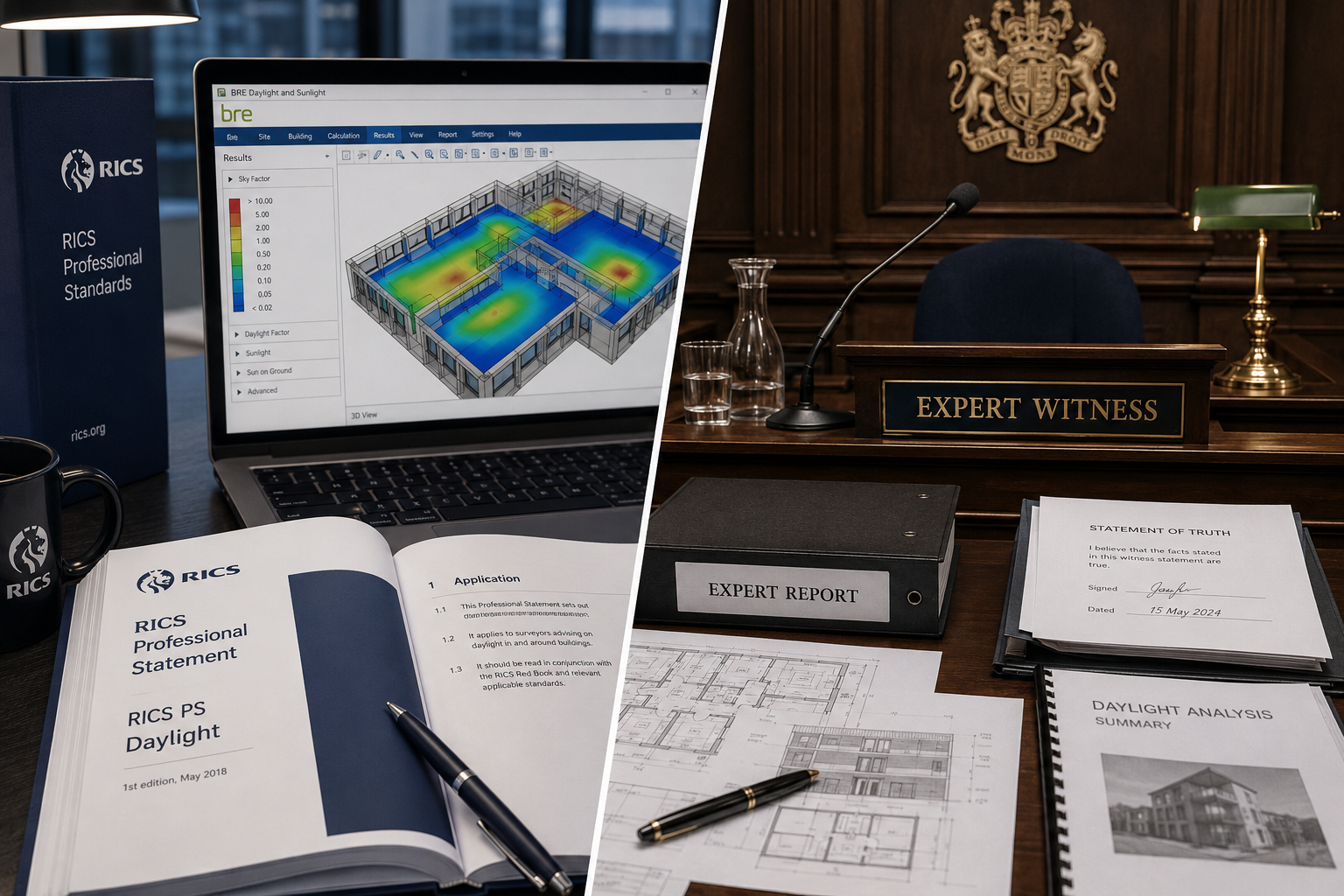
Expert Witness Valuations in Right of Light Disputes: 2026 Case Law and Surveyor Measurement Standards in Practice
Bringing together the technical and legal threads, the following framework reflects current best practice for surveyors preparing expert evidence in 2026.
Pre-Instruction Checklist
Before accepting an instruction, a surveyor should confirm:
- They hold relevant RICS membership and have read the 3rd edition professional standard
- They have no conflict of interest with any party
- They have access to appropriate software for Waldram analysis and, where needed, modern daylight modelling
- They can commit to the court's timetable for expert reports and joint statements
Report Structure
A compliant expert witness report in a rights of light case should include:
- Statement of expertise — qualifications, experience, and RICS membership
- Instructions received — verbatim or summarised, with date
- Documents reviewed — planning drawings, title documents, historical photographs
- Inspection record — date, conditions, persons present, photographs appended
- Methodology — Waldram analysis explained, assumptions listed and justified
- Findings — well-lit area before and after, percentage change, rooms affected
- Damages analysis — hypothetical negotiation model, profit pot justification, individual award range
- Declaration — CPR Part 35 compliance statement
Surveyors working in areas with high development pressure — including central London, where chartered surveyors in central London regularly encounter complex multi-party disputes — should be particularly attentive to the multi-claimant dynamics that Cooper/Ludgate addressed.
Similarly, those operating in growth areas such as chartered surveyors in Islington or chartered surveyors in North London will find that loft conversion and rear extension disputes are increasingly common as permitted development rights are exercised in dense Victorian terraces.
Joint Statements and Hot-Tubbing
Courts increasingly require experts to produce a joint statement identifying areas of agreement and disagreement before trial. This process — sometimes combined with "hot-tubbing," where experts give evidence simultaneously — demands that surveyors be able to articulate and defend their methodology in real time, without reference to their report.
The best preparation is a thorough understanding of the opposing expert's methodology, which requires careful analysis of their report and, where possible, replication of their calculations. Surveyors who cannot explain why their Waldram contours differ from those of the opposing expert will struggle in this format.
For those involved in related property disputes, understanding what constitutes a party wall dispute can provide useful context, since party wall and rights of light issues frequently arise together in extension and loft conversion projects.
Conclusion
The landscape of expert witness valuations in right of light disputes: 2026 case law and surveyor measurement standards is defined by three converging forces: a reaffirmed commitment to Waldram methodology from the courts, a recalibrated damages framework from Cooper/Ludgate, and mandatory professional standards from RICS that demand meticulous documentation at every stage.
Actionable next steps for surveyors in 2026:
- Read and implement the RICS "Rights of Light" 3rd edition (March 2024) in full — it is mandatory, not advisory
- Audit your inspection process to ensure contemporaneous notes and photographs meet the standard required for cross-examination
- Calibrate your damages model against the Cooper/Ludgate 12.5% profit pot benchmark before adopting higher figures
- Invest in training on modern daylight modelling tools, understanding their role as supporting evidence rather than primary methodology
- Seek peer review of expert reports before submission, particularly on the assumptions underpinning Waldram calculations
Surveyors who combine technical rigour with transparent documentation will be best placed to withstand the scrutiny that modern rights of light litigation demands. For complex disputes requiring specialist input, engaging RICS-accredited expert witness professionals with direct experience of court proceedings remains the most reliable path to defensible, court-ready evidence.
References
[1] Role Surveyor Expert Witness Rights Light Cases Dr Peter Defoe – https://www.linkedin.com/pulse/role-surveyor-expert-witness-rights-light-cases-dr-peter-defoe-1no4e
[2] Rights Of Light Update Cooper V Ludgate House Powell V Ludgate House 2025 EWHC 1724 – https://www.stephensonharwood.com/insights/rights-of-light-update-cooper-v-ludgate-house-powell-v-ludgate-house-2025-ewhc-1724/
[3] What Does The Courts Recent Decision On Rights To Light Mean For Development – https://www.trowers.com/insights/2025/july/what-does-the-courts-recent-decision-on-rights-to-light-mean-for-development
[6] Red New Guidance On Rights Of Light Claims – https://www.taylorwessing.com/de/insights-and-events/insights/2025/08/red-new-guidance-on-rights-of-light-claims
[7] Property Litigation 2025 A Year In Review Key Trends Shaping 2026 Part 3 Dev – https://viewpoints.stevens-bolton.com/post/102lxqc/property-litigation-2025-a-year-in-review-key-trends-shaping-2026-part-3-dev