A net balance of -26% for new buyer enquiries in February 2026, followed by a steeper -34% in April, tells a story that every property professional should be reading carefully. [7][3] When buyer demand contracts at this pace, the variables that separate a property that sells from one that stagnates become sharper and more consequential. Energy efficiency is now one of those variables. Valuing Energy Efficiency Upgrades in Cautious 2026 Markets: RICS Insights on Buyer Demand Dip is not an abstract exercise in green policy — it is a practical discipline that directly affects asking prices, negotiation leverage, and the speed of sale in a market where cautious buyers hold more power than they have in years.
Key Takeaways
- The RICS UK Residential Market Survey recorded a net balance of -26% for new buyer enquiries in February 2026 and -34% in April 2026, signalling a sustained market slowdown.
- Properties with EPC ratings of F or G are selling at discounts of up to 20% compared to equivalent C-rated homes in some UK regions.
- RICS introduced its first residential retrofit standard in October 2024, giving surveyors a structured framework for assessing energy efficiency improvements.
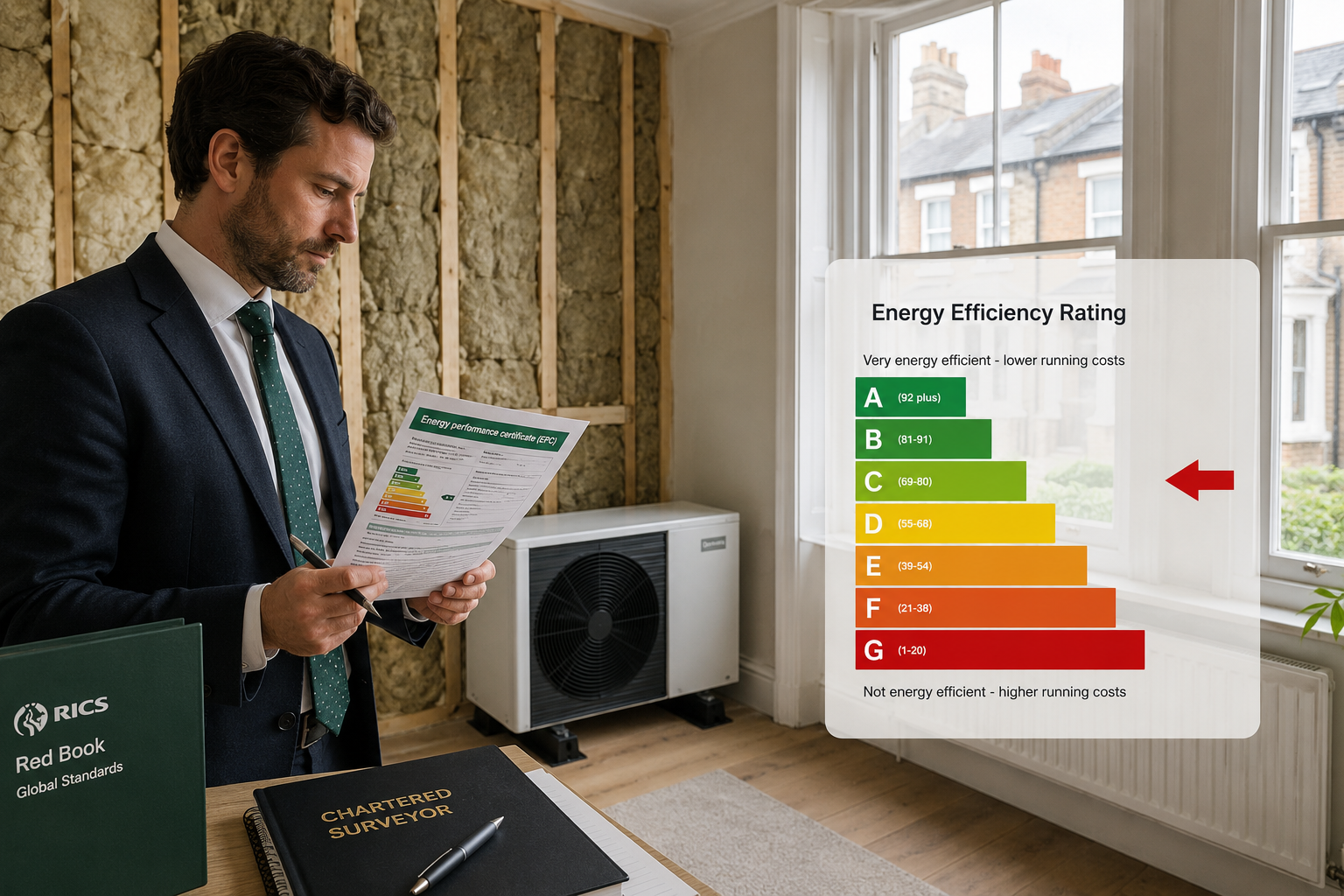
- The 2026 EPC reform introduced four headline metrics — fabric performance, heating system performance, smart readiness, and energy cost — which surveyors must now incorporate into valuations.
- A projected 14% increase in demand for Level 3 building surveys in Spring 2026 confirms that buyers are prioritising thorough property assessments before committing in uncertain conditions.
Why Buyer Caution Amplifies the Green Discount
Soft markets do not treat all properties equally. When buyer enquiries fall sharply, as the RICS data for early 2026 confirms, purchasers become more selective and more financially cautious. Running costs move from a secondary consideration to a central one. A buyer who might have overlooked a poorly insulated home in a competitive 2021 market is now far more likely to factor in annual energy bills, future retrofit obligations, and the risk of being stuck with an unsaleable asset if minimum EPC standards tighten further.
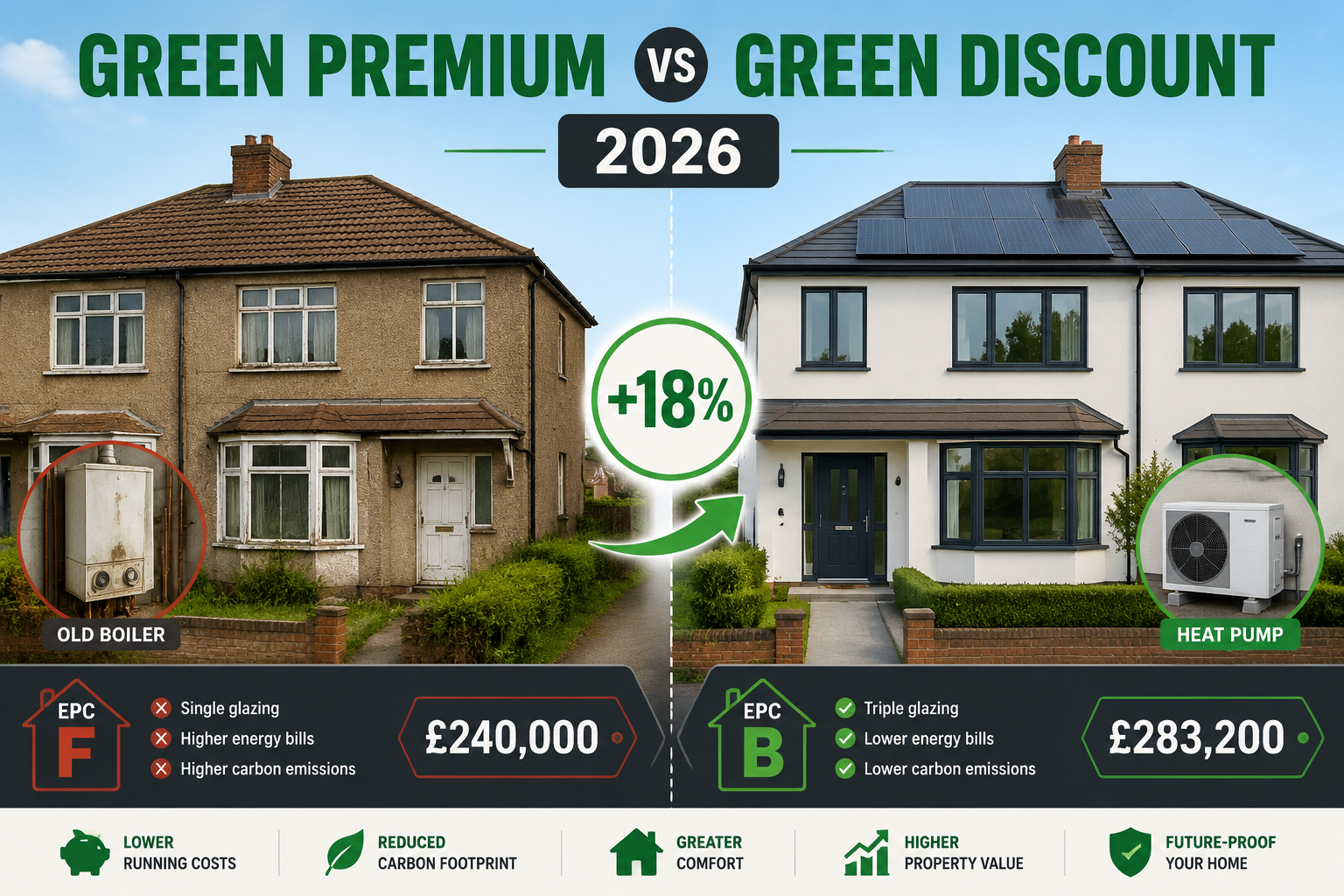
This dynamic creates what analysts describe as the "green discount" — the price penalty applied to properties with low energy ratings. Research cited by Kingston Surveyors indicates that F- and G-rated homes are already selling at discounts of up to 20% against comparable C-rated properties in certain UK regions. [1] That is not a marginal difference. On a property valued at £300,000, a 20% discount represents £60,000 — a figure that dwarfs the cost of most retrofit programmes.
The inverse of the green discount is the "green premium" — the uplift that well-rated properties command. In a cautious market, this premium becomes stickier. Buyers competing for a limited pool of energy-efficient homes are willing to pay above the average because they are purchasing certainty: lower bills, reduced compliance risk, and a property that is easier to sell or remortgage in the future.
"In a flat or softening market, buyers scrutinise running costs more carefully, amplifying the green discount for poorly rated properties." [5]
Understanding where a specific property sits on this spectrum requires more than a glance at an EPC certificate. It requires the kind of structured, evidence-based assessment that RICS-accredited professionals are trained to deliver. For sellers and buyers alike, commissioning a professional RICS valuation before entering negotiations is no longer optional — it is essential.
The RICS Framework: Tools for Valuing Energy Efficiency Upgrades in Cautious 2026 Markets
The October 2024 Residential Retrofit Standard
In October 2024, RICS published its first dedicated residential retrofit standard. This framework was designed to help surveyors systematically assess and document retrofit risks during building surveys. [2] Rather than treating energy efficiency as a footnote, the standard embeds it into the core survey process — covering insulation, heating systems, ventilation, and moisture risk associated with fabric upgrades.
For valuers, this standard provides a consistent methodology for translating physical retrofit evidence into market value adjustments. Without a structured approach, two surveyors assessing the same property could reach materially different conclusions about the value contribution of a new heat pump or external wall insulation. The retrofit standard reduces that variability, which matters enormously in a market where lenders, buyers, and sellers all need to trust the numbers.
The 2026 EPC Reform: Four New Metrics
The 2026 overhaul of the EPC framework represents the most significant change to energy certification in over a decade. The reformed system replaced the single energy efficiency score with four headline metrics:
| Metric | What It Measures |
|---|---|
| Fabric Performance | Insulation quality, air tightness, window specification |
| Heating System Performance | Efficiency and carbon intensity of the heating source |
| Smart Readiness | Capacity to integrate smart controls and demand-response technology |
| Energy Cost | Estimated annual running costs under standardised conditions |
Surveyors must now interpret all four metrics when assessing the value contribution of energy improvements. [5] A property that scores well on fabric performance but poorly on heating system performance — perhaps because it retains solid wall insulation but still runs an old gas boiler — will present a more nuanced valuation picture than a simple A-to-G rating ever could.
For RICS-registered valuers, this complexity demands greater technical literacy. It also creates an opportunity: surveyors who can clearly explain the value implications of each metric to clients will differentiate themselves in a market where buyers are hungry for clarity.
Tighter Comparable Evidence Windows
With national house prices showing signs of stabilisation rather than growth, RICS guidance emphasises applying tighter comparable evidence windows when preparing valuations. [6] In a rising market, a comparable sale from twelve months ago might still be relevant. In a flat market, a six-month-old comparable can already misrepresent current conditions.
For energy efficiency valuations specifically, this means that the green premium or green discount must be calibrated against genuinely recent transactions. A valuer who relies on pre-2025 comparables to justify an energy efficiency uplift risks overstating value in a market where buyer sentiment has shifted. Explicit time adjustments, as recommended in RICS guidance, are now a professional necessity rather than a best-practice option.
Regional Divergence and Its Impact on Energy Efficiency Valuations
Valuing Energy Efficiency Upgrades in Cautious 2026 Markets: RICS Insights on Buyer Demand Dip cannot be approached as a uniform national exercise. Regional market conditions vary significantly, and those variations directly affect how much value an energy efficiency upgrade can realistically add.
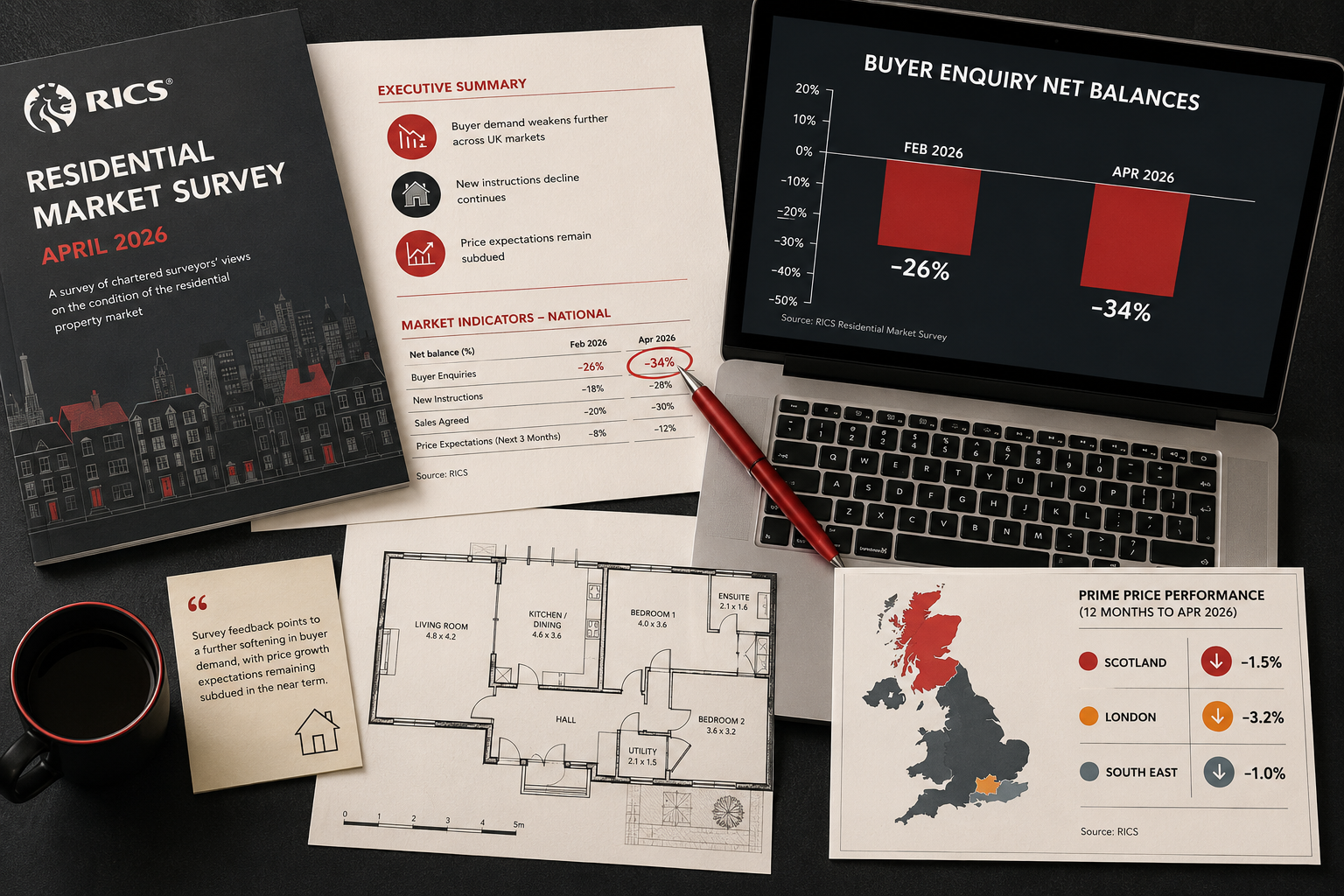
RICS data confirms that Scotland and Northern Ireland are recording modest price gains, while London and the South East face downward pressure. [4] This divergence has direct consequences for retrofit valuations:
- In Scotland and Northern Ireland, where prices are holding or rising, the green premium is more likely to be fully realised. Sellers who have invested in heat pumps, triple glazing, or solid wall insulation can expect buyers to acknowledge that investment in their offers.
- In London and the South East, where prices are under pressure, the green premium may be partially absorbed by broader market softness. However, the green discount for poorly rated properties remains acute — buyers in expensive markets are acutely aware of running costs as a proportion of total ownership cost.
- In the North West and Midlands, mid-market properties with recent energy upgrades are showing resilience compared to unimproved stock, particularly where the improvements are documented, certified, and independently verified.
For property owners in Manchester and the surrounding region, obtaining a Red Book valuation that explicitly accounts for energy efficiency improvements provides a defensible, lender-accepted figure that reflects local market conditions rather than national averages.
What Buyers Are Actually Doing: Survey Evidence and Behaviour Shifts
The -34% net balance for new buyer enquiries in April 2026 does not mean buyers have disappeared. [3] It means they are moving more slowly, asking more questions, and demanding more evidence before committing. This behavioural shift has a direct effect on how energy efficiency is valued in practice.
Key buyer behaviours observed in 2026:
- Requesting energy bills for the past two to three years before making offers
- Commissioning Level 3 building surveys at higher rates than in previous years — demand is projected to rise by 14% in Spring 2026 [8]
- Using EPC ratings as a negotiation tool, citing low ratings to justify reduced offers
- Asking solicitors to include retrofit disclosure obligations in pre-contract enquiries
The 14% increase in demand for comprehensive Level 3 building surveys is particularly telling. These surveys go well beyond a standard mortgage valuation, covering structural integrity, damp, drainage, and — crucially — the condition and specification of energy-related fabric elements. A buyer who commissions a Level 3 survey is signalling that they intend to use the findings in negotiation. Sellers with well-documented energy improvements are in a stronger position; those without documentation face the risk of speculative price reductions.
For buyers, a comprehensive RICS building survey before exchange provides the technical evidence needed to value energy improvements accurately and avoid overpaying for upgrades that are incomplete, poorly installed, or not reflected in the current EPC rating.
Practical Strategies for Sellers: Maximising Value from Energy Upgrades
The cautious 2026 market rewards sellers who can demonstrate energy efficiency with evidence, not just assertion. The following strategies reflect current RICS guidance and market conditions.
Document Everything
Retrofit work that is not documented is retrofit work that buyers cannot price. Sellers should compile:
- Installer certificates and warranties for insulation, glazing, and heating systems
- Updated EPC certificates reflecting completed works
- Smart meter data showing actual energy consumption
- Any structural assessments carried out prior to installation (relevant for external wall insulation or roof works)
Commission a Pre-Sale Valuation
A formal RICS valuation before listing provides a baseline that incorporates energy efficiency improvements at current market rates. This prevents sellers from either underpricing well-improved properties or overpricing improvements that the local market has not yet fully absorbed.
Prioritise High-Impact Upgrades
Not all energy improvements deliver equal value in the current market. Based on buyer behaviour and lender appetite in 2026, the highest-impact upgrades for valuation purposes are:
| Upgrade | Typical EPC Improvement | Buyer Perception |
|---|---|---|
| Loft insulation | 1-2 bands | High — low cost, visible, bankable |
| Double to triple glazing | 0.5-1 band | Medium — valued in cold regions |
| Gas boiler to heat pump | 1-3 bands | High — future-proofs against regulation |
| External wall insulation | 2-4 bands | High — significant fabric improvement |
| Solar PV with battery | 1-2 bands | High — running cost reduction is tangible |
Use the New EPC Metrics Strategically
Under the reformed 2026 EPC framework, a property that scores well on energy cost — even if fabric performance is only moderate — can present a compelling case to cost-conscious buyers. Sellers should ensure their EPC assessor is aware of all installed measures so that the energy cost metric reflects reality.
The Long View: Why 2026 Caution Does Not Erase Long-Term Value
Despite the near-term softness, the twelve-month sales outlook from the RICS February 2026 survey shows a net balance of +17% of respondents expecting sales activity to rise over the coming year. [7] That measured optimism matters for how energy efficiency upgrades should be valued today.
A property improved to EPC Band B or C in 2026 is not just better positioned for today's cautious buyer — it is positioned for the regulatory environment that is coming. Minimum EPC standards for rental properties have already been tightened, and equivalent requirements for owner-occupied sales are widely anticipated. Buyers and lenders who understand this trajectory are already pricing future compliance risk into their offers on poorly rated stock.
This long-term lens also shapes how surveyors should approach valuation methodology. RICS guidance on stabilised markets calls for explicit time adjustments in comparable analysis. [6] But it also implicitly supports the argument that energy efficiency improvements carry a durability of value that other cosmetic upgrades do not. A new kitchen depreciates in perceived value over time; a well-installed heat pump and insulation package retains its relevance as energy costs and regulatory requirements evolve.
For property professionals advising clients on whether to invest in retrofit before sale, the 2026 market provides a clear signal: in a cautious market, the cost of not upgrading — measured in green discounts, slower sales, and reduced negotiating power — often exceeds the cost of the upgrade itself.
Conclusion
Valuing Energy Efficiency Upgrades in Cautious 2026 Markets: RICS Insights on Buyer Demand Dip requires a combination of technical knowledge, market awareness, and methodological rigour that has never been more important. The RICS data is unambiguous: buyer enquiries have contracted sharply, regional markets are diverging, and cautious purchasers are scrutinising running costs with greater intensity than at any point in recent memory.
Actionable next steps for property owners, buyers, and professionals:
- Sellers: Commission a formal RICS valuation before listing, ensure all retrofit work is certified and documented, and use the new four-metric EPC framework to present energy improvements clearly to prospective buyers.
- Buyers: Invest in a Level 3 building survey on any property where energy efficiency is a factor — use the findings to negotiate accurately rather than speculatively.
- Valuers and surveyors: Apply the RICS residential retrofit standard consistently, use tighter comparable evidence windows, and incorporate all four 2026 EPC metrics into value adjustment analysis.
- Investors and landlords: Model the green discount risk on poorly rated stock against the cost of upgrade — in most UK regions, the financial case for proactive retrofit is now stronger than the case for deferral.
The market may be cautious. The opportunity for well-prepared, energy-efficient properties is not.
References
[1] Valuing Retrofit Potential In Cautious Spring 2026 Markets Rics Tools For Epc C Upgrades – https://kingstonsurveyors.com/valuing-retrofit-potential-in-cautious-spring-2026-markets-rics-tools-for-epc-c-upgrades/?utm_source=openai
[2] Energy Efficiency Retrofits In Cautious 2026 Markets Valuation Impacts And Building Survey Protocols Under Rics Guidance – https://princesurveyors.co.uk/blog/energy-efficiency-retrofits-in-cautious-2026-markets-valuation-impacts-and-building-survey-protocols-under-rics-guidance/?utm_source=openai
[3] Uk Residential Survey April 2026 – https://www.rics.org/news-insights/uk-residential-survey-april-2026?utm_source=openai
[4] Subdued Momentum Persists In Uk Housing Market Amidst Autumn Budget Uncertainty – https://www.rics.org/news-insights/subdued-momentum-persists-in-uk-housing-market-amidst-autumn-budget-uncertainty?utm_source=openai
[5] Energy Efficiency Retrofit Valuations In Flat Markets Assessing Epc Improvements When Buyer Demand Softens – https://princesurveyors.co.uk/blog/energy-efficiency-retrofit-valuations-in-flat-markets-assessing-epc-improvements-when-buyer-demand-softens/?utm_source=openai
[6] Valuing Stabilised National Prices In Early 2026 Rics Techniques From January Survey Insights – https://kingstonsurveyors.com/valuing-stabilised-national-prices-in-early-2026-rics-techniques-from-january-survey-insights/?utm_source=openai
[7] Uk Residential Survey February 2026 – https://www.rics.org/news-insights/uk-residential-survey-february-2026?utm_source=openai
[8] Level 3 Building Surveys In Cautious Q2 2026 Markets Rics Tools To Counter 26 Buyer Demand Dip – https://manchestersurveyors.com/level-3-building-surveys-in-cautious-q2-2026-markets-rics-tools-to-counter-26-buyer-demand-dip/?utm_source=openai