
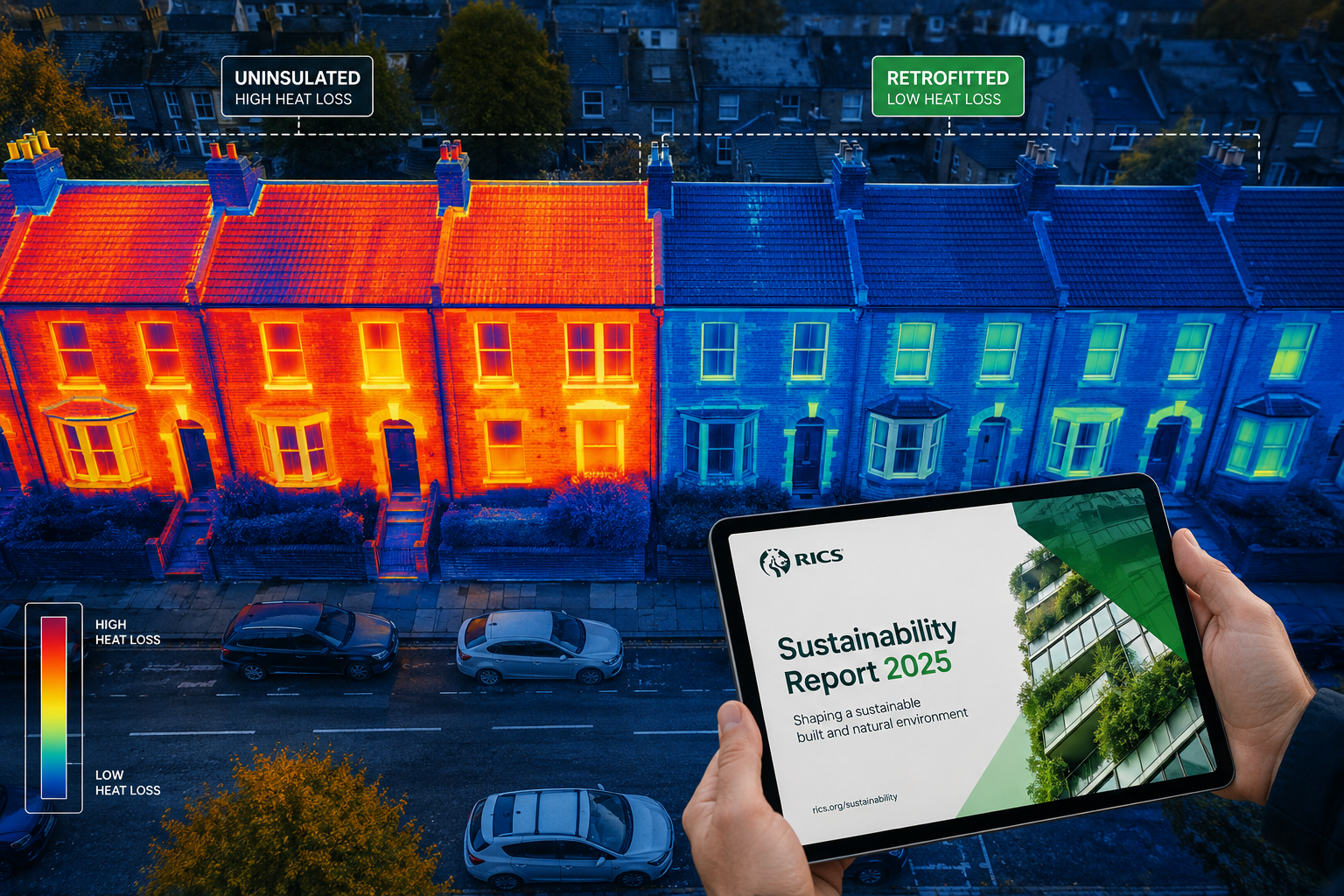
Fewer than 15% of UK homes currently meet the energy performance standards the government considers necessary for net zero — yet millions of retrofit projects are underway or planned for 2026, many of them on terraced and semi-detached properties where a shared wall separates one owner's ambitions from another's legal rights. Navigating Party Wall Notices for Energy Efficiency Retrofits: Integrating RICS Sustainability Report 2025 Insights is no longer a niche concern for specialist surveyors; it is a mainstream compliance challenge that sits at the intersection of property law, sustainability policy, and professional practice standards.

Key Takeaways
- Energy efficiency retrofits — including external wall insulation, heat pump installations, and roof upgrades — frequently trigger obligations under the Party Wall etc. Act 1996, requiring formal notices before work begins.
- The RICS Sustainability Report 2025 identifies a slowdown in green building adoption and calls for mandatory regulatory frameworks to accelerate decarbonization in existing housing stock. [1]
- Three distinct notice types apply under the Act; choosing the wrong one — or serving none at all — exposes building owners to injunctions and liability for neighbour damage.
- A Schedule of Condition prepared before retrofit works provides critical protection for both building owners and adjoining owners in the event of a dispute.
- RICS professional standards for residential retrofit, effective from October 2024, set new benchmarks for surveyors advising on EPC upgrades and sustainable refurbishment. [8]
Why the RICS Sustainability Report 2025 Matters for Retrofit Projects
The RICS Sustainability Report 2025 delivers a frank assessment of where the built environment profession stands on decarbonization. The headline finding is uncomfortable: demand growth for green buildings has weakened significantly, particularly in the Americas, signalling a broader global stagnation in sustainable practice adoption. [1] For UK property professionals, the implications are direct. The report argues that regulatory policies — not voluntary market signals — are the primary lever for driving decarbonization in both new and existing buildings. [2]
This matters enormously for retrofit work. Mandatory building regulations that limit energy use and emissions create the pipeline of projects that, in turn, generate party wall obligations. When a homeowner installs 100mm of external wall insulation across a mid-terrace property, or a landlord upgrades a Victorian flat to EPC Band C to comply with proposed Minimum Energy Efficiency Standards, the physical works almost always affect, or come close to, a shared boundary or party structure.
The report also highlights a critical skills gap. Making meaningful progress in sustainable practices requires professional development at scale. [3] For party wall surveyors, this means understanding not only the legal mechanics of the Act but also the technical characteristics of retrofit measures — how external insulation changes wall thickness and boundary positions, how heat pump installations involve ground works that may trigger excavation notice thresholds, and how vibration from mechanical equipment can affect adjoining structures.
"Regulatory policies are crucial for advancing decarbonization efforts — mandatory building regulations should limit energy use and emissions in both new and existing buildings." — RICS Sustainability Report 2025 [2]
The BS 40104 standard reinforces this professional development imperative by providing detailed guidance for retrofit assessors, emphasising that high-quality pre-retrofit assessments are foundational to improving energy efficiency across UK housing stock. [7] When a surveyor understands the full scope of a retrofit — from thermal bridging calculations to structural load implications — they are far better placed to advise on which party wall notices apply and when to serve them.
Understanding Party Wall Notices for Energy Efficiency Retrofits: Integrating RICS Sustainability Report 2025 Insights Into Legal Compliance
The Three Notice Types and When Retrofit Works Trigger Them
The Party Wall etc. Act 1996 establishes three categories of notice, each relevant to different types of retrofit activity. Understanding which notice applies — and when — is the first practical step in any compliant retrofit project.
| Notice Type | Notice Period | Typical Retrofit Trigger |
|---|---|---|
| Party Structure Notice | 2 months | External wall insulation, cavity wall fill, structural alterations to shared walls |
| Line of Junction Notice | 1 month | New wall built at or astride the boundary (e.g., new plant room) |
| Notice of Adjacent Excavation | 1 month | Ground source heat pump trenches, new foundations within 3 or 6 metres of neighbour's structure |
A Party Structure Notice is the most commonly required notice for energy retrofit work. Installing external wall insulation on a shared or party wall, cutting into a party wall to install insulation ties, or making good render that spans the boundary all fall within the scope of Section 2 of the Act. The two-month notice period is non-negotiable. [5]
The Notice of Adjacent Excavation becomes relevant when ground source heat pump collectors, new drainage runs, or foundation underpinning associated with retrofit structural work are planned within three metres of an adjoining owner's building — or within six metres if the excavation would cut below a 45-degree line drawn from the bottom of the neighbour's foundations. For detailed guidance on how these distance thresholds work in practice, the excavation notice rules under the Party Wall Act provide a useful reference. Similarly, understanding the 3-metre rule for party wall works is essential for any surveyor scoping ground-level retrofit activity.
What Every Valid Notice Must Contain
Regardless of which notice type applies, all Party Wall Notices must include: [5]
- Full names and addresses of both the building owner and the adjoining owner
- A clear, specific description of the proposed works
- The address of the property where work will be carried out
- The proposed start date for the works
Vague descriptions — "insulation works" or "energy improvements" — are insufficient. A notice for external wall insulation should specify the insulation system, approximate thickness, method of fixing, and any associated works such as render application or window reveal extensions. This level of detail protects the building owner and gives the adjoining owner enough information to make an informed decision about consent or dissent.
Once served, a valid notice remains in force for twelve months. If notifiable retrofit works do not commence within that window, the notice lapses and must be re-served. [5] Given that retrofit projects frequently experience delays due to supply chain issues, planning conditions, or funding approvals, building owners should factor this validity period into their project programme from the outset.
What Happens When No Notice Is Served
Proceeding with notifiable works without serving a valid notice is a serious legal risk. Adjoining owners can apply to court for an injunction to stop the works, and the building owner may face liability for any damage caused — with no agreed Schedule of Condition to establish a baseline. For a detailed examination of the consequences, the risks of proceeding without a party wall notice are significant and should not be underestimated.
Schedules of Condition, Vibration Monitoring, and Valuation Uplifts
The Role of Schedules of Condition in Retrofit Projects
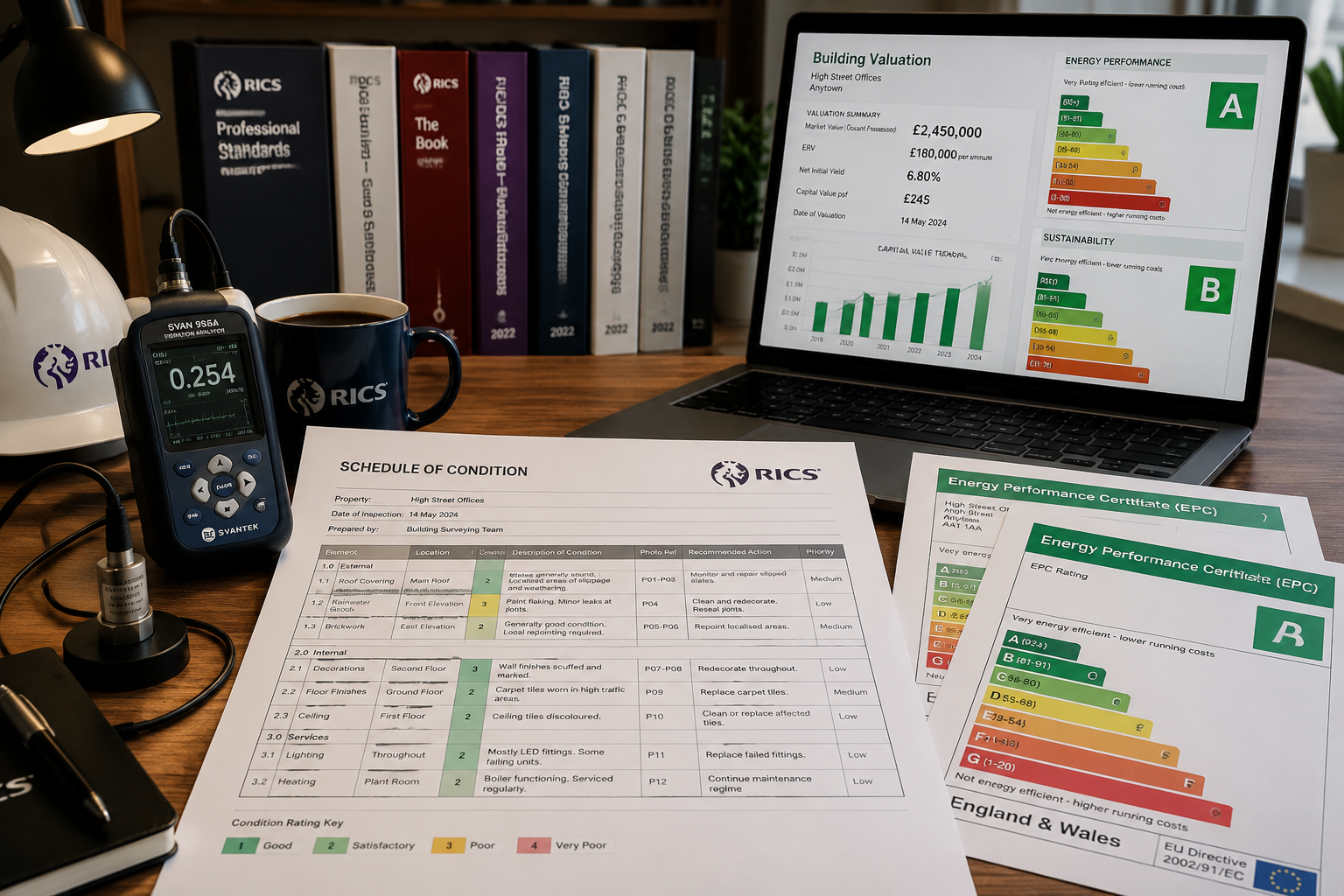
Before any notifiable retrofit work begins, preparing a thorough Schedule of Condition for the adjoining property is one of the most protective steps a building owner can take. [6] This document records — with photographs and written descriptions — the pre-existing state of every element of the neighbour's property that could plausibly be affected by the works.
For retrofit projects specifically, the Schedule of Condition should address:
- External render and masonry: Existing cracks, spalling, or delamination that could be attributed to vibration or thermal movement during works
- Internal plasterwork: Hairline cracks near party wall junctions that might worsen during drilling or mechanical fixing operations
- Windows and doors: Existing alignment, seal condition, and frame integrity — particularly relevant where external insulation changes the reveal depth
- Roof junctions: Condition of flashings and abutments where insulation meets the roof line
The professional standard for this documentation is high. A Schedule of Condition prepared by a qualified RICS chartered building surveyor carries far greater evidential weight in any subsequent dispute than a document prepared by an unqualified party.
Vibration Monitoring: An Emerging Requirement for Retrofit Works
The RICS Sustainability Report 2025 underlines the need for professional skills development to keep pace with the technical complexity of modern retrofit projects. [3] One area where this is increasingly apparent is vibration monitoring. Certain retrofit activities — mechanical drilling for insulation anchors, percussive installation of ground heat exchanger pipework, or compaction of new sub-base material for heat pump plant areas — generate ground-borne vibration that can cause cosmetic or structural damage to adjoining properties.
Where the party wall award or agreed notice conditions require it, monitoring surveys can provide continuous vibration data throughout the works programme. This data serves two purposes: it demonstrates compliance with agreed vibration limits in real time, and it provides an objective record if a damage claim is later made. The threshold levels set out in BS 7385 and BS 5228 are the standard benchmarks used in party wall awards involving vibration-generating works.
Valuation Uplifts for Green Features: What Surveyors Need to Know
One dimension of Party Wall Notices for Energy Efficiency Retrofits: Integrating RICS Sustainability Report 2025 Insights that is often overlooked is the valuation impact of completed retrofit works. The RICS Residential Retrofit Standard, effective from October 2024, sets new benchmarks for RICS members delivering retrofit services and explicitly recognises the growing importance of energy performance in property valuation. [8]
Research consistently shows that properties with higher EPC ratings command a premium over equivalent lower-rated properties. Key valuation considerations for retrofitted properties include:
- EPC Band uplift premium: Properties moving from Band D or E to Band B or C typically achieve measurable sale price premiums, with estimates ranging from 3% to 14% depending on location and property type.
- Green mortgage eligibility: Properties meeting certain EPC thresholds qualify for preferential mortgage rates, increasing the pool of potential buyers and supporting value.
- Reduced running costs: Lower energy bills are increasingly factored into buyers' affordability calculations, particularly in the context of higher energy prices.
For surveyors advising clients on retrofit investment decisions, understanding these valuation dynamics is as important as understanding the legal compliance framework. A well-executed external wall insulation project that is properly notified, professionally monitored, and documented with a robust Schedule of Condition is not just a legal obligation fulfilled — it is a value-adding asset improvement.
It is also worth noting that where retrofit works involve structural elements — such as beam replacements to accommodate new mechanical ventilation systems, or structural openings for heat pump plant rooms — beam calculations and structural engineering input should be integrated into the party wall award process from the outset. This ensures that the structural implications of the retrofit are properly assessed and that the adjoining owner's surveyor has the technical information needed to agree reasonable conditions.
Obtaining Party Wall Consent: Streamlining the Process
When an adjoining owner receives a party wall notice and has no objection to the proposed retrofit works, they can provide written consent within fourteen days, avoiding the need to appoint surveyors and agree a formal award. This is the most efficient outcome for all parties. Guidance on how to secure party wall consent efficiently — including what consent letters should contain and how they interact with the notice — is an important part of any pre-project planning process.
Where consent is not forthcoming, or where the adjoining owner dissents, the formal surveyor appointment and award process begins. For retrofit projects with tight programme constraints — particularly those tied to grant funding deadlines under schemes such as the Great British Insulation Scheme — early notice service is essential to preserve flexibility.
Practical Steps for Surveyors and Building Owners in 2026
The convergence of sustainability policy pressure, RICS professional standards reform, and the practical realities of the Party Wall etc. Act 1996 creates a clear action framework for 2026. The following steps reflect best practice for any retrofit project involving a shared or adjacent boundary:
-
Conduct a thorough pre-design review to identify all notifiable works before finalising the retrofit specification. Changes to the scope after notices are served can require re-notification and restart notice periods.
-
Serve notices at the earliest possible stage — ideally as soon as planning permission is granted or funding is confirmed. The two-month notice period for Party Structure Notices is a hard constraint that cannot be shortened by agreement.
-
Commission a Schedule of Condition before any site activity begins, even where the adjoining owner has consented to the works. Consent does not waive the neighbour's right to claim for damage.
-
Specify vibration monitoring requirements in the party wall award where mechanical or percussive installation methods are proposed.
-
Engage a surveyor with retrofit technical knowledge — not just party wall procedural expertise. The RICS Residential Retrofit Standard [8] and BS 40104 [7] together define the competency benchmark for professionals advising on EPC-driven refurbishment.
-
Document the completed works with post-completion photographs and updated EPC assessments, creating a clear record of the energy performance improvement achieved.
Conclusion
The relationship between Party Wall Notices for Energy Efficiency Retrofits: Integrating RICS Sustainability Report 2025 Insights and practical compliance is not merely academic. As the UK accelerates its retrofit programme in 2026, the legal and professional frameworks governing shared boundary works are under greater pressure than at any point since the Party Wall etc. Act came into force. The RICS Sustainability Report 2025's call for stronger regulatory frameworks [2] and enhanced professional skills [3] maps directly onto the demands placed on surveyors managing retrofit projects on terraced, semi-detached, and flatted properties.
Actionable next steps for building owners and professionals:
- Review the full scope of any planned retrofit against the three notice thresholds before appointing contractors
- Engage a qualified party wall surveyor with documented retrofit experience at the design stage, not after works have started
- Use the RICS Residential Retrofit Standard and BS 40104 as the professional competency benchmarks when selecting advisors
- Treat the Schedule of Condition as a non-negotiable element of the pre-works process, regardless of whether consent or dissent has been received
- Factor valuation uplifts and green mortgage eligibility into the investment case for retrofit works, ensuring clients understand the full financial picture
For comprehensive guidance on the full scope of party wall obligations, the party wall services overview provides a structured starting point for any project involving shared or adjacent structures.
References
[1] Rics Report Warns Of Sustainability Slowdown In Global Built Environment – https://www.rics.org/news-insights/rics-report-warns-of-sustainability-slowdown-in-global-built-environment?utm_source=openai
[2] Sustainability Report 2025.pdf. – https://www.rics.org/content/dam/ricsglobal/documents/reports/Sustainability-report-2025.pdf.?utm_source=openai
[3] Sustainability Report 2025 – https://www.rics.org/news-insights/current-topics-campaigns/sustainability/sustainability-report-2025?utm_source=openai
[4] Party Wall Surveying For Mid Terrace Retrofits Heat Pumps External Insulation And The Party Wall Act – https://www.canterburysurveyors.com/blog/party-wall-surveying-for-mid-terrace-retrofits-heat-pumps-external-insulation-and-the-party-wall-act/?utm_source=openai
[5] Party Wall Notice Explained – https://www.surveyofpartywall.co.uk/party-wall-notice-explained/?utm_source=openai
[6] Party Wall Act Notices For Solar Panel Retrofits Rics Protocols Amid 2026 Net Zero Roof Works Surge – https://www.canterburysurveyors.com/blog/party-wall-act-notices-for-solar-panel-retrofits-rics-protocols-amid-2026-net-zero-roof-works-surge/?utm_source=openai
[7] Bs40104 Retrofit Assessment Domestic Energy – https://ww3.rics.org/uk/en/journals/property-journal/bs40104-retrofit-assessment-domestic-energy.html?utm_source=openai
[8] Retrofit – https://www.rics.org/profession-standards/rics-standards-and-guidance/sector-standards/real-estate-standards/retrofit?utm_source=openai