
The proportion of UK properties receiving lower-than-expected valuations fell by 65% between late 2025 and early 2026 — dropping from 29% to approximately 10% — a shift that fundamentally changes how expert valuers must frame their evidence in property disputes. [2] For any surveyor preparing testimony in 2026, understanding the precise data behind this shift is not optional; it is the difference between credible expert opinion and contested, vulnerable evidence.
This article examines how Valuation Adjustments in Early 2026 Market Recovery: RICS Survey Insights for Expert Witness Credibility should inform professional practice. It draws directly on the January 2026 RICS UK Residential Market Survey and related data to help valuers build robust, defensible positions in litigation, arbitration, and tribunal proceedings.
Key Takeaways 📋
- Downward valuation adjustments dropped sharply in early 2026, signalling improved market stability — but this recovery was fragile and regionally uneven.
- RICS January 2026 data shows improving buyer enquiries, agreed sales, and 12-month price expectations — all critical metrics for evidencing valuation assumptions.
- Regional divergence is significant: Scotland and Northern Ireland outperform, while London and the South East lag — expert witnesses must account for local market conditions.
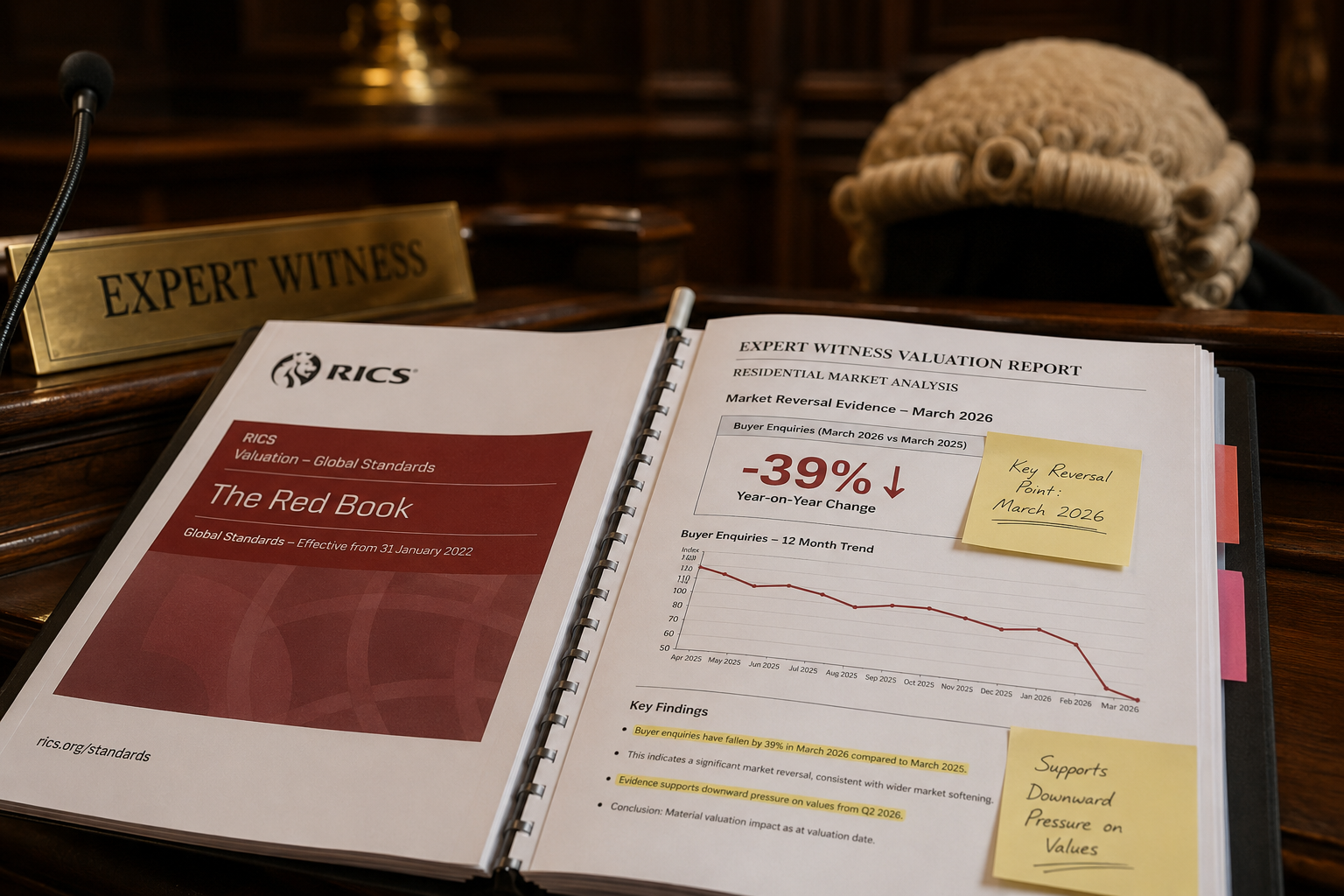
- Market momentum reversed by March 2026, meaning valuations dated to Q1 2026 require careful temporal framing in any expert report.
- Credit conditions tightened severely in Q1 2026, directly impacting buyer capacity and valuation methodology.

Understanding the RICS January 2026 Data Landscape
What the Survey Numbers Actually Tell Us
The RICS UK Residential Market Survey for January 2026 paints a picture of cautious but measurable recovery. [1] Several headline indicators moved in a positive direction simultaneously — a pattern that carries evidential weight when justifying valuation assumptions in dispute contexts.
| Indicator | Nov 2025 | Dec 2025 | Jan 2026 | Trend |
|---|---|---|---|---|
| New buyer enquiries (net balance) | -29% | -21% | -15% | ⬆️ Improving |
| Agreed sales (net balance) | — | — | -9% | ⬆️ Best since Jun 2025 |
| House prices (3-month net balance) | — | — | -10% | ⬆️ Up from -19% Oct 2025 |
| 12-month price expectations | — | — | +43% positive | ⬆️ Best since Feb 2025 |
| 12-month sales expectations | — | — | +35% | ⬆️ Best since Dec 2024 |
Sources: [1][4]
These figures matter enormously for expert witnesses. When a valuation report is challenged on the basis that it was too optimistic or too pessimistic for its date, the surveyor must be able to point to contemporaneous market evidence. The RICS survey data provides exactly that evidential anchor.
💬 "The net balance for agreed sales stood at -9% in January 2026 — the least negative reading since June 2025 — indicating that transactional momentum was genuinely building at that point in the cycle." [1]
Supply-Side Constraints: A Critical Context Factor
Recovery in demand does not automatically translate to recovery in prices or transaction volumes. Supply constraints remained a defining feature of the early 2026 market:
- New instructions: net balance of just +1% in January 2026 [4]
- Landlord instructions: improved to -24% from -34%, but still firmly negative [4]
This supply-demand imbalance is a legitimate basis for upward valuation adjustments in certain property types and locations. An expert witness citing these figures demonstrates command of market mechanics, not just headline price data.
For valuers working under RICS Red Book standards, the obligation to reflect market conditions as at the valuation date makes this contemporaneous data indispensable. Similarly, those preparing RICS Red Book valuations for litigation purposes must be able to demonstrate that their assumptions align with what the market was actually doing — not what it did six months later.
The Rental Market: A Parallel Signal
The residential rental market offered a concurrent recovery signal. Tenant demand edged higher in the three months to January 2026, ending two consecutive quarters of flat or negative readings. Some 28% of respondents expected rental prices to rise in the near term — up sharply from 16% previously. [4]
For valuers working on investment property disputes or landlord-tenant litigation, this rental market data provides a secondary layer of evidence to support yield-based valuation assumptions.
Regional Divergence and Valuation Adjustments in Early 2026 Market Recovery: RICS Survey Insights for Expert Witness Credibility
Why Geography Matters More Than the National Average
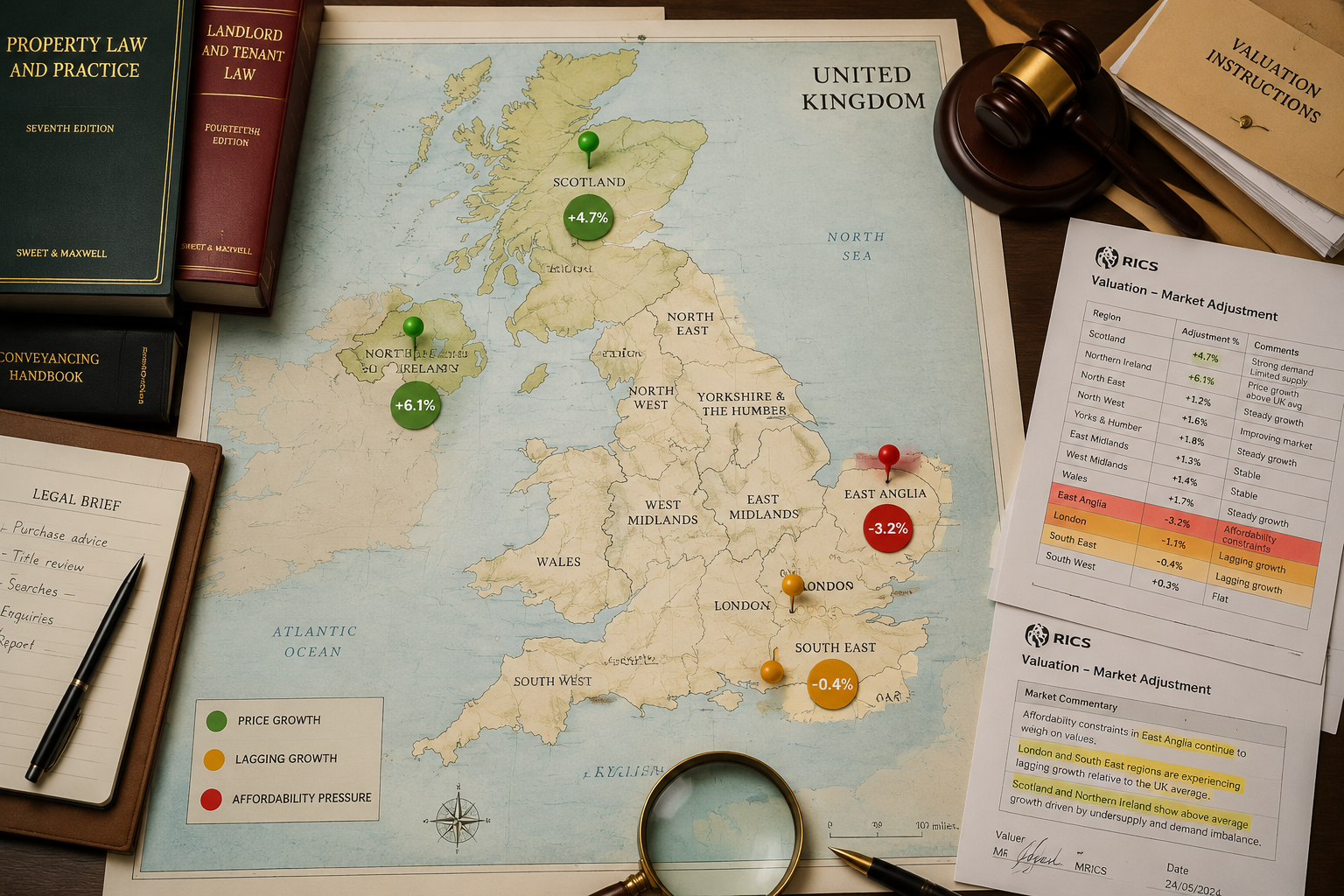
One of the most important — and most frequently overlooked — aspects of the January 2026 RICS data is its regional divergence. [1] A national net balance figure of -10% for prices conceals dramatically different local realities:
🟢 Outperforming regions (price growth trends):
- Scotland
- Northern Ireland
🟡 In line with national average:
- Midlands
- Yorkshire and Humber
- North West
🔴 Lagging behind (affordability challenges):
- London
- South East
- South West
- East Anglia
This divergence has direct implications for expert witness credibility. A valuation prepared for a property in East Anglia using national average recovery assumptions would be methodologically flawed. Conversely, a valuation for a Scottish property that applies London-style downward adjustments would be equally indefensible.
⚠️ Expert witness warning: Using national RICS data without regional disaggregation is a common point of attack in cross-examination. Always cite the specific regional sub-index relevant to your subject property.
Affordability Constraints as a Valuation Variable
The ongoing affordability challenges in London, the South East, and East Anglia are not simply a demand-side story. They reflect structural constraints — high loan-to-income ratios, stretched deposit requirements, and mortgage affordability calculations — that directly cap achievable prices regardless of sentiment.
For expert witness reports prepared for properties in these regions, the appropriate adjustment methodology must incorporate:
- Affordability ceiling analysis — what can a typical buyer actually borrow?
- Comparable evidence weighting — recent comparables carry more weight than older transactions
- Sentiment adjustment factors — documented via RICS survey data as at the valuation date
Surveyors providing expert witness services in contested valuations should be prepared to explain each of these factors in plain language — the court or tribunal will expect clarity, not jargon.
Credit Conditions: The Hidden Constraint
Perhaps the most significant finding for valuation methodology in early 2026 is the dramatic tightening of credit conditions. The RICS credit conditions indicator fell to -44% in Q1 2026, down from +9% in Q4 2025 — the weakest reading since Q3 2023. [3]
This is not a minor data point. A swing of 53 percentage points in credit availability within a single quarter represents a fundamental shift in buyer capacity. For expert witnesses, this means:
- Valuations prepared in Q1 2026 must reflect constrained mortgage lending
- The gap between asking price and achievable price widens when credit tightens
- Forced sale scenarios and distressed asset valuations require even more conservative assumptions
This data is particularly relevant for RICS valuations in shared ownership disputes, where buyer affordability is a central legal question.
Applying Valuation Adjustments in Early 2026 Market Recovery: RICS Survey Insights for Expert Witness Credibility to Dispute Practice
The Fragility of the Recovery Narrative
The January 2026 data told a story of cautious recovery. By March 2026, that story had changed substantially. New buyer enquiries fell to a net balance of -39% — a dramatic deterioration from January's -15%. [1] Geopolitical uncertainty and rising bond yields emerged as headwinds that the January data could not have predicted.
This reversal creates a specific challenge for expert witnesses:
Scenario A: A valuation dated January 2026 is challenged in mid-2026 proceedings. The claimant argues the valuer was too optimistic. The January RICS data supports the valuer's assumptions — but the March reversal is used to argue the recovery was illusory.
Scenario B: A valuation dated March 2026 is challenged. The defendant argues the valuer failed to account for the recovery signals visible in January data. The March deterioration data supports the valuer's caution.
In both scenarios, the expert witness must demonstrate temporal precision — what did the market look like on the specific valuation date, and what was knowable at that moment?
💬 "Valuations must account for a highly volatile, potentially fragmented market rather than a stable uptrend — this is critical for expert credibility." [1]
Building a Defensible Adjustment Methodology
The following framework helps expert valuers structure their adjustments in a way that withstands cross-examination:
Step 1: Establish the Valuation Date Context
- Pull the RICS monthly survey for the relevant month
- Identify the net balance figures for prices, enquiries, and sales
- Note any significant divergence from the preceding month
Step 2: Apply Regional Disaggregation
- Identify the relevant RICS regional sub-index
- Compare regional performance to national average
- Document any local market factors (planning constraints, employment, infrastructure)
Step 3: Incorporate Credit Condition Data
- Reference the RICS credit conditions indicator for the relevant quarter
- Cross-reference with Bank of England mortgage approval data
- Adjust achievable price assumptions accordingly
Step 4: Document Comparable Evidence
- Weight comparables by proximity to valuation date
- Disclose any adjustments made to comparables and the basis for those adjustments
- Reference RICS guidance on comparable selection
Step 5: Apply Sentiment Adjustment (Where Appropriate)
- Use RICS 12-month expectations data to support or temper your assumptions
- Be explicit about whether sentiment data has been used and how
This structured approach aligns with the standards expected of RICS-registered valuers and demonstrates the methodological rigour that tribunals and courts expect.
The 12-Month Expectations Data: A Double-Edged Tool
The January 2026 survey showed 43% of RICS respondents anticipated higher prices over the year ahead — the most positive outlook since February 2025. [1] The 12-month sales recovery expectation reached +35%, the strongest since December 2024. [1]
These figures are powerful for expert witnesses — but they must be used carefully:
✅ Appropriate use: Supporting a valuation that assumes modest price growth over a 12-month hold period in an investment dispute
✅ Appropriate use: Evidencing that market participants had reasonable grounds for optimism at the valuation date
❌ Inappropriate use: Applying 12-month expectations to a spot valuation without adjustment
❌ Inappropriate use: Ignoring the subsequent March 2026 deterioration when preparing a report in mid-2026
For matrimonial valuations — where the valuation date is often contested — the distinction between spot value and forward-looking assumptions is particularly important. Courts in family proceedings are alert to valuers who conflate current market value with anticipated future value.
Rental Market Evidence in Expert Reports
The improvement in rental market sentiment — with 28% of respondents expecting near-term rent rises, up from 16% [4] — provides useful supporting evidence for investment property valuations. For buy-to-let disputes, landlord-tenant disagreements, or commercial lease renewals, this data helps establish:
- Sustainable yield assumptions at the valuation date
- Void period expectations based on tenant demand trends
- Rental growth projections grounded in contemporaneous survey data
Surveyors handling commercial property matters should note that the RICS Q1 2026 Commercial Property Monitor also recorded the credit conditions deterioration — reinforcing that tighter lending affected both residential and commercial valuations simultaneously. [3]
Conclusion: Turning RICS Data Into Expert Witness Strength
The early 2026 UK property market offered a genuinely complex picture — improving sentiment in January, sharp deterioration by March, persistent regional divergence, and a dramatic tightening of credit conditions. For expert witnesses, this complexity is not a weakness; it is an opportunity to demonstrate the depth of professional knowledge that separates credible testimony from superficial opinion.
Actionable next steps for expert valuers in 2026:
- Date-stamp your evidence: Always match RICS survey data to the specific valuation date, not the nearest convenient month.
- Go regional: National averages are a starting point, not a conclusion. Use sub-regional RICS data and local comparables.
- Address credit conditions explicitly: The Q1 2026 credit tightening was severe enough to materially affect achievable prices — document this in every relevant report.
- Acknowledge the March reversal: If preparing reports in mid-2026, address the January-to-March momentum shift directly rather than hoping opposing counsel won't raise it.
- Structure your methodology: Follow a documented, step-by-step adjustment process that can be explained clearly in cross-examination.
- Use RICS Red Book standards: Ensure all expert valuations comply with current RICS Red Book requirements — this is the baseline for professional credibility.
The most defensible expert witness position in 2026 is not the most optimistic or the most conservative — it is the most transparent and evidenced. RICS survey data, properly cited and correctly applied, is the foundation of that transparency.
References
[1] UK Resi Survey Jan 2026 Report Shows Early Signs Market Recovery Despite Caution – https://www.rics.org/news-insights/uk-resi-survey-jan-2026-report-shows-early-signs-market-recovery-despite-caution
[2] Watch – https://www.youtube.com/watch?v=U8d5WC6Q0ng
[3] RICS UK Commercial Property Monitor Q1 2026 – https://www.rics.org/news-insights/rics-uk-commercial-property-monitor-q1-2026
[4] UK Residential Market Survey January 2026 – https://www.rics.org/content/dam/ricsglobal/documents/market-surveys/uk-residential-market-survey/UK-Residential-Market-Survey_January-2026.pdf
[5] Valuation Adjustments For Cautious Spring 2026 Housing Market RICS February Insights On Buyer Demand Dips And Regional Price Flatness – https://nottinghillsurveyors.com/blog/valuation-adjustments-for-cautious-spring-2026-housing-market-rics-february-insights-on-buyer-demand-dips-and-regional-price-flatness