}

Nearly one in three neighbour disputes in England and Wales involves a boundary wall — yet the majority of homeowners who trigger these conflicts have never read a single line of the Party Wall etc. Act 1996. Understanding Party Wall Agreements for Garden Boundary Walls: 2026 Notice Rules, Shared Ownership Disputes, and Building Safeguards is not optional when you plan to build, repair, or demolish a shared garden wall. Get it wrong and you face injunctions, costly legal battles, and damaged neighbourly relations that can last for years.
This guide cuts through the legal jargon to explain exactly what the Act covers, which notice applies to your project, how shared ownership disputes are resolved, and what building safeguards protect both sides of the fence — literally.
Key Takeaways 📌
- Different notice periods apply depending on whether you are building a new boundary wall (1 month) or working on an existing party fence wall (2 months).
- Notices must be in writing — verbal agreements have zero legal standing under the Party Wall etc. Act 1996.
- Neighbours have 14 days to respond; silence legally counts as dissent, triggering a surveyor appointment process.
- A written consent from your neighbour eliminates the need for a formal Party Wall Award and saves surveyor fees.
- Shared ownership disputes are best resolved through an agreed surveyor or two appointed surveyors, with a Party Wall Award as the binding outcome.
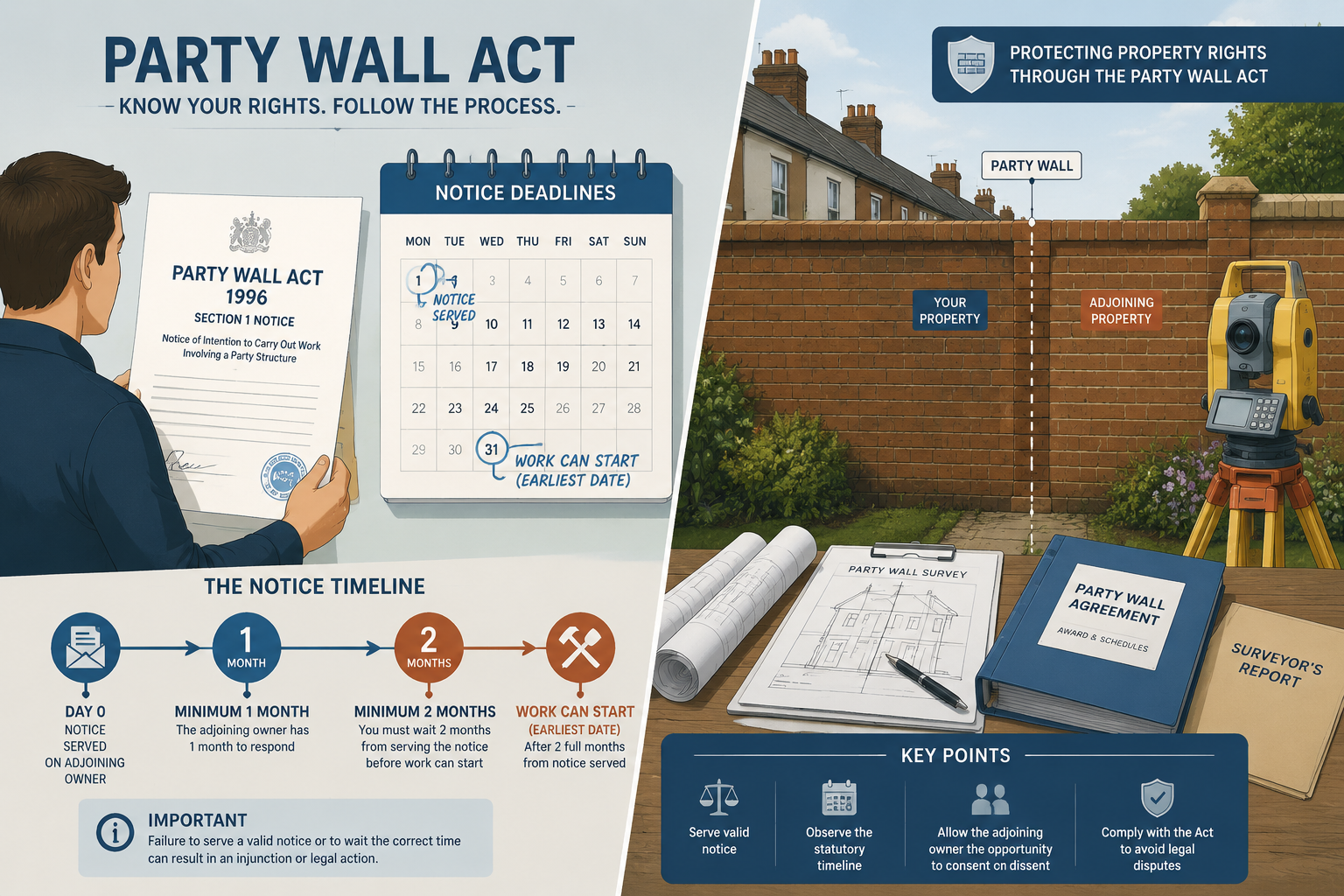
Does the Party Wall Act Actually Cover Garden Boundary Walls?
This is the question most homeowners get wrong. The Party Wall etc. Act 1996 does not just apply to walls inside buildings — it also covers party fence walls, which is the legal term for a garden boundary wall that sits astride the boundary line between two properties and belongs to both owners.
What Qualifies as a Party Fence Wall?
A party fence wall is a wall that:
- Stands on the boundary line between two properties (not entirely within one owner's land)
- Is not part of a building (distinguishing it from a party wall inside a terraced house)
- Is shared between adjoining owners
💡 Pull Quote: "A garden wall sitting astride the boundary line is legally a party fence wall — and the Party Wall Act applies to any work that touches it."
If the wall sits entirely within your land, the Act does not apply to the wall itself, though excavation near a neighbour's building may still trigger a Section 6 notice. A professional boundary survey is often the first step to confirming exactly where the legal boundary falls.
What Work Triggers the Act?
The following activities on or near a party fence wall require notice:
| Work Type | Relevant Section | Notice Required |
|---|---|---|
| Building a new wall on the boundary line | Section 1 | ✅ Yes — 1 month |
| Repairing or altering an existing party fence wall | Section 2 | ✅ Yes — 2 months |
| Demolishing and rebuilding a shared garden wall | Section 2 | ✅ Yes — 2 months |
| Excavating within 3 or 6 metres of a neighbour's building | Section 6 | ✅ Yes — 1 month |
| Painting or minor surface maintenance | N/A | ❌ No notice needed |
2026 Notice Rules: Timelines, Content, and Legal Validity
Understanding Party Wall Agreements for Garden Boundary Walls: 2026 Notice Rules, Shared Ownership Disputes, and Building Safeguards starts with mastering the notice process. The rules have not changed since the Act came into force, but enforcement awareness has grown sharply — and courts are less forgiving of procedural errors than ever.
Notice Periods at a Glance ⏱️
Section 1 — New Boundary Wall:
When building a new wall on or astride the boundary line, the building owner must serve a minimum of one month's written notice before work begins [4].
Section 2 — Existing Party Fence Wall:
Work on an existing shared garden wall requires a minimum of two months' advance notice to all adjoining owners [4]. This longer period reflects the greater potential impact on neighbouring property.
Section 6 — Excavation Near Neighbouring Buildings:
Excavation notices adjacent to a neighbour's building require a minimum of one month's notice, mirroring the Section 1 timeline [4]. For more detail on when this applies, see the guidance on excavation notices for party wall works and the 3-metre rule explained.
The 12-Month Validity Window
A Party Wall notice is not a permanent green light. Notices remain valid for only 12 months from the date of service [1]. If work does not begin within that window — or is not prosecuted with due diligence — the notice expires and must be re-served. This catches many homeowners off guard when planning delays push projects into a new calendar year.
What Must a Valid Notice Include?
A notice missing key details can be declared legally invalid, halting your project entirely [5]. Every notice must contain:
- ✅ Full name and address of the building owner
- ✅ Detailed description of the proposed works (with sufficient particulars)
- ✅ Intended start date of the work
- ✅ Dated signature (strongly recommended to avoid timing disputes)
⚠️ Critical reminder: Notices must be served in writing — by paper or electronic format. The Party Wall Act 1996 does not recognise verbal communication as valid service under any circumstances [1].
Who Must Receive the Notice?
Building owners must serve notice on all parties with a legal interest in the neighbouring property. This includes:
- Freeholders
- Leaseholders with leases exceeding 12 months
Using HM Land Registry searches is strongly recommended to identify all relevant parties accurately [1]. Missing even one affected owner can invalidate the notice and cause significant project delays.
The Response Timeline: What Happens After Service?
| Timeframe | Event |
|---|---|
| Day 0 | Notice served on adjoining owner(s) |
| Day 14 | Deadline for neighbour to respond |
| Day 14+ | No response = legal dissent under the Act |
| Day 14–24 | Building owner may serve 10-day follow-up notice [5] |
| Day 24+ | Building owner may proceed under Party Wall Act terms |
| Within 1 month | Adjoining owner may serve a counter-notice [3] |
Silence is not consent. If a neighbour fails to respond within 14 days, this legally counts as dissent [1]. The building owner can then issue a 10-day follow-up notice, after which work may proceed under the Act's framework [5].
The good news: If the neighbour responds within 14 days with written consent to all proposed works, no formal Party Wall Award is needed — eliminating surveyor fees entirely [3].
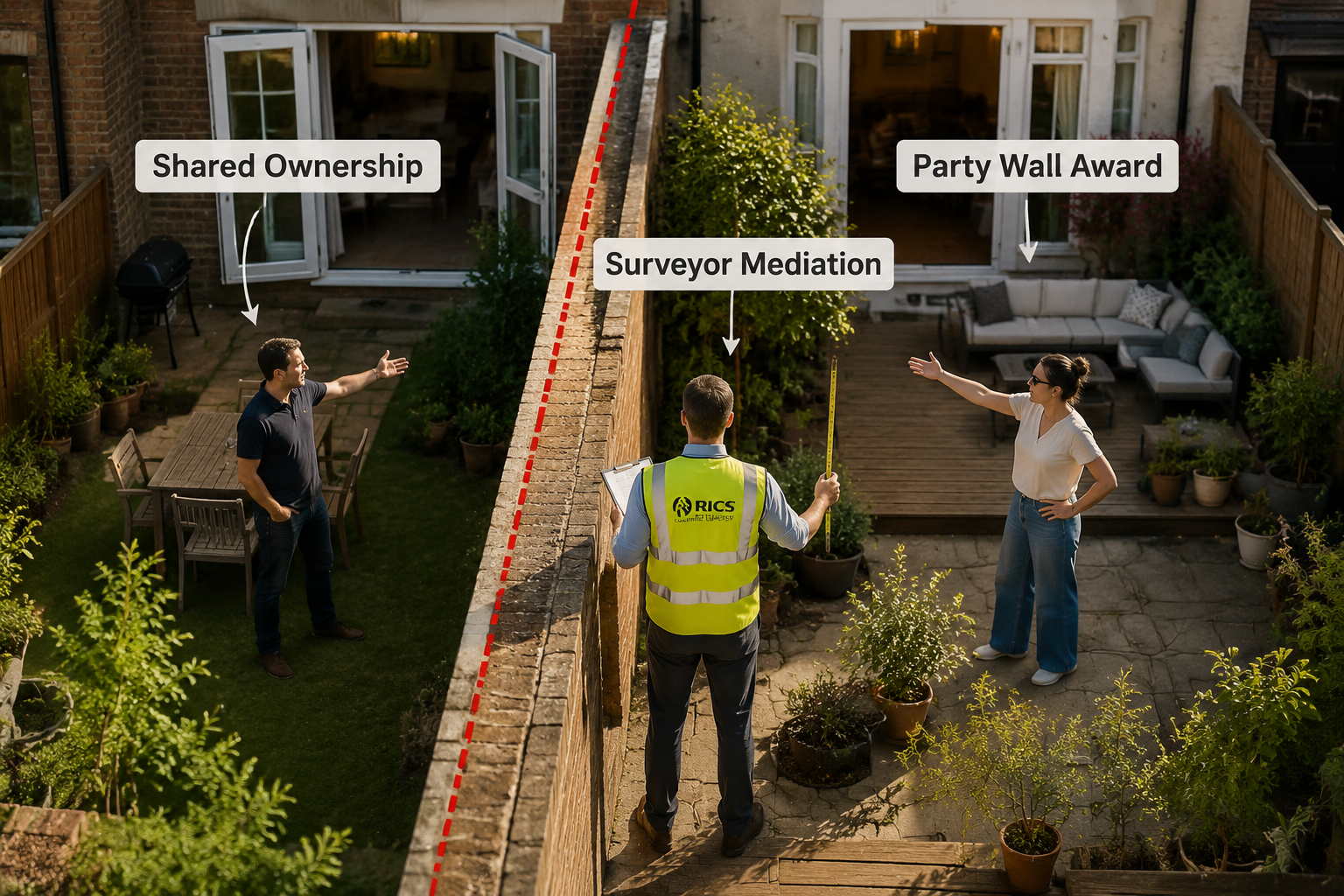
Shared Ownership Disputes: How Terraced House Conflicts Get Resolved
Terraced houses are the flashpoint for the majority of party fence wall disputes in England and Wales. With properties sharing not just walls but garden boundaries, the potential for conflict is significant — especially during renovation seasons.
Common Dispute Scenarios 🏘️
1. Who owns the wall?
Ownership of a boundary wall is not always clear from title deeds. Where a wall straddles the boundary, both owners typically share ownership — and both share responsibility for maintenance costs. A boundary survey can clarify ownership before disputes escalate.
2. One owner wants to rebuild; the other refuses.
Under Section 2 of the Act, a building owner has the right to carry out certain works even if the neighbour objects — provided the correct notice procedure is followed and a Party Wall Award is in place.
3. Damage caused during works.
This is the most emotionally charged dispute type. The Act provides clear mechanisms for claiming compensation. Understanding damage to property in party wall situations is essential for both building owners and adjoining owners.
4. Works carried out without any notice.
Proceeding without notice is a serious error. Learn what happens if no party wall notice was served — the consequences can include injunctions and mandatory reinstatement of works.
The Surveyor Mediation Process
When a neighbour dissents — or fails to respond — the dispute resolution mechanism kicks in automatically:
Option A: Agreed Surveyor
Both parties appoint a single agreed surveyor. This is the most cost-effective route and works well when both parties are willing to cooperate.
Option B: Two Appointed Surveyors
Each party appoints their own surveyor. If the two surveyors cannot agree, they appoint a third surveyor whose decision is binding.
The outcome of either process is a Party Wall Award — a legally binding document that sets out:
- The scope of permitted works
- Working hours and access arrangements
- A schedule of condition (recording the neighbouring property's pre-work state)
- Compensation provisions for any damage caused
For detailed guidance on what a Party Wall Award contains and how it protects both parties, see this Party Wall Award guidance resource.
Surveyor Costs: Who Pays?
In most cases, the building owner (the person carrying out the work) pays the surveyor's fees — including the adjoining owner's surveyor if two are appointed. This is a significant financial consideration. Understanding the cost of party wall agreements before starting a project helps avoid budget surprises.
Building Safeguards: Protecting Both Properties During Garden Wall Works
The third pillar of Party Wall Agreements for Garden Boundary Walls: 2026 Notice Rules, Shared Ownership Disputes, and Building Safeguards is the practical protection the Act provides during construction.
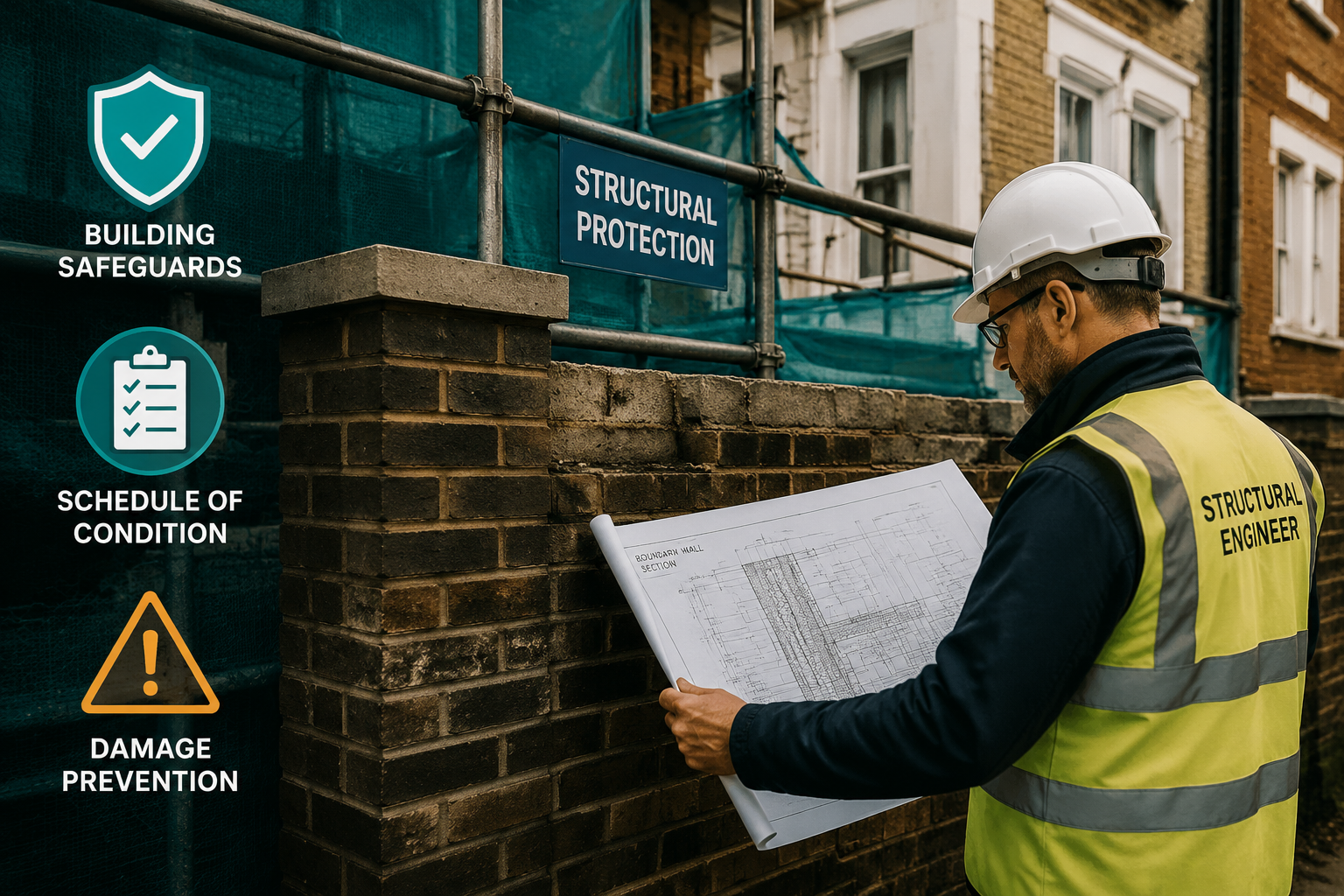
The Schedule of Condition: Your Most Important Document
Before any work begins, a schedule of condition should be prepared. This is a detailed photographic and written record of the adjoining property's state — particularly areas close to the works. It serves as the baseline for any damage claims after work is complete.
💡 Pull Quote: "A schedule of condition is the party wall process's insurance policy — without it, proving pre-existing damage becomes almost impossible."
Key areas to document include:
- The existing boundary wall (cracks, pointing condition, height)
- Adjacent garden surfaces, patios, and landscaping
- The neighbouring property's foundations and any visible structural elements
- Fences, outbuildings, and garden structures within the affected zone
Structural Protections in the Party Wall Award
A well-drafted Party Wall Award for garden boundary wall works should include clauses covering:
- Working method statements — specifying how demolition or construction will be carried out to minimise vibration and structural risk
- Temporary support requirements — ensuring the neighbouring property is not left exposed during rebuilding
- Drainage protection — particularly relevant where excavation near shared drainage runs is involved
- Reinstatement obligations — requiring the building owner to restore any disturbed surfaces or structures
What Happens If Damage Occurs?
If the adjoining owner suffers damage as a result of notified works, the Party Wall Act provides a clear compensation mechanism. The building owner is liable for damage caused by the works, and the Party Wall Award will typically include provisions for assessment and payment. This is why the schedule of condition is so critical — it establishes what damage existed before work began and what is attributable to the current project.
For a broader understanding of your rights and obligations, a building survey of the affected property before works commence can provide an independent structural baseline.
Special Considerations for Terraced Houses
Terraced properties present unique challenges because garden boundary walls often connect to rear outriggers, extensions, and shared drainage infrastructure. Additional care is needed when:
- The boundary wall abuts a rear extension of the neighbouring property
- Shared drainage runs beneath or alongside the wall
- The wall provides structural support to any element of the adjoining building
- The property is in a conservation area where planning consent may also be required
In these scenarios, a full building survey of the neighbouring property — commissioned before works begin — provides both parties with confidence and legal protection.
What Happens If You Skip the Process Entirely?
Ignoring the Party Wall Act is not a victimless shortcut. The consequences of proceeding without a valid notice or agreement include:
- 🚫 Court injunctions halting work immediately
- 💰 Liability for all legal costs of the adjoining owner
- 🔨 Mandatory demolition of completed works in extreme cases
- 📉 Property value impact if disputes appear on conveyancing searches
For a full breakdown of the risks, see what happens if you do not have a party wall agreement.
Conclusion: Actionable Next Steps for 2026
Party wall law for garden boundary walls is more nuanced than most homeowners expect — but it is entirely manageable with the right preparation. Here is a clear action plan:
Step 1: Confirm the boundary. Commission a boundary survey to establish whether your garden wall sits on, within, or astride the legal boundary before serving any notice.
Step 2: Identify the correct notice type. Use the table in this article to match your planned work to the right section of the Act — and the correct notice period (1 month for new walls; 2 months for existing party fence walls).
Step 3: Serve notice correctly. Ensure your notice is in writing, includes all mandatory information, and is served on every party with a legal interest — using HM Land Registry searches to identify them all.
Step 4: Pursue written consent where possible. If your neighbour consents in writing within 14 days, you avoid the cost and delay of a formal Party Wall Award.
Step 5: Appoint a surveyor early if dissent is likely. An experienced party wall surveyor can draft a robust award with strong building safeguard clauses — protecting both parties and keeping the project on track.
Step 6: Commission a schedule of condition. Before a single brick is moved, document the current state of both properties thoroughly.
Getting this process right in 2026 protects your investment, preserves neighbourly relations, and ensures your garden boundary wall project is legally watertight from the first notice to the final brick.
References
[1] How To Serve A Party Wall Notice – https://onlinearchitecturalservices.com/how-to-serve-a-party-wall-notice/
[2] Party Wall Agreement – https://hoa.org.uk/advice/guides-for-homeowners/i-am-improving/party-wall-agreement/
[3] Party Wall Agreements What You Need To Know – https://www.fmb.org.uk/find-a-builder/ultimate-guides-to-home-renovation/party-wall-agreements-what-you-need-to-know.html
[4] Three Types Of Party Wall Notices – https://stokemont.com/advice/three-types-of-party-wall-notices/
[5] Simple Guide To Party Wall Notice Reply – https://fpws.uk/simple-guide-to-party-wall-notice-reply/