
Over 70% of commercial lease dilapidations claims in England and Wales result in some form of dispute — yet the quality of expert evidence presented often determines the outcome more than the underlying facts of the case. In a recovering property market where regional valuations diverge sharply, the role of RICS expert witnesses for dilapidations and valuation disputes: preparing unbiased reports in recovering 2026 markets has never carried greater weight.
This guide is written for chartered surveyors, property lawyers, landlords, and tenants who need to understand exactly how expert evidence should be prepared, structured, and defended in today's complex dispute environment.
Key Takeaways
- 🏛️ Duty shifts to the court: Once appointed as an expert witness, a surveyor's overriding obligation is to the tribunal — not the instructing party.
- 📋 Two specialist roles exist: Dilapidations disputes typically require both a building surveyor (schedule of dilapidations) and a valuation surveyor (diminution valuation).
- 📊 2026 market conditions matter: Regional divergence in property values means comparable evidence must be carefully selected and justified.
- ⚖️ RICS standards are non-negotiable: Expert reports must comply with RICS guidance and Civil Procedure Rules (CPR) Part 35 to withstand tribunal scrutiny.
- 🤝 Joint statements reduce costs: Courts increasingly expect experts to meet, narrow issues, and produce a joint statement before any hearing.
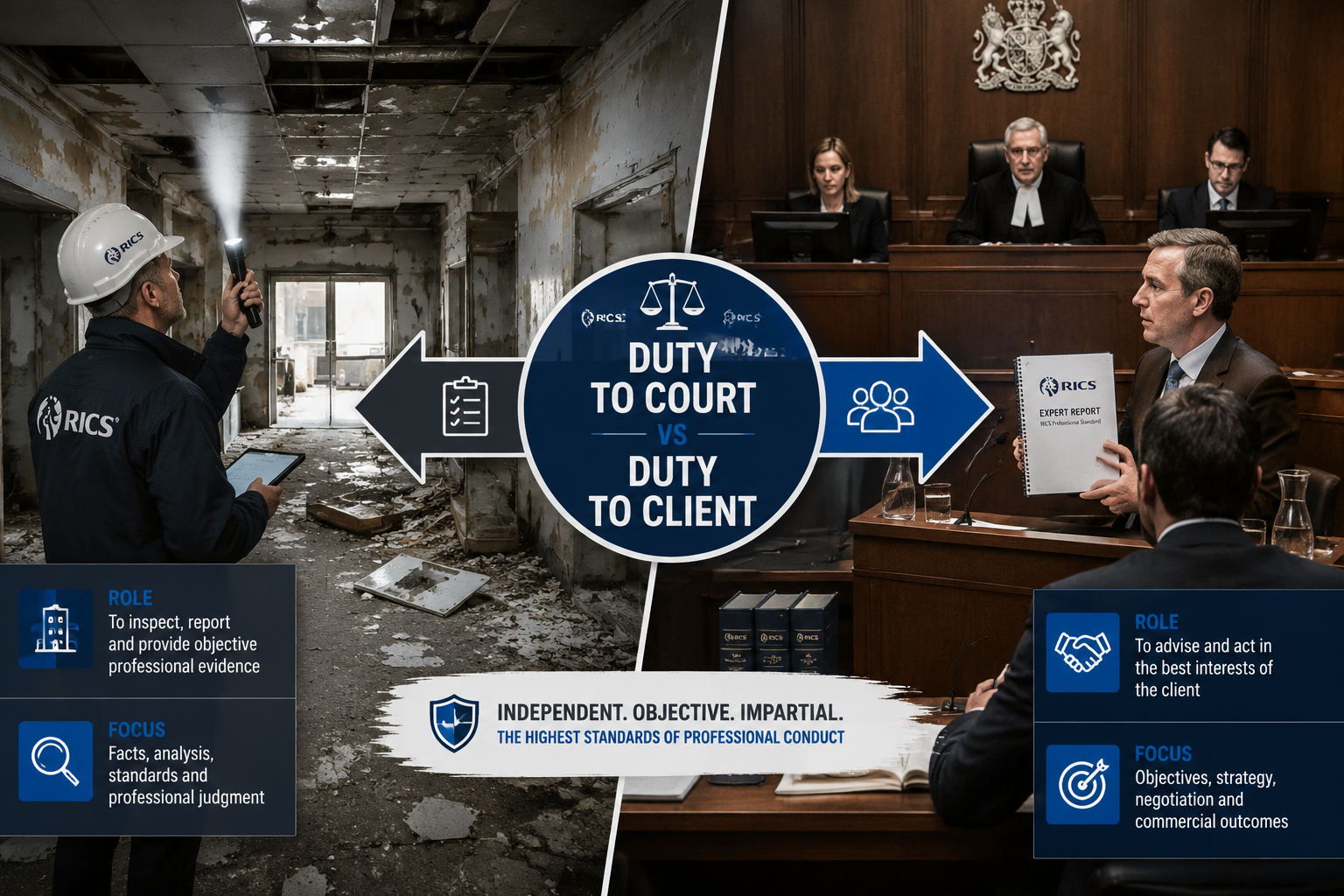
Understanding the Expert Witness Role in Dilapidations and Valuation Disputes
The foundation of effective expert evidence is a clear understanding of what the role actually demands — and what it does not.
What RICS Expert Witnesses Actually Do
RICS expert witnesses can assist courts across a wide range of property disciplines, including building surveying, commercial property, compulsory purchase, dilapidations, planning, development, retail, and valuation matters [1]. This breadth reflects the complexity of modern property disputes, where a single case may involve overlapping technical questions.
In a dilapidations context, two distinct expert roles typically arise:
| Role | Discipline | Primary Function |
|---|---|---|
| Building Surveyor | Building/Dilapidations | Prepares schedule of dilapidations; assesses repair obligations |
| Valuation Surveyor | Valuation | Prepares diminution valuation; quantifies financial loss |
It is standard practice — though not a legal requirement — to engage a chartered building surveyor to prepare a Schedule of Dilapidations on behalf of either party [2]. The schedule identifies breaches of the tenant's repairing, decorating, and reinstatement covenants at lease expiry.
Where a landlord pursues litigation and the dilapidations works have not been completed, a specialist "diminution valuation" report must be prepared by a chartered valuation surveyor [2]. This report answers the critical question: by how much has the property's market value been reduced by the tenant's failure to comply with their lease obligations?
The Critical Duty Shift: Court, Not Client
"The expert's duty is to the court — not to the party that instructed them. This single principle underpins every decision an expert witness makes."
When surveyors are appointed as expert witnesses, their duty becomes to the courts rather than to the parties that originally engaged them [2]. This is not merely a procedural formality. It means:
- Opinions must reflect genuine professional judgment, even if unfavourable to the instructing party
- All material facts — including those that undermine the instructing party's case — must be disclosed
- Reports must be signed with a statement of truth confirming the expert understands their overriding duty
Failure to observe this principle risks the report being disregarded entirely, or worse, the expert facing professional sanctions from RICS.
Preparing Unbiased Reports: RICS Standards and Practical Frameworks for 2026
The preparation of a compliant, credible expert witness report is a structured process. Understanding the framework for RICS expert witnesses for dilapidations and valuation disputes: preparing unbiased reports in recovering 2026 markets is essential before a single word is written.
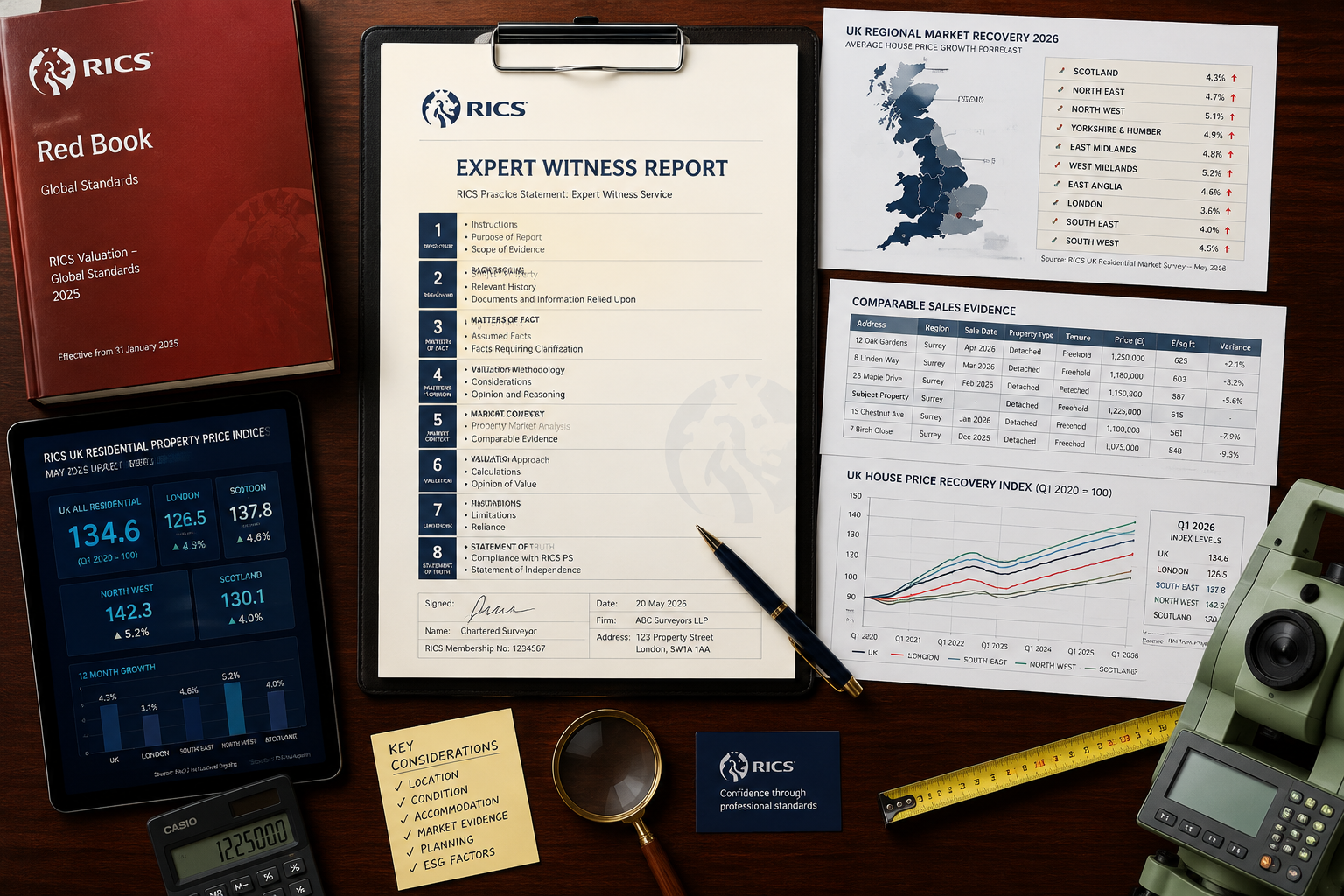
Compliance with CPR Part 35 and RICS Guidance
Expert reports in England and Wales must comply with Civil Procedure Rules Part 35, which governs the use of expert evidence in civil proceedings. Key requirements include:
- Statement of truth and declaration of understanding of the expert's overriding duty
- Disclosure of instructions — a summary of the substance of written instructions
- Clear separation of facts, assumptions, and opinions
- Acknowledgement of uncertainty — where the expert cannot reach a definitive conclusion, this must be stated
RICS publishes its own professional guidance for members acting as expert witnesses, which supplements CPR Part 35. Surveyors should also be familiar with the RICS Valuation — Global Standards (the "Red Book"), which governs how valuations are conducted and reported. Understanding the RICS Red Book valuation framework is essential for any valuation expert preparing evidence for dispute resolution.
Structuring a Dilapidations Expert Report
A well-structured dilapidations expert report typically includes the following sections:
- Executive Summary — key findings and opinions in plain language
- Instructions and Scope — what the expert was asked to do and any limitations
- Property Description — tenure, age, construction, condition at inspection
- Lease Analysis — relevant covenants and their interpretation
- Schedule of Dilapidations — itemised breaches with cost estimates
- Supersession — items where landlord's intended works would override the tenant's liability
- Section 18(1) Cap — analysis of whether damages are capped by the diminution in value
- Conclusions and Opinion — clear, reasoned professional opinion
The Section 18(1) Landlord and Tenant Act 1927 cap is frequently the most contested element. It limits a landlord's damages to the diminution in the property's value caused by the disrepair — meaning a full schedule of dilapidations costs may be substantially reduced if the landlord intends to redevelop or if the market value impact is lower than the repair costs. This is precisely where a reinstatement valuation or a RICS reinstatement build cost valuation becomes directly relevant to quantifying the dispute.
Selecting and Justifying Comparable Evidence in 2026
The property valuation dispute environment in 2026 shows market stabilisation at the national level, but this masks significant regional differences in property valuations and market conditions [4]. For an expert witness, this creates both a challenge and an opportunity.
🔑 Key principles for comparable selection:
- Use transactions that are genuinely comparable in terms of location, size, specification, and tenure
- Adjust for market movement between the transaction date and the valuation date — particularly important in regions where values have moved materially
- Disclose all adjustments transparently, with reasoning
- Do not cherry-pick comparables that support only one view; acknowledge the range of evidence
In recovering markets, there is a particular risk that older comparables understate current values, while very recent transactions may reflect post-recovery premiums not representative of the dispute date. Experts must address this directly in their reports.
For context on how valuation factors interact in complex assessments, the factors of valuation framework provides a useful analytical structure.
Navigating Tribunal Scrutiny: Strategies for RICS Expert Witnesses in Recovering 2026 Markets
Even a technically excellent report can fail under cross-examination if the expert is not prepared for the adversarial environment of a tribunal. The strategies below reflect current best practice for RICS expert witnesses for dilapidations and valuation disputes: preparing unbiased reports in recovering 2026 markets [3][4].
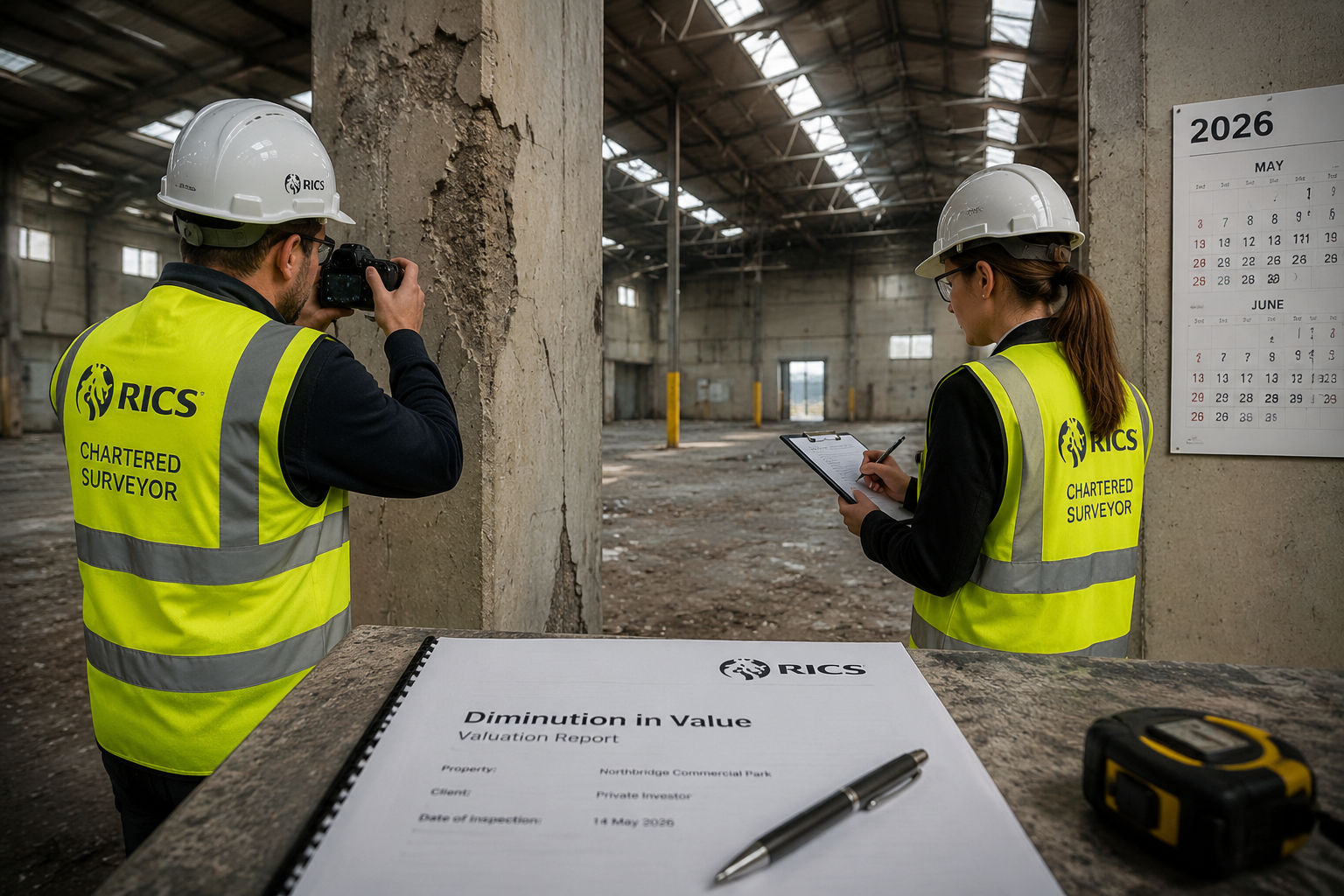
The Joint Statement Process
Courts and tribunals increasingly require opposing experts to meet — either in person or remotely — to:
- Identify and narrow the issues in dispute
- Agree facts where possible
- Produce a signed joint statement recording areas of agreement and disagreement
This process is not optional in most cases. Experts who approach it adversarially, or who use it to re-argue their client's case, risk judicial criticism. The goal is genuine engagement with the opposing expert's reasoning.
"A joint statement that narrows ten issues to three is worth more than a hundred pages of competing evidence."
Handling Challenges to Independence
The most common challenge to an expert witness is that their opinion is shaped by the interests of the instructing party. Practical defences include:
- ✅ Maintaining contemporaneous notes of all inspections and reasoning
- ✅ Ensuring the report acknowledges the strongest points of the opposing case
- ✅ Avoiding language that reads as advocacy rather than analysis
- ✅ Being consistent — opinions should not shift between the report and oral evidence without clear justification
For surveyors who want to understand the full scope of expert witness services available, the expert witness report service and the broader expert witness practice provide a comprehensive framework for engagement.
Dilapidations Disputes: Increased Complexity in 2026
Dilapidations surveys frequently lead to disputes requiring expert evidence on tenant repair obligations and the scope of work, with complexity increasing in the current market [3]. Several factors drive this:
- Lease restructuring post-pandemic has left many commercial leases with non-standard repair clauses
- ESG and energy efficiency requirements are creating new arguments about what constitutes "good repair" in 2026
- Vacant possession values are harder to assess in markets where occupier demand is uneven
- Supersession arguments are more frequent where landlords are undertaking significant refurbishment
Each of these factors requires the expert to go beyond standard analysis and engage with the specific commercial and legal context of the property in question. A thorough schedule of condition report prepared at lease commencement can significantly reduce the scope of dispute at lease expiry — making it an important risk management tool.
Common Errors That Undermine Expert Reports
| Error | Impact |
|---|---|
| Failing to inspect the property personally | Report may be inadmissible or heavily discounted |
| Using comparables without adjustment | Opinion appears superficial or biased |
| Ignoring the Section 18(1) cap | Report fails to address the legal framework |
| Overstating certainty | Credibility damaged under cross-examination |
| Advocacy language | Duty to court appears compromised |
| Not disclosing adverse material | Serious professional and legal consequences |
Diminution Valuations: Specific Technical Requirements
The diminution valuation is arguably the most technically demanding element of a dilapidations expert's work. It requires the expert to assess:
- "Before" value — the hypothetical market value of the property in full repair
- "After" value — the actual market value in its current condition
- The difference — which represents the Section 18(1) cap on damages
This is not a simple subtraction exercise. Market evidence must be applied to both scenarios, and the expert must consider how a hypothetical purchaser in the open market would price the disrepair. In a recovering 2026 market, where buyer sentiment and financing conditions are shifting, this analysis requires particular care. Understanding valuation costs and their relationship to market conditions is an important part of this assessment.
Conclusion: Actionable Next Steps for Expert Witnesses in 2026
The standards expected of RICS expert witnesses in dilapidations and valuation disputes are high — and rightly so. Courts depend on expert evidence to resolve technically complex disputes that turn on professional judgment rather than legal argument alone.
For surveyors preparing to act as expert witnesses in 2026, the following actions are essential:
✅ Before accepting instructions:
- Confirm you have the specific expertise required (building surveying or valuation — these are distinct roles)
- Check for conflicts of interest
- Ensure you understand the overriding duty to the court
✅ During report preparation:
- Inspect personally and document thoroughly
- Select and justify comparables with reference to 2026 market conditions and regional variance
- Address the Section 18(1) cap explicitly in every dilapidations report
- Write for the tribunal, not for the instructing party
✅ Before and during the hearing:
- Engage constructively with the joint statement process
- Be prepared to concede points where the opposing expert's analysis is sound
- Maintain consistency between written report and oral evidence
The recovering property market of 2026 presents both challenges and opportunities for expert witnesses. Regional divergence in values, evolving lease structures, and heightened scrutiny from courts mean that only the most rigorous, independent, and well-reasoned reports will withstand challenge. RICS-qualified surveyors who master these standards will find themselves in strong demand as the volume and complexity of dilapidations and valuation disputes continues to grow.
References
[1] Expert Witness – https://www.ricsfirms.com/residential/legal-issues/expert-witness/
[2] Dilapidations England Wales – https://www.rics.org/consumer-guides/dilapidations-england-wales
[3] Expert Witness Valuations In 2026s Stabilizing Market Rics Standards For Mortgage Disputes And Property Disagreements – https://nottinghillsurveyors.com/blog/expert-witness-valuations-in-2026s-stabilizing-market-rics-standards-for-mortgage-disputes-and-property-disagreements
[4] Expert Witness Testimonies In 2026 Valuation Disputes Rics Strategies Amid Stabilising House Prices And Regional Divides – https://nottinghillsurveyors.com/blog/expert-witness-testimonies-in-2026-valuation-disputes-rics-strategies-amid-stabilising-house-prices-and-regional-divides
[5] Rics Expert Witness – https://www.jamesscottassociates.com/rics-expert-witness/
[6] Application Forms – https://www.rics.org/dispute-resolution-service/drs-services/application-forms