Over 28 million homes in England and Wales share a party wall with a neighbouring property — and in 2026, a growing proportion of their owners are drilling, cutting, and excavating those boundaries to install solar panels, heat pumps, and external wall insulation. The collision between net zero retrofit ambitions and the Party Wall etc. Act 1996 is no longer a niche legal curiosity. It is a daily operational reality for surveyors, contractors, and property owners across the country.
This article examines how Party Wall Notices for Net Zero Compliance Works: Thresholds and Monitoring Under RICS Sustainability 2026 interact with the statutory framework of the Party Wall etc. Act 1996, what RICS guidance says about vibration limits and damage monitoring, and how building owners can navigate notice requirements without stalling critical carbon-reduction projects.
Key Takeaways
- Net zero retrofit works — including solar panel installations, heat pump fixings, and external wall insulation — frequently trigger Party Wall Act notice obligations, even when they appear minor.
- The Party Wall etc. Act 1996 thresholds have not changed; RICS guidance interprets how those thresholds apply to new categories of work such as low-carbon installations.
- RICS is consulting on an updated 8th edition of its party wall practice guidance, but this does not create new statutory thresholds for net zero works.
- Vibration monitoring and schedules of condition are increasingly standard practice for retrofit projects near shared boundaries, reflecting RICS whole life carbon and sustainability principles.
- Failing to serve the correct notice before starting net zero works can expose building owners to injunctions, neighbour disputes, and costly remediation.
Why Net Zero Works Trigger Party Wall Obligations
The Party Wall etc. Act 1996 was written long before heat pumps, photovoltaic arrays, and solid wall insulation entered the mainstream retrofit vocabulary. Yet its three principal notice categories — Line of Junction Notices, Party Structure Notices, and Notices under Section 6 for excavation — map directly onto many net zero installation types.
Solar panel installations on a shared roof structure, or on a roof slope that forms part of a party wall, can require a Party Structure Notice under Section 3 of the Act. Fixing brackets through a shared chimney stack — a common route for roof-mounted panels on Victorian terraces — is a notifiable act [5]. For a detailed look at how shared chimneys interact with party wall law, see this guide on party wall shared chimneys.
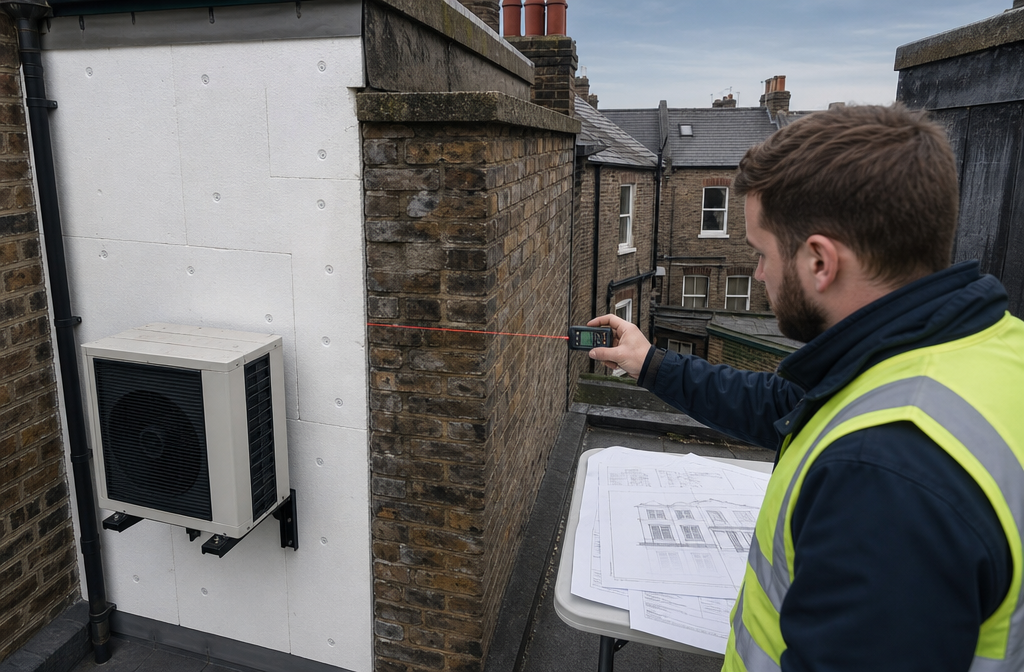
Heat pump installations raise different but equally pressing concerns. An air source heat pump mounted on an external wall that forms a party wall, or positioned close to the boundary, can generate vibration and noise that affects the adjoining owner's structure. Where fixings penetrate the party wall itself, a Party Structure Notice is required before work begins [2][6].
External wall insulation (EWI) systems applied to a party wall face, or to a wall that abuts the boundary, may require a Line of Junction Notice under Section 1 if the insulation is to be built astride the boundary, or may affect the structural integrity of the shared wall if fixings are driven into it.
Excavation works for ground source heat pump loops or new drainage runs associated with retrofit projects must comply with the 3-metre rule under Section 6 of the Act, which requires notice when excavating within 3 metres of an adjoining structure to a depth below its foundations, or within 6 metres under the 45-degree angle test. Understanding the excavation notice requirements for party walls is essential for any ground-breaking net zero project.
"The statutory framework has not changed, but the range of works that fall within it has expanded dramatically as retrofit activity accelerates."
Understanding the Notice Thresholds That Apply in 2026
What the Act Actually Requires
The Party Wall etc. Act 1996 sets out specific thresholds that determine whether a notice must be served. These are statutory obligations, not RICS recommendations. The key triggers for net zero-related works are:
| Work Type | Relevant Act Section | Notice Period |
|---|---|---|
| Cutting into a party wall for fixings | Section 2 | 2 months |
| Building on or at the line of junction | Section 1 | 1 month |
| Excavation within 3m of adjoining structure | Section 6 | 1 month |
| Excavation within 6m under 45-degree rule | Section 6 | 1 month |
| Raising or underpinning a party wall | Section 2 | 2 months |
For net zero works, the most commonly triggered section is Section 2, because many low-carbon installations require fixings, penetrations, or structural modifications to the party wall itself.
RICS Guidance and the 8th Edition Consultation
RICS is currently consulting on an updated 8th edition of its party wall practice guidance [1]. This is an important development, but it is critical to understand what it does — and does not — do. The consultation does not propose new statutory thresholds. The Act itself remains unchanged. What RICS guidance does is interpret how surveyors should apply professional standards, document conditions, and manage disputes when the Act's provisions are engaged.
The RICS ESG and sustainability framework, including its commercial valuation guidance [7], increasingly requires surveyors to consider whole life carbon impacts when assessing works near boundaries. This means that a party wall surveyor in 2026 is expected to think not only about structural damage risk, but also about whether the proposed works are proportionate, reversible, and consistent with the building's long-term sustainability performance.
When No Notice Is Required
Not every net zero installation triggers the Act. The following works are generally outside its scope:
- Installing solar panels on a roof that does not form part of a party wall or shared structure, where no fixings penetrate the party wall
- Fitting an air source heat pump on a standalone external wall that is not a party wall and is set back from the boundary
- Internal insulation works that do not affect the party wall structure
- EV charger installations that do not involve excavation or wall penetrations near the boundary [6]
However, assumptions about what is "clearly outside" the Act are a frequent source of disputes. Where there is any doubt, the safest course is to seek professional advice before starting work. Understanding what constitutes a party wall dispute can help building owners assess their exposure early.
Vibration Monitoring and Schedules of Condition Under RICS Sustainability 2026
Why Monitoring Matters for Retrofit Projects
Party Wall Notices for Net Zero Compliance Works: Thresholds and Monitoring Under RICS Sustainability 2026 are not just about serving paperwork. The monitoring obligations that flow from a Party Wall Award are increasingly sophisticated, particularly where retrofit works involve mechanical equipment, ground disturbance, or repeated vibration from installation machinery.
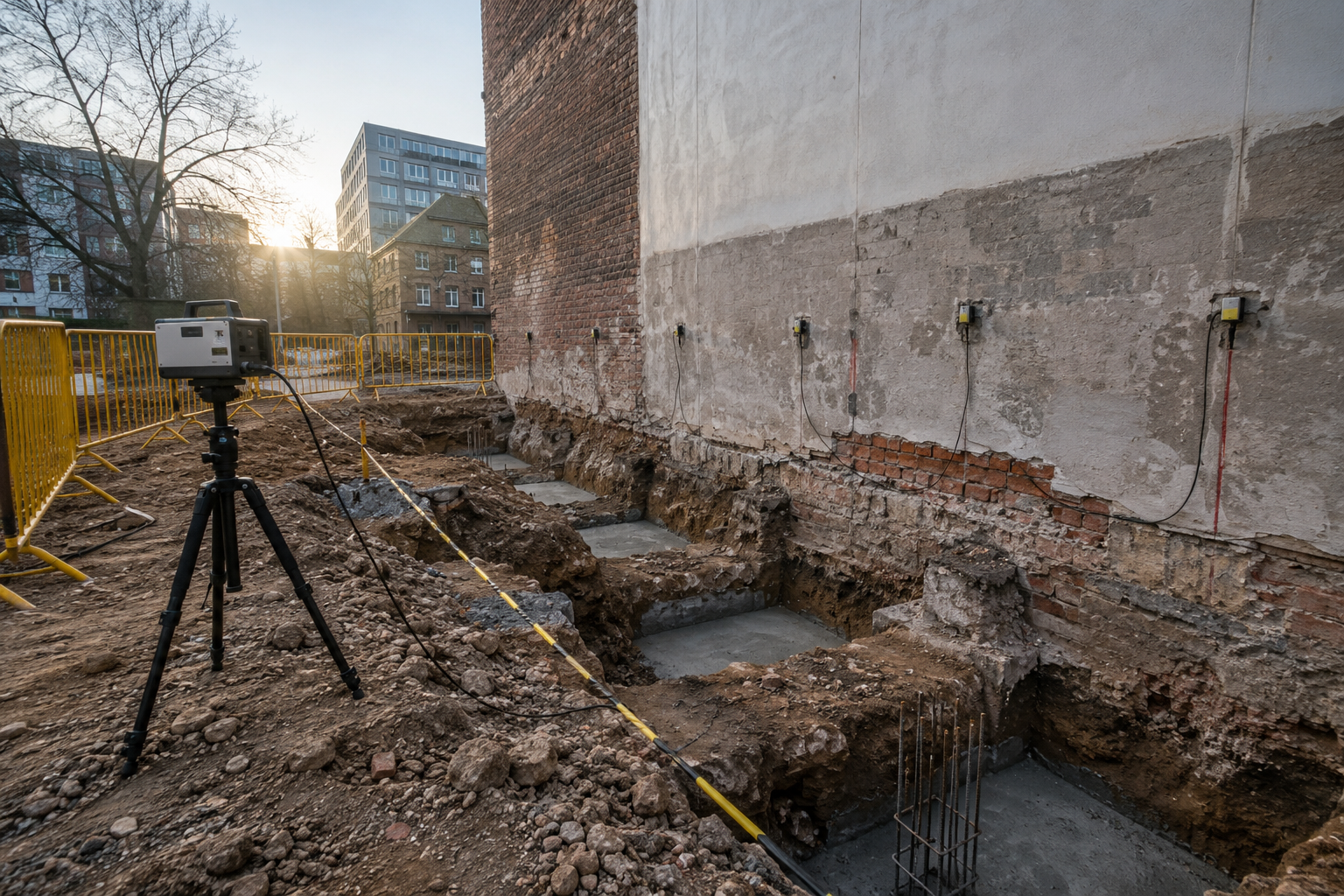
RICS guidance emphasises that a Schedule of Condition — a photographic and written record of the adjoining owner's property before works begin — is best practice for any notifiable works, and is effectively mandatory where vibration or ground movement is a realistic risk [4]. For net zero projects, this includes:
- Ground source heat pump installations, where drilling or trenching can cause settlement
- Heat pump compressor fixings to party walls, where operational vibration over time may cause cracking
- Roof works for solar panel installation, where impact loads during fitting can transmit through shared roof structures
Vibration Thresholds and Damage Categories
The RICS and the wider construction industry use the British Standard BS 7385 and BS 5228 frameworks to assess vibration risk. These standards define peak particle velocity (PPV) thresholds above which structural damage becomes a concern. For residential properties, the threshold for cosmetic damage is typically 15 mm/s PPV, though RICS practice guidance recommends more conservative limits near older masonry party walls.
In practice, vibration monitoring for net zero retrofit works involves:
- Pre-works baseline survey — establishing existing crack patterns and structural condition
- Real-time monitoring during high-impact activities such as drilling or compaction
- Post-works inspection — comparing condition against the Schedule of Condition
- Reporting to the party wall surveyor if thresholds are approached or exceeded [4]
The demand for this type of monitoring has grown sharply. One sector analysis notes a 34% surge in party wall notice activity linked to power and energy facility works in 2026 [9], reflecting the broader net zero retrofit wave.
The Role of the Party Wall Award
Where an adjoining owner dissents from a Party Wall Notice, or fails to respond within the statutory period, the dispute resolution mechanism under the Act requires the appointment of a party wall surveyor (or surveyors) to make a Party Wall Award. The Award sets out:
- The scope and method of the notifiable works
- Any monitoring requirements, including vibration limits
- The Schedule of Condition to be relied upon for damage claims
- Access rights and working hours
For net zero works, Awards in 2026 are increasingly including provisions for post-installation monitoring of heat pump vibration and requirements to demonstrate that solar panel fixings have not compromised the structural integrity of the party wall [2][3]. Understanding the cost of party wall proceedings is an important part of project budgeting for any retrofit scheme.
Practical Steps for Building Owners and Surveyors

Party Wall Notices for Net Zero Compliance Works: Thresholds and Monitoring Under RICS Sustainability 2026 — A Surveyor's Checklist
The following checklist reflects current best practice for surveyors handling net zero-related party wall matters in 2026:
Before serving notice:
- Confirm whether the proposed works fall within the Act's scope by reviewing the installation method and proximity to the party wall
- Identify the correct notice type (Section 1, 2, or 6) and notice period
- Commission structural engineer input where solar panel loads, heat pump fixings, or excavation depths are involved — a structural survey can clarify load paths and risk
- Check whether the property has any existing party wall agreements that may affect the current works
Serving the notice:
- Serve notice in writing, identifying the works clearly and including drawings where required
- Allow the full statutory notice period before starting works
- Keep records of service, including proof of delivery
If the adjoining owner consents:
- Agree a Schedule of Condition before works begin
- Confirm any monitoring requirements in writing
- Ensure the contractor is briefed on access restrictions and working methods
If the adjoining owner dissents or fails to respond:
- Appoint a party wall surveyor promptly — delay increases costs and may delay the project
- Ensure the Award addresses monitoring, reinstatement, and access
- Do not start notifiable works until the Award is in place
Proceeding without a valid agreement or Award is a significant risk. For context on the consequences, see this resource on what happens if you do not have a party wall agreement.
Common Mistakes in Net Zero Party Wall Cases
Several recurring errors increase dispute risk for net zero retrofit projects:
- Assuming solar panel works are always non-notifiable. Where brackets are fixed into a shared roof structure or chimney, the Act is engaged [5].
- Underestimating excavation depth. Ground source heat pump boreholes can easily reach depths that trigger Section 6 obligations.
- Ignoring operational vibration. The party wall process covers not just installation but ongoing effects — a heat pump that vibrates a shared wall may give rise to a claim even after the Award is made [2].
- Failing to document pre-existing damage. Without a Schedule of Condition, any post-works damage claim becomes a credibility contest.
For solar panel projects specifically, the solar panel roof engineer calculations process should be integrated with party wall planning from the outset, not treated as a separate workstream.
RICS Sustainability Considerations in 2026
The RICS sustainability and ESG agenda in 2026 adds a further layer of professional responsibility. Surveyors are expected to consider whole life carbon when advising on party wall matters — this means that recommending unnecessary demolition, over-specification of protective works, or methods that generate significant embodied carbon is increasingly inconsistent with RICS professional standards [7].
In practical terms, this means:
- Preferring reversible fixings and non-invasive monitoring methods where structurally adequate
- Documenting the carbon rationale for any protective measures recommended in a Party Wall Award
- Advising clients on the relative sustainability performance of different installation methods where the party wall implications differ
This integration of sustainability thinking into party wall practice is one of the key themes of the RICS 8th edition consultation [1], even though it does not alter the statutory thresholds themselves.
Conclusion
The intersection of the Party Wall etc. Act 1996 and net zero retrofit ambitions is one of the most active areas of surveying practice in 2026. Party Wall Notices for Net Zero Compliance Works: Thresholds and Monitoring Under RICS Sustainability 2026 require building owners and their surveyors to navigate a statutory framework that predates low-carbon technology, using professional guidance that is actively evolving to keep pace.
Actionable next steps for building owners:
- Before commissioning any net zero installation near a shared boundary, obtain a professional assessment of whether the Party Wall etc. Act applies — do not rely on a contractor's assumption that it does not.
- Budget for party wall surveyor fees and potential Award costs as part of the retrofit project plan.
- Insist on a Schedule of Condition before works begin, regardless of whether the adjoining owner has consented or dissented.
- Where vibration-generating equipment such as heat pump compressors will be fixed to or near a party wall, include operational monitoring provisions in the Award.
- Engage an RICS-accredited surveyor who is familiar with both party wall law and sustainability retrofit practice — the two disciplines are no longer separable.
Proceeding without proper notice and monitoring is not just a legal risk. In 2026, it is also a reputational and professional liability in a sector that is under increasing scrutiny from regulators, lenders, and neighbours alike.
References
[1] Rics Launches Consultation On Updated Party Wall Practice Guidance – https://www.rics.org/news-insights/rics-launches-consultation-on-updated-party-wall-practice-guidance
[2] Party Wall Surveys For Heat Pump Retrofits Rics Compliance In 2026s Net Zero Retrofit Surge – https://nottinghillsurveyors.com/blog/party-wall-surveys-for-heat-pump-retrofits-rics-compliance-in-2026s-net-zero-retrofit-surge
[3] Party Wall Essentials For 2026 Net Zero Compliance Projects Surveyor Checklists For Epc Retrofit Disputes – https://nottinghillsurveyors.com/blog/party-wall-essentials-for-2026-net-zero-compliance-projects-surveyor-checklists-for-epc-retrofit-disputes
[4] Party Wall Awards For 2026 Net Zero Retrofits Vibration Monitoring And Schedules Of Condition Under Rics Standards – https://wimbledonsurveyors.com/party-wall-awards-for-2026-net-zero-retrofits-vibration-monitoring-and-schedules-of-condition-under-rics-standards/
[5] Party Wall Surveys For Solar Panel Installations 2026 Rics Compliance Amid Net Zero Mandates – https://www.canterburysurveyors.com/blog/party-wall-surveys-for-solar-panel-installations-2026-rics-compliance-amid-net-zero-mandates/
[6] Party Wall Act Compliance For Ev Charger And Heat Pump Retrofits Boundary Surveys In 2026 Net Zero Push – https://princesurveyors.co.uk/blog/party-wall-act-compliance-for-ev-charger-and-heat-pump-retrofits-boundary-surveys-in-2026-net-zero-push/
[7] Esg Sustainability Commercial Valuation 4th Edition – https://www.rics.org/content/dam/ricsglobal/documents/standards/esg-sustainability-commercial-valuation-4th-edition.pdf
[9] Power Facility Party Wall Notices 2026 Sector Guidance With 34 Demand Surge – https://partywallsurveyorlondon.uk/blogs/power-facility-party-wall-notices-2026-sector-guidance-with-34-demand-surge/