Scotland's property market is outpacing the rest of the UK by a significant margin in 2026 — average property prices have grown by 8.2% between 2025 and 2026, compared to just 0.8% in London and 1.2% in the Southeast [1]. That gap is not a minor statistical footnote. It is a structural signal that demands a fundamentally different approach to valuation, building surveys, and party wall management across Scotland's built environment.
Scotland's 2026 Valuation Boom: Party Wall and Building Survey Integration for Surveyors is not simply a professional trend — it is an urgent operational reality. Surveyors working in Scotland today face a convergence of rising transaction volumes, a documented skills shortage, evolving government frameworks, and a surge in construction activity that is pushing party wall disputes and building condition assessments to the forefront of practice.
Key Takeaways
- Scotland's property prices are growing at 8.2% in 2026, far exceeding the UK average, requiring region-specific valuation methodologies.
- Housebuilding activity is rising sharply, with public sector housing workloads up by a net balance of 11% and private sector housing up 10% in Q1 2026.
- A critical skills shortage in Scottish surveying, compounded by declining educational provision, is placing pressure on existing professionals.
- Party wall agreements are increasingly complex and costly in high-demand markets, ranging from £100 to over £4,000 per neighbour.
- Integrating building surveys with party wall assessments and RICS-compliant valuations is now a competitive and professional necessity for Scottish surveyors.
Understanding Scotland's 2026 Property Market Dynamics
The 8.2% price growth figure is not uniform across Scotland. Urban centres such as Edinburgh, Glasgow, and Aberdeen are driving much of the momentum, while rural and island communities are experiencing their own distinct pressures tied to remote working migration and limited housing stock. For surveyors, this regional divergence within Scotland itself — not just between Scotland and England — demands granular, locality-specific valuation frameworks [1].
The Scottish Government holds statutory authority to amend the valuation framework, methodology, and timetable, which directly influences how surveyors must approach assessments [8]. Any surveyor operating in Scotland in 2026 without a clear understanding of these statutory levers is exposed to professional risk, particularly when valuations are challenged or used in legal proceedings.
Key market indicators for Scotland in 2026:
| Indicator | Scotland | London | Southeast England |
|---|---|---|---|
| Average price growth (2025-2026) | 8.2% | 0.8% | 1.2% |
| Public sector housing workload change | +11% net balance | N/A | N/A |
| Private sector housing workload change | +10% net balance | N/A | N/A |
| Surveyor sales optimism (next 3 months) | 39% anticipate rise | N/A | N/A |
Sources: [1][4][7]
Despite a net balance of -8% of surveyors reporting a fall in new buyer enquiries in February 2026, 39% of professionals still anticipate that sales will rise over the following three months [7]. This cautious optimism reflects a market that is fundamentally undersupplied rather than structurally weak — a distinction that matters enormously when producing RICS Red Book valuations for mortgage, litigation, or probate purposes.
Understanding the factors of valuation in this context means going beyond comparable evidence. Surveyors must account for constrained supply pipelines, planning delays, and the specific cost implications of Scottish building regulations, which differ materially from those in England and Wales.
The Skills Crisis Reshaping Scottish Surveying Practice
No discussion of Scotland's 2026 Valuation Boom: Party Wall and Building Survey Integration for Surveyors would be complete without addressing the workforce crisis that underpins every operational challenge in the sector.
RICS has formally identified a critical shortage of skilled professionals in Scotland's built environment, with direct consequences for housing supply, infrastructure delivery, and progress toward net-zero targets [2]. The RICS Scotland Manifesto 2026 outlines urgent priorities for the Scottish Government, including skills development, accelerated housing delivery, infrastructure investment, and climate action — a combination that places enormous pressure on a profession already stretched thin [2].
The situation is made worse by the suspension of the building surveying programme at Glasgow Caledonian University, one of the most visible signs of declining educational provision in the field [3]. The RICS Scotland Building Surveying and Dilapidations Conference in February 2026 specifically addressed this crisis, with delegates highlighting the risk that fewer graduates will enter a market that urgently needs more professionals, not fewer [3].
"A profession that cannot replenish its own ranks will struggle to meet the demands of a booming market — and the clients who depend on it will bear the consequences."
For practising surveyors, this shortage has two immediate effects. First, workloads are increasing as fewer professionals share the same volume of instructions. Second, the premium on multi-disciplinary competence is rising. A surveyor who can integrate building condition assessments, party wall procedures, and formal valuations into a single, coherent service offering is significantly more valuable than one who operates in silos.
Practical responses to the skills shortage:
- Invest in continuing professional development (CPD) that spans valuation, building pathology, and party wall law.
- Consider mentoring arrangements with junior surveyors or apprentices to build pipeline capacity.
- Use technology to reduce time spent on routine tasks, freeing capacity for complex professional judgements.
- Collaborate with firms in England and Wales on cross-border instructions, particularly for clients with portfolios spanning both jurisdictions.
Party Wall Integration in Scotland's Construction Surge
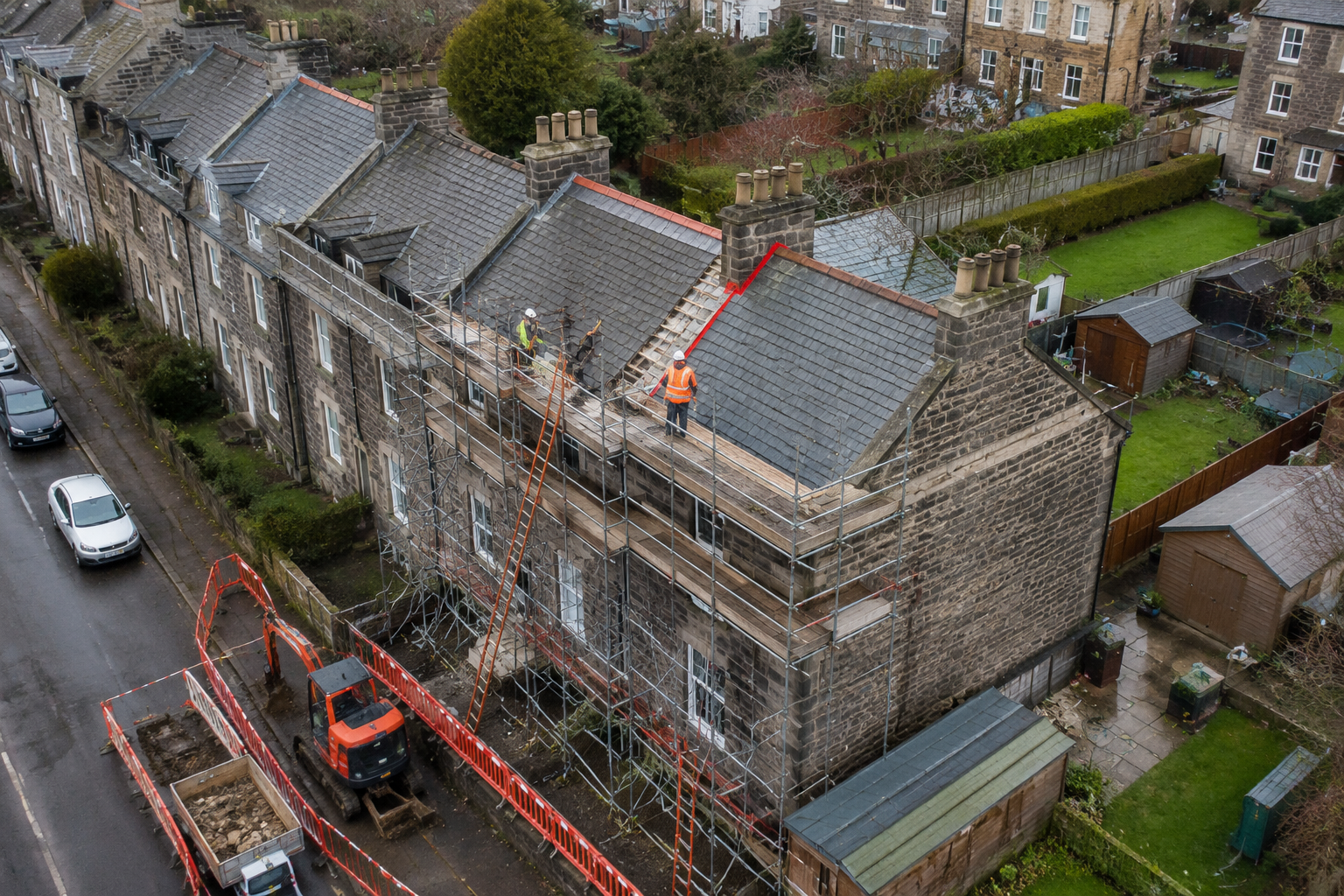
Housebuilding activity in Scotland rose sharply in Q1 2026, with public sector housing workloads increasing by a net balance of 11% and private sector housing by 10% [4]. This construction surge is generating a corresponding wave of party wall notices, schedule of condition reports, and boundary disputes that surveyors must manage alongside their valuation and building survey commitments.
It is important to note that the Party Wall etc. Act 1996 applies in England and Wales, not in Scotland. Scotland operates under common law principles and the law of the tenement for shared structures — a distinction that creates genuine complexity for surveyors working on cross-border instructions or advising clients who have recently relocated from England. However, the practical disciplines of documenting shared wall conditions, assessing potential damage, and managing neighbour relations are directly applicable in Scottish practice, even where the statutory framework differs.
For properties in England and Wales — including those owned by Scottish-based investors or developers — understanding the full cost and procedural implications of party wall agreements is essential. The cost of a party wall agreement in 2026 ranges from approximately £100 where neighbours consent, to over £4,000 per neighbour where they dissent and separate surveyors must be appointed [5]. In high-demand markets, those costs can escalate further if disputes become protracted.
Common party wall scenarios in the 2026 construction boom:
- Loft conversions in terraced or semi-detached properties requiring party wall notices for loft work
- Basement excavations triggering the three-metre rule for notifiable works
- Extensions to shared walls in densely developed urban areas
- Insulation upgrades to party walls as part of retrofit programmes
The surge in party wall notices is making robust documentation practices non-negotiable. A schedule of condition prepared before works begin is the single most effective tool for resolving disputes about whether damage was pre-existing or caused by construction activity [6]. In Scotland's rising market, where property values are increasing rapidly, the financial stakes attached to party wall damage claims are correspondingly higher.
Surveyors should also be alert to situations where a neighbour carries out works without a party wall agreement — a scenario that becomes more common when construction activity accelerates and builders and owners prioritise speed over compliance.
Cross-Border Considerations for Scottish Surveyors
Scottish surveyors increasingly encounter instructions with cross-border dimensions. A client based in Edinburgh may own rental properties in Manchester, Newcastle, or London. A developer operating in Glasgow may be undertaking simultaneous projects in Leeds. In these cases, understanding the party wall framework that applies in England and Wales — even as a referral or advisory matter — adds measurable professional value.
The three-metre rule for excavation works and the procedural requirements for serving valid party wall notices are areas where Scottish surveyors advising on English properties must be confident. Referring clients to appropriately qualified party wall surveyors in the relevant jurisdiction, and coordinating that advice with the building survey and valuation work, is a mark of professional competence rather than a limitation.
Building Survey Integration: Technology, Methodology, and Scotland-Specific Practice
Scotland's 2026 Valuation Boom: Party Wall and Building Survey Integration for Surveyors demands that building condition assessments be treated not as standalone instructions but as integral components of a broader professional service. The market conditions of 2026 make this integration both commercially sensible and professionally necessary.
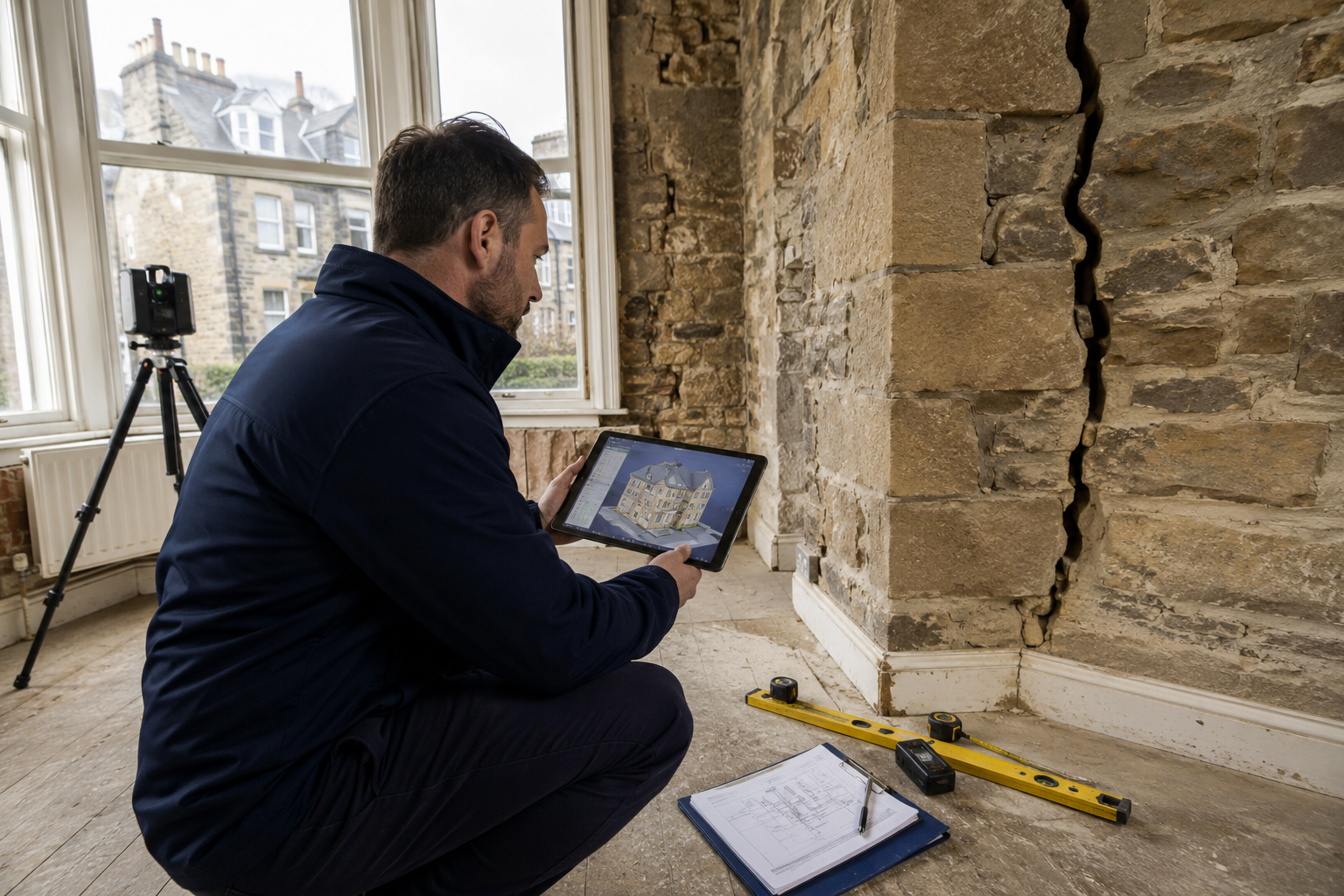
Surveyors are increasingly adopting technologies including 3D laser scanning, Building Information Modelling (BIM), and AI-powered analytics to enhance valuation accuracy and operational efficiency [1]. In Scotland, where traditional stone construction — sandstone tenements, granite terraces, harled farmhouses — presents specific pathological challenges, these technologies offer genuine advantages in identifying defects that are difficult to assess visually.

Technology tools gaining traction in Scottish surveying practice:
| Technology | Primary Application | Benefit for Scottish Properties |
|---|---|---|
| 3D laser scanning | Structural measurement and defect mapping | Accurate assessment of stone wall movement and settlement |
| BIM software | Project coordination and documentation | Supports complex refurbishment and retrofit projects |
| AI-powered analytics | Comparable analysis and valuation modelling | Handles thin comparable evidence in rural markets |
| Drone surveys | Roof and elevation inspection | Essential for high tenements and inaccessible rooflines |
A drone survey is particularly valuable in Scotland's urban tenement stock, where traditional access to upper elevations is difficult, expensive, and time-consuming. Integrating drone imagery into a building survey report provides clients with a level of evidence that supports both the condition assessment and, where relevant, the insurance reinstatement valuation.
Aligning Building Surveys with Valuation Outputs
One of the most significant opportunities for surveyors in Scotland's current market is the alignment of building survey findings with formal valuation outputs. A homebuyer survey that identifies significant defects — rising damp, failing roof coverings, structural movement — must be reflected in the valuation figure. In a rising market, there is sometimes pressure to minimise the weight given to defects in order to support a transaction. Resisting that pressure, and ensuring that the valuation methodology is transparent and defensible, is a professional obligation under RICS standards.
The reinstatement valuation is another area where building survey integration adds direct value. Scotland's traditional construction methods — solid stone walls, lime mortar, traditional slating — carry higher reinstatement costs per square metre than modern construction. A building survey that accurately characterises the construction type enables a more precise reinstatement figure, reducing the risk of underinsurance in a market where rebuilding costs are rising alongside property values.
For commercial properties, a commercial building survey that integrates condition findings with lease obligations, dilapidations exposure, and market valuation provides landlords and tenants with a comprehensive picture of their financial position — particularly relevant as Scotland's commercial property market adjusts to post-pandemic occupancy patterns and net-zero retrofit requirements.
Dilapidations and the Scottish Commercial Market
Dilapidations remain a significant area of practice in Scotland's commercial sector. The principles governing dilapidation surveys — assessing the gap between the actual condition of a property and its required condition under the lease — are consistent across the UK, but the specific provisions of Scottish commercial leases and the application of Scots property law create nuances that surveyors must understand.
In 2026, as lease expiries coincide with a market recovery and increased tenant mobility, dilapidations instructions are rising. Surveyors who can integrate dilapidations assessments with current market valuations and building condition reports are well placed to serve both landlord and tenant clients effectively.
Practical Framework for Integrated Surveying in Scotland's 2026 Market
The following framework reflects the operational demands of Scotland's current market and provides a structured approach for surveyors seeking to integrate valuation, building survey, and party wall services effectively.
Stage 1 — Instruction Scoping
- Confirm the applicable legal framework (Scots law vs. English/Welsh law for cross-border instructions).
- Identify whether party wall or shared structure issues are relevant to the instruction.
- Determine the valuation purpose (mortgage, probate, litigation, insurance) to align methodology from the outset.
Stage 2 — Site Investigation
- Deploy appropriate technology (laser scanning, drone survey, thermal imaging) based on property type and access constraints.
- Complete a thorough schedule of condition for any shared walls or boundaries where construction is planned or ongoing.
- Document all defects with photographic and measured evidence to support both the building survey report and the valuation.
Stage 3 — Report Production
- Ensure that building condition findings are explicitly reflected in the valuation figure and methodology.
- Where party wall matters are relevant, cross-reference the schedule of condition with the valuation to quantify potential impact on value.
- Provide clients with clear, plain-language summaries of findings, costs of repair, and implications for value.
Stage 4 — Post-Report Support
- Advise on the appointment of specialist contractors for identified defects.
- Where party wall disputes arise, provide or coordinate expert witness support.
- Review valuations where market conditions change materially between instruction and completion.
Conclusion
Scotland's property market in 2026 presents surveyors with both significant opportunity and genuine professional challenge. The 8.2% price growth driving Scotland's 2026 Valuation Boom: Party Wall and Building Survey Integration for Surveyors is not a passive backdrop — it is an active force reshaping client expectations, professional standards, and the competitive landscape of surveying practice.
The skills shortage is real, the educational pipeline is under pressure, and the construction activity generating party wall and building survey demand is accelerating. Surveyors who respond by deepening their technical competence, embracing integrative service models, and staying current with both Scottish statutory frameworks and RICS standards will be best positioned to serve their clients and protect their professional standing.
Actionable next steps for surveyors operating in Scotland in 2026:
- Review your valuation methodology to ensure it reflects Scotland-specific market conditions and the Scottish Government's current valuation framework.
- Invest in CPD covering party wall law as it applies to cross-border instructions, and Scottish common law principles for shared structures.
- Integrate building survey findings explicitly into valuation reports rather than treating them as separate outputs.
- Adopt at least one technology tool — drone surveys, 3D scanning, or AI-comparable analysis — to improve efficiency and report quality.
- Engage with RICS Scotland's skills development initiatives to support the profession's long-term capacity.
The market will not wait for the profession to catch up. The surveyors who act now will define the standard of practice for Scotland's built environment through the remainder of this decade.
References
[1] Building Surveys In 2026s Market Recovery How Surveyors Should Adapt Valuations To Regional Price Divergence – https://wimbledonsurveyors.com/building-surveys-in-2026s-market-recovery-how-surveyors-should-adapt-valuations-to-regional-price-divergence/?utm_source=openai
[2] Rics Scotland Manifesto 2026 Surveying Scotland – https://www.rics.org/news-insights/rics-scotland-manifesto-2026-surveying-scotland?utm_source=openai
[3] Conference Spotlights Skills Crisis Amid Disappearing Building Surveying Courses – https://www.scottishconstructionnow.com/articles/conference-spotlights-skills-crisis-amid-disappearing-building-surveying-courses?utm_source=openai
[4] Overall Workloads Stagnate While Housebuilding Activity Rises – https://www.scottishconstructionnow.com/articles/overall-workloads-stagnate-while-housebuilding-activity-rises?utm_source=openai
[5] Party Wall Cost – https://dohertybuilders.co.uk/cost/party-wall-cost/?utm_source=openai
[6] Party Wall Surveys Amid 2026 Construction Boom Handling Disputes In High Demand Uk Housing Markets – https://nottinghillsurveyors.com/blog/party-wall-surveys-amid-2026-construction-boom-handling-disputes-in-high-demand-uk-housing-markets?utm_source=openai
[7] Scottish Surveyors Report Slower Homebuyer Demand But Remain Optimistic About Outlook – https://projectscot.com/2026/03/scottish-surveyors-report-slower-homebuyer-demand-but-remain-optimistic-about-outlook/?utm_source=openai
[8] Foi 202600506012 Information Released Annex – https://www.gov.scot/binaries/content/documents/govscot/publications/foi-eir-release/2026/04-d/foi-202600506012/documents/foi-202600506012—information-released—annex/foi-202600506012—information-released—annex/govscot%3Adocument/FOI%2B202600506012%2B-%2BInformation%2BReleased%2B-%2BAnnex.pdf?utm_source=openai