Over 60% of Section 8 possession proceedings in England involve rental properties undergoing active renovation — yet the legal intersection between landlord database registration and party wall obligations remains one of the most overlooked compliance traps of 2026. The mandatory rollout of the Private Rented Sector (PRS) Database under the Renters' Rights Act has fundamentally changed how party wall surveyors must verify notice validity when boundary disputes arise during renovation works. Understanding the party wall implications of PRS database registration: surveyor checks for valid Section 8 notices in 2026 renovations is no longer optional — it is a core professional competency for any surveyor, landlord, or legal adviser operating in the current market.

Key Takeaways 📋
- PRS Database registration (mandatory from October 2026) directly affects the validity of Section 8 notices — unregistered landlords may face invalid notices and stalled possession proceedings [1][2].
- Party wall surveyors must now cross-reference landlord registration status when assessing notice validity in renovation-related boundary disputes.
- Section 8 notices served by non-compliant landlords during renovation works can be challenged, creating significant legal and financial exposure.
- The Renters' Rights Act 2025 has created a new compliance layer that interacts with the Party Wall etc. Act 1996 in ways many practitioners have not yet anticipated [2].
- Early engagement with a qualified party wall surveyor and legal adviser is the most effective way to protect both landlord and adjoining owner interests in 2026 renovations.
What the PRS Database Means for Landlords in 2026
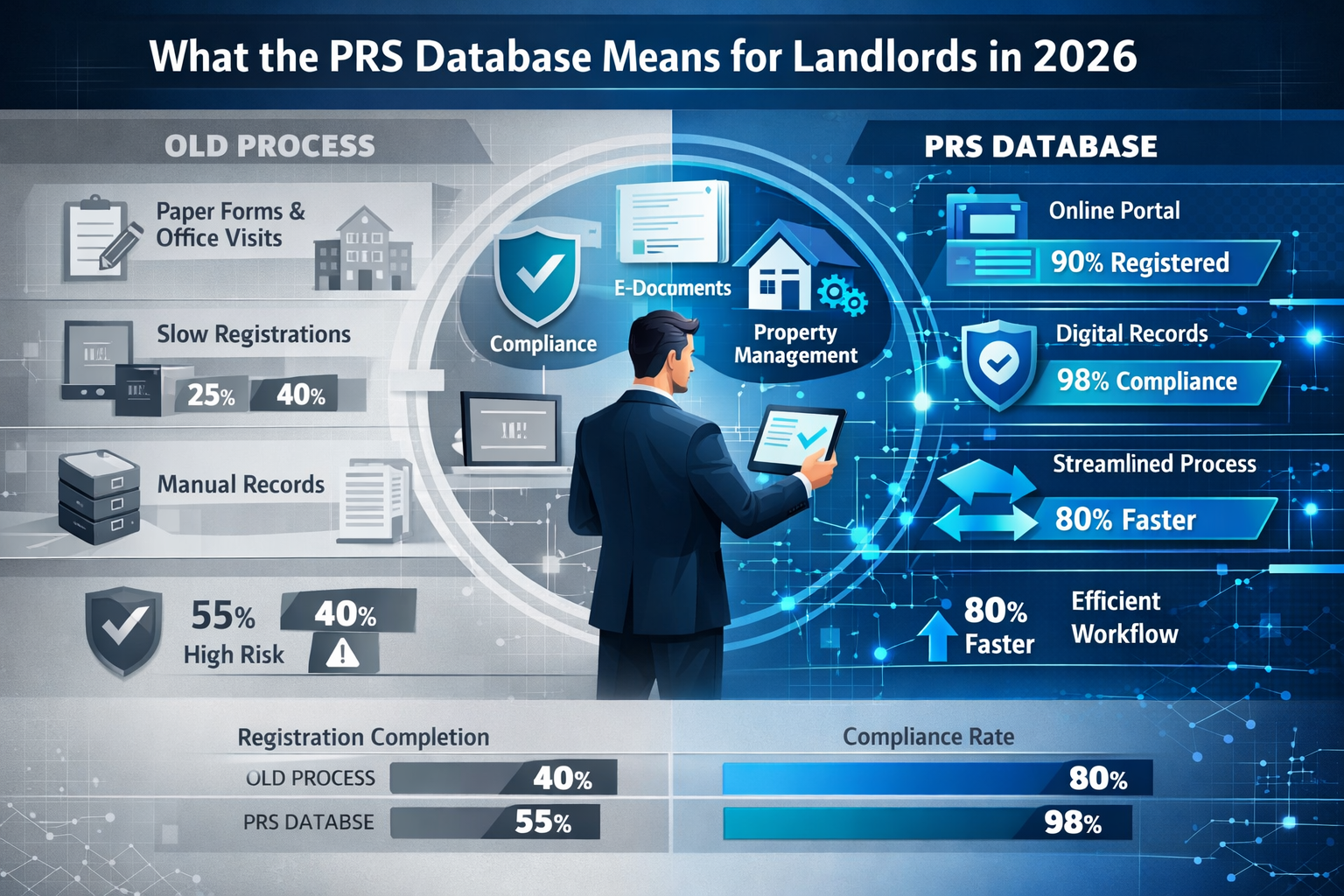
The Private Rented Sector Database is one of the most significant structural changes to residential landlord regulation in a generation. From 1 May 2026, the Renters' Rights Act began its implementation journey, with full mandatory landlord registration on the PRS Database required by October 2026 [2]. Every private landlord in England must register their properties and demonstrate compliance with key standards — including Energy Performance Certificate (EPC) ratings, safety certifications, and licensing conditions [1].
💡 Pull Quote: "The PRS Database is not just an administrative exercise — it is a legal prerequisite that now touches every aspect of landlord-tenant law, including the validity of possession notices."
What Landlords Must Register
The registration requirements are broad and include:
| Requirement | Detail |
|---|---|
| Property address and ownership details | Full legal ownership must be declared |
| EPC rating | Minimum EPC Band C required by October 2030 [3][6] |
| Safety certificates | Gas, electrical, and fire safety documentation |
| Licensing compliance | HMO and selective licensing where applicable |
| Ombudsman membership | Mandatory membership of the Private Landlord Ombudsman [1][2] |
Failure to register carries significant penalties, including fines and — critically — the potential invalidation of Section 8 notices served during the non-compliant period [2]. This is where the party wall implications become acute.
The Energy Performance Dimension 🔋
The government's consultation response on raising energy efficiency standards confirmed that EPC Band C will be the minimum standard for new tenancies, with a compliance deadline of October 2030 [3][6]. This has triggered a wave of landlord-led renovation works — insulation upgrades, window replacements, boiler changes — many of which directly engage party wall obligations under the Party Wall etc. Act 1996.
For landlords upgrading properties to meet EPC requirements, works such as party wall insulation on shared walls, or structural changes near boundaries, will require proper party wall notices to be served before works commence.
How Section 8 Notice Validity Intersects With PRS Registration
This is the crux of the issue. A Section 8 notice is a formal notice served by a landlord to a tenant, citing specific grounds for possession under Schedule 2 of the Housing Act 1988. For the notice to be legally valid in 2026, it must meet a growing checklist of requirements — and PRS Database registration is now part of that checklist.
The Core Legal Problem
Under the Renters' Rights Act framework, a landlord who has not registered on the PRS Database by the required date may find that any Section 8 notice they serve is:
- ❌ Challenged as procedurally defective by the tenant or their legal representative
- ❌ Dismissed by the court on the grounds that the landlord is not compliant with mandatory registration
- ❌ Used as evidence of wider non-compliance, potentially triggering local authority enforcement action [2][4]
This creates a direct link to renovation disputes. When a landlord serves a Section 8 notice during or shortly before a renovation project — particularly one involving party wall works — the adjoining owner's surveyor, the tenant's adviser, or the court may scrutinise the landlord's registration status as part of a broader compliance review.
What Party Wall Surveyors Must Now Check ✅
The party wall implications of PRS database registration: surveyor checks for valid Section 8 notices in 2026 renovations require surveyors to expand their standard due diligence. A party wall surveyor appointed under the Party Wall etc. Act 1996 has a duty to act impartially — but that duty now operates in a more complex regulatory environment.
Key checks for surveyors in 2026 include:
- Confirm the building owner is registered on the PRS Database (where the property is tenanted)
- Verify that any Section 8 notice served during renovation works is procedurally valid
- Check that party wall notices have been served correctly — failing to serve a party wall notice before commencing works remains a common and costly error
- Assess whether EPC-driven works trigger the 3-metre rule for excavation near party walls
- Record the condition of adjoining properties before works begin — a schedule of condition is essential protection for all parties
🔑 Key Point: A surveyor who overlooks a landlord's non-compliance with PRS registration requirements during a renovation dispute may inadvertently produce an award that is later challenged on procedural grounds.
The Section 8 Notice Validity Checklist for 2026
For a Section 8 notice to withstand legal scrutiny in 2026, the following must be confirmed:
- ✅ Correct prescribed form used (updated post-Renters' Rights Act)
- ✅ Correct grounds cited with supporting evidence
- ✅ Proper notice period given (varies by ground)
- ✅ Landlord registered on PRS Database (new 2026 requirement)
- ✅ Property compliant with licensing requirements
- ✅ No outstanding rent repayment orders against the landlord
- ✅ Ombudsman membership confirmed [1][2]
Surveyor Responsibilities in 2026 Renovation Disputes
The party wall implications of PRS database registration: surveyor checks for valid Section 8 notices in 2026 renovations extend beyond simple procedural verification. Surveyors are increasingly being drawn into disputes that blend property law, tenancy law, and building regulations — a convergence that demands broader professional awareness.
When Renovation Works Trigger Multiple Legal Obligations
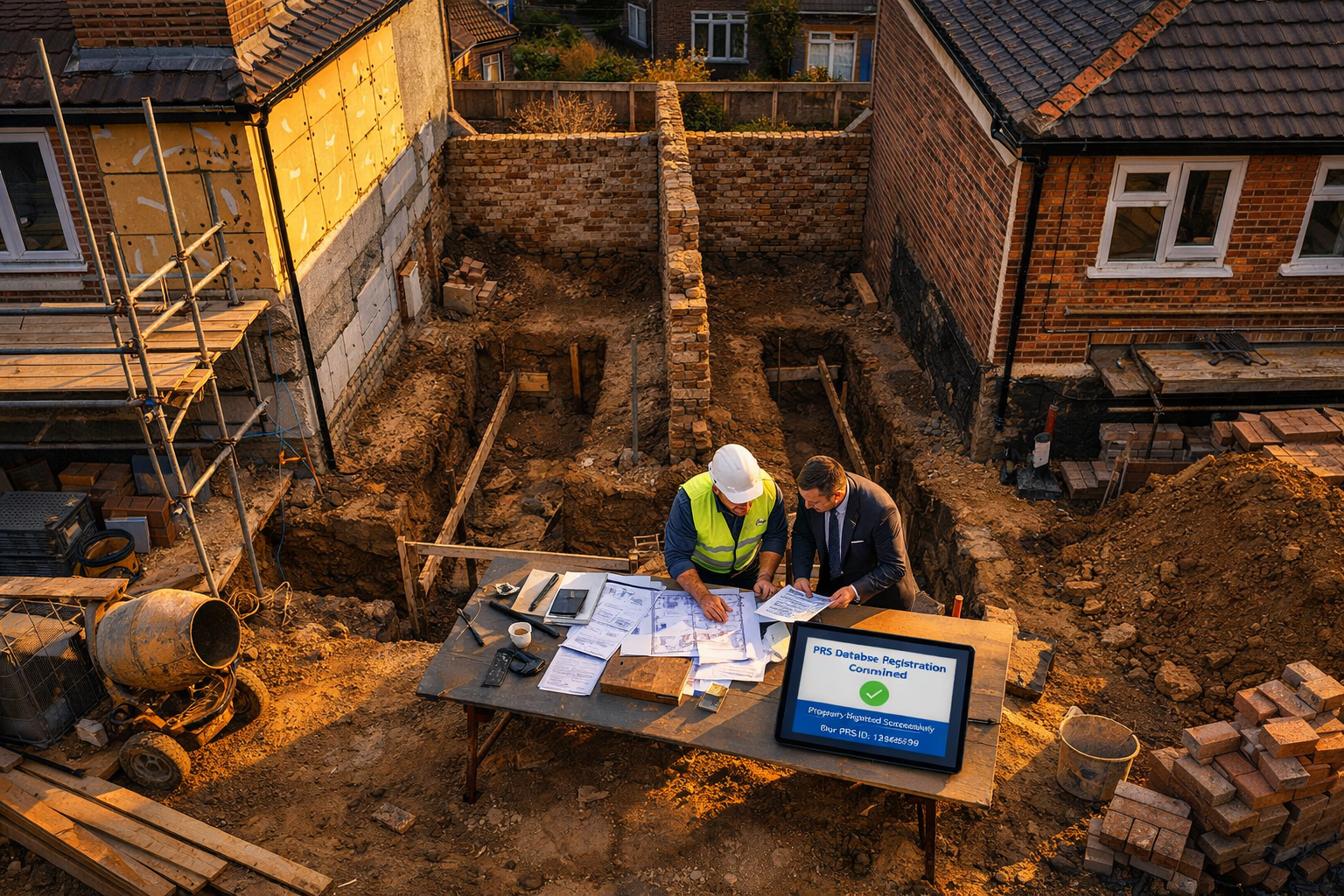
Consider a typical 2026 scenario: a landlord owns a mid-terrace rental property and plans a loft conversion to increase the property's value and EPC rating. The works will involve cutting into the party wall and raising the roof structure. Simultaneously, the landlord is seeking possession of the property from the current tenant using Section 8 grounds.
This scenario triggers at least three separate legal frameworks:
- The Party Wall etc. Act 1996 — requiring notice to be served on the adjoining owner(s) [see loft conversions and party wall obligations]
- The Renters' Rights Act 2025 — requiring PRS Database registration and valid Section 8 notice procedure
- Building Regulations — requiring compliance with structural and energy efficiency standards
A failure in any one of these areas can derail the entire project. If the Section 8 notice is invalid because the landlord is not yet registered on the PRS Database, the tenant may remain in occupation during the renovation — creating serious safety, insurance, and legal complications.
The Adjoining Owner's Position 🏠
The adjoining owner in a party wall dispute has a legitimate interest in the legal status of the building owner undertaking works. If the building owner is a landlord who is non-compliant with PRS registration, this may indicate:
- A pattern of regulatory non-compliance that could extend to the party wall process
- Financial instability that could affect the ability to pay compensation for damage caused during party wall works
- A higher risk profile that justifies a more detailed schedule of condition before works begin
Adjoining owners who are concerned about a neighbour's renovation project should understand what happens if there is no party wall agreement and take proactive steps to protect their position.
Local Authority Enforcement: A Growing Factor
Local authorities are now equipped with enhanced enforcement powers under the Renters' Rights Act framework [2][4]. Enforcement officers responsible for PRS compliance can:
- Issue civil penalties of up to £40,000 for non-registration [2]
- Apply for rent repayment orders on behalf of tenants
- Refer non-compliant landlords to the Private Landlord Ombudsman
- Share data with planning and building control departments
This last point is significant. A local authority enforcement officer investigating a landlord's PRS non-compliance may simultaneously flag unauthorised building works or defective party wall notices to the building control team — creating a compound enforcement risk for landlords who have not managed their compliance obligations carefully.
Practical Steps for Landlords and Surveyors in 2026
Navigating the party wall implications of PRS database registration: surveyor checks for valid Section 8 notices in 2026 renovations requires a structured, proactive approach. The following steps apply to landlords planning renovation works and the surveyors advising them.
For Landlords 🏗️
- Register on the PRS Database immediately — do not wait until the October 2026 deadline if renovation works are planned [1][2]
- Serve party wall notices at the correct time — typically two months before works begin for party structure notices, and one month before for line of junction notices
- Obtain a schedule of condition for all adjoining properties before works start
- Ensure Section 8 notices are reviewed by a specialist solicitor before service, particularly where renovation works are concurrent
- Budget for party wall surveyor costs — understanding the cost of party wall proceedings early avoids surprises
- Upgrade EPC ratings in line with the 2030 deadline — works that touch party walls require proper notice [3]
For Party Wall Surveyors 📐
- Incorporate PRS registration verification into standard pre-award due diligence
- Be alert to the 3-metre rule for excavations when EPC-driven groundworks are proposed
- Document all communications carefully in case Section 8 proceedings become contested
- Consider whether a party wall dispute is likely to escalate given the landlord's broader compliance profile
- Recommend RICS-qualified chartered building surveyors for complex renovation projects involving multiple legal frameworks
A Note on the New Land Register Transparency 🗺️
Emerging land registration reforms are also increasing transparency around who controls land and property [5]. This greater visibility means that surveyors and adjoining owners can more easily verify ownership, identify landlord registration status, and cross-reference compliance records — making it harder for non-compliant landlords to obscure their regulatory position during party wall proceedings.
Conclusion: Compliance Convergence Is the New Normal
The regulatory landscape for private landlords in 2026 has become a matrix of interlocking obligations. The PRS Database, the Renters' Rights Act, EPC upgrade requirements, and the Party Wall etc. Act 1996 do not operate in isolation — they interact in ways that can either protect or expose landlords, depending on how well they are managed.
The key message is clear: a landlord who fails to register on the PRS Database before serving a Section 8 notice, or before commencing renovation works that affect a party wall, is not just risking a fine. They are potentially invalidating their possession proceedings, exposing themselves to enforcement action, and undermining the legal foundation of their entire renovation project.
Actionable Next Steps ✅
- Landlords: Register on the PRS Database now, review all pending Section 8 notices with a solicitor, and serve party wall notices at the correct statutory time.
- Surveyors: Update due diligence checklists to include PRS registration verification and Section 8 notice validity as standard pre-award checks.
- Adjoining owners: If a neighbour is undertaking renovation works, verify their party wall notice compliance and consider appointing your own surveyor.
- All parties: Seek specialist advice early — the cost of getting it wrong in 2026 is significantly higher than the cost of getting it right.
The convergence of tenancy law and party wall law is not a temporary anomaly. It is the new normal for 2026 renovations — and the professionals who adapt first will serve their clients best.
References
[1] New Year New Challenges What Residential Landlords Need To Know For 2026 – https://www.placeyorkshire.co.uk/new-year-new-challenges-what-residential-landlords-need-to-know-for-2026/
[2] Shw Renters Rights Act Begins Implementation Journey On 1st May 2026 – https://www.shw.co.uk/news/2025/shw—renters-rights-act-begins-implementation-journey-on-1st-may-2026.html
[3] Government Publishes Response To The Consultation On Raising Energy Efficiency St – https://insights.devonshires.com/post/102mfc7/government-publishes-response-to-the-consultation-on-raising-energy-efficiency-st
[4] 260114 Prs Update 65 January – https://hqnetwork.co.uk/wp-content/uploads/2026/01/260114-PRS-update-65-January.pdf
[5] Who Really Controls Land New Register Set To Revea – https://www.clydeco.com/en/insights/2025/10/who-really-controls-land-new-register-set-to-revea
[6] Government Reforms Energy Performance Buildings Regime And Raises Minimum Energy – https://www.osborneclarke.com/insights/government-reforms-energy-performance-buildings-regime-and-raises-minimum-energy