Fewer than 24 hours. That is the window landlords may have to respond once a tenant reports an emergency hazard under Awaab's Law — and from 2026, that clock starts ticking for hazards far beyond damp and mould. The anticipated Phase 2 extension of Awaab's Law introduces building survey protocols for new Awaab's Law hazards in PRS covering excess cold, falls, and structural collapse, fundamentally reshaping what a compliant property inspection must look like in the private rented sector.
For surveyors, landlords, and property managers, the shift is not merely procedural. It demands a rethink of survey checklists, evidence trails, and remediation timelines — before enforcement catches up with an unprepared sector.
Key Takeaways 📋
- Phase 2 of Awaab's Law is anticipated to extend to 13 additional HHSRS hazard categories in 2026, including excess cold, falls, and structural collapse — moving well beyond Phase 1's damp and mould focus. [3]
- Emergency hazards must be investigated and made safe within 24 hours; significant hazards require investigation within 10 working days. [3]
- Survey reports must now function as compliance audit trail initiators, not just observational documents — documenting hazard location, cause, health risk, and urgency. [1]
- Falls hazards cover four subcategories: baths, level surfaces, stairs, and falls between levels — each requiring specific checklist items. [3]
- Structural collapse risks include cracked walls, subsidence, unsafe balconies, and explosion risks from gas leaks, demanding specialist assessment protocols. [2]
Understanding the Awaab's Law Timeline: From Phase 1 to PRS Extension
Awaab's Law was named after two-year-old Awaab Ishak, who died in 2020 from prolonged exposure to mould in a social housing flat. Phase 1 came into force on 27 October 2025, covering damp, mould, and emergency hazards for the social rented sector. [4]
The legislative roadmap that follows is significant:
| Phase | Expected Timing | Coverage |
|---|---|---|
| Phase 1 | October 2025 (live) | Damp, mould, emergency hazards — social housing |
| Phase 2 | Anticipated 2026 | 13 additional HHSRS hazard categories — social housing, with PRS extension signalled |
| Phase 3 | Anticipated 2027 | All remaining HHSRS categories except crowding and space |
[3][4]
💡 Pull Quote: "Phase 2 is not a minor update — it is a structural overhaul of how hazard risk is assessed, documented, and remediated across the rented sector."
The extension to the private rented sector (PRS) in 2026 remains an evolving area. Detailed protocols are still emerging, but the direction of travel is clear: PRS landlords should treat social housing compliance standards as the benchmark to prepare against now. [5]
What Phase 2 Hazard Categories Mean for Survey Practice
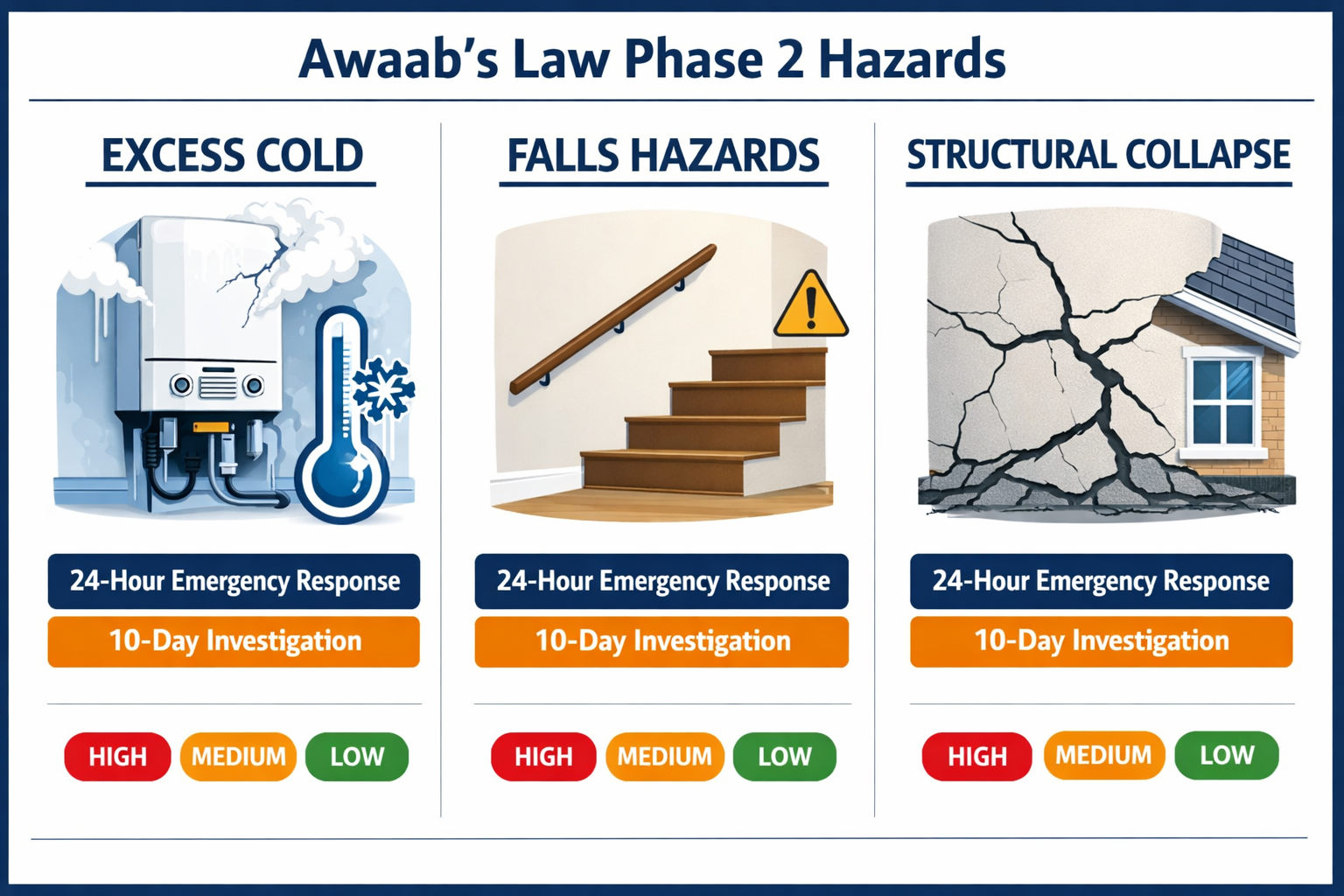
Building survey protocols for new Awaab's Law hazards in PRS covering excess cold, falls, and structural collapse require surveyors to move beyond general condition reporting. Each hazard category demands specific assessment criteria, evidence capture, and recommended action timescales.
Excess Cold (and Excess Heat) 🌡️
Excess cold is one of the most common hazards in older UK rental stock, particularly in properties with:
- Broken or inadequate boilers
- Failed or absent insulation (walls, loft, floors)
- Single-glazed windows in exposed locations
- No central heating or heating limited to one room
Under the anticipated Phase 2 framework, surveyors assessing excess cold must document the current heating provision, the thermal efficiency of the building envelope, and any evidence of tenant health risk from cold exposure. [3]
Excess heat — relevant in summer overheating scenarios, particularly in top-floor flats and south-facing properties — is also confirmed as a Phase 2 category. This matters for PRS properties in urban heat island areas.
What surveyors must record:
- Boiler age, condition, and output rating
- Insulation presence and condition (loft, cavity, floor)
- Window type and draught-proofing status
- Room temperatures where measurable
- Heating controls and zoning capability
A RICS Level 3 Building Survey is the appropriate tool for this depth of thermal and fabric assessment — a mortgage valuation will not provide the granularity required. [3]
Falls Hazards: Four Subcategories Requiring Distinct Checklists ⚠️
Falls are the leading cause of accidental death in the home for people over 65. Phase 2 breaks this hazard into four distinct subcategories, each requiring targeted survey attention: [3]
- Falls associated with baths — missing grab rails, slippery surfaces, awkward bath-to-shower transitions
- Falling on level surfaces — uneven flooring, loose carpets, trip hazards at thresholds
- Falling on stairs — loose or missing handrails, broken treads, inadequate lighting, steep pitch
- Falling between levels — unsafe balustrades, low or missing barriers at mezzanines or open landings
Checklist items for a compliant falls assessment:
- ✅ Handrail continuity and fixing security on all stair flights
- ✅ Balustrade height (minimum 900mm for stairs, 1100mm for balconies under Building Regs)
- ✅ Stair tread condition — no cracked, loose, or missing nosings
- ✅ Floor surface continuity — no level changes without transition strips
- ✅ Bathroom grab rail provision for vulnerable occupants
- ✅ External step condition and lighting
A specific defect report can be commissioned where a particular falls risk has already been identified, allowing focused investigation before the statutory clock starts.
Structural Collapse and Falling Elements 🏗️
This is arguably the most technically demanding Phase 2 category. Structural collapse and falling elements cover: [2][3]
- Cracked walls — distinguishing structural movement from cosmetic cracking
- Subsidence and settlement — differential movement affecting load-bearing elements
- Unsafe balconies — corroded fixings, delaminated concrete, inadequate balustrade connections
- Gas leaks presenting explosion risk — a structural hazard by consequence
💡 Pull Quote: "Not all cracks are equal — but under Awaab's Law Phase 2, every crack in a PRS property needs a documented assessment decision, not just a visual note."
Surveyors must apply crack classification systems (such as the BRE's six-category scale) and clearly state whether observed cracking is cosmetic, moderate, or severe. A vague note that "cracking is present" will not satisfy the audit trail requirements that Phase 2 is expected to demand. [1][2]
For properties showing signs of ground movement, a dedicated subsidence survey provides the specialist evidence needed to determine whether emergency or significant hazard timescales apply.
Where structural concerns involve load-bearing elements, beam calculations, or foundation assessment, structural engineering input becomes essential to the compliance process.
Statutory Timescales: The Compliance Clock Every PRS Landlord Must Know
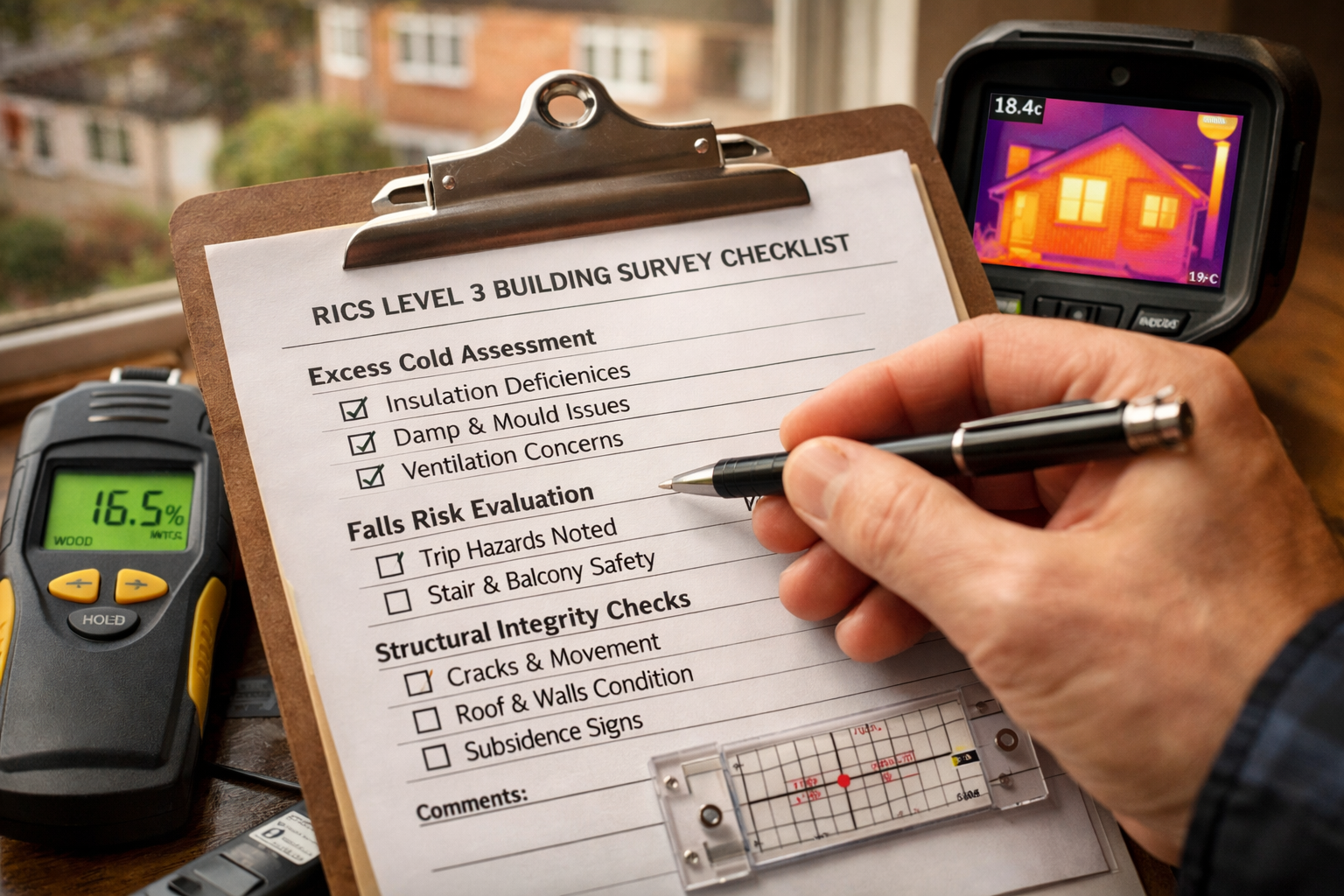
Building survey protocols for new Awaab's Law hazards in PRS — excess cold, falls, and structural collapse — are only meaningful if landlords and their surveyors understand the timescales they feed into. Phase 2 is expected to mirror Phase 1's statutory framework: [3]
| Hazard Type | Investigation Deadline | Written Summary to Tenant | Safety Works Completion | Preventative Works Start |
|---|---|---|---|---|
| Emergency | 24 hours | N/A (immediate action) | 24 hours | Within 12 weeks |
| Significant | 10 working days | 3 working days after investigation | 5 working days after investigation | 5 working days to begin; 12 weeks to complete |
[3][4]
These timescales have direct implications for how surveys must be structured:
- Emergency hazards (e.g., a structural crack suggesting imminent collapse, or a total heating failure in winter) require same-day reporting with clear severity classification.
- Significant hazards (e.g., a loose stair handrail or inadequate insulation) require a written investigation summary within a defined window.
- Preventative works must be formally instructed and physically commenced — not just quoted for.
The evidence trail for each stage must include: dated reports, inspection findings, contractor instructions, completion confirmations, and tenant communications. [3] This is not optional documentation — it is the compliance record that demonstrates the landlord met their legal duty.
Redesigning Survey Reports for Awaab's Law Compliance
Survey reports in 2026 must do more than describe what a surveyor saw. Under the anticipated Phase 2 framework, reports must provide housing providers and landlords with sufficient clarity to: [1]
- Determine whether a hazard exists
- Assess its severity (emergency vs. significant)
- Understand the probable cause (structural, ventilation, condensation, wear)
- Know what action is required and with what urgency
This represents a fundamental shift — from surveys as observational documents to surveys as compliance audit trail initiators. [1]
What a Phase 2-Compliant Survey Section Must Include
For each hazard category identified, the survey report should contain:
- 📍 Location — specific room, element, and position within the property
- 📏 Extent — area affected, crack width, temperature differential, or fall height
- 🔍 Probable cause — structural movement, heating failure, maintenance neglect
- 🏥 Health risk — who is at risk and what the likely impact is
- ⏱️ Recommended remediation timeframe — emergency, urgent, or routine
- 📸 Photographic evidence — dated, geotagged where possible
Surveyors working with RICS-certified expertise are best placed to produce reports that meet this standard, given their training in HHSRS assessment methodology and professional indemnity obligations.
The Role of Level 3 Surveys in PRS Compliance
A RICS Level 3 Building Survey — formerly the Building Survey or Full Structural Survey — is the most thorough inspection available for residential properties. It is the natural fit for Awaab's Law Phase 2 compliance because it:
- Covers all accessible parts of the structure and fabric
- Provides detailed condition ratings for each element
- Identifies defects, their causes, and repair options
- Produces a report suitable for use as a legal compliance document
For PRS landlords managing older or non-standard stock — Victorian terraces, converted flats, properties with flat roofs or timber frames — a Level 3 survey conducted before Phase 2 enforcement begins is a prudent investment against future liability.
Practical Steps for PRS Landlords and Surveyors in 2026
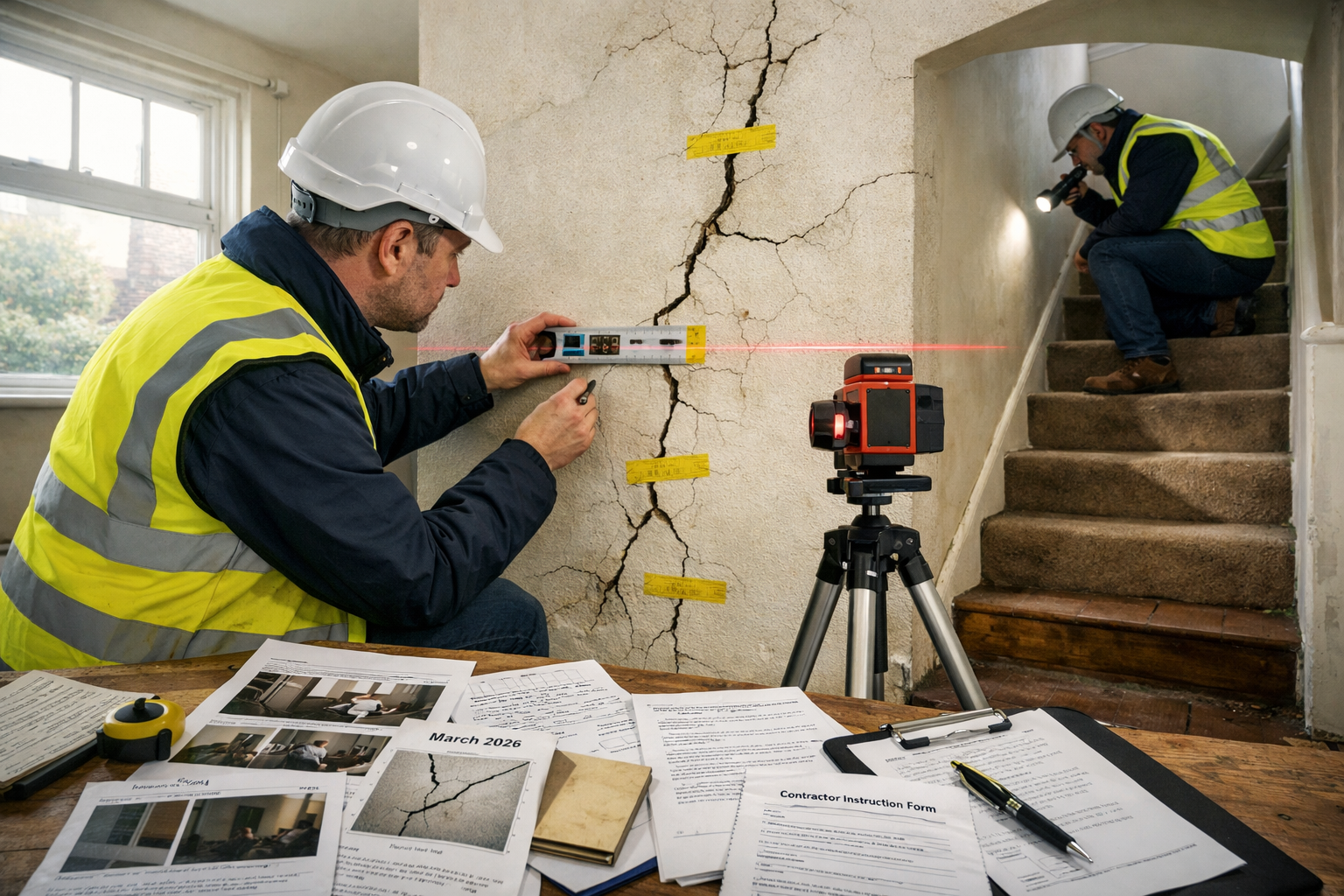
The combination of tight statutory timescales and expanded hazard categories means that reactive compliance is a high-risk strategy. The following practical steps reflect best practice for the 2026 landscape:
For Landlords 🏠
- Commission a pre-compliance Level 3 survey on all PRS properties before Phase 2 enforcement begins — identify hazards before tenants report them.
- Build a hazard register for each property, updated after each inspection or maintenance visit.
- Establish contractor relationships in advance — 24-hour emergency response requires pre-agreed contracts, not cold calls.
- Create a tenant communication template for written summaries, ensuring the 3-working-day deadline is met consistently.
- Review heating systems now — excess cold is one of the most common and most actionable Phase 2 hazards.
For Surveyors 📐
- Update survey templates to include specific sections for each Phase 2 hazard category.
- Apply crack classification systems consistently — document the BRE category for every crack observed, not just "minor" or "significant."
- Photograph everything with date stamps — the evidence trail starts at inspection.
- Distinguish clearly between emergency and significant hazards in report language — ambiguity creates compliance risk for clients.
- Recommend specialist input (structural engineer, energy assessor) where the hazard exceeds general surveying scope.
Understanding what a chartered surveyor looks for in a property inspection helps landlords prepare properties and set realistic expectations before the surveyor arrives.
Conclusion: Act Before the Clock Starts ⏰
The anticipated Phase 2 extension of Awaab's Law to the private rented sector in 2026 is not a distant regulatory concern — it is an imminent compliance reality. Building survey protocols for new Awaab's Law hazards in PRS covering excess cold, falls, and structural collapse demand a level of survey rigour, report clarity, and evidence documentation that goes well beyond traditional practice.
The key actions for 2026 are clear:
- ✅ Commission Level 3 surveys on PRS stock to identify Phase 2 hazards proactively
- ✅ Ensure survey reports meet the new standard: location, extent, cause, health risk, and urgency for every hazard
- ✅ Build contractor and communication infrastructure to meet 24-hour and 10-working-day statutory deadlines
- ✅ Apply specialist structural and engineering assessment where collapse or falls risks are identified
- ✅ Treat the survey report as the first document in a compliance audit trail, not the last
The landlords and surveyors who invest in robust protocols now will be far better positioned when enforcement begins. Those who wait for a tenant complaint to trigger the clock will find 24 hours is a very short time indeed.
References
[1] Awaabs Law And Surveyors What Your Reports Must Include In 2026 – https://goreport.com/awaabs-law-and-surveyors-what-your-reports-must-include-in-2026/
[2] Building Survey Protocols For Structural Collapse Risks Awaabs Law 2026 Extensions And High Risk Property Assessments – https://nottinghillsurveyors.com/blog/building-survey-protocols-for-structural-collapse-risks-awaabs-law-2026-extensions-and-high-risk-property-assessments
[3] Awaabs Law Phase 2 Changes 2026 – https://hazardclock.co.uk/blog/awaabs-law-phase-2-changes-2026/
[4] Awaabs Law Guidance For Social Landlords Timeframes For Repairs In The Social Rented Sector – https://www.gov.uk/government/publications/awaabs-law-guidance-for-social-landlords/awaabs-law-guidance-for-social-landlords-timeframes-for-repairs-in-the-social-rented-sector
[5] Awaabs Law Extensions To Prs In 2026 Party Wall And Building Survey Protocols For New Hazard Categories – https://nottinghillsurveyors.com/blog/awaabs-law-extensions-to-prs-in-2026-party-wall-and-building-survey-protocols-for-new-hazard-categories