Thirty years. That is how long Manchester has gone without adding a single new conservation area, until now. On 15 October 2026, Manchester City Council confirmed proposals for seven new conservation areas, a move that would push the city's total from 35 to 42 and mark the first expansion since the 1990s. For homeowners in Didsbury, Fallowfield, Burnage, Ardwick, Chorlton-upon-Medlock and Rusholme, this is not a minor planning footnote. It could change what can be built, altered or removed on their street for decades to come.
This article explains exactly what is being proposed, which streets are affected, and what conservation area status really means for anyone who owns, buys or sells property in these neighbourhoods. The Manchester new conservation areas 2026 proposals are still subject to approval, but the direction of travel is now clear.
Key Takeaways
- Manchester City Council has proposed seven new conservation areas, the first since the 1990s, following a review by heritage consultancy Donald Insall Associates.
- If approved, Manchester's conservation area total rises from 35 to 42.
- Proposed areas include parts of Didsbury Village, Fallowfield, Burnage Garden Village, Ardwick Green, Chorlton-upon-Medlock, Moon Grove (Rusholme), and Spath Road and Victoria Avenue.
- 16 existing areas get minor boundary adjustments; 18 remain completely unchanged.
- No consultation dates or decision timetable have been published yet, homeowners should watch for a public consultation announcement.
Seven New Conservation Areas Proposed, First Since the 1990s
The proposals form part of Manchester's wider Local Plan process, which involves a systematic review of the city's protected heritage areas. Donald Insall Associates, a respected heritage and conservation architecture firm, carried out the assessment that identified neighbourhoods worthy of new protection.
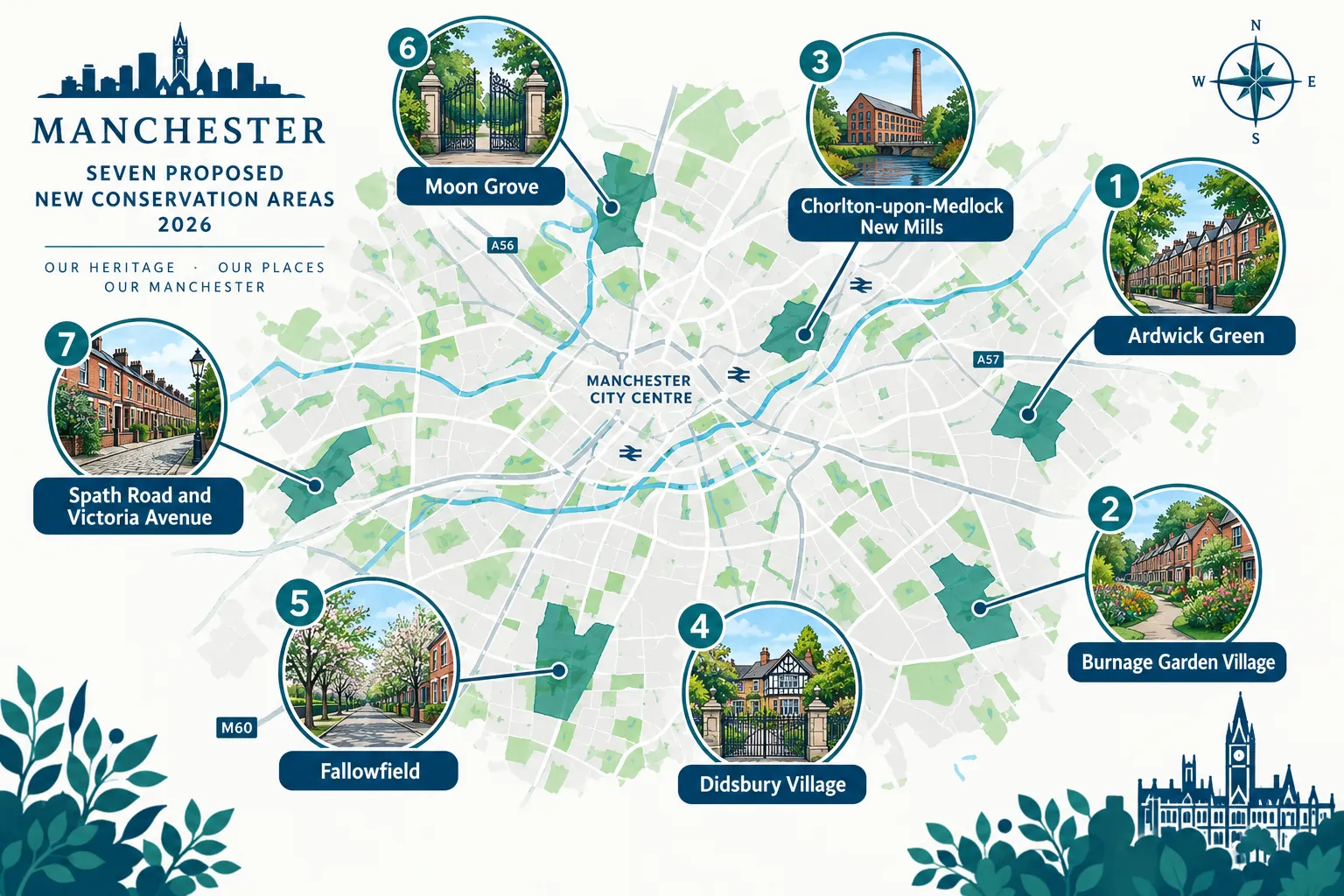
"This is the first time Manchester has added new conservation areas since the 1990s", a signal that the city sees genuine heritage value in these streets that has gone unrecognised for a generation.
It is important to stress: these are proposals, not approved designations. The council has not yet opened a public consultation, and no decision date has been confirmed. Homeowners in the affected streets are not yet subject to any new restrictions, but that is likely to change if the proposals proceed through the normal planning process.
The Seven Proposed Manchester New Conservation Areas 2026
Each of the seven areas was chosen for a distinct architectural or historic character. Here is a breakdown of where the boundaries are expected to fall:
| Proposed Area | Location | Notable Features |
|---|---|---|
| Ardwick Green | Around the park | Includes Tanzaro House |
| Burnage Garden Village | East of Burnage Lane | Green at centre of North, East, West and South avenues |
| Chorlton-upon-Medlock New Mills | Great Marlborough Street / Cambridge Street | Includes fire-damaged Hotspur Press mill |
| Didsbury Village | Churchwood Road, Davenfield Road, Grove Lane | Established Victorian village character |
| Fallowfield | North and south of Brook Road | Amherst Road and Clifton Avenue included |
| Moon Grove | Rusholme | Cobbled street setting |
| Spath Road and Victoria Avenue | Between Spath Road and Barlow Moor Road, Didsbury | Residential avenue character |
For Didsbury homeowners, two separate proposals, Didsbury Village and Spath Road and Victoria Avenue, show how closely the council has examined the suburb's street-by-street character. Fallowfield residents around Brook Road, Amherst Road and Clifton Avenue would see similar scrutiny applied to their Victorian terraces. In Burnage, the Garden Village estate's distinctive avenue layout around the central green is the focus, reflecting its status as a planned early twentieth-century housing scheme.
What Conservation Area Status Actually Means for Homeowners
Conservation area designation does not freeze a neighbourhood in time, but it does add a layer of planning control that many owners do not expect until they try to do building work. Understanding this matters just as much as knowing whether a street is on the list.
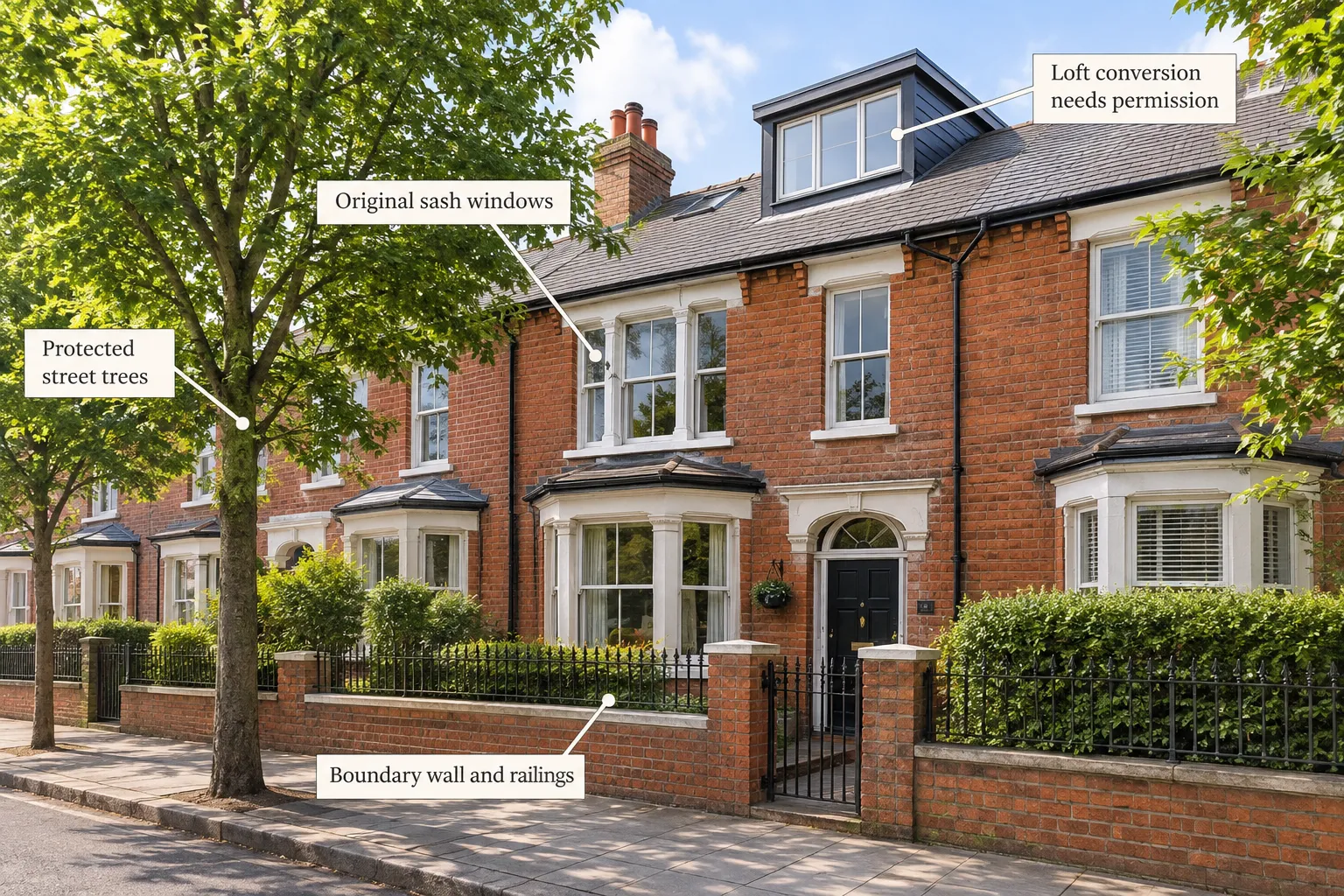
In England, conservation area status typically means:
- Permitted development rights are reduced. Some works that would normally need no planning permission, certain extensions, cladding, and in some cases window replacements where an Article 4 Direction applies, require formal consent.
- Demolition control. Demolishing all or part of a building, including some outbuildings and boundary walls, can require permission that would not apply outside the area.
- Tree protection. Anyone wanting to cut down, top or lop a tree in a conservation area must usually give the council six weeks' notice, even without a formal Tree Preservation Order.
- Extensions and loft conversions face closer scrutiny. Design, materials and scale are assessed against the character of the area, which can mean more detailed applications and longer waits.
- Valuations, surveys and transactions can be affected. Surveyors and conveyancers typically flag conservation area status during due diligence, and buyers' solicitors will usually check for any Article 4 Directions or listed building issues nearby.
The council has also indicated that developers proposing new schemes within the seven new areas must demonstrate they have considered and reduced any impact on the area's character, a requirement that goes beyond standard planning policy and will apply specifically to sites within the proposed boundaries.
No statistics on price effects have been published alongside these proposals, and homeowners should treat any claims about valuation uplift or decline with caution until there is verified local data.
Boundary Tweaks and Areas Left Unchanged
Not every existing conservation area is affected equally. The council's review split the city's 35 current areas into three groups:
- 18 areas unchanged, including Albert Square, Ancoats, Castlefield, Chorlton Green, Northenden, St Ann's Square and St Peter's Square.
- 16 areas with minor boundary tweaks, including Albert Park, Victoria Park, Whalley Range, Withington and Whitworth Street.
- 7 brand-new areas, the ones detailed above.
Owners in the 16 "tweaked" areas should check whether their specific property falls inside or outside the revised boundary once consultation documents are published, since even a small boundary shift can move a house in or out of designated status.
What Happens Next for Manchester New Conservation Areas 2026
As of publication, the council has not announced a public consultation period or a decision date. Typically, conservation area designation in England requires a period of public consultation, followed by a committee decision and formal designation. Homeowners and local residents' groups in Didsbury, Fallowfield and Burnage are likely to have an opportunity to comment once that stage begins.
In a separate but related development, Manchester is expected to approve around 3,500 new student beds across seven buildings in the week following the conservation area announcement. While this decision sits outside the conservation area process, it illustrates the pressure the council is balancing between heritage protection and the city's continued growth as a student and housing hub, a tension likely to shape debate as the conservation area consultation unfolds.
Frequently Asked Questions
Has Manchester officially approved the seven new conservation areas?
No. As of October 2026, these are proposals only. No consultation dates or final decision timetable have been announced.
Will my home automatically need permission for all building work if it becomes a conservation area?
Not for everything, but certain works, including some extensions, demolition, cladding, and window changes where an Article 4 Direction applies, will likely need planning permission that was not previously required.
Does conservation area status protect trees in my garden?
Yes, generally. Anyone wanting to significantly prune or fell a tree typically must give the council six weeks' notice, even without an individual Tree Preservation Order.
Which Didsbury streets are affected by the Manchester new conservation areas 2026 proposals?
Two separate proposed areas touch Didsbury: Didsbury Village (around Churchwood Road, Davenfield Road and Grove Lane) and Spath Road and Victoria Avenue.
Could this affect my home's sale or survey process?
Conservation area status is routinely checked by conveyancers and surveyors during a sale. It may prompt additional questions about permitted works, but no verified price-impact data has been published for these specific proposals.
When will residents be able to comment on the proposals?
No consultation date has been confirmed yet. Residents should monitor council announcements for the formal consultation period.
Conclusion
The proposed expansion of Manchester's conservation areas is the most significant heritage planning development the city has seen in thirty years. For homeowners in Didsbury, Fallowfield, Burnage, Ardwick, Chorlton-upon-Medlock and Rusholme, the practical next steps are straightforward: check whether a specific address falls within one of the seven proposed boundaries or the 16 areas earmarked for boundary tweaks, review any planned building work against potential new restrictions, and watch for the council's public consultation announcement. Those planning extensions, loft conversions or tree work in the affected streets should consider seeking professional planning advice before committing to designs, since requirements could tighten once designation is confirmed.
Manchester conservation areas, Didsbury planning, Fallowfield heritage, Burnage Garden Village, Manchester local plan, Article 4 direction, conservation area rules England, Manchester City Council planning, heritage property protection, Donald Insall Associates, Manchester property planning 2026, listed building consent