Properties with development potential represent some of the most lucrative opportunities in the UK real estate market, yet many owners leave substantial value on the table by failing to recognize or properly assess these possibilities. A single-story bungalow on a generous plot could be worth 40% more with planning permission for an additional floor, while a commercial building with residential conversion rights might command double its current valuation. Understanding Development Appraisals and Maximising Property Value: Surveyor Strategies for Properties with Development Potential has become essential for property owners, investors, and professionals navigating the complex intersection of valuation, planning regulations, and market dynamics in 2026.
The role of chartered surveyors has evolved significantly beyond traditional property valuation. Today's surveyors must combine technical valuation expertise with comprehensive knowledge of planning policy, construction costs, and market absorption rates. This article explores how professional surveyors assess development potential, conduct rigorous appraisals, and advise clients on strategies to maximize property value through development opportunities.
Key Takeaways
- Development appraisals use specialized methodologies like the residual method to determine the current value of properties based on their future development potential
- Planning considerations including local development plans, permitted development rights, and planning history directly impact property valuations by 20-50%
- Site analysis factors such as access, topography, contamination, and infrastructure availability significantly influence development feasibility and costs
- Value maximization strategies require balancing development density, design quality, and market timing to achieve optimal returns
- Professional surveyor expertise bridges the gap between current property condition and future development value through comprehensive appraisal techniques
Understanding Development Appraisals in Property Valuation
Development appraisals represent a specialized form of property valuation that assesses not just what a property is worth today, but what it could be worth if its full development potential were realized. This forward-looking approach requires surveyors to evaluate multiple scenarios, understand complex planning frameworks, and apply sophisticated financial modeling techniques.
What Makes Development Appraisals Different
Unlike standard residential valuations that compare similar properties, development appraisals must account for transformation potential. A RICS home survey might value a property at £500,000 based on its current condition, but a development appraisal could reveal that with planning permission for subdivision into flats, the same property has a development value of £750,000.
Key components of development appraisals include:
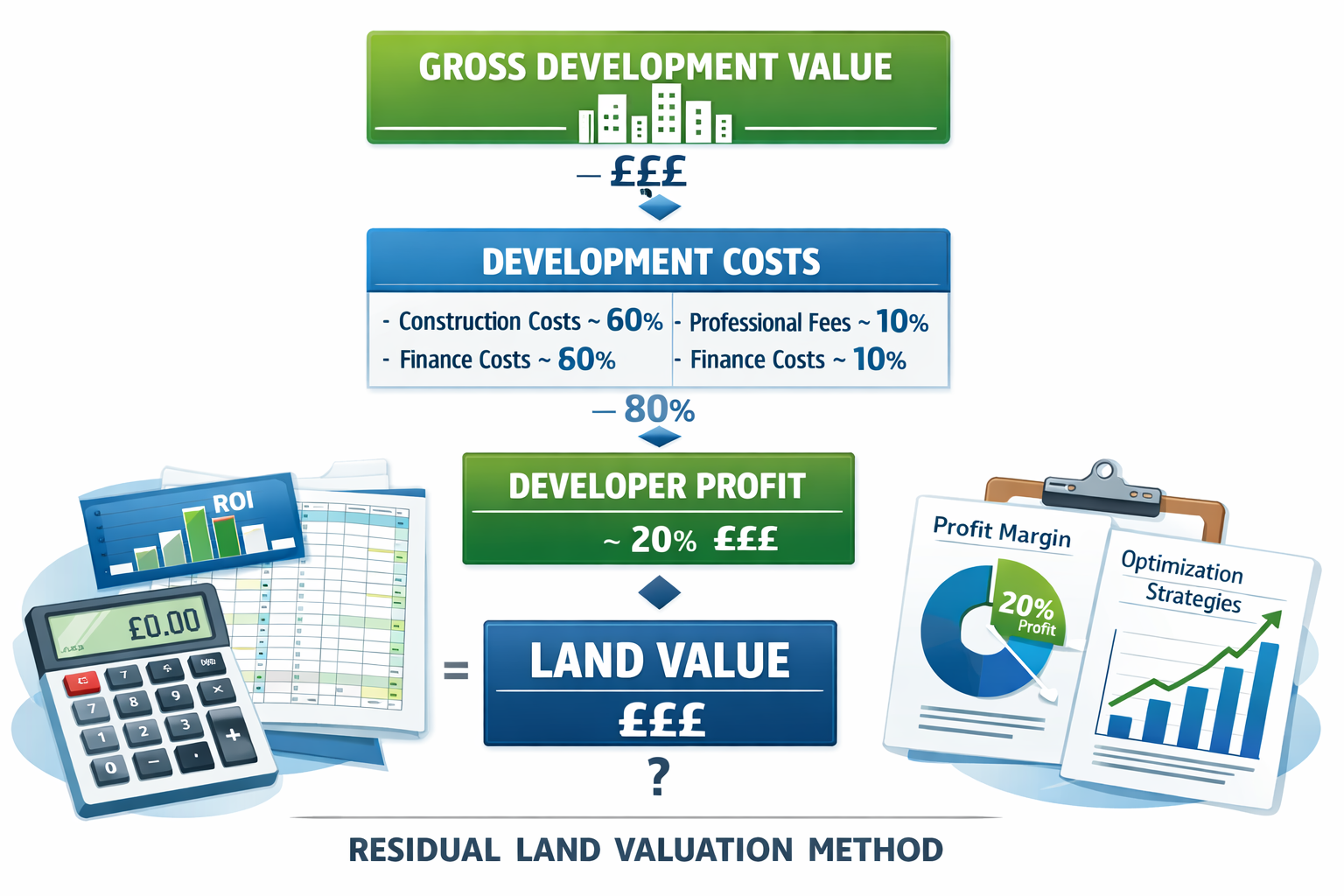
- 🏗️ Gross Development Value (GDV) – The total value of the completed development
- 💰 Development costs – Construction, professional fees, finance, and contingencies
- 📊 Developer's profit – Typically 15-20% of GDV for residential projects
- 🏡 Residual land value – What remains after deducting costs and profit from GDV
The residual method forms the foundation of most development appraisals. This calculation works backwards from the expected end value to determine what the site is worth today. Surveyors must carefully estimate each component, as small variations in assumptions can dramatically affect the final valuation.
The Surveyor's Role in Development Assessment
Professional surveyors bring critical expertise to development appraisals that automated valuation models cannot replicate. According to recent industry analysis, real-time surveyor data consistently outperforms automated valuation models when assessing properties with development potential [3].
Chartered surveyors provide:
- Site-specific analysis – Physical inspection reveals constraints and opportunities invisible in desktop valuations
- Planning expertise – Understanding local development plans and policy interpretation
- Market intelligence – Current demand, absorption rates, and pricing for comparable developments
- Risk assessment – Identifying technical, legal, and financial risks that affect feasibility
- Optimization strategies – Advising on design, phasing, and timing to maximize returns
When comparing different types of survey, development appraisals require the most comprehensive analysis. They often incorporate elements of building surveys, planning assessments, and financial modeling into a single cohesive evaluation.

Identifying and Evaluating Development Potential
Recognizing development potential requires a trained eye and systematic evaluation process. Properties that appear ordinary may harbor significant value-creation opportunities through extensions, conversions, subdivisions, or complete redevelopment.
Site Analysis and Physical Constraints
The physical characteristics of a property fundamentally determine its development potential. Surveyors conducting Development Appraisals and Maximising Property Value: Surveyor Strategies for Properties with Development Potential must thoroughly assess:
Plot characteristics:
- Size and shape – Irregular plots may limit design options but sometimes offer creative opportunities
- Topography – Sloping sites increase foundation costs but can enable split-level designs
- Access – Adequate vehicular and pedestrian access is essential for most developments
- Boundaries – Shared boundaries may require party wall agreements or easements
Environmental factors:
- Contamination – Previous industrial use may require remediation costing £50-£200 per square meter
- Flooding – Properties in flood zones face restrictions and increased insurance costs
- Ecology – Protected species or habitats can delay or prevent development
- Trees – Tree preservation orders (TPOs) limit development near protected trees
Infrastructure availability:
- Utilities – Connection costs for water, electricity, gas, and sewerage
- Drainage – Adequate capacity for increased development density
- Highways – Impact on local road network and parking requirements
A chartered surveyor's property inspection for development potential goes far beyond standard condition assessment to evaluate these critical factors.
Planning Considerations and Policy Framework
Planning permission represents the single most significant factor affecting development value. Properties with existing planning permission typically command premiums of 30-50% over similar properties without consent.
Planning assessment includes:
| Planning Factor | Impact on Value | Surveyor Considerations |
|---|---|---|
| Permitted Development Rights | +15-25% | Verify PDR availability, size limits, neighbor proximity |
| Local Plan Allocation | +20-40% | Check site allocations for housing, commercial, or mixed use |
| Conservation Areas | -10-30% | Additional design requirements, longer approval times |
| Planning History | Variable | Previous applications indicate likely success rates |
| Section 106 Obligations | -5-15% | Affordable housing, infrastructure contributions |
Surveyors must understand the National Planning Policy Framework (NPPF) and local development plans. Each local authority has specific policies regarding:
- Housing density requirements
- Design standards and materials
- Parking provision
- Affordable housing thresholds
- Environmental performance standards
Properties in areas covered by chartered surveyors in North London, Surrey, or Sussex may face different planning constraints than those in other regions, requiring local expertise.
Market Demand and Absorption Analysis
Even with planning permission and physical feasibility, development only creates value if market demand exists for the end product. Surveyors must analyze:
Market factors:
- 📈 Local property prices – Current values and recent trends for comparable properties
- 🏘️ Supply pipeline – Competing developments that may affect absorption
- 👥 Demographics – Population growth, household formation, and buyer profiles
- 🚇 Location quality – Transport links, schools, amenities, and employment centers
- ⏱️ Sales rates – How quickly similar developments have sold historically
The 2026 property market has shown regional variations, with some areas experiencing stronger demand than others. Surveyors must incorporate current market intelligence into their appraisals rather than relying solely on historical data.
Maximising Property Value Through Strategic Development
Once development potential has been identified and appraised, surveyors advise clients on strategies to maximize value realization. This requires balancing multiple factors including development density, design quality, phasing, and timing.
Optimization Strategies for Different Property Types
Different property types offer distinct development opportunities requiring tailored approaches:
Residential properties:
- Extensions and conversions – Loft conversions, basement excavations, and rear extensions can add 15-30% to property value
- Subdivision – Large houses converted to flats, particularly in high-demand urban areas
- Garden development – Building additional dwellings on large plots where planning permits
- Renovation and upgrading – Modernization to achieve premium pricing
Commercial properties:
- Change of use – Converting offices, warehouses, or retail to residential under permitted development
- Mixed-use schemes – Combining commercial ground floors with residential above
- Intensification – Adding floors or infilling underutilized space
- Repositioning – Upgrading to attract higher-value tenants
Development sites:
- Master planning – Optimizing layout, density, and unit mix
- Phasing strategies – Sequencing development to manage risk and cash flow
- Infrastructure provision – Coordinating utilities and access to enable development
When considering factors of valuation, development properties require analysis of both current and future value drivers.
Financial Modeling and Viability Assessment
Sophisticated financial modeling forms the backbone of development appraisals. Surveyors must accurately estimate all costs and revenues to determine whether a development is financially viable.
Revenue projections:
- Sales values – Based on comparable evidence and market analysis
- Rental income – For investment or mixed-tenure schemes
- Sales pace – Absorption rates affecting cash flow and finance costs
- Incentives – Discounts, part-exchange, or other sales costs
Cost estimation:
- Construction costs – Typically £1,200-£2,500 per square meter depending on specification
- Professional fees – Architects, engineers, surveyors (10-15% of construction costs)
- Planning costs – Application fees, reports, consultants (£20,000-£100,000+)
- Finance costs – Interest on development loans (5-8% annually in 2026)
- Marketing and sales – Agent fees, legal costs (3-5% of sales value)
- Contingency – Risk buffer (5-10% of total costs)
Profit and risk:
- Developer's profit – 15-20% of GDV for residential, 15-25% for commercial
- Risk adjustment – Higher profit requirements for complex or uncertain schemes
- Sensitivity analysis – Testing how variations in assumptions affect viability
Understanding valuation costs helps property owners budget appropriately for professional development appraisals.
Timing and Phasing Considerations
When to develop can be as important as what to develop. Market timing significantly affects both costs and revenues:
Market cycle considerations:
- Entry timing – Acquiring sites during market downturns can enhance returns
- Development timing – Starting construction when costs are competitive
- Exit timing – Completing when demand is strong and prices are rising
- Holding strategies – Sometimes delaying development preserves value
Phasing strategies:
- Sequential phases – Reducing initial capital requirements and market risk
- Infrastructure-led – Establishing access and services before building
- Market-responsive – Adjusting later phases based on early sales performance
- Mixed tenure – Balancing affordable and market housing to manage cash flow
While market timing is challenging, surveyors can advise on optimal strategies based on current conditions and forward indicators.
Value Engineering and Design Optimization
Maximizing value doesn't always mean building the largest or most expensive development. Strategic design decisions can significantly improve returns:
Design strategies:
- Efficient layouts – Maximizing net-to-gross ratios (typically 75-85% for residential)
- Specification balance – Matching quality to target market expectations
- Flexible designs – Adaptable spaces that appeal to broader buyer pools
- Distinctive features – Unique elements that justify premium pricing
Cost management:
- Procurement strategy – Design-and-build versus traditional contracts
- Material selection – Balancing quality, cost, and program
- Standardization – Repeating elements to achieve economies of scale
- Value engineering – Systematic cost reduction without compromising quality
Sustainability and future-proofing:
- Energy efficiency – Meeting and exceeding building regulations (Part L)
- Environmental standards – BREEAM, Passivhaus, or other certifications
- Adaptability – Designing for changing needs and technologies
- Longevity – Quality construction that maintains value over time
Properties in premium locations such as Chelsea, Hampstead, or Fulham often justify higher specification levels that might not be viable elsewhere.
Risk Management in Development Appraisals
Every development carries risks that can affect both feasibility and final value. Professional surveyors identify, quantify, and advise on managing these risks.
Planning and Regulatory Risks
Planning permission uncertainty:
- Refusal risk – Applications may be rejected despite apparent policy compliance
- Delay risk – Determination periods often exceed statutory timeframes
- Condition risk – Onerous planning conditions can increase costs or reduce value
- Section 106 risk – Negotiated contributions may exceed initial expectations
Mitigation strategies:
- Pre-application consultation with planning authorities
- Engaging planning consultants with local expertise
- Designing schemes that demonstrably comply with policy
- Building contingency time and cost into appraisals
Construction and Technical Risks
Building challenges:
- Ground conditions – Unforeseen contamination or poor bearing capacity
- Party wall issues – Disputes or delays affecting adjacent properties
- Design changes – Modifications during construction increasing costs
- Contractor performance – Delays, insolvency, or quality issues
Risk management:
- Comprehensive site investigations before commitment
- Appropriate contract structures with performance bonds
- Professional team with relevant experience
- Adequate contingency allowances (5-10% of construction costs)
Conducting specific defect surveys can identify technical issues before committing to development.
Market and Financial Risks
Market volatility:
- Price movements – Property values may fall during development period
- Demand shifts – Buyer preferences or economic conditions changing
- Competition – New supply affecting absorption and pricing
- Cost inflation – Construction costs rising faster than anticipated
Financial risks:
- Funding availability – Development finance becoming scarce or expensive
- Interest rate changes – Affecting both finance costs and buyer affordability
- Cash flow – Timing mismatches between costs and revenues
- Exit strategy – Inability to sell or refinance as planned
According to industry analysis, appraisal volume and market conditions continue to evolve, with surveyors needing to stay current on market dynamics [1].
Professional Surveyor Services for Development Properties
Engaging qualified chartered surveyors provides essential expertise for navigating the complexities of development appraisals and value maximization.
Types of Surveyor Services
Development appraisal services:
- Residual land valuations
- Highest and best use analysis
- Feasibility studies
- Financial modeling and sensitivity analysis
- Market assessment and absorption studies
Planning and design services:
- Planning application support
- Design review and optimization
- Boundary surveys for accurate site definition
- Topographical surveys for design purposes
- Constraint analysis and mitigation strategies
Valuation services:
- Red Book valuations for lending purposes
- Development monitoring valuations
- Completion valuations
- Portfolio valuations for investment properties
Project services:
- Project management and monitoring
- Cost consultancy and quantity surveying
- Employer's agent services
- Technical due diligence
Selecting the Right Surveyor
Choosing a surveyor with appropriate expertise is crucial for development properties:
Essential qualifications:
- ✅ RICS chartered status (MRICS or FRICS)
- ✅ Relevant experience in development appraisals
- ✅ Local market knowledge
- ✅ Professional indemnity insurance
- ✅ Understanding of planning and construction
Regional expertise matters:
Different regions have distinct market characteristics and planning frameworks. Whether working with chartered surveyors in Berkshire, Essex, or Oxfordshire, local knowledge enhances appraisal accuracy.
Cost Considerations
Professional surveyor fees for development appraisals typically range from £1,500 to £10,000+ depending on:
- Property size and complexity
- Scope of services required
- Level of detail in financial modeling
- Supporting reports and documentation
- Urgency and timeframes
While these fees represent an upfront investment, professional advice often identifies value opportunities or risks that far exceed the cost of the appraisal itself. Understanding survey pricing helps property owners budget appropriately.
Case Studies: Development Value Maximization
Case Study 1: Residential Extension and Conversion
Property: Victorian semi-detached house in West London
Current value: £850,000
Development strategy: Rear extension, loft conversion, and basement excavation
Appraisal findings:
- GDV after development: £1,350,000
- Total development costs: £280,000
- Finance and fees: £45,000
- Developer's profit (15%): £202,500
- Residual value: £822,500
Outcome: The development appraisal revealed that while the property's current value was £850,000, its development value was actually lower at £822,500 due to high construction costs relative to the value uplift. The surveyor advised the client to either negotiate a lower purchase price or pursue a less extensive development scheme to achieve viable returns.
Case Study 2: Commercial to Residential Conversion
Property: Former office building in Manchester city center
Current value (commercial use): £1,200,000
Development strategy: Conversion to 12 residential apartments under permitted development
Appraisal findings:
- GDV (12 apartments at £275,000 each): £3,300,000
- Conversion costs: £1,440,000 (£120,000 per unit)
- Professional fees and finance: £285,000
- Marketing and sales: £115,000
- Developer's profit (18%): £594,000
- Residual land value: £866,000
Outcome: Despite the current commercial value of £1,200,000, the development appraisal indicated the site was only worth £866,000 for residential conversion. However, the surveyor identified that by increasing the unit count to 15 smaller apartments, the GDV could reach £3,750,000, making the development viable at the asking price.
Case Study 3: Garden Development Opportunity
Property: Detached house on 0.3-acre plot in Surrey
Current value: £1,100,000
Development strategy: Retain existing house, build two new detached houses in garden
Appraisal findings:
- Value of retained house: £950,000
- GDV of two new houses: £1,600,000 (£800,000 each)
- Total GDV: £2,550,000
- Construction costs (new houses): £720,000
- Infrastructure and fees: £180,000
- Finance costs: £65,000
- Developer's profit (17%): £433,500
- Residual value: £1,151,500
Outcome: The development appraisal demonstrated that the property was worth approximately £50,000 more than its current use value due to the garden development potential. The surveyor advised the owner to either develop the site themselves to capture the full profit margin (approximately £433,500) or market the property emphasizing its development potential to achieve a premium sale price.
Conclusion
Development Appraisals and Maximising Property Value: Surveyor Strategies for Properties with Development Potential represents a sophisticated discipline that combines technical valuation expertise, planning knowledge, construction understanding, and market intelligence. In 2026's complex property market, professional chartered surveyors provide essential guidance for property owners, developers, and investors seeking to identify and realize development value.
The key principles for maximizing property value through development include:
🏗️ Comprehensive assessment – Thorough evaluation of physical, planning, and market factors
📊 Rigorous financial modeling – Accurate estimation of costs, revenues, and risks
🎯 Strategic optimization – Balancing density, quality, and timing for optimal returns
⚖️ Risk management – Identifying and mitigating planning, construction, and market risks
👨💼 Professional expertise – Engaging qualified surveyors with relevant experience
Next Steps for Property Owners
If you own or are considering purchasing a property with development potential:
- Obtain a professional development appraisal – Understanding true development value before making commitments
- Research planning constraints – Investigate local development plans, conservation areas, and planning history
- Engage early with planners – Pre-application discussions can identify issues and opportunities
- Assemble a professional team – Surveyors, architects, planning consultants, and solicitors with development experience
- Consider phasing and timing – Evaluate whether immediate development or strategic holding maximizes value
The difference between recognizing development potential and successfully realizing it lies in professional expertise and systematic analysis. Chartered surveyors provide the bridge between current property value and future development potential, helping clients navigate complexity and make informed decisions.
Whether you're evaluating a residential property for extension, considering commercial conversion, or assessing a development site, professional surveyor guidance ensures you understand both opportunities and risks. In a market where development potential can represent 30-50% of a property's true value, engaging expert advice isn't just prudent—it's essential for maximizing returns and avoiding costly mistakes.
The properties with the greatest development potential are often those where others see only challenges. With the right surveyor strategies and comprehensive development appraisals, these challenges become opportunities for substantial value creation.
References
[1] 2026 Market Update Appraisal Volume Waivers And Pdcs – https://www.workingre.com/2026-market-update-appraisal-volume-waivers-and-pdcs/
[3] Navigating Uncertainty In Spring 2026 Valuations How Rics Real Time Surveyor Data Outperforms Automated Valuation Models – https://nottinghillsurveyors.com/blog/navigating-uncertainty-in-spring-2026-valuations-how-rics-real-time-surveyor-data-outperforms-automated-valuation-models