Nearly half of all UK marriages end in divorce, and every year tens of thousands of probate estates include residential property — yet the quality of the property valuation obtained in each case can make a difference of tens of thousands of pounds to the parties involved. Surveyor Valuations for Divorce, Probate and Shared-Ownership Buyouts: Getting Fair Figures in Sensitive Situations is not simply a technical exercise. It sits at the intersection of legal process, financial consequence, and human emotion — and getting it wrong carries real costs. [7]
This guide walks consumers, solicitors, and housing association tenants through exactly how a RICS-registered valuer approaches each of these contentious scenarios, how to brief the surveyor effectively, and what to do when the figures are disputed.
Key Takeaways
- RICS Red Book valuations are the legally recognised standard for divorce, probate, and shared-ownership transactions in the UK.
- A single jointly-instructed surveyor is usually the most cost-effective and court-accepted approach in matrimonial cases.
- Probate valuations must satisfy HMRC requirements; an incorrect figure can trigger penalties and interest charges.
- Shared-ownership valuations are typically valid for only three months, so timing the instruction carefully matters.
- Disagreements over value are best resolved with comparable evidence, not opinion — and a formal review process exists for each scenario.

Why These Valuations Carry More Weight Than a Standard Mortgage Survey
Most homeowners are familiar with a lender's mortgage valuation, but that report serves the bank's interests, not the borrower's, and it is rarely suitable for legal proceedings. Understanding the difference between a mortgage valuation and a full survey is the first step toward appreciating why specialist instructions matter.
Valuations for matrimonial disputes, probate, and staircasing must comply with the RICS Valuation — Professional Standards (commonly called the Red Book). This framework requires the valuer to:
- Define the basis of value precisely (usually Market Value)
- Inspect the property in person
- Analyse verified comparable transactions — not asking prices
- Produce a signed, dated report that is defensible in court or before HMRC [7]
An incorrect Red Book valuation carries consequences that a lender's desk-based estimate does not. Under-valuing a probate estate can lead to HMRC penalties and interest. Over-valuing a matrimonial asset can distort a financial settlement unfairly. Mis-stating a shared-ownership property's value can cost a tenant thousands of pounds during staircasing. [7]
"Valuations for matrimonial disputes, probate, and tax purposes carry significant legal weight. Incorrect valuations can lead to capital gains tax exposure, HMRC penalties, and disputes among heirs." [7]
For this reason, all three scenarios require instruction of a RICS-accredited chartered surveyor whose independence and professional indemnity insurance can be verified.
Surveyor Valuations for Divorce: Navigating the Matrimonial Process
How Courts Use Property Valuations in Divorce
When a couple separates and cannot agree on what the family home is worth, the court needs an objective figure to divide assets fairly. A Chartered Surveyor accredited by RICS provides an impartial market valuation that both parties and the court can rely upon. [2] The valuation is based on what a willing buyer would pay a willing seller on the open market on the date of valuation — not what either spouse hopes to achieve. [3]
Specialist matrimonial valuations differ from a standard market appraisal in several ways:
| Feature | Standard Market Appraisal | Matrimonial RICS Valuation |
|---|---|---|
| Legal standing | Low | High — court admissible |
| Basis of value | Broad estimate | Defined Market Value (Red Book) |
| Comparable evidence | May be verbal | Documented and verifiable |
| Surveyor's duty | To the client | To the court / both parties |
| Retrospective dating | Rarely required | Sometimes required (date of separation) |
Joint Instruction vs. Competing Appraisals
Parties can choose one of two approaches:
- Joint single expert — Both spouses instruct one neutral RICS valuer. This is cost-effective, reduces conflict, and courts generally prefer it. [3]
- Separate appraisers — Each spouse instructs their own surveyor. This leads to competing reports, higher costs, and often requires a third surveyor to adjudicate. [3]
The joint expert route is strongly recommended unless there is a specific reason to believe the property has unusual features that require specialist knowledge. When each party does instruct separately, the surveyors are expected to meet and narrow the gap before the matter reaches a hearing.
How to Brief a Matrimonial Surveyor
A clear, complete instruction saves time and money. When briefing a surveyor for a divorce valuation, provide:
- The full address and tenure (freehold, leasehold, or shared ownership)
- The date of valuation required — this may be today's date or a historical date (e.g., the date of separation or the date of marriage)
- Any known defects or recent works that could affect value
- Copies of the lease if the property is leasehold, including the remaining term and service charge history
- Confirmation that both parties consent to access, or details of any access restrictions
Solicitors should also confirm whether the report will be used solely for negotiation or whether it may be filed as court evidence, since the latter requires the surveyor to include a specific statement of compliance with Part 35 of the Civil Procedure Rules.
Probate Valuations: Meeting HMRC's Standards After a Bereavement
What a Probate Valuation Must Achieve
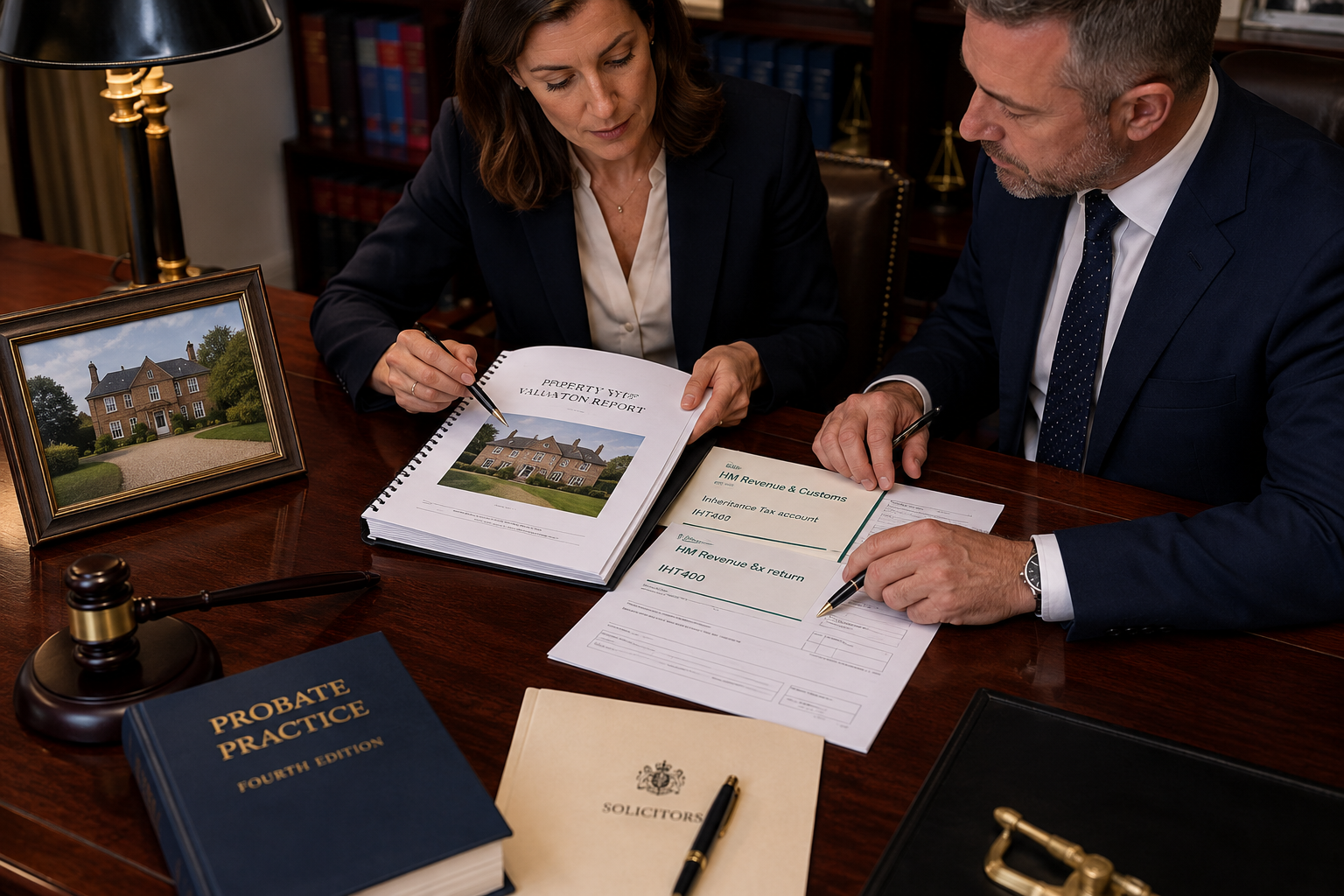
When a property owner dies, the estate's personal representatives (executors or administrators) must report the open market value of all property to HMRC as part of the Inheritance Tax return. The valuation must reflect the price the property would have fetched on the open market at the date of death — not the date of sale, which may be months later. [4]
HMRC scrutinises probate valuations carefully. The Valuation Office Agency (VOA) has the power to challenge figures it considers too low, and any shortfall in Inheritance Tax paid as a result of an under-valuation can attract both additional tax and interest charges. [7] This is why a properly evidenced Red Book report from a qualified RICS surveyor is essential rather than optional.
Common Pitfalls in Probate Valuations
Several factors regularly cause problems:
- Using an estate agent's opinion rather than a RICS valuation. Estate agents are not bound by Red Book standards and their opinions carry no legal weight with HMRC.
- Ignoring the condition of the property at the date of death. If the property was in poor condition when the deceased died but has since been renovated, the valuation must reflect the earlier state.
- Overlooking development potential. If the property has planning permission or is in a location where buyers would pay a premium for redevelopment, this must be reflected.
- Leasehold issues. A short lease can substantially reduce value. A surveyor must consider the unexpired term and any associated costs. [9]
Retrospective Valuations
Sometimes probate valuations are instructed months or even years after the date of death — perhaps because the estate is complex or because a dispute has arisen among beneficiaries. A RICS valuer can produce a retrospective valuation using historical comparable sales data, provided sufficient evidence exists. The report must clearly state the effective date of valuation and the methodology used.
Surveyor Valuations for Shared-Ownership Buyouts: The Staircasing Process
Why an Independent RICS Valuation Is Non-Negotiable
Shared ownership allows buyers to purchase a percentage of a property and pay rent on the remainder. When a shared-ownership tenant wishes to buy additional shares — a process called staircasing — or sell their share, the housing association requires an independent RICS valuation to determine the current market value of the whole property. [1] The price of the additional shares is then calculated as a percentage of that figure.
This is one area where the tenant's interests and the housing association's interests can diverge. The housing association benefits from a higher valuation (more money for the shares it sells); the tenant benefits from a lower one. An independent RICS surveyor acts as the neutral arbiter. [1]
Key facts about shared-ownership valuations:
- Validity period: Typically three months from the date of inspection. If the transaction does not complete within that window, a desktop update may be required — provided market conditions have remained stable. [1]
- Instruction: The tenant commissions and pays for the valuation, but the surveyor must be acceptable to the housing association.
- Scope: The surveyor values the whole property, not just the tenant's share. The share price is then calculated arithmetically.
For those considering whether to purchase a freehold interest as part of a shared-ownership arrangement, it is worth reading about the implications of buying a share of freehold before proceeding.
Factors That Can Suppress a Shared-Ownership Valuation
Property owners sometimes find that the RICS valuation comes in lower than they expected. [5] This is not always an error. Legitimate factors that reduce value include:
- Short remaining lease term — anything below 80 years starts to affect mortgage availability and therefore market value
- High service charges — buyers factor ongoing costs into their offer
- Recent comparable sales in the development or street that are lower than asking prices
- Condition issues — damp, structural movement, or dated kitchens and bathrooms
- Restrictive covenants in the lease that limit alterations or subletting [5]
It is important to understand that asking prices and sold prices are not the same thing. A surveyor uses verified sold data from Land Registry, not estate agent listings. [5]
Disputing a Shared-Ownership Valuation
If the valuation appears too low, the first step is to review the report carefully for factual errors — incorrect floor area, missing rooms, or wrong comparable properties. A challenge is most likely to succeed when:
- A factual error can be demonstrated
- Relevant comparable sales were overlooked
- The property has features that distinguish it positively from the comparables used [5]
Challenges based purely on the owner's opinion of value, without supporting evidence, are unlikely to succeed. Most housing associations have a formal review process, and in some cases a second RICS valuer can be instructed to provide a review opinion.

Handling Disagreements: Practical Steps for All Three Scenarios
When the Figures Are Contested
Disagreements over surveyor valuations are more common in sensitive situations than in standard transactions, precisely because the financial stakes are higher and emotions run strong. The following framework applies across divorce, probate, and shared-ownership contexts:
Step 1 — Request the full report and workings. A Red Book valuation must include the comparable evidence used. Review each comparable for accuracy and relevance.
Step 2 — Identify specific grounds for challenge. Vague dissatisfaction is not a basis for challenge. Identify whether there is a factual error, a missing comparable, or a methodological issue.
Step 3 — Engage the original surveyor. Most RICS members will consider a reasoned written challenge and respond formally. This is the fastest and cheapest route to resolution.
Step 4 — Seek a second opinion. If the original surveyor does not amend the report, a second RICS valuer can be instructed. Courts and housing associations generally expect parties to have attempted resolution before escalating.
Step 5 — Formal dispute resolution. For matrimonial cases, the court can direct a single joint expert. For shared ownership, some housing associations have an arbitration process. For probate, the VOA has its own review procedure.
The Importance of Choosing the Right Surveyor
Not every RICS member has experience in contentious valuations. When selecting a surveyor for divorce, probate, or shared-ownership work, look for:
- Demonstrated experience in the specific type of instruction
- Familiarity with the local market where the property is located
- Professional indemnity insurance adequate for the value of the property
- Willingness to attend court or a formal hearing if required
For properties across the UK, chartered surveyors with RICS accreditation can be found through the RICS Find a Surveyor service or through specialist firms with dedicated matrimonial and probate valuation teams.
Briefing Your Surveyor: A Practical Checklist
Regardless of the scenario, a well-briefed surveyor produces a better, faster, and more defensible report. Use this checklist before instructing:
For all three scenarios:
- Confirm the basis of value required (Market Value is standard)
- Provide the effective date of valuation
- Supply title documents, lease (if leasehold), and any planning permissions
- Disclose known defects or ongoing disputes
Additional items for divorce:
- Confirm joint or single-party instruction
- Clarify whether Part 35 CPR compliance is required
- Agree access arrangements with the other party
Additional items for probate:
- Provide the date of death
- Supply any recent estate agent valuations for reference (not substitution)
- Confirm whether the property has been altered since the date of death
Additional items for shared ownership:
- Provide the current lease and any correspondence with the housing association
- Confirm the percentage share currently held
- Note the transaction deadline to manage the three-month validity window [1]
For properties in specific regions, local expertise matters. Specialist teams cover areas including North London, West London, and South East London, ensuring that comparable evidence is drawn from genuinely local transactions.
Conclusion
Surveyor Valuations for Divorce, Probate and Shared-Ownership Buyouts: Getting Fair Figures in Sensitive Situations require a level of rigour, independence, and legal awareness that goes well beyond a standard market appraisal. The financial and legal consequences of an inaccurate figure — whether it is an inflated matrimonial asset, an under-declared probate estate, or a mispriced shared-ownership staircase — can be severe and long-lasting.
Actionable next steps:
- Instruct early. In divorce and probate cases, delay often complicates matters. Commission the RICS valuation as soon as the need is identified.
- Choose a specialist. Verify that the surveyor has specific experience in the type of instruction required, not just general residential valuation experience.
- Brief thoroughly. Provide all relevant documents upfront. A well-informed surveyor produces a more defensible report.
- Challenge on evidence, not emotion. If the figure surprises you, review the comparable data before reacting. A reasoned, evidence-based challenge is far more likely to succeed.
- Seek legal advice in parallel. A solicitor experienced in family law, probate, or housing law can advise on how the valuation fits into the broader legal process.
For a no-obligation discussion about commissioning a Red Book valuation for any of these scenarios, contact the team directly or request a quote to understand costs and timescales before committing.
References
[1] Shared Ownership Valuations – https://www.nuvensurveyors.co.uk/services/rics-valuations/shared-ownership-valuations/?utm_source=openai
[2] Divorce Valuation Of Property – https://hardingsurveyors.co.uk/divorce-valuation-of-property?utm_source=openai
[3] Appraisal Versus Fair Market Value In A Divorce – https://legalclarity.org/appraisal-versus-fair-market-value-in-a-divorce/?utm_source=openai
[4] Valuations – https://www.surveymerchant.com/services/valuations?utm_source=openai
[5] Shared Ownership Valuation Surveyor Guide – https://southsurveyors.co.uk/2026/05/15/shared-ownership-valuation-surveyor-guide/?utm_source=openai
[6] How To Get A Home Appraisal For Divorce – https://legalclarity.org/how-to-get-a-home-appraisal-for-divorce/?utm_source=openai
[7] Valuation Services Beyond Mortgages Expert Valuations For Matrimonial Disputes Probate And Tax Liabilities – https://www.canterburysurveyors.com/blog/valuation-services-beyond-mortgages-expert-valuations-for-matrimonial-disputes-probate-and-tax-liabilities/?utm_source=openai
[8] Matrimonial Valuation – https://hardingsurveyors.co.uk/valuations/matrimonial-valuation?utm_source=openai
[9] When Would I Need A Property Valuation – https://www.reallymoving.com/surveyors/guides/when-would-i-need-a-property-valuation?utm_source=openai
[10] theresidentialvaluationgroup.info – https://theresidentialvaluationgroup.info/?utm_source=openai