Nearly one in five property buyers in the UK report feeling surprised by defects discovered after completion — defects that a properly conducted survey should have flagged. That gap between what buyers expect from a survey and what they actually receive sits at the heart of why the RICS Home Survey Standard in Practice: What Level 2 and Level 3 Reports Should Say About Risk matters so much in 2026. Understanding how surveyors are required to communicate risk — and what good risk communication actually looks like — can be the difference between a buyer making an informed decision and one walking into a costly mistake.
Key Takeaways
- The RICS Home Survey Standard, effective from 1 March 2021 and updated in January 2023, sets mandatory requirements for how risk must be expressed in Level 2 and Level 3 reports.
- Level 2 reports use a standardised condition rating system to signal urgency; Level 3 reports go further by explaining defect causes, remedial options, and maintenance consequences.
- Risk communication in a survey is only useful when it conveys urgency, likelihood, and consequence in plain language — not just a colour-coded box.
- Buyers should understand the limitations of each survey level before choosing, as the wrong level can leave significant risks unidentified.
- Surveyors have a professional duty to make recommendations actionable, not merely descriptive.
What the RICS Home Survey Standard Requires from Risk Reporting
The RICS Home Survey Standard came into effect on 1 March 2021, replacing the earlier suite of guidance documents with a single, unified framework. Its purpose is to ensure consistent, high-quality residential property survey services across all RICS-regulated firms and members [1]. The standard was last updated in January 2023, reflecting the profession's commitment to keeping pace with evolving consumer expectations and property types [7].
At its core, the standard requires that surveyors do more than list what they observed. They must communicate what those observations mean for the buyer. Risk must be expressed in terms that a non-specialist can act upon. This is not optional guidance — it is a mandatory professional obligation for any firm or individual holding an RICS Home Survey licence [5].
The standard applies to three survey levels. Level 1 (Condition Report) provides the most basic overview. Level 2 (HomeBuyer Report or Survey) and Level 3 (Building Survey) carry progressively greater obligations to identify, explain, and contextualise risk. Both Level 2 and Level 3 reports must clearly indicate:
- What the defect or issue is
- How serious it is (urgency and severity)
- What the likely consequence is if left unaddressed
- What action the buyer should take next
Failing to communicate all four elements reduces a survey to a description rather than an assessment — and descriptions do not protect buyers.
How Risk Is Expressed in Level 2 Reports
A Level 2 HomeBuyer Survey is designed for conventional properties in reasonable condition. The inspection is a thorough visual examination of the building, its services, and the grounds [2]. It is not a structural investigation, and surveyors are not required to move furniture, lift floorboards, or open up concealed areas. That limitation is important because it shapes how risk can be expressed.
The Condition Rating System
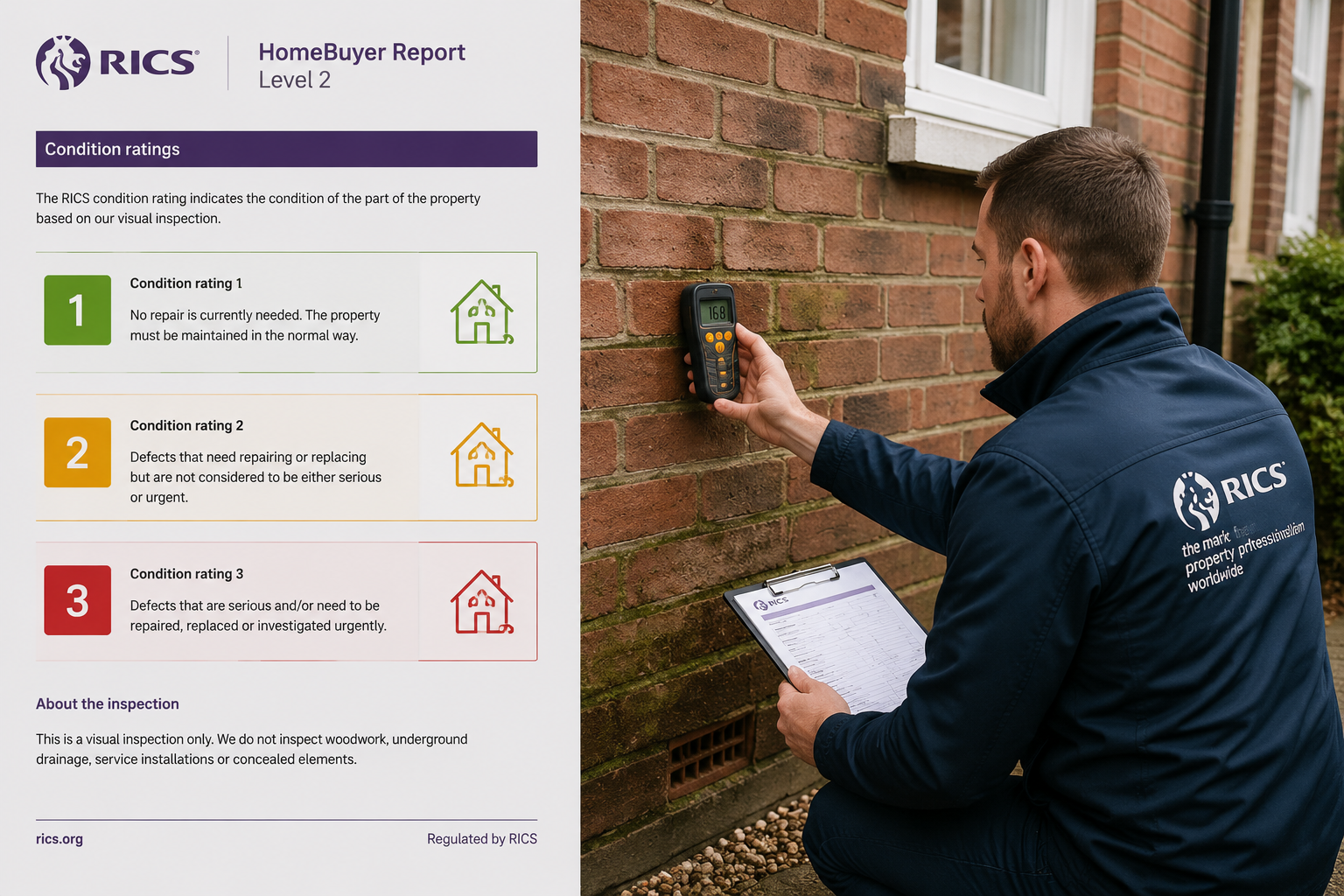
Level 2 reports use a three-tier condition rating system:
| Rating | Colour | Meaning |
|---|---|---|
| Condition Rating 1 | Green | No repair is currently needed |
| Condition Rating 2 | Amber | Defects that need repairing or replacing but are not considered serious or urgent |
| Condition Rating 3 | Red | Defects that are serious and/or need to be repaired, replaced, or investigated urgently |
This system provides a quick visual signal of risk severity. However, the colour alone is insufficient. The standard requires that each rating be supported by written commentary explaining why that rating was assigned [1]. A Condition Rating 3 entry for roof coverings, for example, should not simply say "roof coverings are in poor condition." It should explain what was observed, why it is serious, and what the buyer should do — whether that is obtaining a specialist contractor's quote before exchange, renegotiating the purchase price, or instructing further investigation.
Where Level 2 Risk Reporting Often Falls Short
The most common weakness in Level 2 risk reporting is vague language. Phrases such as "monitor over time," "seek further advice," or "typical for age" are not risk assessments — they are deferrals. The RICS Home Survey Standard in Practice: What Level 2 and Level 3 Reports Should Say About Risk makes clear that surveyors must go beyond observation to interpretation.
Effective Level 2 risk language includes:
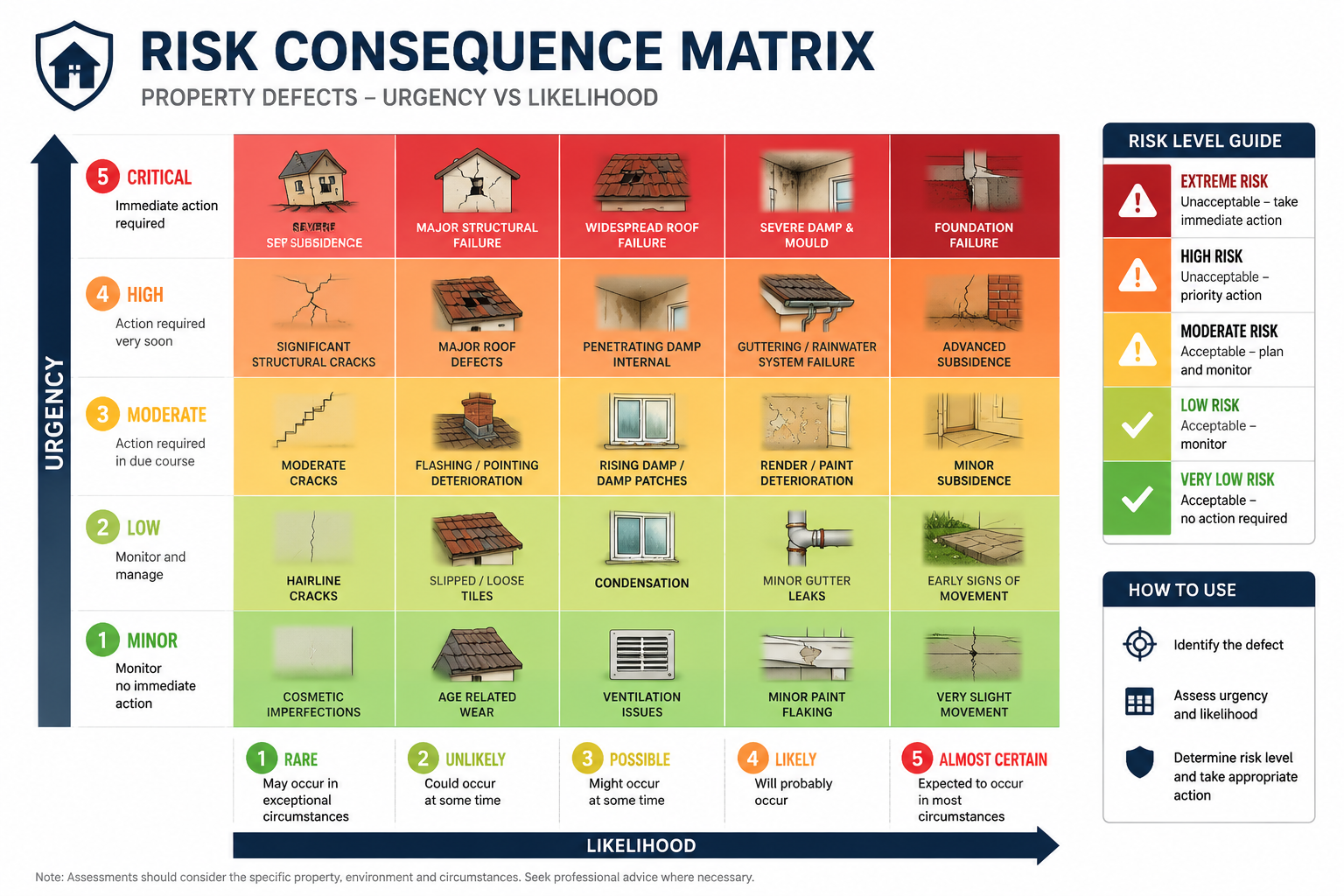
- Urgency: "This defect requires attention before exchange of contracts."
- Consequence: "If left unaddressed, water ingress is likely to cause progressive damage to the internal structure."
- Likelihood: "Given the age of the property and the visible condition of the flashings, failure is probable within the next one to three years."
Buyers who receive a report with these three elements can make genuinely informed decisions. Those who receive vague commentary cannot.
It is also worth noting that Level 2 surveys are not appropriate for all properties. Older, larger, or significantly altered homes typically warrant a Level 3 Building Survey, where the scope of inspection and risk analysis is considerably deeper. Choosing the wrong survey level is itself a risk that buyers should understand before instructing a surveyor. A useful starting point is to compare different types of survey to understand which level suits the property in question.
How Risk Is Expressed in Level 3 Reports
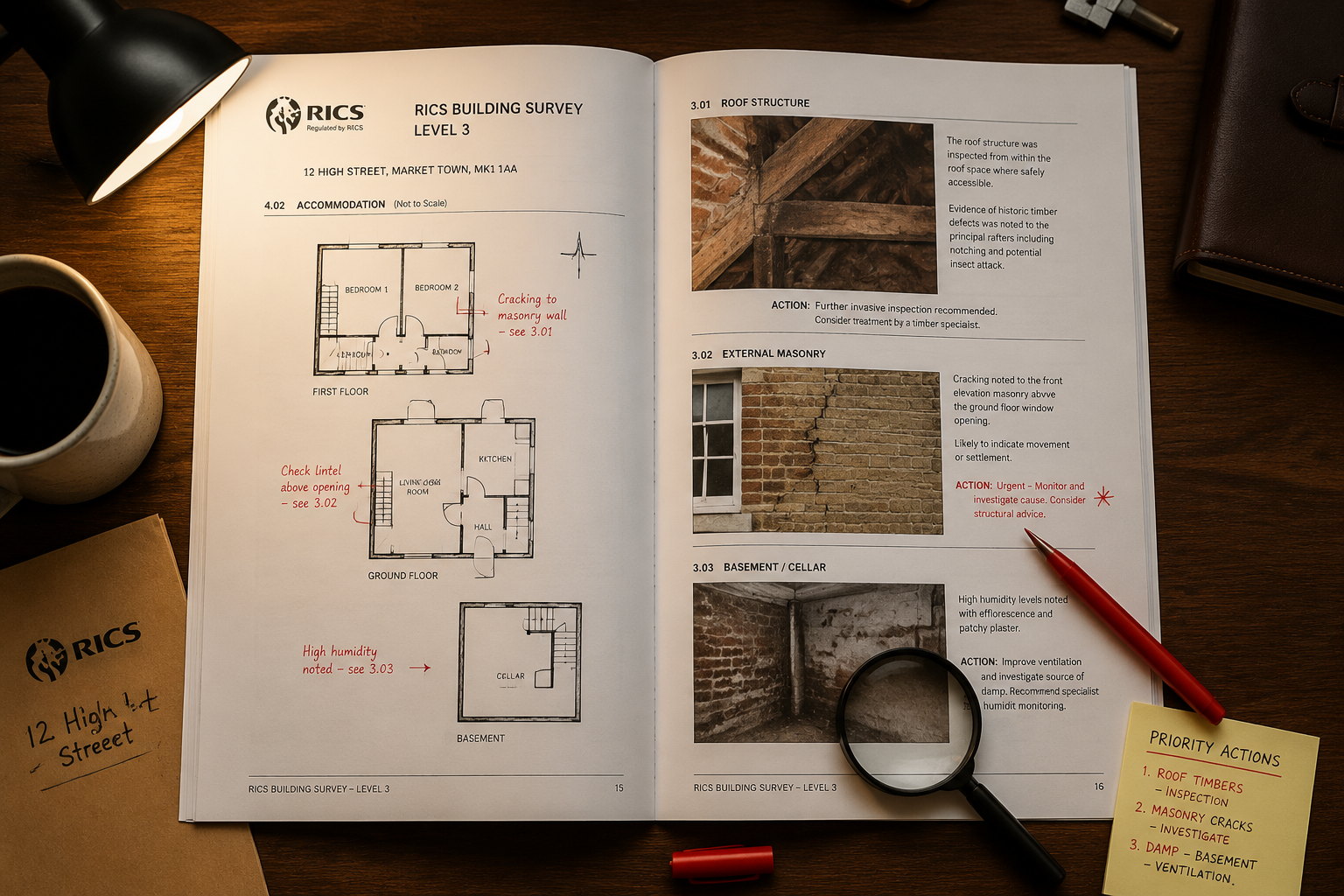
A Level 3 Building Survey is the most comprehensive residential survey available. It is designed for large, older, altered, or structurally complex properties, or those in poor condition [3]. The inspection goes significantly further than Level 2: concealed areas are inspected where it is safe and reasonable to do so, services are observed in normal operation, and the surveyor is expected to comment on materials used, construction methods, defect causes, remedial options, and future maintenance requirements [3].
Depth of Risk Analysis Required
In a Level 3 report, risk communication must operate on multiple levels simultaneously. The surveyor is not simply flagging that a defect exists — they are required to explain:
- The cause of the defect (e.g., failed damp-proof course, inadequate roof ventilation, differential settlement)
- The extent of the defect and whether it is isolated or symptomatic of a wider problem
- The remedial options available, from minor repair to significant structural intervention
- The approximate cost implications, where it is reasonable to provide an indication
- The maintenance implications for the buyer going forward
This is a fundamentally different type of risk reporting from Level 2. Where Level 2 tells a buyer that something is wrong and how urgent it is, Level 3 tells them why it is wrong, what their options are, and what it will cost them — in time, money, and ongoing attention — to own the property.
Expressing Urgency, Likelihood, and Consequence Clearly
The RICS Home Survey Standard in Practice: What Level 2 and Level 3 Reports Should Say About Risk is most demanding at Level 3 precisely because the stakes are higher. These surveys are typically commissioned for more complex or higher-value properties where the financial consequences of an unidentified risk are greater.
"A Level 3 report that identifies a defect without explaining its cause, its likely progression, and the range of remedial options has not fulfilled the standard's requirements — it has merely described a symptom."
Surveyors producing Level 3 reports should structure their risk commentary around three clear questions:
- What is likely to happen if this defect is not addressed? (consequence)
- How quickly is that outcome likely to occur? (urgency and likelihood)
- What are the buyer's realistic options? (actionability)
For example, a report identifying suspected subsidence should not simply note the presence of cracking and recommend further investigation. It should explain the likely cause (e.g., clay shrinkage, tree root activity, leaking drains), describe the pattern and severity of cracking observed, indicate whether the movement appears active or historic, and set out the investigative steps required — such as a subsidence survey or structural engineer's report — before the buyer can make an informed decision.
Making Risk Recommendations Genuinely Useful to Buyers
The gap between a technically compliant survey and a genuinely useful one often comes down to how recommendations are written. The RICS Home Survey Standard sets the floor; good professional practice raises the ceiling.
Practical Principles for Actionable Risk Reporting
Whether at Level 2 or Level 3, the following principles distinguish reports that serve buyers well from those that merely satisfy a checklist:
1. Avoid passive deferrals. "Further investigation is recommended" is not a recommendation — it is an avoidance. A useful recommendation specifies who should carry out the investigation, what it should involve, and by when.
2. Quantify where possible. Buyers are making financial decisions. Indicating that a roof replacement is likely to cost in the range of £8,000 to £15,000, or that repointing works are likely to take two to three weeks, gives buyers something concrete to work with during negotiation or budgeting.
3. Distinguish between pre-exchange and post-completion actions. Some risks require resolution before the buyer commits legally. Others can be managed after moving in. A well-structured report separates these clearly.
4. Use plain language. Technical terminology has its place, but risk communication must be accessible. A buyer does not need to know the precise Latin classification of a fungal decay — they need to know that the timber is rotting, that it will spread if untreated, and that remediation will involve specialist contractors.
5. Context matters. A Condition Rating 3 on a property priced to reflect its condition is a different risk from the same rating on a property presented as fully refurbished. Good surveyors contextualise their findings within the purchase scenario.
Buyers who want to understand what a chartered surveyor looks for during a property inspection will find that risk identification and communication are central to the entire process — not an afterthought.
When a Specialist Report Is the Right Answer
There are circumstances where neither a Level 2 nor a Level 3 survey can fully assess a specific risk. In these cases, the surveyor's duty is to recommend a specialist report clearly and promptly. Common examples include:
- Suspected asbestos-containing materials (requiring an asbestos survey)
- Drainage concerns (requiring a drainage survey)
- Structural concerns requiring engineering calculations
- Damp issues requiring specialist damp investigation
A specific defect survey may also be appropriate where a single element — such as a chimney stack, a retaining wall, or a flat roof — requires more detailed analysis than the standard survey scope permits.
The key point is that recommending a specialist is not a failure of the survey — it is part of responsible risk communication. What is not acceptable is leaving the buyer uncertain about whether they need one.
Choosing the Right Survey Level and Knowing What to Expect
Understanding the difference between Level 2 and Level 3 is not just academic. It directly affects the quality of risk information a buyer receives and the decisions they can make based on it [6].
A buyer purchasing a 1990s semi-detached house in good condition may find a Level 2 survey entirely adequate. A buyer purchasing a Victorian terrace with a loft conversion, rear extension, and signs of damp may be significantly underserved by the same level of inspection. The RICS Home Survey Standard makes clear that surveyors have a responsibility to advise buyers on the appropriate survey level for the property in question [1].
It is also worth distinguishing a survey from a mortgage valuation. A mortgage valuation protects the lender, not the buyer. It does not assess risk in the way a HomeBuyer Survey or Building Survey does. Buyers who rely solely on a mortgage valuation are, in effect, proceeding without a proper risk assessment of the property they are about to purchase. Understanding whether a mortgage valuation is the same as a survey is an essential first step for any buyer.
Conclusion
The RICS Home Survey Standard in Practice: What Level 2 and Level 3 Reports Should Say About Risk establishes a clear professional obligation: surveyors must communicate risk in terms of urgency, likelihood, and consequence — not just observation. A survey that identifies defects without explaining what they mean, how serious they are, and what the buyer should do next has not fulfilled its purpose.
For buyers, the actionable steps are straightforward:
- Choose the right survey level for the property type, age, and condition — do not default to the cheapest option.
- Read the risk commentary carefully, not just the condition ratings. The written text is where the real information lives.
- Act on pre-exchange recommendations promptly. If a surveyor flags an urgent issue, treat it as urgent.
- Ask questions. A good surveyor will explain their findings in plain language. If a report is unclear, request clarification before proceeding.
- Commission specialist reports where the survey recommends them — these are not optional extras but essential risk management steps.
Property purchase is one of the largest financial commitments most people make. A well-executed survey, grounded in the RICS Home Survey Standard and communicated with genuine clarity about risk, is one of the most valuable tools available to protect that investment.
References
[1] Home Survey Standards – https://www.rics.org/profession-standards/rics-standards-and-guidance/sector-standards/building-surveying-standards/home-surveys/home-survey-standards?utm_source=openai
[2] Scope Of Inspection Home Survey Level Two – https://www.rics.org/profession-standards/rics-standards-and-guidance/sector-standards/building-surveying-standards/home-surveys/scope-of-inspection-home-survey-level-two?utm_source=openai
[3] Scope Of Inspection Home Survey Level Three – https://www.rics.org/profession-standards/rics-standards-and-guidance/sector-standards/building-surveying-standards/home-surveys/scope-of-inspection-home-survey-level-three?utm_source=openai
[4] Home Surveys – https://www.rics.org/profession-standards/rics-standards-and-guidance/sector-standards/building-surveying-standards/home-surveys?utm_source=openai
[5] Home Surveys Licences – https://www.rics.org/profession-standards/home-surveys-licences?utm_source=openai
[6] House Surveys UK The Costs Types And Benefits Of An RICS Home Survey – https://www.rics.org/consumer-guides/house-surveys-uk-the-costs-types-and-benefits-of-an-rics-home-survey?utm_source=openai
[7] Home Survey Standard Nov 2020 – https://www.rics.org/content/dam/ricsglobal/documents/standards/home_survey_standard_nov_2020.pdf?utm_source=openai