A 26% decline in buyer enquiries recorded in early 2026 has triggered a surge in contested property valuations across England and Wales, placing RICS-accredited surveyors at the centre of Lands Tribunal hearings, arbitration proceedings, and county court disputes at a rate not seen in years [3]. For solicitors, developers, and property owners navigating these conflicts, the quality of expert witness evidence can determine the outcome entirely. Selecting the right regional expert witness surveyor — one who combines local market knowledge with rigorous RICS compliance — is no longer a procedural afterthought. It is a strategic necessity.
This guide to Regional Expert Witness Surveyors for Party Wall and Valuation Disputes: Finding RICS Specialists in 2026 covers the criteria that matter most: CPR Part 35 compliance, regional competence, and the evolving RICS standards reshaping how expert evidence is prepared and presented.
Key Takeaways
- RICS launched a global consultation in April 2026 on the 5th edition of its expert witness standard, introducing guidance on AI usage, digital evidence, and fee structures for the first time since 2014.
- The April 2026 RICS UK Residential Market Survey recorded a net balance of -34% in house prices, intensifying valuation disputes and the demand for specialist expert witnesses.
- Regional price divergence in 2026 — with gaps exceeding £85,000 between comparable northern and southern properties — demands locally experienced RICS valuers, not generalists.
- Party wall surveyors must act with statutory impartiality under the Party Wall etc. Act 1996; the draft 8th edition RICS guidance reinforces this duty explicitly.
- CPR Part 35 compliance is non-negotiable: any expert witness report that fails its independence test risks being struck out or heavily discounted by the tribunal.
What Is an Expert Witness Surveyor and Why Does RICS Accreditation Matter in 2026
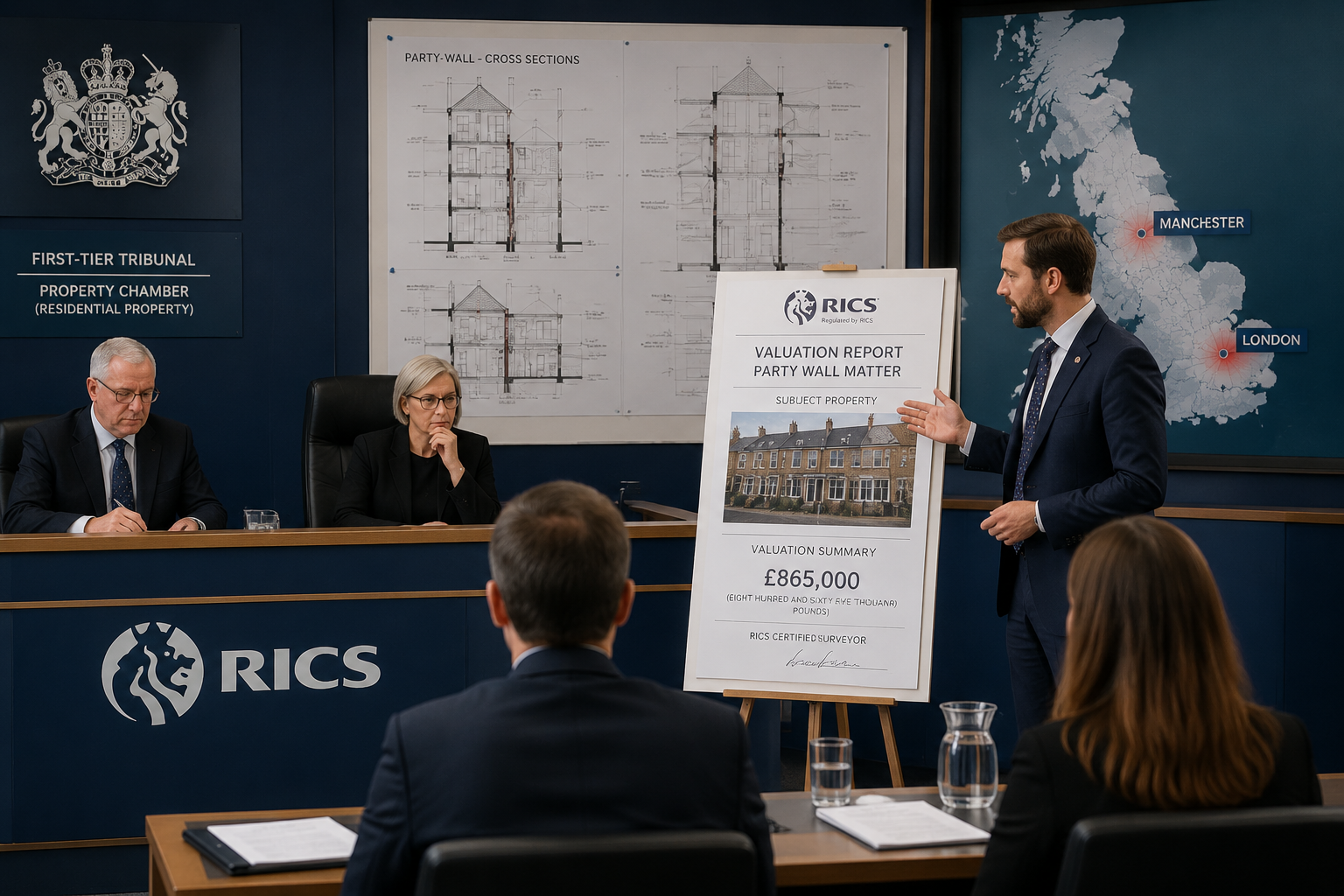
An expert witness surveyor is a qualified professional appointed to provide independent, opinion-based evidence to a court, tribunal, or arbitration panel on matters requiring specialist knowledge. In property disputes, this typically covers building defects, party wall damage, reinstatement costs, and contested market valuations. The expert's primary duty is to the tribunal — not to the instructing party — a principle that sits at the heart of Civil Procedure Rules (CPR) Part 35.
RICS accreditation matters because it signals a verifiable standard of competence, ethics, and professional indemnity. In 2026, RICS launched a six-week public consultation on the 5th edition of its professional standard, "Surveyors Acting as Expert Witnesses" — the first revision since 2014 [2]. The updated standard is designed to be globally applicable and introduces new guidance on:
- The use of artificial intelligence tools in preparing expert reports
- Digital evidence handling and authentication
- Fee structures and the risk of perceived bias from conditional fee arrangements
- Strengthened duties of independence and impartiality
"An expert witness's primary duty is to the tribunal, ensuring all reports and evidence are independent and unbiased." — RICS, 2026 Consultation [2]
For solicitors preparing litigation files, instructing a surveyor who operates under this updated standard is a significant risk-reduction measure. A report that does not meet CPR Part 35 requirements can be excluded entirely, leaving a client without the technical foundation their case depends upon.
The expert witness services available from RICS-regulated firms cover a broad range of dispute types, from structural defect claims and party wall damage assessments to formal Red Book valuations for tribunal proceedings.
CPR Part 35: The Non-Negotiable Compliance Framework
CPR Part 35 governs expert evidence in civil proceedings in England and Wales. Any surveyor acting as an expert witness must:
- Provide an overriding duty statement confirming their duty to the court
- Confirm the report contains their independent opinion
- Disclose any material instructions received
- Confirm they understand their duty and have complied with it
Failure on any of these points can result in the report being inadmissible or the expert being cross-examined on their independence. When selecting a regional specialist, verifying their familiarity with CPR Part 35 — and their track record in adversarial proceedings — is essential due diligence.
Regional Expert Witness Surveyors for Party Wall and Valuation Disputes: The Case for Local Expertise
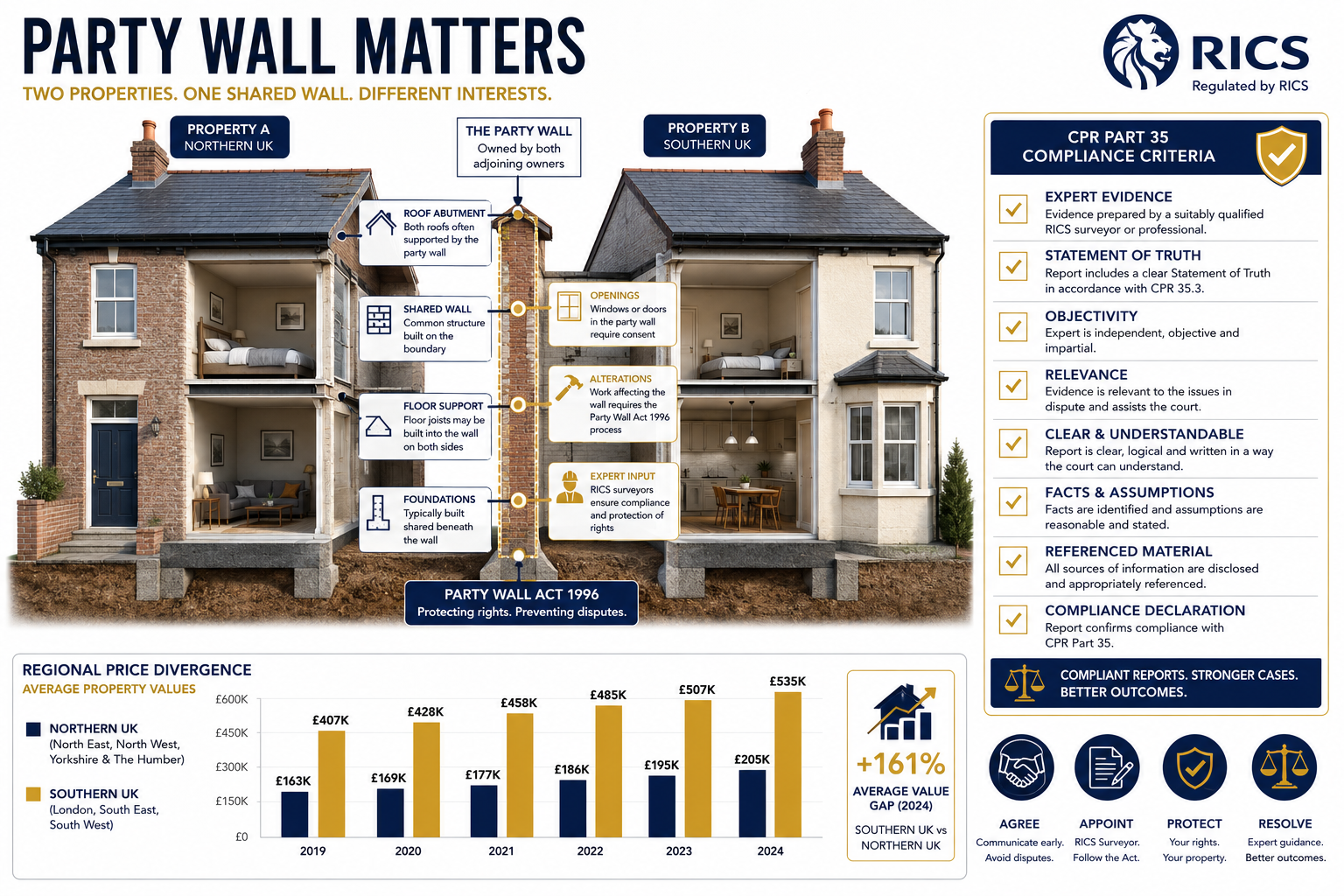
One of the most significant market developments in 2026 is the scale of regional price divergence. Comparable properties in northern regions versus southern markets now show valuation gaps exceeding £85,000, creating fertile ground for disputed expert opinions in lease extension claims, compulsory purchase proceedings, and probate valuations [5]. A generalist surveyor with no regional grounding can produce a technically compliant report that is still fundamentally undermined during cross-examination by a locally experienced opponent.
Why Regional Knowledge Determines Expert Credibility
Regional expertise encompasses several distinct competencies:
| Competency | Why It Matters in Disputes |
|---|---|
| Local comparable evidence | Tribunal members scrutinise comparable selection closely |
| Knowledge of regional planning constraints | Affects development value assumptions |
| Familiarity with local construction methods | Critical for party wall damage assessments |
| Regional market cycle awareness | Affects valuation date adjustments |
| Relationships with local agents and contractors | Supports reinstatement cost evidence |
The April 2026 RICS UK Residential Market Survey recorded a net balance of -34% in house prices — the sharpest monthly decline since late 2022 [4]. This downturn has forced expert witnesses to recalibrate their assumptions carefully, particularly where valuations were agreed at an earlier date and are now being contested in a materially different market environment.
For property owners and developers in the North West, working with RICS-certified chartered surveyors in Manchester provides access to professionals who understand local price dynamics, construction quality variations, and the specific building stock characteristics that influence both party wall risk and valuation outcomes.
Party Wall Disputes: When Expert Evidence Becomes Statutory
Party wall disputes occupy a unique legal space. Under the Party Wall etc. Act 1996, appointed surveyors have a statutory role that is distinct from a purely advisory one. When a dispute arises — or is deemed to have arisen — the appointed surveyor must act impartially, even when appointed by one party.
The draft 8th edition of RICS's party wall guidance, released for consultation in April 2026, reinforces this duty explicitly [1]. Key updates include:
- Revised appointment letters clarifying the statutory and personal nature of the appointment
- Updated award templates reflecting current best practice
- Strengthened guidance on regulatory and conduct matters
- Clarification that a surveyor's appointment is independent of client instruction
This matters for expert witness purposes because party wall awards can be challenged in the county court. Where an award is appealed, the appointed surveyor may be called to give evidence about their process. A surveyor who has not followed the updated RICS guidance may find their award — and their professional credibility — under scrutiny.
Common scenarios where expert witness evidence is required in party wall contexts include:
- Damage claims: Where a building owner's works have caused structural damage to a neighbour's property
- Disputed awards: Where either party challenges the terms of a party wall award in court
- Jurisdictional challenges: Where it is alleged that no notifiable works existed and the award was made without proper jurisdiction
- Schedule of condition disputes: Where the pre-works condition record is contested
Understanding party wall award guidance and the procedural requirements underpinning valid awards is foundational knowledge for any surveyor offering expert witness services in this area. Similarly, issues such as excavation notices for party wall works and loft conversion party wall obligations frequently generate disputes requiring expert evidence when works proceed without proper agreement.
How to Select and Instruct Regional RICS Expert Witnesses in 2026
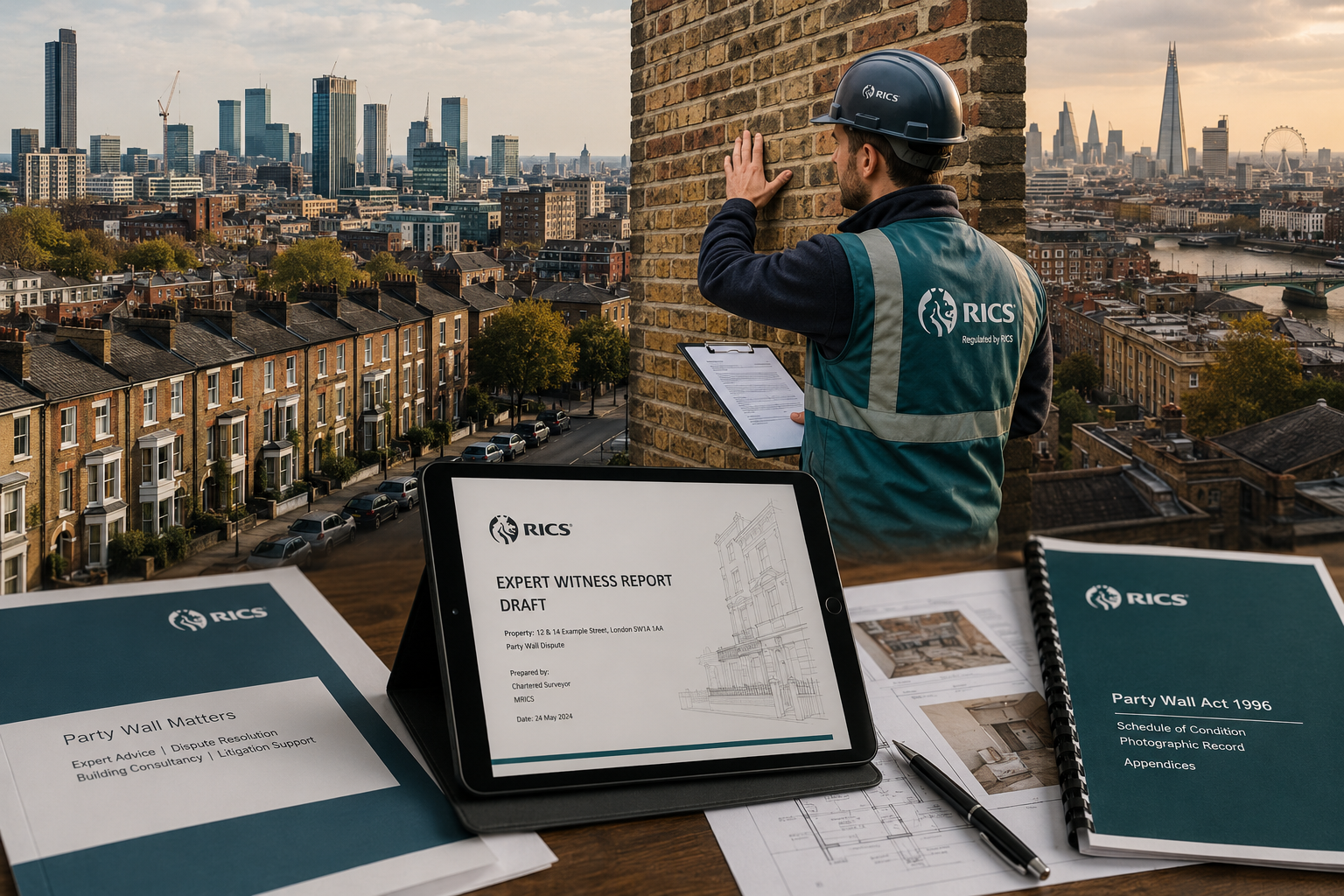
Selecting the right expert witness is not simply a matter of finding the nearest RICS member. The selection process should be structured, documented, and defensible. Solicitors and litigants in person alike benefit from a clear framework.
Step 1: Define the Dispute Type Precisely
Expert witness surveyors typically specialise in one or more of the following areas:
- Party wall and neighbourly matters: Structural damage, award challenges, jurisdiction disputes
- Building defects and dilapidations: Structural failures, damp, subsidence, specification breaches
- Residential valuation disputes: Lease extensions, compulsory purchase, probate, Help to Buy redemptions
- Commercial valuation disputes: Rent reviews, rating appeals, development appraisals
- Reinstatement cost assessments: Insurance disputes, fire damage, flood claims
Matching the expert's specialism to the dispute type is the single most important selection criterion. A highly regarded residential valuer may be entirely unsuitable for a structural defect claim requiring building pathology expertise.
For valuation disputes specifically, instructing a surveyor who can produce a RICS Red Book valuation is essential. Red Book compliance (RICS Valuation — Global Standards) is the benchmark that tribunals and courts expect for formal valuation evidence.
Step 2: Verify RICS Registration and Relevant Experience
Before instructing any expert, confirm:
- Current RICS membership status (check the RICS Find a Surveyor directory)
- Relevant pathway membership (e.g., Valuation, Building Surveying, Residential)
- Specific experience in expert witness work, including tribunal and court appearances
- Familiarity with the updated RICS expert witness standard under consultation in 2026 [2]
- Professional indemnity insurance adequate for the claim value
Ask directly: "How many expert witness reports have you prepared in the last three years, and in how many cases did you give oral evidence?" A surveyor who has only ever prepared reports without being cross-examined may struggle under adversarial questioning.
Step 3: Assess Regional Credentials
For regional disputes, request evidence of:
- Recent comparable transactions used in valuation work within the relevant postcode area
- Familiarity with local planning policies affecting value
- Knowledge of regional construction methods relevant to the defect or party wall issue
The RICS Right to Buy valuations process illustrates why regional knowledge matters: discount calculations and market value assessments for Right to Buy disputes require precise local comparable evidence that a non-regional expert simply cannot provide with the same credibility.
Step 4: Review the Expert's Approach to Impartiality
Ask to see a redacted example of a previous expert witness report. Look for:
- A clear overriding duty statement
- Transparent disclosure of instructions
- Balanced treatment of evidence, including evidence that does not support the instructing party's position
- A "single joint expert" capability if the case may proceed on that basis
A critical red flag: any expert who suggests they can "tailor" their conclusions to support a particular outcome should be disqualified immediately. This is not only a breach of CPR Part 35 but a potential disciplinary matter under RICS conduct rules [6].
Step 5: Confirm Availability and Timetable Compatibility
Court and tribunal timetables are unforgiving. Confirm:
- Availability to inspect within the required window
- Capacity to produce a report by the directions deadline
- Availability for any concurrent evidence ("hot tubbing") sessions if ordered
- Willingness to engage in without-prejudice discussions with the opposing expert
Regional Coverage: Where to Find RICS Specialists
RICS-regulated firms operate across all UK regions. For disputes in London and the South East — where valuation complexity is highest due to leasehold structures and premium market volatility — specialists are available in areas including North West London, Central London, and Surrey.
For Northern disputes, Manchester-based RICS firms offer the regional depth that London-centric practices cannot replicate. The RICS reinstatement build cost valuation is a specific area where regional construction cost data is critical — national indices can diverge significantly from actual local contractor rates, particularly in the current inflationary environment.
The Role of the Schedule of Condition in Limiting Disputes
One of the most effective ways to reduce the likelihood of requiring expert witness evidence is to commission a thorough schedule of condition before notifiable works begin. This contemporaneous record of the neighbouring property's pre-works condition provides an objective baseline against which any subsequent damage claims are assessed. Where a schedule of condition exists, disputes about causation and quantum are significantly easier to resolve without litigation.
Emerging Issues Shaping Expert Witness Practice in 2026
Several developments are reshaping the landscape for regional expert witness surveyors in 2026:
Artificial intelligence in report preparation: The updated RICS expert witness standard addresses AI usage for the first time [9]. Experts using AI tools to assist with comparable analysis or report drafting must disclose this and ensure the final opinion remains their own independent professional judgment.
Digital evidence: Drone surveys, 3D laser scanning, and photogrammetric records are increasingly used in party wall damage assessments and building defect claims. Experts must be able to authenticate and explain digital evidence under cross-examination.
Market volatility adjustments: With the April 2026 RICS survey recording a -34% net balance in house prices [4], expert witnesses in valuation disputes must address the impact of market conditions at the valuation date with greater precision than in stable market conditions. Failure to do so invites challenge.
Jurisdictional challenges in party wall awards: The draft 8th edition RICS party wall guidance specifically addresses awards made without proper jurisdiction [1]. This is an area of increasing challenge in the county court, and expert witnesses instructed to advise on the validity of awards must be familiar with the updated guidance.
Conclusion
The demand for Regional Expert Witness Surveyors for Party Wall and Valuation Disputes: Finding RICS Specialists in 2026 has never been higher, driven by market volatility, regional price divergence, and a wave of contested party wall awards. The quality of expert evidence — its independence, regional credibility, and compliance with CPR Part 35 and updated RICS standards — will determine outcomes in disputes that often involve six-figure sums.
Actionable next steps for solicitors and property owners:
- Define the precise dispute type before searching for an expert — specialism alignment is the most important selection criterion.
- Verify current RICS registration and confirm the expert's familiarity with the 2026 consultation updates to both the party wall guidance and the expert witness standard.
- Prioritise regional experience: request evidence of recent local comparable transactions or regional construction cost data relevant to the dispute.
- Commission a schedule of condition before any notifiable party wall works begin — it is the most cost-effective way to limit future expert witness costs.
- For valuation disputes, insist on Red Book compliance and confirm the surveyor can withstand cross-examination on their comparable selection methodology.
The updated RICS standards coming into effect in 2026 raise the bar for expert witness practice. Instructing a surveyor who meets that bar — and can demonstrate it — is the most important investment any party to a property dispute can make.
References
[1] Rics Launches Consultation On Updated Party Wall Practice Guidance – https://www.rics.org/news-insights/rics-launches-consultation-on-updated-party-wall-practice-guidance?utm_source=openai
[2] Rics Launches Global Consultation On Updated Expert Witness Standard – https://www.rics.org/news-insights/rics-launches-global-consultation-on-updated-expert-witness-standard?utm_source=openai
[3] Formal Valuations As Expert Witness In Property Disputes Rics Preparation For Solicitors And Tribunals – https://kingstonsurveyors.com/formal-valuations-as-expert-witness-in-property-disputes-rics-preparation-for-solicitors-and-tribunals/?utm_source=openai
[4] Geopolitical Volatility In April 2026 Rics Surveys Party Wall Risk Adjustments For Developer Projects – https://kingstonsurveyors.com/geopolitical-volatility-in-april-2026-rics-surveys-party-wall-risk-adjustments-for-developer-projects/?utm_source=openai
[5] Expert Witness Valuations In 2026 Buyer Enquiry Surge Rics Guidelines For Resolving Regional Disputes – https://www.canterburysurveyors.com/blog/expert-witness-valuations-in-2026-buyer-enquiry-surge-rics-guidelines-for-resolving-regional-disputes/?utm_source=openai
[6] rics – https://www.rics.org/?utm_source=openai
[9] Expert Witness Preparation For 2026 Uk Valuation Disputes Rics Standards In A Recovering Market – https://www.canterburysurveyors.com/blog/expert-witness-preparation-for-2026-uk-valuation-disputes-rics-standards-in-a-recovering-market/?utm_source=openai