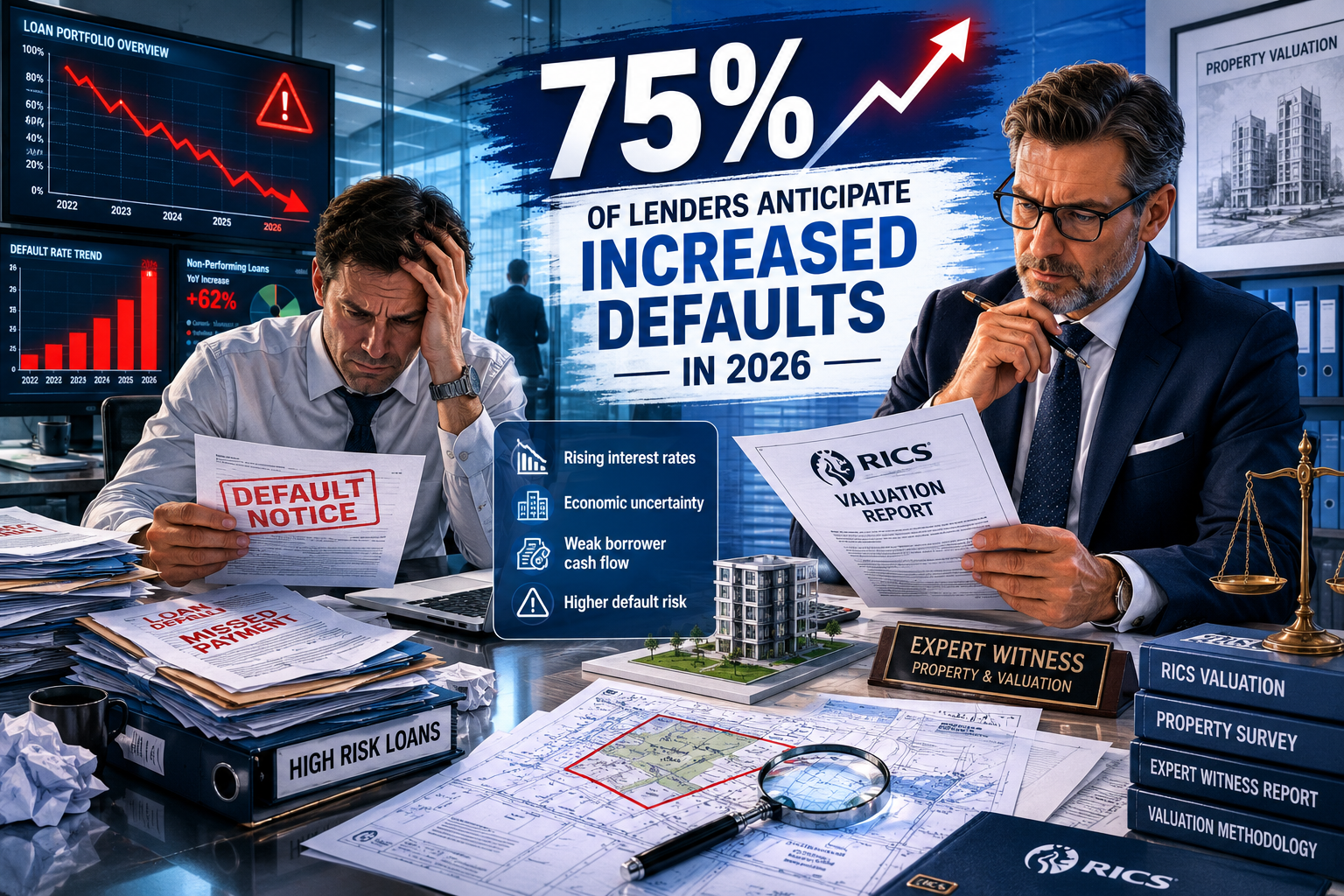
Over 75% of lenders anticipate an increase in loan defaults and workouts in 2026 compared to 2025 — a statistic that signals not just financial stress, but a coming wave of formal disputes that will require rigorous, court-ready evidence [1]. Against this backdrop, understanding Expert Witness Roles in 2026 Lender Volume Uplift Disputes: Preparing for Survey Demand Surge has become an urgent priority for chartered surveyors, legal teams, and financial institutions alike. As lending volumes recover through Q1 and beyond, the intersection of property valuation, survey evidence, and litigation is growing more complex — and more consequential — than at any point in recent memory.
Key Takeaways
- More than 75% of lenders expect loan defaults and workouts to rise in 2026, driving a surge in valuation-related disputes requiring expert witness testimony.
- Nearly two-thirds of deal professionals anticipate M&A dispute volumes to increase, compounding demand for qualified expert witnesses in complex financial cases.
- Expert witnesses are now being integrated earlier in the case lifecycle — shaping litigation strategy before formal proceedings begin.
- Chartered surveyors providing expert evidence must meet strict RICS standards and demonstrate independence, methodological rigour, and clear written communication.
- Resource constraints and AI-related lending concerns are reshaping how expert witnesses prepare and present evidence in 2026 disputes.
Why 2026 Is a Pivotal Year for Lender Volume Uplift Disputes
The phrase "lender volume uplift" refers to the increase in lending activity — mortgages, commercial loans, and specialist finance products — that follows periods of market recovery. When transaction volumes rise rapidly, so does the potential for disputes. Borrowers challenge valuations. Lenders contest survey findings. Developers dispute professional negligence claims. Each of these scenarios demands expert witness input that is both technically authoritative and legally defensible.
Several converging forces make 2026 particularly significant:
Macroeconomic pressure and competition. Specialist lenders have identified macroeconomic stress and intensifying competition as their two most pressing challenges this year [7]. When margins tighten and risk appetites shift, disputes over collateral valuations and loan-to-value ratios become more frequent and more contentious.
Rising M&A activity. Nearly two-thirds of deal professionals expect M&A dispute volumes to rise over the next 12 months, with 81% reporting an increase in 2025 [2]. Property assets sit at the centre of many of these transactions, making accurate survey evidence a critical component of dispute resolution.
Cross-border regulatory scrutiny. 82% of organisations express concern about cross-border or multi-agency investigations in 2026 [4]. For lenders operating across jurisdictions, expert witnesses must understand not only domestic valuation standards but also the regulatory frameworks that govern international lending.
AI-driven lending decisions. Lenders are increasingly using artificial intelligence to assess creditworthiness and property risk. When those decisions are challenged, expert witnesses must be prepared to interrogate algorithmic outputs alongside traditional survey data [1].
Budget constraints in litigation. 38% of organisations report inadequate disputes budgets for 2026 [4]. This places a premium on expert witnesses who can deliver clear, concise, and cost-effective evidence — reducing the need for prolonged expert conferencing or repeated report revisions.
The Core Functions of Expert Witnesses in Valuation Disputes
Understanding Expert Witness Roles in 2026 Lender Volume Uplift Disputes: Preparing for Survey Demand Surge requires a clear picture of what expert witnesses actually do — and how those functions are evolving.
An expert witness in a lender valuation dispute is not an advocate for either party. Their duty is to the court or tribunal. They provide independent, specialist opinion on matters that fall outside the knowledge of a judge or arbitrator — typically property condition, market value, survey methodology, or professional standards.
Primary Responsibilities
| Function | Description |
|---|---|
| Opinion on Value | Providing an independent assessment of a property's market value at a specific date |
| Methodology Review | Evaluating whether the original surveyor followed accepted RICS standards |
| Comparative Analysis | Identifying comparable transactions to support or challenge a valuation |
| Report Preparation | Drafting a formal expert report compliant with Civil Procedure Rules (CPR) Part 35 |
| Joint Statement | Collaborating with the opposing expert to narrow areas of disagreement |
| Oral Testimony | Presenting evidence clearly under cross-examination |
For lender volume uplift disputes specifically, the most contested areas tend to be:
- Whether a property was correctly valued at the time of mortgage advance
- Whether a building survey identified material defects that affected lending decisions
- Whether a structural survey was conducted to the standard expected of a competent professional
- Whether a RICS building survey report adequately disclosed risk factors relevant to the lender
The Shift Toward Early Integration
One of the most significant trends reshaping expert witness practice in 2026 is the move toward earlier involvement in the case lifecycle [5]. Traditionally, expert witnesses were instructed after pleadings were settled. Now, legal teams are bringing them in at the pre-action stage — using their technical knowledge to assess whether a claim is viable, identify the strongest evidence, and avoid costly litigation where settlement is achievable.
This proactive model benefits lenders and claimants alike. It reduces the risk of expert reports being undermined by procedural challenges, and it allows surveyors to flag evidential gaps before they become liabilities in court.
"Expert witnesses are no longer just witnesses — they are strategic assets whose technical insight shapes the entire direction of complex financial litigation."
Preparing for the Survey Demand Surge: Evidence Standards and Practical Strategies
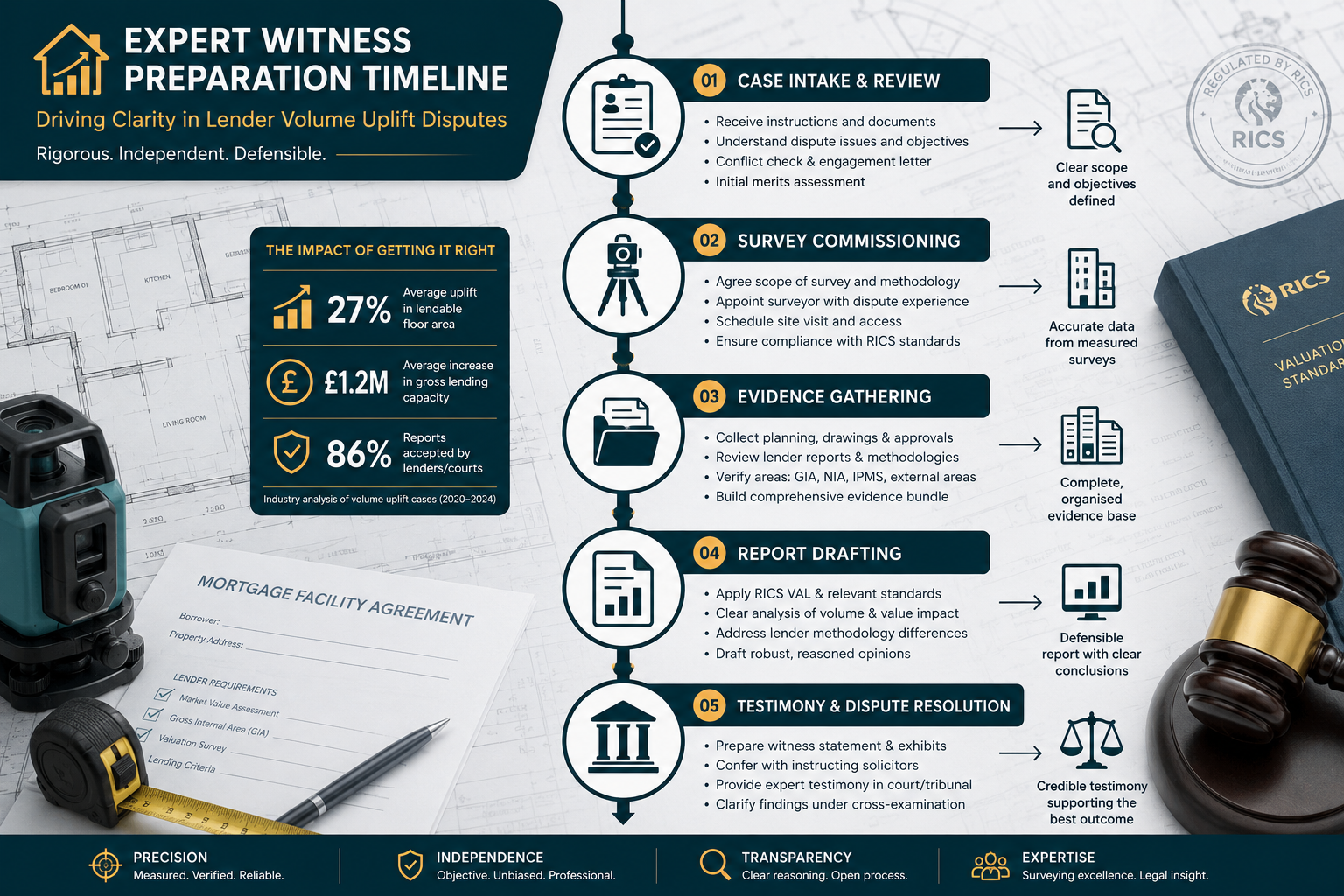
The anticipated surge in survey-related disputes during 2026 creates both opportunity and obligation for chartered surveyors. Those who wish to act as expert witnesses must ensure their practice — and their evidence — meets the standards that courts, tribunals, and arbitrators will demand.
Building a Court-Ready Survey Evidence Base
The foundation of any expert witness instruction in a lender dispute is the underlying survey documentation. Whether the dispute concerns a residential mortgage or a complex commercial lending arrangement, the quality of the original survey record will determine how effectively an expert can construct or challenge a case.
Key documentary standards include:
- Contemporaneous records: Field notes, photographs, and inspection logs taken at the time of the original survey carry significant evidential weight. Retrospective reconstruction is difficult to defend under cross-examination.
- Methodology transparency: Expert reports must explain not just what was found, but how it was found. Courts expect surveyors to articulate the scope of their inspection and any limitations explicitly acknowledged at the time.
- Comparable evidence: Valuation disputes almost always turn on comparable transactions. Expert witnesses should maintain access to robust comparable databases and be prepared to justify their selection criteria.
- RICS compliance: All survey and valuation work cited in expert evidence should demonstrably comply with the relevant RICS guidance notes and professional standards applicable at the date of the original instruction.
For surveyors unfamiliar with the range of survey types that may come under scrutiny in lender disputes, a review of the different types of survey available — from Level 2 homebuyer reports to full Level 3 building surveys — provides essential context.
The Role of Red Book Valuations in Dispute Evidence
When lenders advance funds against a property, they typically rely on a formal valuation prepared in accordance with the RICS Valuation — Global Standards (the "Red Book"). These valuations carry specific requirements around independence, methodology, and disclosure. In disputes, the Red Book valuation often becomes the central document under examination.
Expert witnesses instructed in lender volume uplift disputes must be familiar with Red Book valuation standards and capable of assessing whether the original valuer complied with them. Common grounds for challenge include:
- Failure to inspect adequately
- Inappropriate selection of comparables
- Insufficient adjustment for market conditions at the date of valuation
- Non-disclosure of conflicts of interest
Understanding factors of valuation — including location, condition, tenure, and market sentiment — is essential for any expert witness seeking to provide credible opinion evidence in these cases.
Dilapidations and Commercial Lending Disputes
In the commercial lending space, disputes frequently arise from dilapidations — the condition of a property at the end of a lease or at the point of loan default. When a lender takes possession of a commercial asset and finds it in worse condition than the survey indicated, a professional negligence claim against the original surveyor may follow.
Expert witnesses in these cases must understand both the technical aspects of property condition and the legal framework governing dilapidation surveys and schedules of dilapidations. The ability to translate complex building pathology into clear, accessible language for a non-technical tribunal is a core competency that distinguishes effective expert witnesses from merely qualified ones.
Cybersecurity and Data Integrity in Survey Evidence
Corporate counsel are facing sustained litigation pressure from escalating cybersecurity exposure [6]. For expert witnesses in lender disputes, this has a practical implication: the integrity of digital survey records, valuation models, and AI-generated risk assessments may itself become a subject of dispute. Expert witnesses should be prepared to address questions about data provenance, system reliability, and the auditability of digitally produced evidence.
Expert Witness Roles in 2026 Lender Volume Uplift Disputes: Preparing for Survey Demand Surge — Practical Guidance for Surveyors

For chartered surveyors considering or expanding their expert witness practice in 2026, the following framework provides a structured approach to preparation.
Qualifications and Accreditation
Courts and tribunals expect expert witnesses to demonstrate relevant expertise through:
- RICS membership (MRICS or FRICS) with active practising status
- Specialist experience in the type of property and dispute in question
- Familiarity with CPR Part 35 and the associated Practice Direction
- Completion of recognised expert witness training (such as that offered by the Expert Witness Institute or Bond Solon)
Report Writing Standards
An expert report in a lender volume uplift dispute must:
- Clearly state the expert's qualifications and the scope of their instruction
- Identify the documents and evidence reviewed
- Set out the methodology applied
- Distinguish between fact and opinion
- Acknowledge contrary evidence and explain why it has been given less weight
- Include a statement of truth and a declaration of independence
Poor report writing is one of the most common reasons expert evidence is challenged or excluded. Surveyors should invest in peer review of draft reports before service.
Managing Conflicts of Interest
In a period of high lending volume, the risk of undisclosed conflicts increases. Expert witnesses must conduct thorough conflict checks before accepting instructions — particularly where they have previously acted for lenders, borrowers, or valuers involved in the dispute. Transparency at the outset protects both the expert and the integrity of the proceedings.
Staying Current with Market Data
Lender volume uplift disputes often hinge on what the market was doing at a specific historical date. Expert witnesses must maintain access to reliable historical market data — including transaction volumes, yield movements, and lending conditions — to contextualise their opinions effectively. Regular engagement with chartered surveyor professional networks and market intelligence services is essential.
The Factoring and Specialist Lending Context
The factoring industry is expanding as traditional credit tightens [8], creating a new category of lending disputes where expert witnesses may be required to assess the value of receivables, stock, or specialist assets used as collateral. Surveyors with experience in commercial building surveys and commercial property valuation are well positioned to serve this growing market.
Conclusion
The convergence of rising loan defaults, surging M&A activity, regulatory complexity, and AI-driven lending decisions makes 2026 a defining year for expert witness practice in lender volume uplift disputes. Chartered surveyors and valuation professionals who prepare now — investing in accreditation, report writing skills, and robust evidence management — will be best placed to meet the demand surge that is already materialising.
Actionable next steps for surveyors and legal teams:
- Audit existing survey documentation practices to ensure contemporaneous records meet court-ready standards
- Review RICS Red Book compliance across all current valuation instructions
- Engage expert witness training programmes before caseloads peak in Q2 and Q3 2026
- Establish clear conflict-of-interest screening protocols for new expert witness instructions
- Build relationships with legal teams specialising in lender disputes to position for early-stage instruction
- Maintain access to current and historical market data to support comparable evidence in valuation challenges
The demand for credible, independent, technically rigorous expert evidence in lender disputes is not a temporary spike — it reflects structural changes in the lending market, the litigation environment, and the regulatory landscape. Surveyors who treat expert witness work as a core professional discipline, rather than an occasional sideline, will define the standard of evidence in 2026 and beyond.
References
[1] Survey Reveals Lender Concern With Fraud Defaults And Ai – https://www.globenewswire.com/news-release/2026/02/17/3239120/0/en/Survey-Reveals-Lender-Concern-with-Fraud-Defaults-and-AI.html?utm_source=openai
[2] Survey Ma Disputes Expected To Surge As Deal Volume Rebounds – https://www.consultingmag.com/amp/2026/03/17/survey-ma-disputes-expected-to-surge-as-deal-volume-rebounds/?utm_source=openai
[3] Expert Witness Roles In 2026 Lender Valuation Disputes Evidence Standards Amid Rising Transactions – https://wimbledonsurveyors.com/expert-witness-roles-in-2026-lender-valuation-disputes-evidence-standards-amid-rising-transactions/?utm_source=openai
[4] Global Disputes Forecast 2016 – https://www.bakermckenzie.com/en/newsroom/2026/01/global-disputes-forecast-2016?utm_source=openai
[5] How Expert Witness Strategy Is Evolving In Complex Litigation – https://www.doar.com/insights/how-expert-witness-strategy-is-evolving-in-complex-litigation/?utm_source=openai
[6] 2026 Annual Litigation Trends Survey – https://www.nortonrosefulbright.com/en/knowledge/publications/139d4d56/2026-annual-litigation-trends-survey?utm_source=openai
[7] Volatility And Competition Focus Leadership Teams As Ownership Transition Moves Forward 2026 Interpath Specialist Lender Survey – https://interpath.com/media-hub/articles/volatility-and-competition-focus-leadership-teams-as-ownership-transition-moves-forward-2026-interpath-specialist-lender-survey/?utm_source=openai
[8] Factoring Finds Its Moment Growth Discipline And Opportunity In A Slowing Economy – https://www.sfnet.com/home/industry-data-publications/the-secured-lender/magazine/tsl-article-detail/factoring-finds-its-moment–growth–discipline–and-opportunity-in-a-slowing-economy?utm_source=openai