Effective rent growth returned to positive territory in Q1 2026 for the first time since 2024, rising 0.4% year-over-year nationally — a modest figure that masks a structural shift with significant implications for landlords and valuers alike [7]. The combination of sharply reduced new supply, stabilising interest rates, and rising tenant demand has created a market environment where building survey data is no longer a due-diligence formality. It is now a primary input in rental valuation. Valuing Properties in 2026 Tenant Demand Uptick: Building Survey Integration for Rental Growth is the defining challenge for property professionals navigating this constrained, competitive landscape.
Key Takeaways
- New apartment deliveries collapsed to 31,055 units in Q1 2026, down from a quarterly average of 80,400, tightening supply and supporting rental growth [7].
- Building survey findings directly affect achievable rents, tenant retention rates, and long-term asset performance in a demand-led market.
- Structural condition, damp, and dilapidations data are now essential inputs in rental valuation models, not optional extras.
- Landlords who integrate professional survey intelligence into their pricing strategy are better positioned to justify premium rents and reduce void periods.
- Stabilised interest rates are unlocking delayed transactions, making accurate, survey-backed valuations critical for acquisitions and refinancing decisions [1].

Why the 2026 Supply Squeeze Is Reshaping Rental Valuations
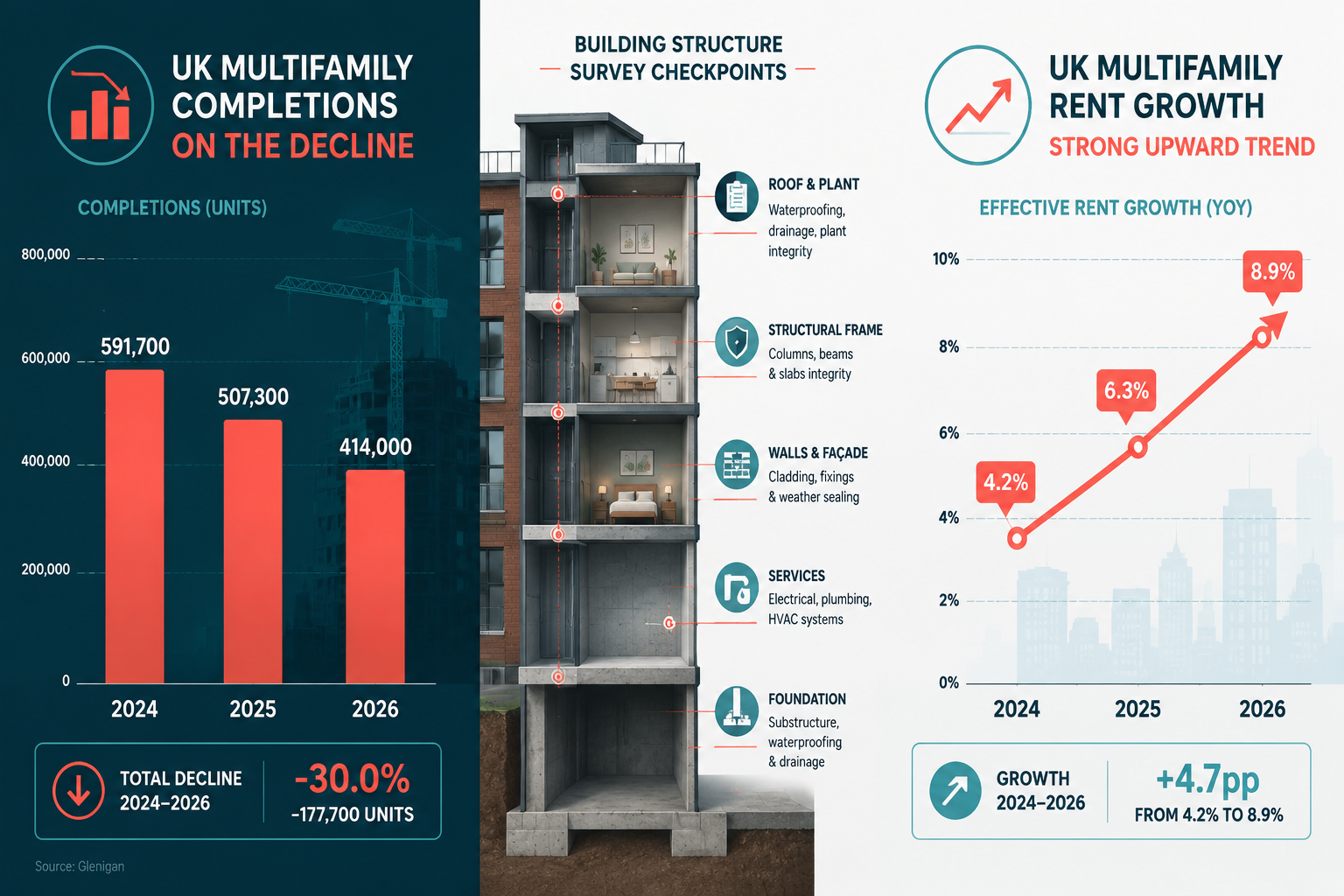
The arithmetic of the current rental market is straightforward, even if its implications are not. Multifamily construction has fallen from 591,700 units delivered in 2024 to a projected 414,000 units in 2026 [2]. Fewer new homes entering the market means existing stock carries greater weight in meeting tenant demand. That weight translates directly into pricing power — but only for landlords whose properties can withstand scrutiny.
Berkadia's 2026 Multifamily Investor Sentiment Survey found that 72% of investors plan to moderately expand their portfolios, with most anticipating rent growth between 1.0% and 3.0% as vacancy rates stabilise [10]. National apartment vacancies are expected to hold in the mid-5% range, a figure that signals a healthy but not overheated market [9]. For individual landlords, however, the gap between average performance and top-quartile performance is widening — and building condition is a key differentiator.
Zillow's 2026 housing market forecast projects 1.2% home-value growth nationally, with mortgage rates remaining above 6% [8]. This sustained affordability pressure keeps more households in the rental sector for longer, deepening demand. The result is a market where tenants are staying put and, critically, where they are more selective about the quality of properties they choose to rent.
The valuation implication is clear: a property with documented structural integrity, no damp issues, and a clean dilapidations record commands a measurable premium over comparable stock with unresolved defects. Integrating building survey findings into rental valuation is no longer best practice — it is competitive necessity.
How Supply Constraints Affect Yield Calculations
Traditional yield calculations — dividing annual rent by property value — become unreliable when market fundamentals are shifting as rapidly as they are in 2026. A static yield figure does not capture:
- Tenant quality risk: Poorly maintained properties attract higher tenant turnover, increasing void costs.
- Maintenance liability: Unidentified defects create unbudgeted capital expenditure that erodes net yield.
- Regulatory exposure: Properties with outstanding compliance issues face rent restriction or enforcement action.
- Refinancing risk: Lenders increasingly require survey-backed condition reports before releasing funds at competitive rates [1].
A stock condition survey provides a systematic audit of all these variables, translating physical condition into financial risk. When integrated into a valuation model, this data allows landlords and valuers to calculate a more accurate net present value of rental income over a five-to-ten-year horizon.
Building Survey Integration for Rental Growth: The Technical Framework
Valuing Properties in 2026 Tenant Demand Uptick: Building Survey Integration for Rental Growth requires a structured methodology. The following framework reflects current best practice among RICS-regulated valuers operating in constrained supply markets.
Step 1 — Establish a Baseline Condition Profile
Before any rental figure can be justified to a lender, investor, or sophisticated tenant, the property's physical condition must be documented with precision. A RICS building survey provides a comprehensive assessment covering:
| Survey Element | Valuation Relevance |
|---|---|
| Structural integrity | Affects insurance premiums and lender appetite |
| Roof and envelope condition | Directly linked to maintenance capex forecasts |
| Damp and moisture ingress | Tenant retention risk and regulatory compliance |
| Electrical and mechanical systems | Safety certification and void-period risk |
| Drainage and plumbing | Latent defect liability |
| Energy performance indicators | EPC rating affects legal lettability from 2025 onward |
Each element feeds into the valuation model differently. Structural defects, for example, may require immediate capital expenditure that reduces net yield in year one but, once remediated, supports a rental premium in years two through five. Damp issues, if unresolved, create a ceiling on achievable rents because tenants in a demand-led market have enough choice to avoid properties with known problems.
A damp survey conducted before a rental valuation is not a cost — it is a risk-quantification exercise that protects the landlord's pricing position.
Step 2 — Translate Defects into Rental Adjustments
Once the condition profile is established, each defect category requires a rental adjustment. This is where survey data becomes valuation data. The adjustment methodology typically follows three stages:
- Categorise defects by urgency: Immediate, short-term (within 12 months), and long-term (within five years).
- Estimate remediation costs: Using current market rates for labour and materials.
- Apply a rental discount or premium: Based on whether defects are remediated before letting or disclosed to tenants.
A property with no material defects in a high-demand submarket can justify a rental premium of 5% to 15% over comparable stock with outstanding issues. This premium is defensible to lenders and investors because it is grounded in documented survey evidence rather than subjective market opinion.
For commercial landlords, a RICS commercial building survey provides the same structured framework applied to industrial, retail, or mixed-use assets. Industrial properties are currently outperforming most other sectors, with vacancy rates tightening and rental growth steady across key markets [4]. Survey-backed valuations are essential for capturing this growth accurately.
Step 3 — Incorporate Dilapidations and Lease Obligations
In the rental market, the relationship between a landlord and a tenant is governed by lease obligations that extend beyond the initial letting. Dilapidations — the costs of restoring a property to its pre-tenancy condition — represent a significant but often underestimated financial variable. A schedule of dilapidations prepared at the outset of a tenancy creates a documented baseline that protects the landlord's position at lease end.
In 2026's tenant-demand environment, landlords who can demonstrate a clear, professionally prepared dilapidations schedule are better positioned to:
- Attract institutional or corporate tenants who require documented property management processes.
- Negotiate higher rents on the basis of transparent condition records.
- Defend rental valuations under lender scrutiny during refinancing.
"A well-prepared dilapidations schedule is not just a legal document — it is a valuation instrument that protects rental income across the full lease cycle."
Sector-Specific Considerations for Valuing Properties in 2026 Tenant Demand Uptick
Different property types face distinct demand and supply dynamics in 2026, and the survey integration approach must reflect these differences.

Residential Rental Properties
The residential rental sector is experiencing its most significant supply-demand rebalancing since 2021. With only 31,055 units added to inventory in Q1 2026 — compared to a three-year quarterly average of 80,400 — absorption is outrunning deliveries for the first time in several years [7]. This creates a window for landlords with well-maintained stock to achieve above-average rent growth.
For residential landlords, the most impactful survey inputs are:
- Structural surveys to confirm the building envelope is sound, supporting EPC compliance and insurance ratings. A structural survey provides the depth of analysis needed for older stock.
- Specific defect reports for targeted issues such as subsidence, roof failure, or wall tie corrosion. A specific defect report allows landlords to address isolated problems without commissioning a full survey.
- Homebuyer or RICS home survey for properties being acquired as buy-to-let investments, ensuring the purchase price reflects condition accurately. A RICS home survey is the standard entry point for residential acquisition due diligence.
Sun Belt markets in the US are facing the most pressure from oversupply, with national rent growth projected at just 1.2% [6]. In the UK context, the equivalent dynamic is playing out in outer suburban markets where planning approvals have been more generous. In constrained urban markets — where supply is genuinely limited — survey-backed condition premiums are more achievable and more durable.
Senior Housing and Specialist Accommodation
With the first baby boomers turning 80 in 2026, senior housing is approaching a historic demand inflection point [3]. Record-high occupancy levels and limited new supply make this subsector particularly sensitive to property condition. Tenants and their families are making long-term commitments based on care quality and building safety. A property with documented structural integrity and compliance with fire safety and accessibility standards commands a significant premium.
For landlords in this space, a stock condition survey covering all units within a portfolio provides the systematic evidence base needed to justify regulated rents and satisfy CQC or equivalent regulatory requirements.
Commercial and Industrial Properties
Industrial properties continue to outperform, with vacancy rates tightening and rental growth steady [4]. Data centres face a different challenge: national vacancy below 2% and most facilities pre-leased before completion, but power shortages and supply bottlenecks limiting expansion [5]. For both asset classes, survey integration focuses on technical due diligence — power infrastructure, structural loading capacity, and environmental compliance — rather than residential habitability.
A commercial building survey with project management integration is particularly valuable for landlords undertaking refurbishment or conversion projects to meet evolving tenant specifications.
Practical Steps for Landlords and Valuers in 2026
The following action plan consolidates the technical framework into practical steps that landlords and valuers can implement immediately.
Before Letting:
- Commission a full building survey or RICS-level condition report.
- Address Category 1 and Category 2 defects before marketing the property.
- Prepare a schedule of condition to document the property's state at the start of the tenancy.
- Obtain an updated EPC rating to confirm legal lettability.
During the Valuation Process:
- Provide the valuer with all survey reports, remediation invoices, and compliance certificates.
- Use survey evidence to justify rental comparables above the local average.
- Quantify the cost of any outstanding defects and apply a transparent rental adjustment methodology.
For Portfolio Landlords:
- Conduct rolling stock condition surveys across the portfolio on a three-to-five-year cycle.
- Use survey data to prioritise capital expenditure and maximise net yield.
- Integrate dilapidations schedules into all new leases, regardless of property type or tenant covenant.
For Acquisitions:
- Never rely on a desktop valuation alone in a supply-constrained market.
- Use survey findings to negotiate purchase price reductions that reflect remediation costs.
- Factor survey costs into the acquisition budget as a fixed line item, not a discretionary expense.
Stabilised interest rates in 2026 are unlocking delayed transactions across the commercial real estate sector, with capital remaining abundant but deployed selectively [1]. In this environment, survey-backed valuations provide the evidence base that lenders and investors require to commit capital with confidence.
Conclusion
The 2026 tenant demand uptick is not a temporary market anomaly — it is the product of structural supply constraints, sustained affordability pressure, and demographic shifts that will persist well beyond this year. Valuing Properties in 2026 Tenant Demand Uptick: Building Survey Integration for Rental Growth is the discipline that separates landlords who capture this demand effectively from those who leave rental income on the table.
Actionable next steps:
- Commission a RICS building survey before marketing any rental property or refinancing an existing investment.
- Prepare a schedule of dilapidations at the start of every new tenancy to protect the landlord's financial position at lease end.
- Use stock condition surveys to maintain a rolling evidence base for portfolio valuations.
- Engage a chartered surveyor with RICS credentials to ensure valuation reports meet lender and investor standards.
- Review the full range of survey types available to match the survey scope to the specific property type and risk profile.
The landlords who will benefit most from the 2026 rental market are those who treat building surveys not as a cost of compliance, but as a strategic tool for rental growth.
References
[1] Real Estate M&A Outlook – https://www.deloitte.com/us/en/industries/real-estate/articles/real-estate-m-a-outlook.html?utm_source=openai
[2] Rental Market Valuation Adjustments Strategies For Surveying Properties Amid Landlord Shortage And Tenant Demand Surge In 2026 – https://nottinghillsurveyors.com/blog/rental-market-valuation-adjustments-strategies-for-surveying-properties-amid-landlord-shortage-and-tenant-demand-surge-in-2026?utm_source=openai
[3] Property Type Outlook – https://www.pwc.com/us/en/industries/financial-services/asset-wealth-management/real-estate/emerging-trends-in-real-estate-pwc-uli/property-type-outlook.html?utm_source=openai
[4] Winter 2026 Survey – https://www.anderson.ucla.edu/about/centers/ucla-anderson-forecast/projects-and-partnerships/allen-matkins/winter-2026-survey?utm_source=openai
[5] Emerging Trends In Real Estate 2026 – https://www.pwc.com/us/en/about-us/newsroom/press-releases/emerging-trends-in-real-estate-2026.html?utm_source=openai
[6] Multifamily Outlook 2026 Faces Slower Rent Growth – https://www.credaily.com/briefs/multifamily-outlook-2026-faces-slower-rent-growth/?utm_source=openai
[7] Multifamily CRE Q1 2026 Rent Growth Returns Supply Peak – https://www.hbcapitalre.com/multifamily-cre-q1-2026-rent-growth-returns-supply-peak/?utm_source=openai
[8] Zillow Expects Calmer 2026 Housing Market Improved Affordability – https://www.housingwire.com/articles/zillow-expects-calmer-2026-housing-market-improved-affordability/?utm_source=openai
[9] 2026 US Commercial Real Estate Outlook Navigating Recovery And Repricing – https://www.sterlingassetgroup.com/insights/2026-us-commercial-real-estate-outlook-navigating-recovery-and-repricing?utm_source=openai
[10] Investor Optimism For Multifamily Builds In 2026 As Confidence Returns – https://www.berkadia.com/news/investor-optimism-for-multifamily-builds-in-2026-as-confidence-returns/?utm_source=openai