Over 40% of party wall disputes in England and Wales involve disagreements about pre-existing defects — cracks, settlement, and vibration damage — that were either missed or poorly documented before construction began. As AI-powered defect prediction tools become embedded in surveying workflows, the stakes for getting this right have never been higher. The introduction of Responsible AI Tools for Party Wall Defect Prediction: RICS March 2026 Standards and Ethical Implementation marks a turning point: for the first time, RICS members and regulated firms face mandatory obligations governing exactly how these tools may be used. [6]
This article unpacks what those obligations mean in practice — from excavation risk modelling and vibration threshold prediction to bias-free award drafting — and provides actionable checklists for surveyors navigating high-risk party wall projects in 2026.
Key Takeaways 📌
- The RICS AI professional standard came into mandatory effect on 9 March 2026, applying to all members and regulated firms using AI in any service that materially affects delivery. [6]
- AI tools used for party wall defect prediction — including excavation risk models and vibration analysis — fall squarely within the standard's scope. [3]
- Human-in-the-loop oversight is non-negotiable: surveyors retain full professional responsibility for all AI-assisted outputs. [9]
- Four core pillars govern compliant AI use: governance and risk management, professional judgement, transparency, and responsible development. [6]
- Bias detection and audit trails are essential for producing defensible, fair party wall awards in 2026. [5]
What the RICS March 2026 AI Standard Actually Requires
The Royal Institution of Chartered Surveyors published its first-ever global professional standard on responsible AI use in September 2025, with mandatory effect from 9 March 2026. [6] This is not guidance — it is a binding professional standard. Any RICS member or regulated firm using AI tools that materially affect service delivery must comply or risk disciplinary action. [3]
💬 "AI assists professional practice; it does not replace it." — RICS, 2026 [6]
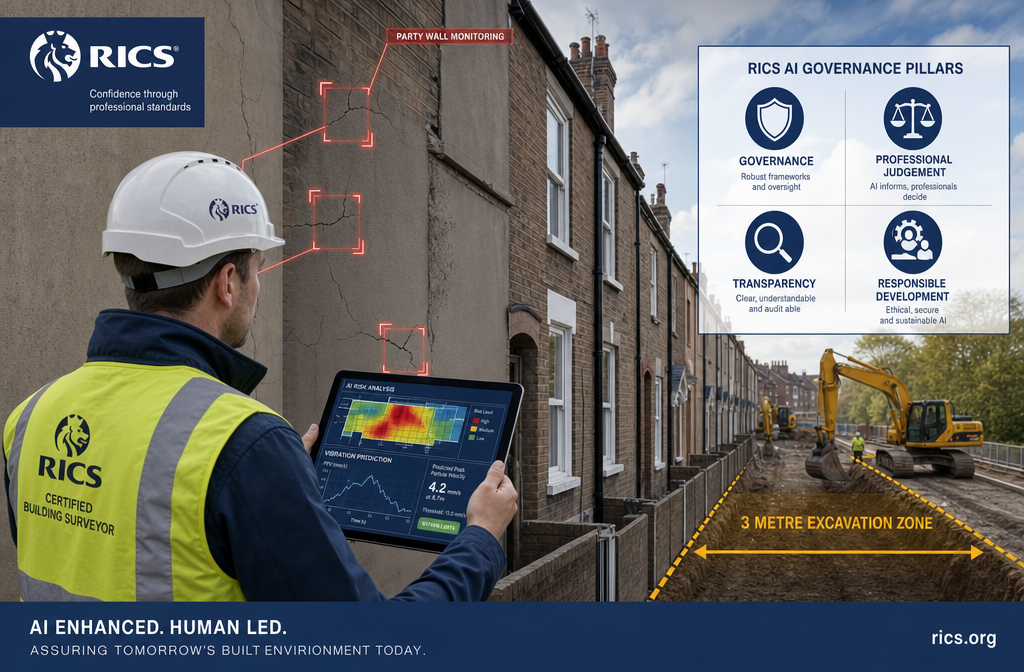
The standard is built around four pillars:
| Pillar | Core Obligation |
|---|---|
| Governance & Risk Management | Firms must identify, assess, and manage risks posed by AI tools before deployment |
| Professional Judgement & Oversight | Human review is mandatory for all AI outputs; responsibility cannot be delegated to an algorithm |
| Transparency & Client Communication | Clients must be informed when AI is used and what its limitations are |
| Responsible Development | AI tools must be developed or procured with fairness, accuracy, and accountability in mind |
For party wall surveyors, this framework applies directly to any software or algorithm used to assess defect risk, predict vibration impact, model excavation proximity effects, or draft condition schedules. [2]
Why Party Wall Work Is Specifically in Scope
The RICS standard applies wherever AI materially affects a professional service. Party wall surveying clearly qualifies because:
- Condition surveys establish the pre-construction baseline that determines liability
- Defect identification directly influences whether an adjoining owner can claim compensation
- Dispute risk analysis shapes the terms of a party wall award
A poorly calibrated AI model that misclassifies a pre-existing crack — or fails to flag a subsidence risk near a proposed excavation — can cause real financial harm to property owners. [5] That is precisely why the RICS standard demands human oversight rather than uncritical reliance on algorithmic outputs. [9]
For a thorough grounding in party wall obligations before any AI tool is applied, the party wall FAQ provides an essential starting point.
Responsible AI Tools for Party Wall Defect Prediction: Excavation Risk and Vibration Modelling
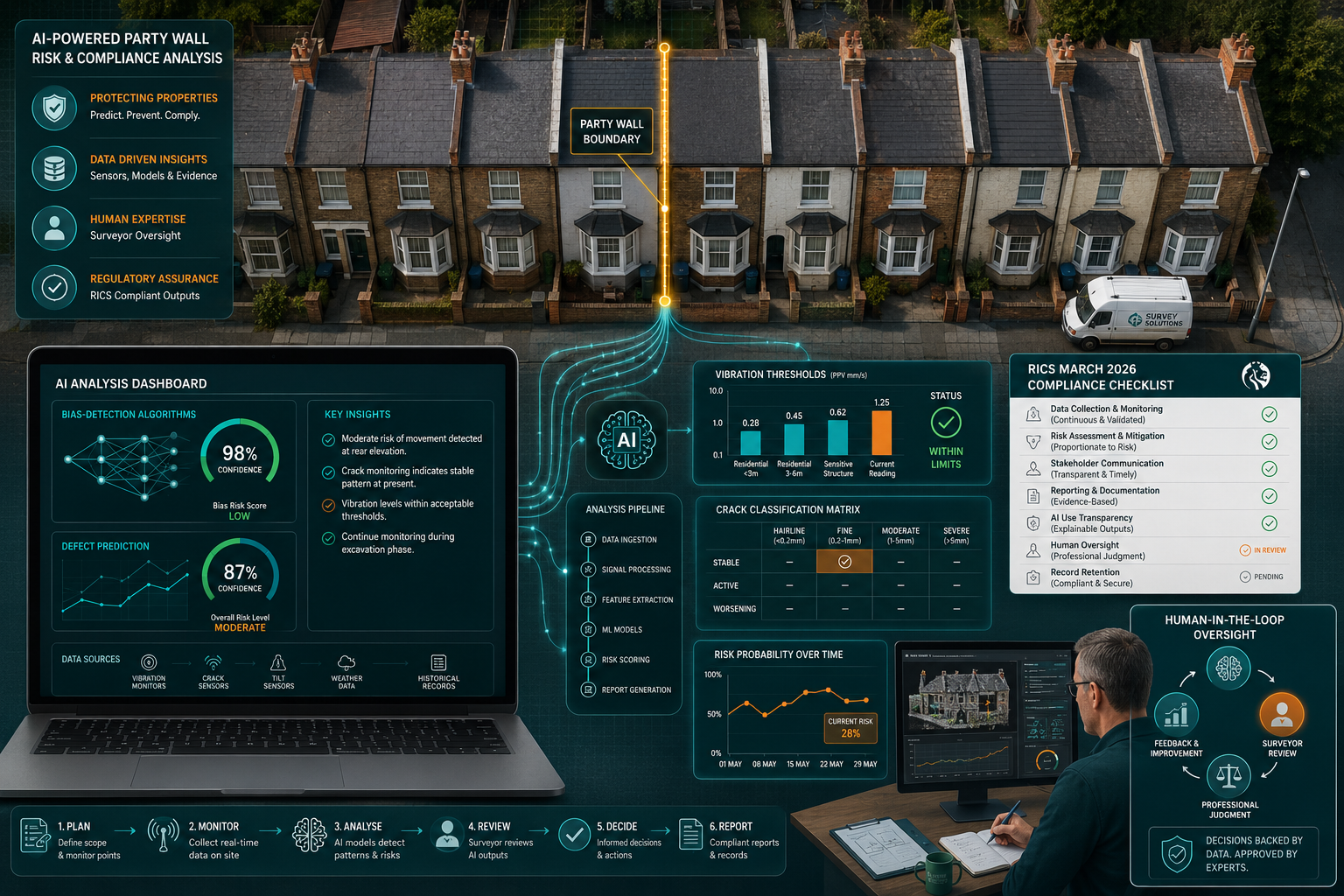
The most technically demanding application of AI in party wall work involves excavation risk prediction and vibration impact modelling. Both carry significant liability implications, and both are now subject to the RICS March 2026 standards.
Excavation Risk Prediction: What AI Can and Cannot Do
Modern AI tools can process historical ground movement data, soil classification records, foundation depth estimates, and proximity calculations to generate probabilistic risk scores for excavation-related damage. Under the 3-metre rule, any excavation within three metres of a neighbouring structure — or six metres if it undercuts a line drawn at 45 degrees — triggers party wall notice obligations.
AI can assist surveyors in:
- ✅ Identifying which excavation scenarios require formal notice
- ✅ Modelling differential settlement risk based on soil type and foundation depth
- ✅ Flagging historical subsidence patterns in a given postcode
- ✅ Generating condition schedule templates from photographic input
However, AI tools cannot:
- ❌ Replace a physical site inspection
- ❌ Guarantee accuracy where input data is incomplete or biased
- ❌ Assume professional responsibility for the final award
- ❌ Account for site-specific anomalies not present in training data
🔑 Key point: An AI risk score is a starting point for professional analysis, not a conclusion. RICS members must apply independent judgement to every output. [9]
For projects involving deep excavations, the excavation notice for party wall process must be followed regardless of what any AI tool recommends.
Vibration Threshold Modelling
Vibration from piling, demolition, and heavy plant is a leading cause of party wall damage claims. AI-assisted vibration modelling uses inputs such as:
- Peak Particle Velocity (PPV) thresholds from BS 7385 and BS 5228
- Distance from source to structure
- Building age, construction type, and condition
- Ground transmission characteristics
Responsible implementation under the RICS 2026 standard requires surveyors to:
- Document the AI tool used and its version or training dataset
- Cross-reference outputs against established PPV thresholds manually
- Record any deviations between AI predictions and site observations
- Communicate limitations to both the building owner and adjoining owner
A specific defect report commissioned before construction begins creates the defensible baseline that makes post-construction vibration claims either provable or disprovable.
Ethical Implementation and Bias-Free Party Wall Awards: A Practical Checklist
Responsible AI Tools for Party Wall Defect Prediction: RICS March 2026 Standards and Ethical Implementation are not just about technical compliance — they are about fairness. Algorithmic bias in defect prediction tools can systematically disadvantage certain property types, neighbourhoods, or building ages, leading to awards that fail to reflect actual risk. [7]
Understanding Bias in Defect Prediction Models
AI models trained predominantly on data from one region, property type, or construction era may produce skewed outputs when applied elsewhere. Common bias risks in party wall AI tools include:
- Geographic bias: Models trained on London data may underperform in Northern cities with different construction stock
- Age bias: Pre-1919 terraced housing — common in many UK cities — may be underrepresented in training datasets
- Severity bias: Models may over-predict or under-predict defect severity depending on how training labels were assigned
The RICS standard's requirement for responsible development directly addresses this: firms must scrutinise the provenance and representativeness of any AI tool they deploy. [6]
✅ RICS 2026 Compliance Checklist for AI-Assisted Party Wall Surveys
Use this checklist before, during, and after deploying AI tools in party wall defect prediction:
Before Deployment
- Confirm the AI tool has been assessed for known bias and documented limitations
- Verify the tool's training data is relevant to the property type and region
- Ensure the firm has a governance policy covering AI use in surveying
- Confirm client disclosure language is prepared
During the Survey
- Conduct a physical site inspection independent of AI outputs
- Record all AI-generated risk scores and the inputs used
- Apply professional judgement to validate or override AI findings
- Flag any discrepancies between AI outputs and physical observations
When Drafting the Award
- Ensure the award reflects surveyor judgement, not raw AI output
- Document the role AI played in the assessment process
- Include a clear statement of the surveyor's independent conclusions
- Retain a full audit trail of AI inputs, outputs, and any overrides
For guidance on what a properly drafted award should contain, the party wall award guidance resource covers the legal and professional requirements in detail.
Transparency with Clients: What Must Be Disclosed
Under the RICS 2026 standard, clients have a right to know when AI is involved in their survey. [3] Practically, this means:
- Stating in the engagement letter that AI tools may be used
- Explaining what the AI does and what its limitations are
- Confirming that a qualified surveyor has reviewed and taken responsibility for all outputs
- Providing a contact point for queries about the AI-assisted elements of the report
This transparency obligation applies equally to building owners and adjoining owners — both parties to a party wall dispute have an interest in knowing how risk assessments were generated. [2]
The Non-Delegable Responsibility Principle
Perhaps the most important concept in the RICS 2026 framework is that professional responsibility cannot be delegated to an AI system. [9] If an AI tool predicts that a proposed excavation carries low risk, and the surveyor signs off on that assessment without independent verification, the surveyor — not the software vendor — bears liability if damage occurs.
This principle has direct implications for structural surveys and condition assessments conducted alongside party wall work. The surveyor's professional indemnity insurance covers their judgement, not the algorithm's output.
Responsible AI Tools for Party Wall Defect Prediction: Governance Frameworks for Firms

For surveying practices deploying AI tools across multiple party wall instructions, a firm-level governance framework is now a RICS requirement, not an optional extra. [1]
Building a Compliant AI Governance Policy
A robust governance policy for AI-assisted party wall work should address:
1. Tool Selection and Procurement
- Due diligence on AI vendors, including bias testing results
- Contractual clarity on data ownership and model updates
- Compatibility with RICS professional standards
2. Staff Training and Competency
- Surveyors must understand the limitations of AI tools they use
- Training records should be maintained and updated
- New tools require re-training before deployment on live instructions
3. Quality Assurance and Audit
- Regular review of AI outputs against actual outcomes
- Escalation procedures when AI predictions are uncertain
- Documentation standards for all AI-assisted assessments
4. Incident Management
- Clear process for reporting AI-related errors or near-misses
- Client notification procedures if AI outputs are subsequently found to be inaccurate
- Learning loops to improve tool performance and oversight processes
Firms operating across multiple locations — from Manchester to London — should ensure their governance frameworks are consistent regardless of regional office. [8]
The Role of RICS-Accredited Surveyors
Only RICS-accredited professionals should be signing off AI-assisted party wall assessments. The standard is explicit that membership carries responsibility for AI use within a firm's practice. [6] For clients seeking assurance, working with RICS-registered valuers and surveyors provides a baseline guarantee of professional accountability.
For complex party wall scenarios — particularly those involving obstruction in party wall situations or disputed condition schedules — the combination of AI-assisted analysis and experienced human oversight is the only defensible approach in 2026. [7]
Conclusion: Actionable Next Steps for Surveyors in 2026
The RICS March 2026 AI standard has fundamentally changed the professional landscape for party wall surveyors. AI tools for defect prediction, excavation risk modelling, and vibration analysis are powerful — but they are only as reliable as the human oversight applied to them.
Here are the immediate actions every party wall surveyor should take:
- Audit your current AI tools against the four RICS pillars: governance, professional judgement, transparency, and responsible development
- Update your engagement letters to include AI disclosure language before the next instruction
- Implement the compliance checklist above on every AI-assisted party wall survey
- Train your team on the non-delegable responsibility principle — no AI output should be signed off without independent professional review
- Build your audit trail from day one: document every AI input, output, and override
- Review your PI insurance to confirm coverage extends to AI-assisted work
The firms that treat the RICS 2026 standard as a genuine quality framework — rather than a compliance burden — will produce more defensible awards, fewer disputes, and stronger client trust. That is the real competitive advantage of responsible AI implementation.
For expert support with party wall matters, contact a qualified party wall surveyor to discuss how AI-assisted assessments can be delivered in full compliance with the March 2026 RICS standards.
References
[1] Rics Issues First Mandatory Global Standard Responsible Ai – https://www.linkedin.com/pulse/rics-issues-first-mandatory-global-standard-responsible-ai-l9hie
[2] Responsible Ai Use In Party Wall Surveys Rics 2026 Standards For Dispute Prediction And Award Drafting – https://wimbledonsurveyors.com/responsible-ai-use-in-party-wall-surveys-rics-2026-standards-for-dispute-prediction-and-award-drafting/
[3] Rics Sets The Standard Responsible Ai Use Becomes Mandatory In Surveying – https://beale-law.com/article/rics-sets-the-standard-responsible-ai-use-becomes-mandatory-in-surveying/
[5] Ai Tools For Party Wall Defect Prediction Ethical Rics Compliance In 2026 High Risk Projects – https://www.canterburysurveyors.com/blog/ai-tools-for-party-wall-defect-prediction-ethical-rics-compliance-in-2026-high-risk-projects/
[6] Rics First Ever Standard On Responsible Ai Use Now In Effect – https://www.rics.org/news-insights/rics-first-ever-standard-on-responsible-ai-use-now-in-effect
[7] Responsible Ai Tools For Party Wall Defect Prediction Rics Standards Compliance In 2026 Disputes – https://kingstonsurveyors.com/responsible-ai-tools-for-party-wall-defect-prediction-rics-standards-compliance-in-2026-disputes/
[8] Responsible Ai Tools For Party Wall Defect Prediction Rics 2026 Standards And Practical Surveyor Applications – https://www.canterburysurveyors.com/blog/responsible-ai-tools-for-party-wall-defect-prediction-rics-2026-standards-and-practical-surveyor-applications/
[9] Rics Ai Guidance Article – https://www.4newsquare.com/rics-ai-guidance-article/
[10] Responsible Ai Use In Party Wall Awards Rics March 2026 Standards For Automated Condition Monitoring – https://wimbledonsurveyors.com/responsible-ai-use-in-party-wall-awards-rics-march-2026-standards-for-automated-condition-monitoring/