Over 40% of party wall disputes that escalate to formal resolution involve disagreements not about the works themselves — but about who pays, how much, and when. As RICS launches its consultation on the draft 8th edition of Party Wall Legislation and Procedure in spring 2026, fee transparency and third surveyor protocols have emerged as two of the most debated areas of reform [1][3]. For surveyors, building owners, and adjoining owners navigating this evolving landscape, understanding these changes is no longer optional — it is a compliance essential.
This article unpacks the key shifts proposed in the draft 8th edition consultation, with a focused lens on fee practices and third surveyor protocols — the two areas where the guidance is most significantly strengthened — and what practitioners must do to stay compliant in 2026.
💡 Important Notice: As of spring 2026, the 8th edition of RICS Party Wall Legislation and Procedure remains a consultation draft only. It is not yet a binding standard. The consultation ran for approximately eight weeks across April and May 2026, targeting surveyors, legal professionals, and dispute resolution practitioners in England and Wales [1][4]. Practitioners should continue to apply the 7th edition until the finalised guidance is published.
Key Takeaways
- 📋 The RICS 8th edition party wall guidance is currently a consultation draft (spring 2026) — not yet enforceable
- 💷 The draft proposes stronger transparency requirements around fee structures, including clearer billing breakdowns for building owners
- ⚖️ Third surveyor appointment and referral protocols are more explicitly defined to reduce procedural deadlock
- 🔔 Rising dispute volumes are driving the need for clearer guidance on fee recovery and impartiality standards
- ✅ Surveyors should begin aligning internal practices with the draft now to ensure a smooth transition once finalised
Why Fee Practices Are Under the Spotlight in 2026
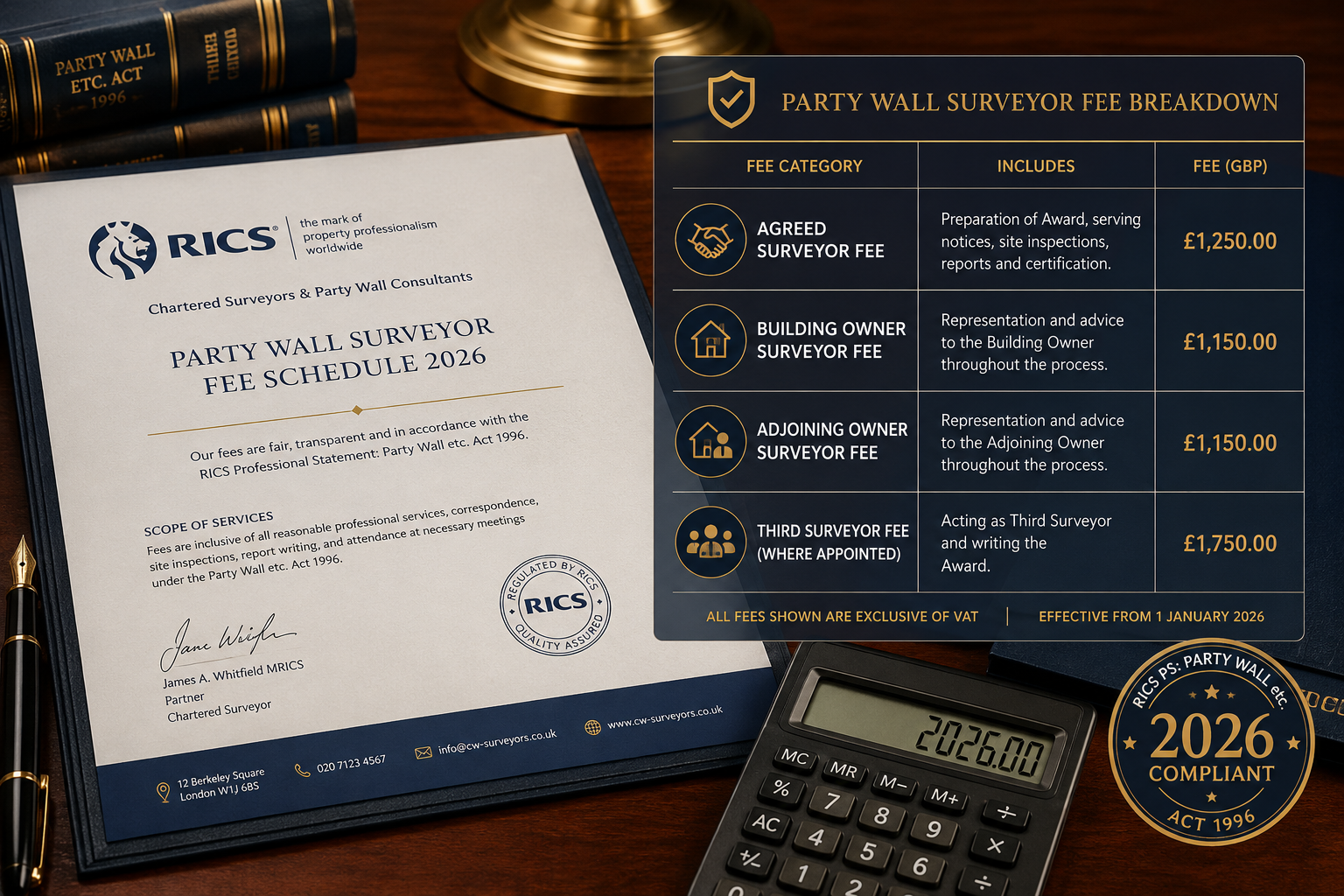
The 7th edition of RICS party wall guidance, published in January 2022, set a solid foundation for fee conduct — but it left room for interpretation that has, in practice, led to inconsistency [10]. The draft 8th edition addresses this directly, with more prescriptive language around what constitutes a reasonable fee, how costs should be communicated, and when fee disputes should be escalated [1][8].
What the Draft 8th Edition Says About Fees
The consultation draft reinforces several key principles:
- Proportionality: Fees must be proportionate to the complexity and scope of the works
- Transparency: Surveyors should provide clear, itemised billing that distinguishes between different stages of the party wall process
- Reasonableness: The standard of "reasonable fees" is retained, but the draft provides more contextual guidance on what factors should inform that assessment
- Fee recovery: The building owner remains primarily responsible for surveyor fees, but the draft clarifies circumstances under which an adjoining owner's unreasonable conduct may shift cost liability [8][9]
For a detailed overview of how party wall awards are structured and what costs are typically involved, see this guide on party wall award guidance.
The Problem with Opaque Billing
One of the most common complaints in party wall disputes — and a driver of third surveyor referrals — is billing opacity. When a building owner receives an invoice from the adjoining owner's surveyor with no breakdown, tensions escalate quickly. The draft 8th edition responds to this by encouraging surveyors to:
| Best Practice | Why It Matters |
|---|---|
| Provide a fee estimate at instruction | Sets expectations early, reduces disputes |
| Issue itemised invoices | Demonstrates proportionality and transparency |
| Distinguish between Award preparation and site visits | Helps parties understand cost drivers |
| Communicate fee increases promptly | Avoids surprise billing at completion |
"Transparent billing is not just good practice — in the context of the draft 8th edition, it is increasingly the expected standard." [2]
Fee Structures: A Practical Breakdown
The party wall services and fee structures typically encountered in 2026 include:
- Agreed Surveyor Fee — a single surveyor acts for both parties; generally the most cost-effective route
- Two Surveyor Route — each party appoints their own surveyor; fees are usually borne by the building owner
- Three Surveyor Route — triggered when the two appointed surveyors cannot agree; the third surveyor's fee is also typically recoverable from the building owner unless the dispute arose from unreasonable conduct by the adjoining owner
Understanding which route applies to a given project is critical for accurate cost forecasting. For common questions about the process, the party wall FAQ is a useful starting point.
Third Surveyor Protocols: Strengthened Guidance for Deadlock Resolution

The third surveyor mechanism — established under Section 10 of the Party Wall etc. Act 1996 — exists precisely for situations where the two appointed surveyors cannot reach agreement. In theory, it is a clean resolution pathway. In practice, it has often been misunderstood, misused, or avoided due to cost concerns and procedural uncertainty.
The draft 8th edition consultation tackles this head-on, with clearer protocols for when and how the third surveyor should be engaged [1][3].
When Should the Third Surveyor Be Called?
Under the existing 7th edition framework, the threshold for third surveyor referral is relatively clear in statute but less clear in practice. The draft 8th edition guidance proposes more explicit criteria, including:
- Genuine impasse — the two surveyors have made reasonable attempts to agree and have documented their positions
- Procedural disputes — disagreements about the scope of the Award, not just minor drafting differences
- Fee disputes — where the two surveyors cannot agree on what constitutes a reasonable fee for the adjoining owner's surveyor
- Unresponsive surveyor — where one surveyor fails to engage within a reasonable timeframe
🔑 Key point: The draft guidance discourages using the third surveyor as a first resort or as a tactical tool to pressure the other party. This is a significant clarification that aligns with the broader push for proportionate dispute resolution.
Appointment and Impartiality Standards
The third surveyor is selected at the outset — typically agreed between the two appointed surveyors before any dispute arises. The draft 8th edition reinforces that the third surveyor must:
- Be genuinely independent of both parties and both appointed surveyors
- Avoid any conflict of interest, including prior involvement in the project
- Act judicially — considering the merits of both surveyors' positions without favour
- Issue a determination that is reasoned and proportionate
This matters particularly in the context of the party wall process more broadly, where impartiality is the cornerstone of the entire statutory framework.
The Third Surveyor's Role in Fee Disputes
One of the most practically significant clarifications in the draft 8th edition concerns the third surveyor's jurisdiction over fee disputes. The draft makes clearer that:
- The third surveyor can determine what constitutes a reasonable fee for the adjoining owner's surveyor
- This determination is binding unless challenged in court
- The third surveyor should consider the complexity of the works, the time reasonably spent, and the local market rate for comparable services [8][9]
This is a welcome development. Previously, fee disputes often fell into a grey area where neither surveyor was certain whether the third surveyor had clear jurisdiction. The draft 8th edition removes that ambiguity.
⚠️ Practical tip for surveyors: Document your time and reasoning at every stage. If a fee dispute reaches the third surveyor, a well-maintained file is your strongest evidence.
Referral Procedure: Step-by-Step
The draft 8th edition sets out a cleaner referral procedure:
- Identify the dispute — document the specific point of disagreement in writing
- Attempt resolution — the two surveyors must demonstrate they have tried to agree
- Notify the third surveyor — formal written referral with supporting documents
- Third surveyor review — both surveyors submit their positions; the third surveyor may request further information
- Determination issued — the third surveyor issues a written determination, which forms part of or supplements the Award
- Cost allocation — the determination should address who bears the third surveyor's fee
For projects involving excavation near a party wall, where disputes about scope and cost are particularly common, see the guidance on excavation notices under the Party Wall Act.
Compliance Essentials: What Practitioners Must Do Now
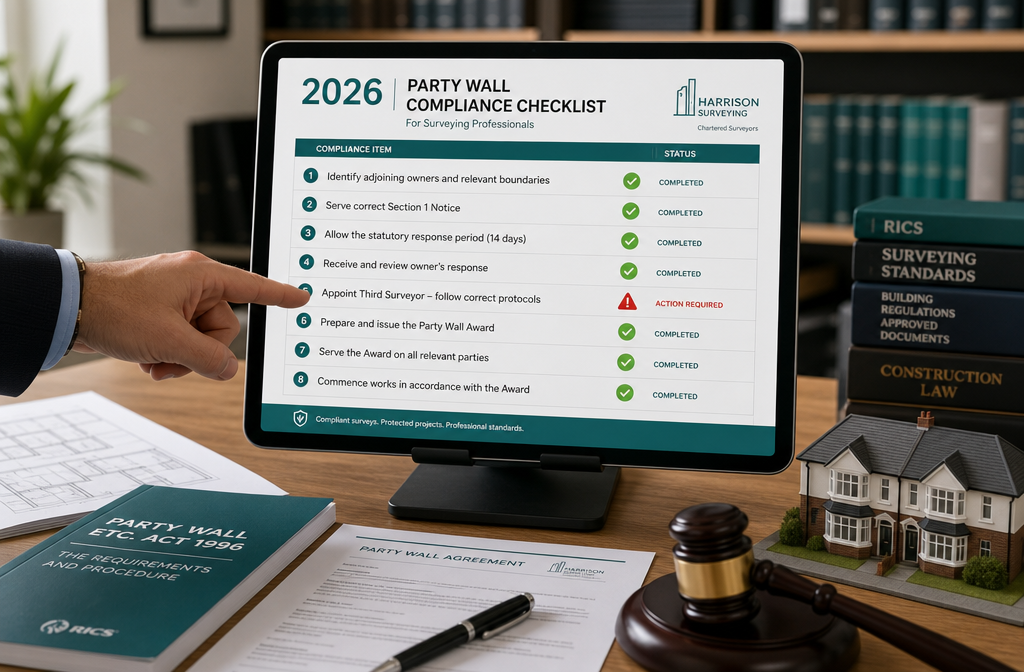
Given that the 8th edition remains a consultation draft in 2026, practitioners face a dual responsibility: continue applying the 7th edition while preparing internal processes for the changes ahead. Here is a practical compliance roadmap.
Immediate Actions (Pre-Finalisation)
✅ Review your fee communication templates — ensure they align with the transparency principles in the draft 8th edition, even before it becomes binding
✅ Update your third surveyor selection process — confirm that your agreed third surveyor has no conflicts and is genuinely independent
✅ Audit your file management — the draft places greater emphasis on documented reasoning; ensure your files reflect this
✅ Engage with the consultation — RICS actively sought input from surveyors and practitioners during the April–May 2026 consultation window [1][4]
✅ Brief clients early — building owners and adjoining owners benefit from understanding the fee structure and third surveyor mechanism before disputes arise
Longer-Term Preparation
For RICS-chartered surveyors, staying current with evolving guidance is part of professional obligation. Working with a RICS chartered building surveyor ensures that clients receive advice grounded in the latest standards and best practice.
Key areas to monitor as the 8th edition moves toward finalisation:
- Fee guidance updates — watch for any specific thresholds or benchmarks introduced in the final version
- Third surveyor jurisdiction — the final text may further clarify or expand the third surveyor's remit
- Digital delivery — there is growing discussion about electronic service of notices and Awards; the 8th edition may address this more formally [6]
- Schedule of condition requirements — the draft is expected to reinforce the importance of pre-works condition records; see the guidance on schedules of condition in party wall awards for current best practice
A Note on Rising Dispute Volumes
Dispute volumes in the party wall sector have been increasing, driven by a combination of urban densification, rising property values, and greater awareness of the Act among building owners and neighbours alike [6][7]. This makes the clarity offered by the draft 8th edition — particularly around fees and third surveyor use — more important than ever.
Where a neighbour is already carrying out works without a party wall agreement, the situation can escalate rapidly. Understanding the options available is essential — see the guidance on what to do when a neighbour carries out works without a party wall agreement.
Summary Table: 7th Edition vs Draft 8th Edition Key Changes
| Area | 7th Edition (2022) | Draft 8th Edition (2026 Consultation) |
|---|---|---|
| Fee transparency | General reasonableness standard | More prescriptive itemisation guidance |
| Third surveyor jurisdiction | Implied over fee disputes | More explicitly stated |
| Referral procedure | Broadly outlined | Step-by-step protocol proposed |
| Impartiality standards | Established principle | Reinforced with clearer criteria |
| Fee recovery | Building owner liable | Clearer guidance on shifting liability |
| Digital delivery | Not addressed | Under active discussion |
Conclusion
The draft 8th edition of RICS Party Wall Legislation and Procedure represents the most significant update to party wall practice guidance in several years. For practitioners in 2026, the strengthened provisions around fee practices and third surveyor protocols are not peripheral details — they are central to how party wall work is conducted, billed, and resolved.
The core message is clear: transparency, proportionality, and procedural rigour are the standards to which surveyors will increasingly be held. Whether the 8th edition is finalised later in 2026 or early 2027, the direction of travel is unmistakable.
Actionable Next Steps
- Download and read the consultation draft from the RICS website and note the specific fee and third surveyor provisions
- Update your client care letters and fee proposals to reflect the transparency principles in the draft
- Review your third surveyor panel — ensure independence and document the selection process
- Train your team on the proposed referral procedure so that, when disputes arise, the process is followed correctly from day one
- Engage a qualified RICS party wall surveyor who is already preparing for the 8th edition transition — get a quote for party wall services at Manchester Surveyors
The party wall framework exists to protect both building owners and neighbours. Getting the fee and third surveyor elements right is how that protection is delivered in practice.
References
[1] Rics Launches Consultation On Updated Party Wall Practice Guidance – https://www.rics.org/news-insights/rics-launches-consultation-on-updated-party-wall-practice-guidance
[2] James Kavanagh 65448b17 Rics Launches Consultation On Updated Party Activity 7448044807869988865 Vpzf – https://www.linkedin.com/posts/james-kavanagh-65448b17_rics-launches-consultation-on-updated-party-activity-7448044807869988865-vPZF
[3] Rics Launches Consultation On Party Wall Guidance – https://thenegotiator.co.uk/news/regulation-law-news/rics-launches-consultation-on-party-wall-guidance/
[4] Party Wall Legislation And Procedure – https://www.rics.org/profession-standards/rics-standards-and-guidance/sector-standards/building-surveying-standards/party-wall-legislation-and-procedure
[6] Building Your Expert Witness Practice In 2026 Specializations In Party Wall Defects And Valuations – https://www.canterburysurveyors.com/blog/building-your-expert-witness-practice-in-2026-specializations-in-party-wall-defects-and-valuations/
[7] Schedules Of Condition In Party Wall Awards Rics Updated Templates For 2026 Damage Defense – https://partywallsurveyorlondon.uk/blogs/schedules-of-condition-in-party-wall-awards-rics-updated-templates-for-2026-damage-defense/
[8] Rics Consults On Updated Party Wall Practice Guidance – https://www.lexisnexis.co.uk/legal/news/rics-consults-on-updated-party-wall-practice-guidance
[9] Party Wall Awards By Chartered Building Surveyors Rics Services Fee Structures And Case Studies For 2026 – https://manchestersurveyors.com/party-wall-awards-by-chartered-building-surveyors-rics-services-fee-structures-and-case-studies-for-2026/
[10] Jan 22 Party Wall Legislation And Procedure 7th Edition – https://www.rics.org/content/dam/ricsglobal/documents/standards/jan_22_party_wall_legislation_and_procedure_7th_edition.pdf