Only 23% of private rented sector properties in England currently meet all Housing Health and Safety Rating System (HHSRS) standards — yet from 2026, the legal bar for landlords is rising sharply. Expert Witness Evidence for Structural Collapse and Explosion Hazards in Awaab's Law Disputes: 2026 PRS Cases is fast becoming one of the most technically demanding areas of housing law, as Phase 2 of Awaab's Law brings structural failure and explosion risks into scope for the first time [4][9].
For surveyors, structural engineers, and housing lawyers, the question is no longer whether expert evidence will be needed in these disputes — it is how to prepare reports that satisfy CPR Part 35 obligations, meet the law's strict statutory timeframes, and withstand tribunal scrutiny.
Key Takeaways 📋
- From 2026, Awaab's Law Phase 2 explicitly covers "structure collapse and falling elements" and "explosion" as prescribed HHSRS hazards, requiring strict investigation and repair timelines [4][9].
- Emergency structural/explosion hazards must be investigated within 24 hours of a landlord becoming aware, with safety works starting immediately [4].
- Awaab's Law technically applies to social housing as of October 2025, but its standards are increasingly used as a benchmark in PRS disrepair claims before courts and tribunals [10].
- CPR Part 35-compliant expert witness reports from chartered structural engineers are now essential to evidence whether landlord responses were timely and reasonable [5][8].
- Early PRS enforcement cases in 2026 are already testing how courts apply Awaab's Law norms to private tenants — surveyors must understand both the legal framework and technical evidence standards.
What Awaab's Law Phase 2 Means for Structural and Explosion Hazards
Awaab's Law — named after two-year-old Awaab Ishak, who died in 2020 following prolonged exposure to severe mould — came into force for social landlords on 27 October 2025 [7]. Phase 1 focused on emergency hazards and significant damp and mould. However, Phase 2, rolling out from 2026, widens the regime to a broader set of HHSRS prescribed hazards, explicitly including:
| HHSRS Hazard Category | Awaab's Law Phase |
|---|---|
| Damp and mould growth | Phase 1 (Oct 2025) |
| Emergency structural collapse | Phase 1 (emergency) |
| Significant structural collapse | Phase 2 (2026) |
| Explosion (gas/structural) | Phase 2 (2026) |
| Excess cold/heat | Phase 2 (2026) |
| Falls on stairs/surfaces | Phase 2 (2026) |
| Electrical hazards | Phase 2 (2026) |
This expansion means that structural engineers and explosion specialists are now being positioned as frontline expert witnesses in anticipated litigation [9]. Legal briefings from early 2026 confirm that these hazards will be subject to the same fixed statutory timeframes that have already reshaped how social landlords respond to damp complaints [4].
💬 "Awaab's Law represents a broader legislative shift — one that will redefine the evidentiary standards required in all housing hazard disputes, not just those involving mould." — ARK Consultancy [9]
The Statutory Timeframes That Shape Expert Evidence
Understanding the timeframes is critical for anyone preparing or commissioning expert witness reports. The draft guidance sets out two distinct tracks [4]:
🚨 Emergency Hazards (imminent structural collapse or explosion risk):
- Landlord must investigate within 24 hours of becoming aware
- Safety works must commence as soon as reasonably practicable within that 24-hour window
- Written records of all steps taken must be maintained
⚠️ Significant (Non-Imminent) Hazards:
- Investigation must begin within 10 working days
- Written findings delivered to tenant within 3 working days of investigation conclusion
- Relevant safety work to start within 5 working days of conclusion
- Complex physical works to begin within 12 weeks
These timeframes do more than govern landlord behaviour — they directly shape the scope and urgency of expert witness instructions. When a landlord claims that a delay was "reasonable," it falls to a chartered structural engineer or explosion specialist to provide independent evidence either supporting or challenging that position [5].
Preparing CPR Part 35-Compliant Reports: Standards for Structural Collapse and Explosion Cases
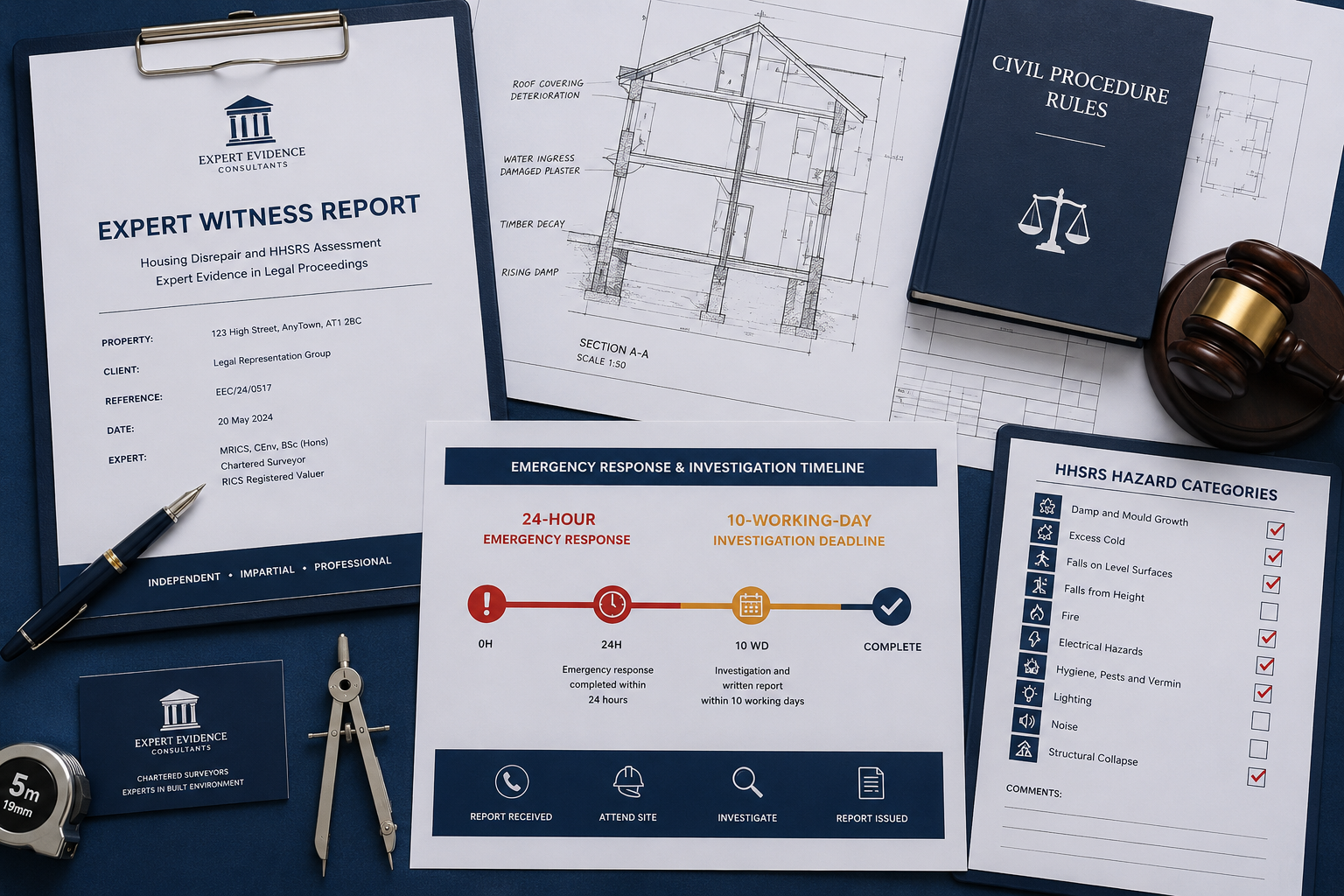
CPR Part 35 governs expert evidence in civil proceedings in England and Wales. Any expert witness report used in an Awaab's Law dispute — whether in the First-tier Tribunal (Property Chamber), County Court, or Housing Ombudsman proceedings — must comply with these rules. For Expert Witness Evidence for Structural Collapse and Explosion Hazards in Awaab's Law Disputes: 2026 PRS Cases, the technical complexity is significantly higher than for damp or mould cases.
A fully compliant CPR Part 35 report for structural collapse or explosion hazards must include:
1. 📐 Scope of Instruction and Independence Declaration
The report must clearly state the expert's instructions, confirm they understand their overriding duty to the court (not the instructing party), and include the Part 35 declaration. This is non-negotiable and frequently the first point challenged by opposing counsel.
2. 🏗️ Technical Assessment of the Hazard
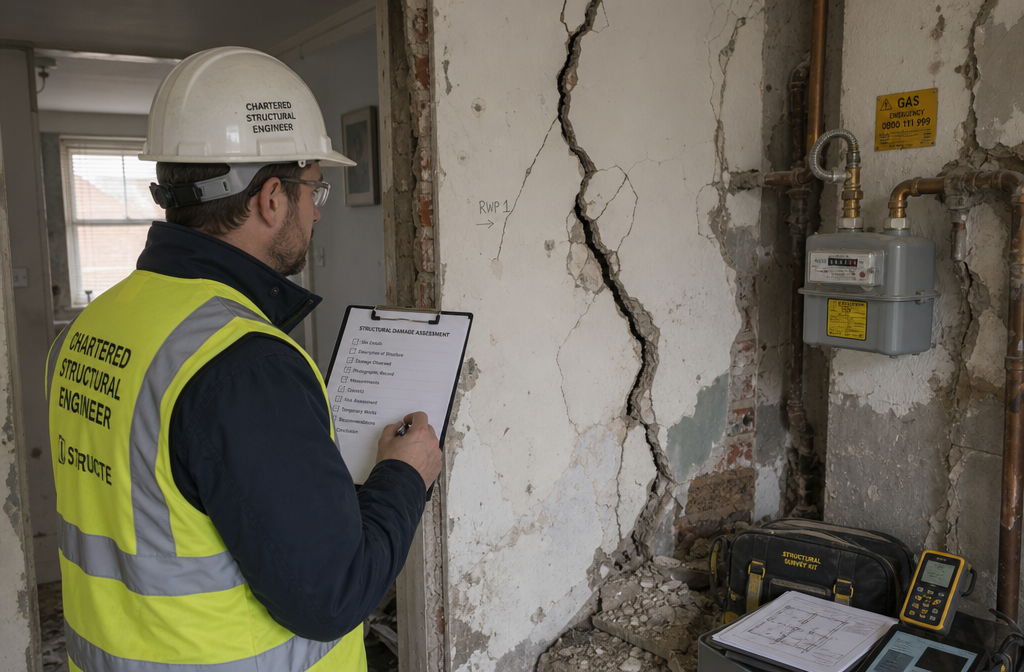
For structural collapse, this means:
- Visual inspection findings (cracks, subsidence, lintel failure, roof spread)
- Assessment against HHSRS Category 1 and Category 2 thresholds
- Structural calculations where load-bearing elements are involved
- Photographic evidence with annotations
For explosion hazards, this typically involves:
- Gas installation condition and compliance with Gas Safe regulations
- Assessment of ventilation and pressure relief
- Evidence of prior complaints or near-miss incidents
- Liaison with Gas Safe Register records where appropriate
A thorough structural survey carried out by a chartered surveyor provides the foundational evidence base from which an expert witness report is built.
3. ⏱️ Chronological Analysis of Landlord Awareness and Response
This is where Awaab's Law timeframes become forensically important. The expert must map:
- When the landlord first became (or should have become) aware of the hazard
- What steps were taken and when
- Whether those steps met the 24-hour or 10-working-day thresholds
- Whether any delay was objectively "reasonable" given the circumstances
Courts and tribunals will scrutinise this timeline closely. An expert witness report that presents this chronology clearly, with supporting documentary evidence, is far more persuasive than one that simply lists defects.
4. 📊 Quantum Assessment
Where compensation is sought, the report must address the financial impact of the hazard — including diminution in rental value, cost of temporary rehousing, and the cost of remedial works. Surveyors should cross-reference findings with a stock condition survey to establish the baseline condition of the property.
5. 🔍 Causation and Foreseeability
Expert evidence must address whether the hazard was foreseeable and whether the landlord had sufficient information to act. In explosion cases, this often involves reviewing gas safety certificates and any prior complaints. In structural cases, it may involve reviewing historic survey reports or planning records.
The PRS Dimension: How Awaab's Law Norms Are Entering Private Rented Sector Disputes
As of spring 2026, Awaab's Law formally applies only to registered social housing providers and local authority landlords [4][10]. It does not yet extend to the private rented sector. However, this technical boundary is becoming increasingly porous in practice.
Courts and tribunals adjudicating PRS disrepair claims — brought under the Landlord and Tenant Act 1985 or the Homes (Fitness for Human Habitation) Act 2018 — are beginning to treat Awaab's Law standards as a persuasive benchmark when assessing whether a private landlord's response to a structural or explosion hazard was adequate [10].
💬 "Even where Awaab's Law does not directly apply, claimants' solicitors are citing its timeframes and investigation standards as evidence of what a reasonable landlord should have done." — Expert Court Reports [10]
This creates a significant risk for PRS landlords who are unaware of the emerging norms. It also creates an opportunity for expert witnesses who understand both the technical and legal landscape.
Early 2026 PRS Enforcement: What Cases Are Showing
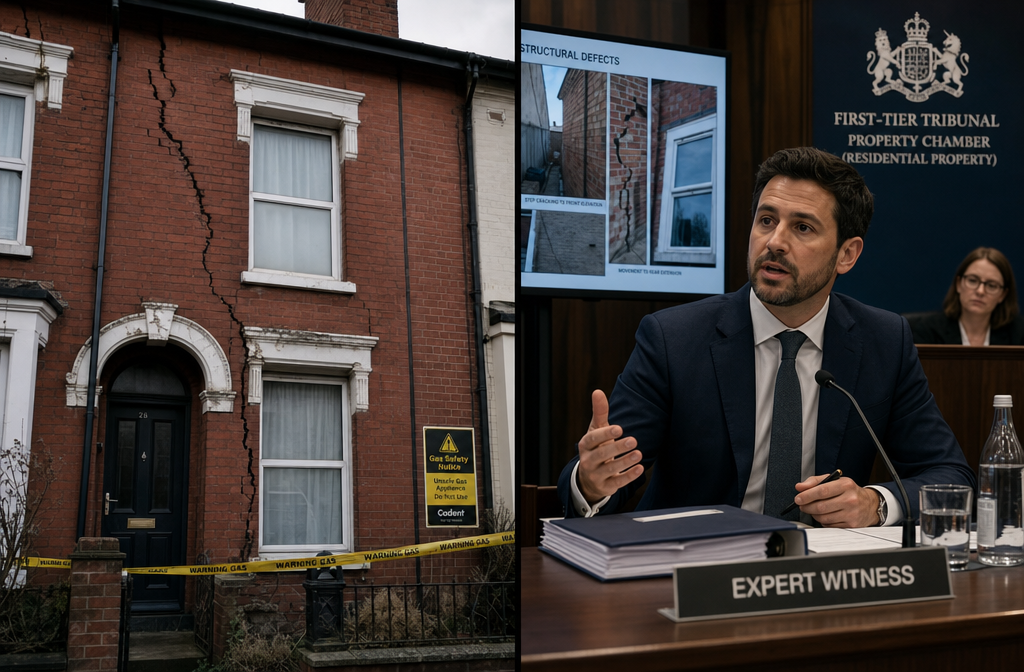
Early 2026 PRS cases involving structural and explosion hazards are revealing several recurring patterns:
Pattern 1: Delayed Gas Safety Response
Tenants reporting gas smells or suspected leaks where landlords failed to respond within 24 hours. Expert witnesses are being asked to assess whether the risk was genuinely imminent and whether the landlord's delay was reasonable. Gas Safe engineers and explosion specialists are increasingly instructed alongside chartered surveyors.
Pattern 2: Subsidence and Structural Movement Disputes
Properties showing progressive cracking where tenants allege the landlord was aware but failed to investigate. Structural engineers are providing expert evidence on the rate of movement, the point at which the hazard became Category 1, and whether earlier intervention would have prevented escalation.
Pattern 3: Shared Ownership and Leasehold Complications
While Awaab's Law does not cover long leaseholders, some PRS disputes involve properties with shared structural elements. Party wall disputes and shared structural responsibilities are adding complexity to expert witness instructions in these cases.
Pattern 4: Failure to Commission Adequate Surveys
In several early cases, landlords have been criticised for relying on basic property checks rather than commissioning a proper RICS building survey before letting a property with known structural issues. Expert witnesses are being asked to opine on whether a competent pre-let survey would have identified the hazard.
Qualifications and Competency: Who Should Act as Expert Witness?
Not every surveyor is qualified to provide expert witness evidence on structural collapse or explosion hazards. The 2026 landscape demands specialists with:
For Structural Collapse Cases:
- Chartered Structural Engineer (CEng MIStructE or MICE) — essential for load-bearing assessments
- RICS Chartered Surveyor with demonstrated experience in structural pathology
- Familiarity with BS 5628, Eurocode 2/3, and HHSRS guidance on structural hazards
- Experience of commercial building surveys and residential structural assessments
For Explosion Hazard Cases:
- Gas Safe Registered Engineer for gas installation assessments
- Explosion and fire investigator (often with forensic engineering background)
- Familiarity with Gas Safety (Installation and Use) Regulations 1998 and BS 6891
For All Awaab's Law Expert Witness Roles:
- Demonstrable CPR Part 35 experience and court/tribunal familiarity
- Ability to produce clear, jargon-free reports accessible to non-technical decision-makers
- Understanding of HHSRS scoring methodology and Category 1/2 thresholds
- Current awareness of Awaab's Law Phase 2 prescribed hazard definitions [8]
💡 Pro tip for instructing solicitors: Always check that your expert witness has specific experience with HHSRS hazard assessments, not just general surveying credentials. The difference between a Category 1 and Category 2 finding can determine whether Awaab's Law emergency timeframes apply — and that distinction must be expertly evidenced.
Common Pitfalls in Expert Witness Reports for These Cases
Based on emerging 2026 case patterns, the following errors are most likely to undermine an expert witness report:
| ❌ Common Pitfall | ✅ Best Practice |
|---|---|
| Failing to declare CPR Part 35 compliance | Include full declaration and confirm overriding duty to court |
| Conflating Category 1 and Category 2 HHSRS findings | Clearly distinguish severity thresholds with scoring rationale |
| Omitting a chronological landlord-awareness analysis | Map all key dates against Awaab's Law timeframes |
| Providing opinion beyond area of expertise | Limit scope to qualified specialism; recommend co-expert if needed |
| Using technical jargon without explanation | Define all technical terms; write for a non-specialist tribunal |
| Failing to address quantum | Include cost of remediation and impact on habitability |
| Not inspecting the property in person | Remote assessment is rarely sufficient for structural/explosion cases |
Conclusion: Actionable Steps for Surveyors and Legal Teams in 2026
Expert Witness Evidence for Structural Collapse and Explosion Hazards in Awaab's Law Disputes: 2026 PRS Cases demands a new level of technical rigour, legal awareness, and procedural precision. The combination of Awaab's Law's strict statutory timeframes, its growing influence on PRS litigation, and the technical complexity of structural and explosion hazards means that poorly prepared expert reports will face robust challenge.
✅ Actionable Next Steps
-
Review your CPR Part 35 compliance procedures — ensure every report includes the mandatory declaration, clear scope of instruction, and overriding duty statement.
-
Upskill on HHSRS hazard scoring — particularly for structural collapse and explosion categories, as these are now Phase 2 prescribed hazards under Awaab's Law [9].
-
Build a chronological evidence framework — every expert report in an Awaab's Law-adjacent dispute should map landlord awareness against the 24-hour and 10-working-day response thresholds [4].
-
Commission thorough baseline surveys — a comprehensive RICS building survey or structural survey before tenancy commencement provides critical baseline evidence.
-
Collaborate across disciplines — structural collapse and explosion cases often require joint expert evidence from structural engineers, gas safety specialists, and chartered surveyors. Plan for this from the outset.
-
Monitor PRS case law developments — courts are actively applying Awaab's Law norms to private sector disputes; staying current with tribunal decisions is essential for all housing expert witnesses [10].
The 2026 landscape is one of rapid legal evolution. Surveyors and engineers who invest now in understanding the intersection of Awaab's Law, HHSRS, and CPR Part 35 will be best placed to provide the authoritative expert evidence that courts, landlords, and tenants urgently need.
References
[1] Awaab's Law Must Be Repealed And Re-Written Claims Expert – https://housingdigital.co.uk/awaabs-law-must-be-repealed-and-re-written-claims-expert/
[2] Watch (RICS APC Awaab's Law explanation) – https://www.youtube.com/watch?v=KeILjP-L3sQ
[3] Fix Fast: How Awaab's Law Is Forcing Action in Social Housing – https://www.linkedin.com/pulse/fix-fast-how-awaabs-law-forcing-action-social-szrme
[4] Awaab's Law: Compliance, Consequences and Oversight for Social Housing Providers – https://www.penningtonslaw.com/insights/awaabs-law-compliance-consequences-and-oversight-for-social-housing-providers/
[5] Expert Witness Reports for Electrical Hazards in Awaab's Law Disputes – https://nottinghillsurveyors.com/blog/expert-witness-reports-for-electrical-hazards-in-awaabs-law-disputes-building-evidence-standards-and-quantum-assessments-post-2026-expansion
[7] Awaab's Law Comes Into Force: What Does It Mean for Construction – https://www.trowers.com/insights/2025/november/awaabs-law-comes-into-force-what-does-it-mean-for-construction
[8] Forensisgroup Discusses 2026 Trends Affecting Expert Witness Testimony – https://www.thedestinlog.com/press-release/story/37901/forensisgroup-discusses-2026-trends-affecting-expert-witness-testimony/
[9] Awaab's Law: A Broader Legislative Shift – https://www.arkconsultancy.co.uk/news-article/awaabs-law-a-broader-legislative-shift/
[10] Awaab's Law and Housing Disrepair Claims – https://www.expertcourtreports.co.uk/blog/awaabs-law-housing-disrepair-claims/