Nearly 40% of real estate professionals say they are operating in a market defined by uncertainty — rising interest rates, shifting demographics, and AI-driven disruption have created conditions where the cost of getting a property decision wrong has never been higher. This is precisely why the impact of 2026 real estate trends on property surveying demands is a subject that deserves serious attention. From high-growth corridors like Dallas-Fort Worth to ageing urban housing stock across the UK, the forces reshaping property markets in 2026 are directly — and measurably — increasing the need for precise, professional surveying services.

Key Takeaways 📌
- AI adoption in real estate is accelerating deal velocity but creating new due-diligence gaps that only physical surveys can fill.
- Demographic shifts — particularly the surge in senior housing demand — are generating a wave of specialist survey requirements for new-build and converted stock.
- Market "fog" (high uncertainty, compressed transaction timelines) makes professional property surveys more critical, not less.
- High-growth markets such as Dallas-Fort Worth demonstrate how rapid development amplifies surveying demand across all property types.
- Buyers, investors, and lenders who skip or delay surveys in 2026's volatile market are taking on disproportionate financial risk.
How 2026 Real Estate Trends Are Reshaping the Surveying Landscape
The Urban Land Institute (ULI) has consistently highlighted three macro forces shaping real estate in 2026: artificial intelligence, demographic transformation, and market opacity — what analysts are calling the "fog" of post-pandemic property cycles. Each of these forces has a direct knock-on effect on surveying demand.
🤖 AI in Real Estate: Speed Without Certainty
AI-powered platforms are now capable of generating property valuations, risk scores, and investment analyses in seconds. Institutional investors use machine-learning models to screen thousands of assets simultaneously. On the surface, this might seem to reduce the need for boots-on-the-ground surveying. In reality, it does the opposite.
"AI can tell you what a property is worth on paper. Only a qualified surveyor can tell you what it's worth in practice."
Here's why AI is increasing surveying demand in 2026:
- Automated valuations miss physical defects. Algorithms rely on comparable sales data and square footage — they cannot detect subsidence, structural movement, or damp.
- Faster deal cycles compress due diligence windows. When AI-driven platforms accelerate offer timelines, buyers face pressure to commit before traditional checks are complete. The risk of skipping a survey grows — and so does the financial exposure.
- Lenders are tightening requirements. As AI-generated valuations become more common, many mortgage lenders are now requiring independent RICS-compliant surveys as a counterbalance.
For buyers navigating this landscape, understanding which survey you need is the essential first step before any transaction moves forward.
Demographics Driving Senior Housing — and New Surveying Requirements
The second major trend identified by ULI is demographic: the ageing of the Baby Boomer generation is creating unprecedented demand for senior housing, assisted living facilities, and purpose-built retirement communities. In the UK alone, the number of people aged 75 and over is projected to grow by over 50% in the next two decades.
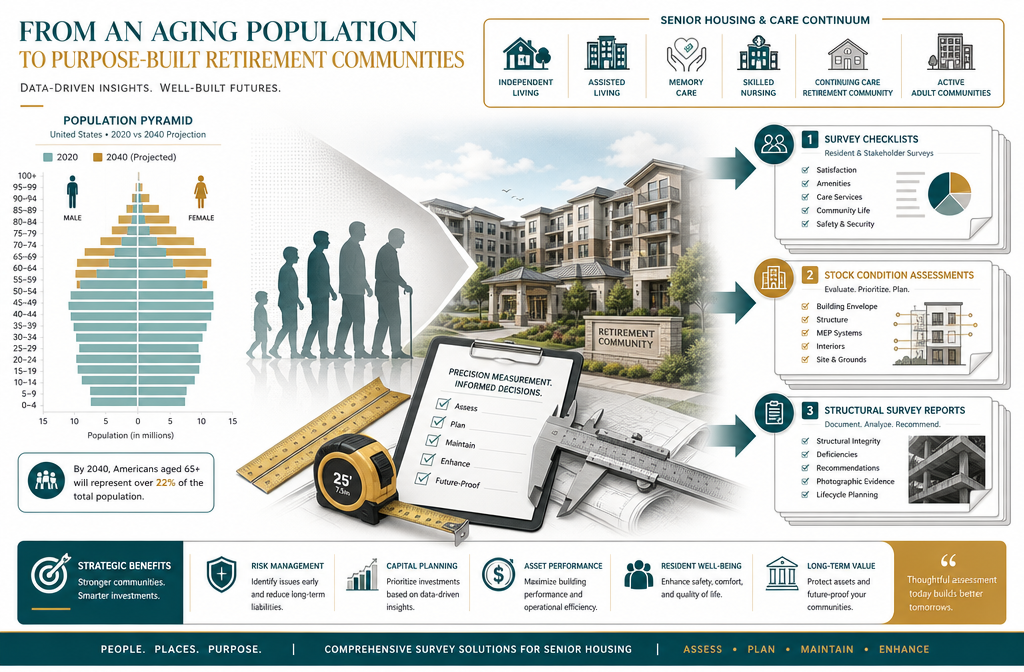
This demographic wave has direct implications for property surveying across several categories:
New-Build Senior Housing
Developers rushing to meet demand are constructing purpose-built retirement communities at scale. Every new development requires:
- Structural surveys to verify build quality against specification
- Stock condition surveys to establish baseline condition data for long-term asset management
- Compliance checks against accessibility and fire safety standards
A stock condition survey is particularly valuable for housing associations and retirement community operators who need to plan maintenance budgets over 10–30 year horizons.
Conversion Projects
Many developers are converting existing commercial or residential buildings into senior living accommodation. These projects carry higher structural risk than new builds, making professional surveys non-negotiable. Issues such as inadequate floor loading, outdated electrical systems, and poor thermal performance are common in older stock being repurposed.
| Property Type | Key Survey Concern | Recommended Survey |
|---|---|---|
| New-build retirement community | Build quality & compliance | Structural survey |
| Converted office to assisted living | Structural integrity, fire safety | RICS Building Survey |
| Older residential stock | Damp, subsidence, roof condition | Homebuyer Survey |
| Commercial care facility | Dilapidations, lease obligations | Dilapidation Survey |
The Right-to-Buy and Shared Ownership Angle
Demographic change is also driving demand for affordable and shared ownership housing. Many older buyers are downsizing using Right to Buy schemes, which require formal RICS valuations. Understanding the Right to Buy valuation process is essential for anyone navigating this route in 2026.
Market "Fog" and Why Uncertainty Amplifies Surveying Demand
The third ULI trend — market opacity — may be the most consequential for surveying professionals. In 2026, property markets are characterised by:
- Compressed transaction timelines driven by competitive bidding
- Inconsistent pricing signals as interest rate expectations shift
- Increased cross-border and institutional investment in previously local markets
- Post-pandemic structural changes in how offices, retail, and industrial spaces are used
This "fog" creates a dangerous environment for buyers and investors who rely on surface-level data. The antidote is precise, professional surveying — the kind that cuts through market noise and delivers verified, actionable intelligence about a property's true condition and value.
The Dallas-Fort Worth Effect: A Case Study in Rapid Growth
Dallas-Fort Worth (DFW) has become one of the most closely watched real estate markets globally. Population growth, corporate relocations, and infrastructure investment have driven double-digit property value increases in certain submarkets. But rapid growth creates its own surveying challenges:
- Fast-tracked construction increases the risk of defects in new builds
- Older stock in gentrifying neighbourhoods may carry hidden structural issues
- Commercial conversions from retail to mixed-use require specialist assessments
- Boundary and title disputes become more common as land values rise sharply
The DFW dynamic mirrors patterns seen in high-growth UK markets — from Manchester's Northern Quarter to London's outer boroughs — where rapid development and rising values create both opportunity and risk. In these conditions, a RICS Building Survey provides the depth of analysis that protects buyers from costly post-purchase surprises.
The Impact of 2026 Real Estate Trends on Property Surveying Demands: Sector-by-Sector Analysis
Understanding the impact of 2026 real estate trends on property surveying demands requires looking at each major property sector individually.

🏠 Residential Property
The residential market in 2026 is characterised by:
- High buyer competition in desirable postcodes
- Increased leasehold reform activity creating new valuation needs
- Energy Performance Certificate (EPC) requirements driving demand for condition assessments
For residential buyers, a homebuyer survey remains the most cost-effective way to identify defects and negotiate on price. In a market where properties are selling quickly, having survey results ready can be the difference between securing a deal and losing it.
🏢 Commercial Property
The commercial sector is undergoing structural transformation. Hybrid working has permanently altered office demand, while e-commerce continues to reshape retail. Key surveying demands in 2026 include:
- Dilapidations surveys as commercial leases expire and landlords seek to recover reinstatement costs
- Structural assessments for office-to-residential conversion projects
- Condition surveys for industrial and logistics assets experiencing high demand
For landlords and tenants navigating end-of-lease obligations, understanding dilapidation surveys is critical to avoiding costly disputes.
🏗️ Development and Refurbishment
Development activity in 2026 — driven by housing targets, urban regeneration, and infrastructure investment — is generating significant demand for:
- Structural engineering assessments prior to planning applications
- Party wall surveys where development affects neighbouring properties
- Monitoring surveys during construction phases
When neighbours carry out works without the proper agreements in place, the consequences can be severe. Understanding what happens when a neighbour carries out works without a Party Wall Agreement is essential knowledge for any property owner in 2026.
Key Drivers of Increased Surveying Demand in 2026
Here is a consolidated view of the forces driving surveying demand this year:
📊 Primary Demand Drivers
1. AI-Driven Transaction Speed
Faster deals = less time for due diligence = greater need for rapid, professional surveys.
2. Demographic Housing Shifts
Senior housing boom creates new-build and conversion survey requirements at scale.
3. Market Uncertainty
Buyers and lenders seek verified condition data to reduce financial risk in volatile conditions.
4. Regulatory Change
EPC requirements, leasehold reform, and building safety legislation all generate new survey obligations.
5. High-Growth Market Dynamics
Rapid development in markets like DFW — and their UK equivalents — increases the frequency of defect claims, boundary disputes, and structural assessments.
6. Institutional Investment
Pension funds and REITs acquiring residential and commercial assets require portfolio-level condition surveys to satisfy governance requirements.
Choosing the Right Survey in 2026's Complex Market
Not every property situation requires the same type of survey. The 2026 market has created a more nuanced landscape of surveying needs. Here is a practical guide:
| Situation | Recommended Survey Type |
|---|---|
| First-time buyer, standard residential | Homebuyer Survey |
| Older property with visible defects | RICS Building Survey |
| Commercial lease expiry | Schedule of Dilapidations |
| New-build retirement development | Stock Condition Survey |
| Neighbour's extension affecting your wall | Party Wall Survey |
| Investment portfolio acquisition | Commercial Building Survey |
| Conversion or major refurbishment | Structural Survey |
For a full breakdown of costs and what each survey covers, reviewing survey pricing helps buyers and investors budget accurately before committing.
The Impact of 2026 Real Estate Trends on Property Surveying Demands: What This Means for Professionals
For chartered surveyors, the 2026 landscape presents both challenge and opportunity. Demand is rising across virtually every sector, but so is complexity. Surveyors who can combine traditional expertise with digital tools — drone surveys, thermal imaging, AI-assisted report generation — will be best positioned to meet client expectations.
For property buyers and investors, the message is clear: the conditions that make surveying feel optional are precisely the conditions that make it essential. A fast-moving market, an AI-generated valuation, or a competitive bidding process are not reasons to skip a survey — they are reasons to prioritise one.
For lenders and financial institutions, the increased use of automated valuation models (AVMs) should be matched with robust physical inspection requirements, particularly for higher-value or higher-risk assets.
Conclusion: Actionable Next Steps for 2026
The impact of 2026 real estate trends on property surveying demands is clear: AI acceleration, demographic transformation, and market uncertainty are collectively driving a significant increase in the need for professional, verified property assessments. Whether buying a first home, acquiring a commercial portfolio, or developing senior housing at scale, the stakes in 2026 are too high to rely on data alone.
Here are the actionable next steps:
✅ Identify your survey need early. Don't wait until you're under offer — understand what type of survey your property requires before the process begins.
✅ Factor surveying costs into your budget. Survey fees are a fraction of the financial risk they protect against. Review current pricing before finalising your transaction budget.
✅ Don't let AI replace physical due diligence. Use automated tools for initial screening, but always commission a professional survey before exchanging contracts.
✅ Stay informed on regulatory changes. EPC requirements, building safety rules, and leasehold reform are all evolving in 2026 — a qualified surveyor can help you navigate these obligations.
✅ Act quickly in high-growth markets. In fast-moving markets, having a surveyor instructed early can prevent delays and protect your position in competitive transactions.
The property market in 2026 rewards those who move with precision, not just speed. A professional survey is not a bureaucratic hurdle — it is the clearest possible signal that a buyer or investor is making a decision based on facts, not fog.