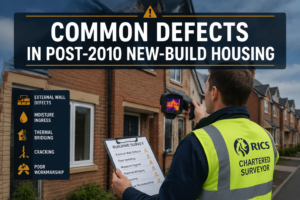
One in four UK construction firms that entered insolvency in the past three years was carrying a live contract at the time of collapse — leaving clients, lenders, and insurers holding the financial consequences. That sobering reality sits at the heart of why Rising Construction Costs and Contractor Failures: How Valuation Surveyors Should Stress‑Test Build Cost Assumptions in 2026 has become one of the most pressing competency challenges facing the profession today.
Tender prices, prime cost (PC) sums, and contingency allowances that looked robust twelve months ago can be dangerously stale in a market shaped by persistent materials inflation, labour shortages, and a wave of contractor insolvencies. Valuation surveyors who fail to interrogate those numbers — whether for reinstatement, development appraisal, or insurance purposes — risk producing figures that neither reflect reality nor withstand professional scrutiny.
Key Takeaways 📌
- Build cost assumptions must be stress-tested, not simply accepted from tender documents or historical BCIS data without adjustment.
- Contractor insolvency risk is a material valuation consideration that affects both reinstatement cost assessments and development appraisals in 2026.
- PC sums and contingency allowances are frequently understated in volatile markets and require active interrogation by the surveyor.
- Scenario modelling — using best-case, mid-case, and worst-case cost assumptions — is now considered best practice for high-value or complex instructions.
- Regular reassessment of build cost figures, at least annually, is essential to avoid underinsurance and inaccurate valuations.
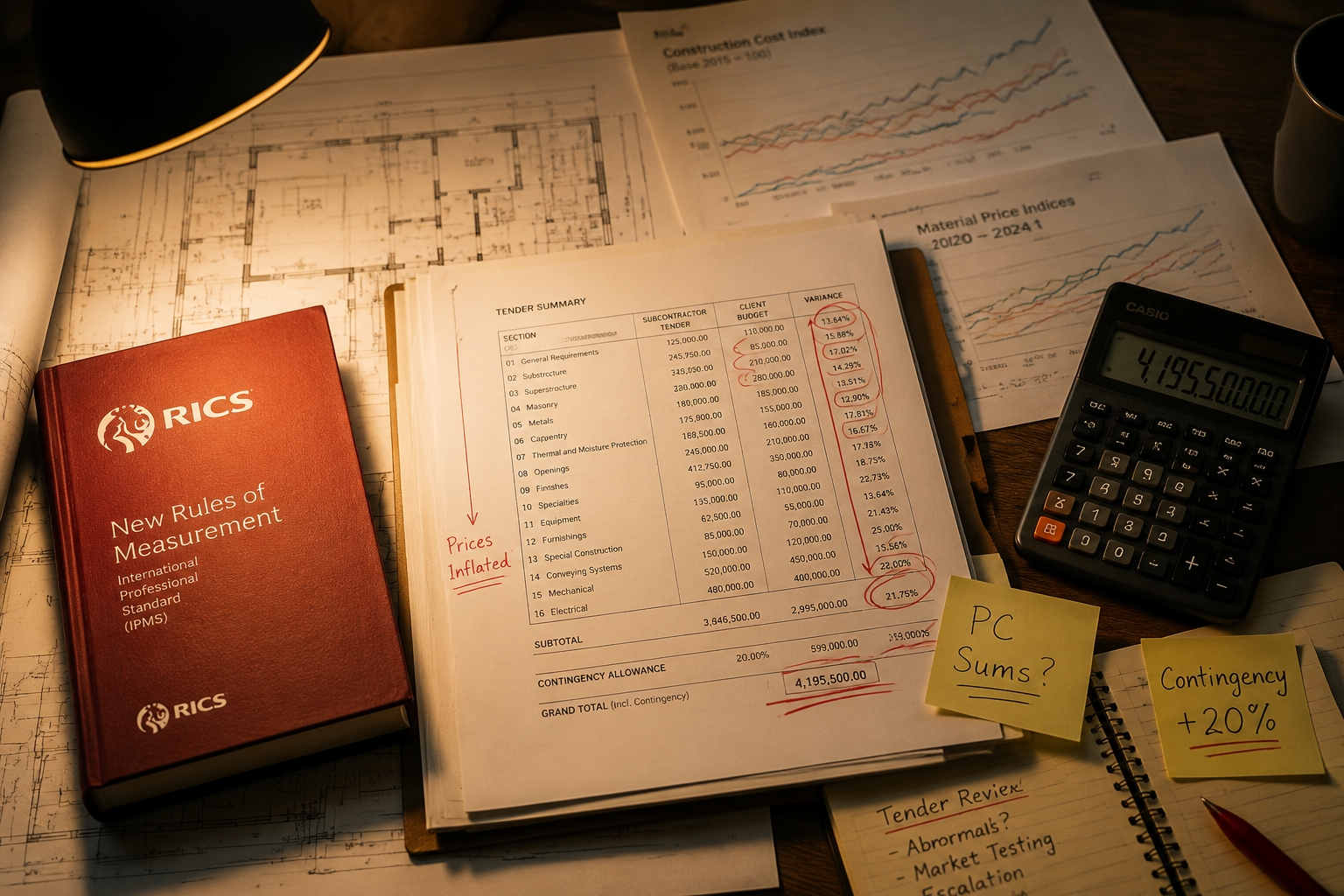
Understanding the 2026 Construction Cost Landscape
Why Standard Benchmarks Are No Longer Enough
The Building Cost Information Service (BCIS) indices remain an essential reference point, but they are retrospective by nature. In a market where steel, timber, and mechanical and electrical (M&E) components have experienced double-digit price swings within single quarters, relying on a published index without adjustment introduces structural error into any valuation.
Several forces are converging in 2026 to make this problem worse:
| Cost Driver | Impact on Build Costs |
|---|---|
| Imported materials inflation | Elevated due to ongoing supply chain fragmentation |
| Skilled labour shortages | Pushing subcontractor rates 15–25% above pre-2020 norms in many regions |
| Energy-intensive production costs | Affecting concrete, brick, and glass manufacturing |
| Regulatory changes (Part L, Future Homes Standard) | Adding compliance costs to new-build and refurbishment |
| Contractor risk premiums | Firms pricing higher margins to offset their own financial exposure |
💡 Pull Quote: "A tender price is a point-in-time estimate from a contractor under commercial pressure. It is not a valuation of true build cost risk."
For surveyors undertaking a reinstatement cost assessment, this distinction matters enormously. The reinstatement figure must reflect what it would actually cost to rebuild — including demolition, professional fees, and statutory compliance — not simply what a contractor quoted on a good day.
The Insolvency Dimension
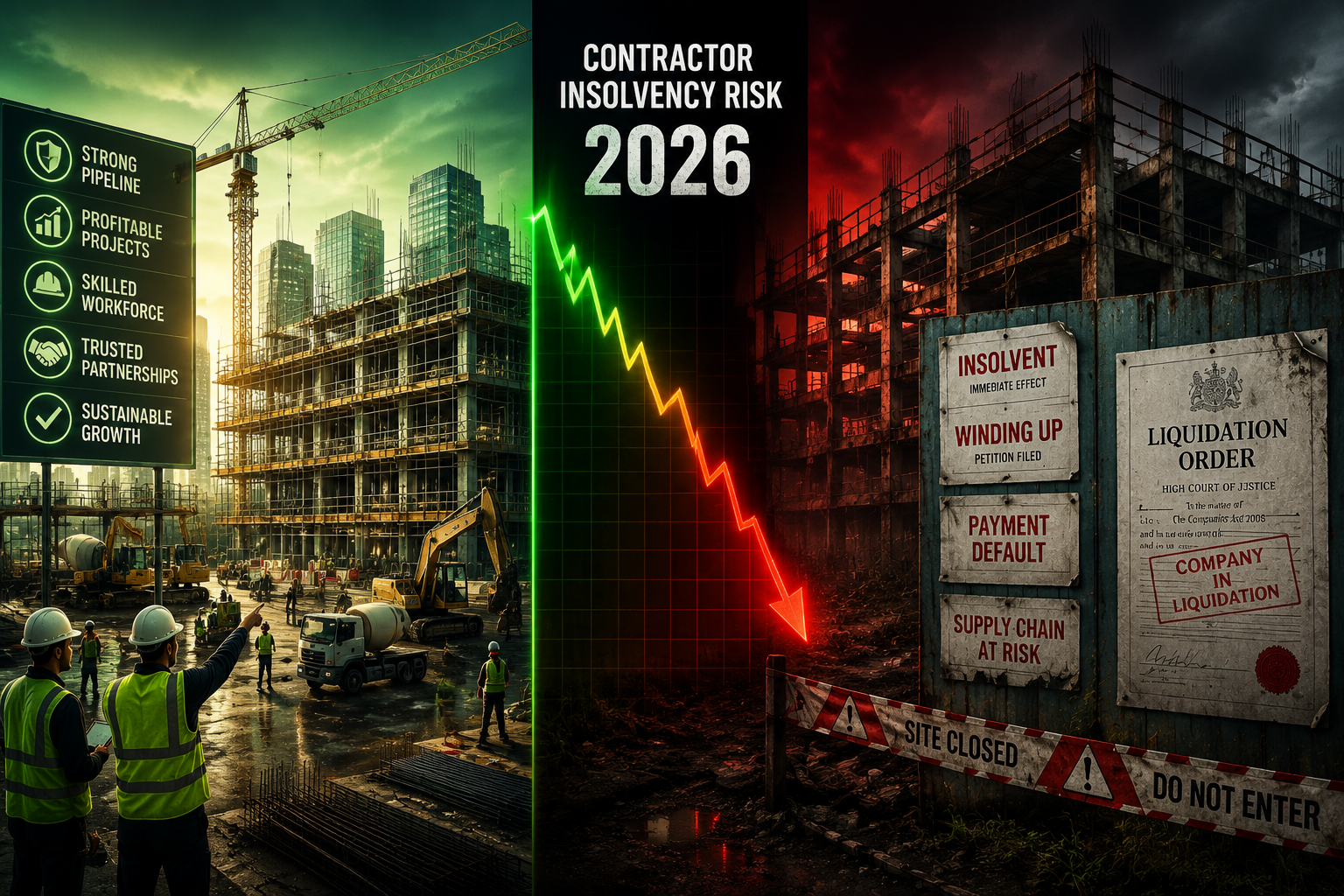
The UK construction sector has consistently recorded the highest insolvency rates of any industry. In a volatile cost environment, contractors who win work on thin margins find themselves squeezed between fixed-price contracts and rising input costs. When they fail mid-project, the consequences cascade:
- Incomplete works require a new contractor, often at a significant premium
- Defective works by the insolvent firm may need rectification
- Retention funds held by the insolvent contractor may be irrecoverable
- Performance bonds may not cover the full gap
For valuation surveyors, this is not merely a project management concern. It directly affects the reliability of any build cost figure that underpins a valuation, whether residential or commercial.
How to Interrogate Tender Prices, PC Sums, and Contingency Allowances
This is the practical core of Rising Construction Costs and Contractor Failures: How Valuation Surveyors Should Stress‑Test Build Cost Assumptions in 2026. The following framework gives surveyors a structured approach to challenging the numbers in front of them.
Step 1: Decompose the Tender Price
Never treat a tender price as a single, opaque figure. Request or reconstruct a breakdown that separates:
- Preliminaries (site setup, management, insurance)
- Measured works (labour and materials by trade)
- Prime Cost (PC) sums (allowances for items not yet specified)
- Provisional sums (for works whose scope is uncertain)
- Contractor's overheads and profit
- Contingency
Each element carries a different risk profile. PC sums and provisional sums are the most dangerous components in a volatile market because they are, by definition, estimates within an estimate.
Step 2: Stress-Test PC Sums Specifically
PC sums are placeholder figures inserted when a specification is incomplete. In residential extensions and small commercial refurbishments, they commonly cover:
- Kitchen and bathroom fittings
- Electrical installations
- Heating and plumbing systems
- External landscaping
The key questions to ask:
- Is the PC sum based on current supplier quotes or a historical allowance?
- Has the specification been finalised, or could scope creep inflate the final figure?
- What is the lead time for key components, and could delays trigger price escalation clauses?
A PC sum for an M&E package quoted at £45,000 twelve months ago may now require £58,000–£65,000 to deliver to the same specification. Surveyors should apply a minimum 15–20% sensitivity uplift to unconfirmed PC sums in current market conditions.
Step 3: Evaluate Contingency Allowances Critically
Industry convention has historically suggested a contingency of 5–10% for well-defined projects and 10–15% for complex or phased works. In 2026, those benchmarks are arguably insufficient for:
- Projects with long programme durations (price escalation risk)
- Works in areas with acute labour shortages
- Refurbishments of older buildings where hidden defects are likely
- Projects dependent on a single specialist subcontractor
⚠️ Warning: A contingency allowance that looks generous on paper may already be consumed by known risks before a single unexpected event occurs.
Surveyors should document their reasoning for accepting or adjusting a contingency figure. If the contingency appears inadequate, this should be flagged explicitly in the valuation report, particularly for insurance reinstatement valuations where underinsurance carries direct financial consequences for the client.
Step 4: Apply Scenario Modelling
Best practice in 2026 involves presenting build cost assumptions across at least three scenarios:
| Scenario | Approach | Typical Adjustment |
|---|---|---|
| Base case | Accepted tender/BCIS benchmark with minor adjustment | 0–5% uplift |
| Mid case | Accounts for known market pressures and PC sum risk | 10–20% uplift |
| Stress case | Contractor failure mid-project + full market re-tender | 25–40% uplift |
The stress case is not a prediction — it is a risk disclosure tool. It shows the client, lender, or insurer what the financial exposure looks like if conditions deteriorate. For lenders assessing development finance, this scenario analysis is increasingly expected as part of due diligence.
Step 5: Assess Contractor Financial Health
Where a specific contractor is named in a development appraisal or tender, surveyors should consider:
- Credit rating and Companies House filing history — are accounts filed on time? Are there County Court Judgements (CCJs)?
- Bonding and warranty position — is a performance bond in place? What is its limit?
- Subcontractor dependency — does the main contractor rely heavily on a single specialist subcontractor who may themselves be financially fragile?
- Payment terms — aggressive early payment demands can signal cash flow stress
This is not a full financial due diligence exercise, but a competent surveyor should flag obvious red flags. The RICS Reinstatement Build Cost Valuation process, for example, should account for the realistic cost of completing works if the original contractor cannot do so.
Reflecting Contractor Insolvency Risk in Residential and Small Commercial Valuations
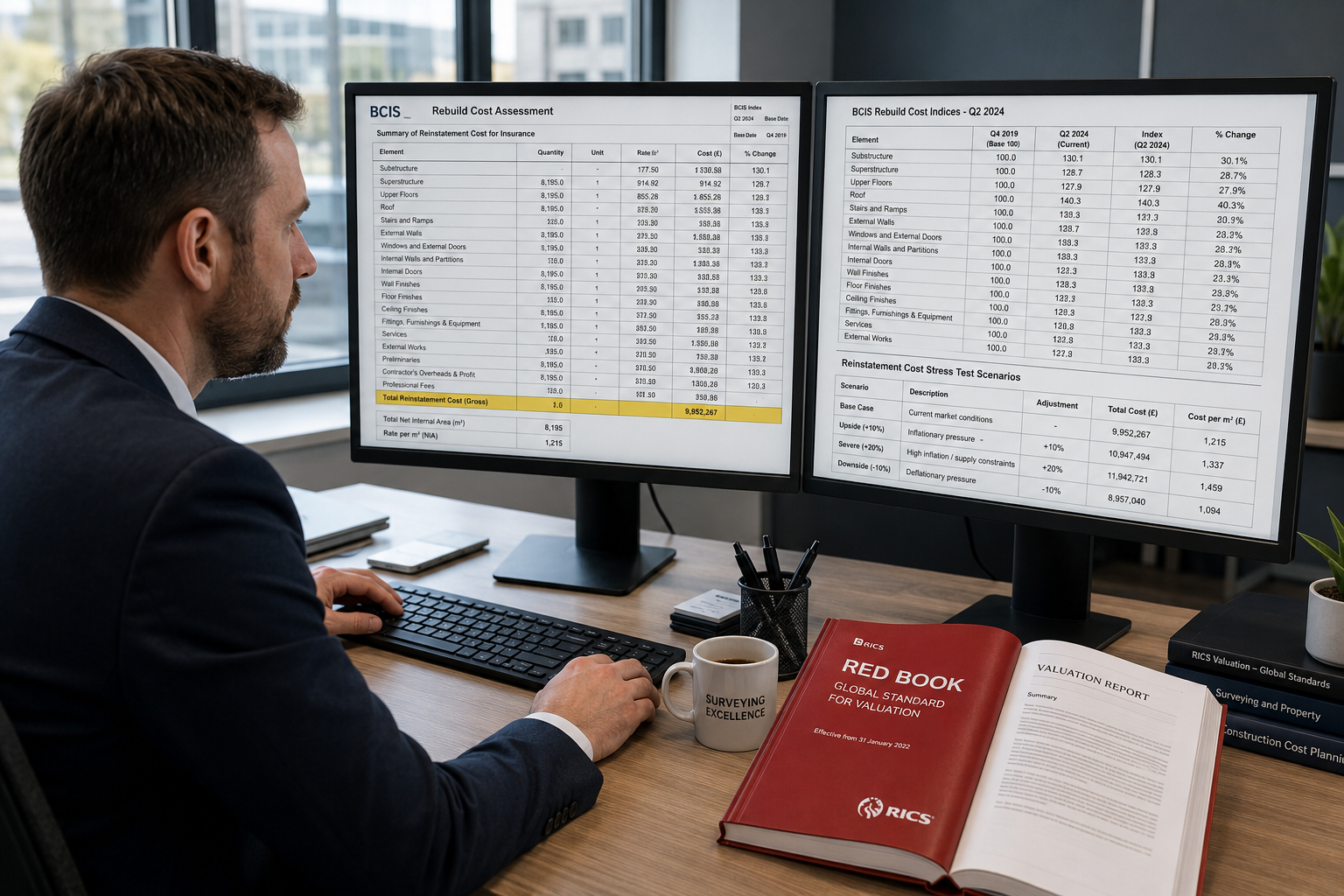
The third pillar of Rising Construction Costs and Contractor Failures: How Valuation Surveyors Should Stress‑Test Build Cost Assumptions in 2026 concerns how insolvency risk should be reflected — not just identified — in formal valuation outputs.
Residential Reinstatement Cost Assessments
For standard residential properties, the reinstatement cost assessment (RCA) is the figure that drives buildings insurance cover. An underestimate creates underinsurance; an overestimate creates unnecessary premium costs. In the current environment, the following adjustments are warranted:
- Regional labour cost uplift: Major cities and the South East continue to command significant premiums over national averages. Surveyors covering areas such as London and the Home Counties should reference local market data, not just national indices. This is equally relevant whether working on a Manchester valuation or a property in the South East.
- Demolition and clearance costs: These are frequently underestimated, particularly for properties with basements, contaminated materials, or restricted site access.
- Professional fees: Architect, structural engineer, and project manager fees typically add 12–15% to base build costs. In a post-insolvency scenario, appointing replacement professionals adds further cost and delay.
- Inflation indexing: The RCA should specify the date of assessment and recommend annual review. A figure that is more than 18 months old should be treated with caution.
Small Commercial Valuations
For small commercial properties — retail units, offices, light industrial — the valuation surveyor's role in interrogating build costs becomes more complex. The valuation of commercial property must account for:
- Fit-out costs that vary enormously by use class and specification
- Dilapidations liability — where a tenant's repairing obligation meets a contractor market that has repriced significantly
- Development appraisals where residual land value is highly sensitive to build cost assumptions
A 10% error in build cost on a £2 million commercial development can swing the residual land value by £150,000–£200,000 — a material difference that affects both the viability assessment and any lending decision.
Reporting Obligations and Professional Liability
RICS members have a duty to report material assumptions clearly. Where build cost figures are accepted from third-party sources (quantity surveyors, contractors, developers), the valuation report should:
- Identify the source of the build cost figure
- State the date on which it was prepared
- Note any adjustments made by the valuer
- Flag material uncertainties — particularly where PC sums or contingencies appear inadequate
- Recommend review if the figure is to be relied upon beyond a defined period
Failure to do this exposes the surveyor to professional liability claims, particularly where a contractor subsequently fails and the actual cost of completion significantly exceeds the assumed figure.
Practical Tools and Ongoing Vigilance
Recommended Data Sources for 2026
Surveyors should triangulate build cost assumptions using multiple sources rather than relying on any single benchmark:
- BCIS Rebuild Cost Calculator — useful baseline, but apply market adjustments
- Local contractor quotations — real-time, but subject to commercial pressure
- Quantity surveyor input — essential for complex or high-value instructions
- Trade body cost reports — the CIOB and RIBA publish periodic market intelligence
- Regional tender price indices — account for geographic variation
When to Commission Independent Cost Advice
There are instructions where a valuation surveyor should not attempt to assess build costs without specialist support:
- Properties over £2 million reinstatement value
- Complex refurbishments involving listed buildings or unusual construction
- Development appraisals where the build cost drives a lending or investment decision
- Any instruction where the client has a known interest in a particular outcome
In these cases, commissioning a formal cost plan from a chartered quantity surveyor is not a sign of professional weakness — it is sound risk management. The cost of that advice is trivial compared to the liability exposure of an unsupported assumption.
The Annual Review Imperative
Build cost assumptions have a shelf life. In the current market, that shelf life is shorter than ever. Surveyors should advise clients — particularly those holding insurance reinstatement valuations — to commission a review at least annually, and immediately following any significant change in:
- Construction market conditions
- The property's use or specification
- Regulatory requirements affecting reinstatement
This advice should be included as a standard recommendation in every RCA report. Clients who ignore it and subsequently find themselves underinsured have been warned; clients who act on it are protected.
Conclusion: Stress-Testing Is Now a Core Professional Competency
The era of accepting a tender price at face value, applying a standard BCIS index, and moving on is over. Rising Construction Costs and Contractor Failures: How Valuation Surveyors Should Stress‑Test Build Cost Assumptions in 2026 is not a niche technical concern — it is a mainstream professional obligation.
The construction market in 2026 rewards surveyors who ask hard questions: about PC sums that may be understated, contingencies that may be inadequate, and contractors whose financial health may not survive the duration of a project. Those questions, documented clearly and reported transparently, protect clients, protect lenders, and protect the surveyor's own professional standing.
Actionable Next Steps for Valuation Surveyors ✅
- Decompose every tender price into its component parts before accepting it as a valuation input
- Apply a minimum 15–20% sensitivity uplift to unconfirmed PC sums in current market conditions
- Model three cost scenarios (base, mid, stress) for any instruction where build cost is material to the valuation conclusion
- Flag contractor financial health concerns explicitly in reports where a named contractor is central to the appraisal
- Recommend annual review of all reinstatement cost assessments as a standard report condition
- Commission independent quantity surveyor input for high-value or complex instructions
- Stay current with BCIS updates, regional tender price indices, and trade body market intelligence throughout 2026
For surveyors seeking to strengthen their approach to RICS building surveys and valuation practice in a volatile market, the starting point is the same: interrogate the numbers, document the reasoning, and never let a cost assumption go unchallenged.
For professional guidance on reinstatement valuations, commercial property assessments, or building surveys, explore the full range of services available from RICS Chartered Building Surveyors.