Over 700,000 residential properties in England are estimated to have some form of fire safety defect linked to cladding, compartmentation failure, or unsafe structural alterations — many of which were never flagged in pre-purchase surveys. The Building Safety Act 2022 changed everything. Building Surveying Under the Building Safety Regime: What Client Reports Now Need to Say About Fire and Structural Risk is no longer a niche compliance concern; it is the new standard of professional practice that every surveyor and their clients must understand in 2026.
This article explains how the maturing Building Safety Act framework has reshaped what Level 2 and Level 3 building surveys must address — particularly for blocks of flats, converted houses, and other higher-risk residential buildings — and what clients should now expect to see in their reports.
Key Takeaways 📋
- The Building Safety Act 2022 extended limitation periods and accountability duties, meaning surveyors face long-tail liability for missing fire and structural risks.
- Client reports must now go beyond "condition only" to include explicit identification of fire hazards, structural risks, remediation advice, and residual risk explanations.
- Higher-Risk Buildings (HRBs) — those over 18 metres or 7 storeys with at least 2 residential units — face the most stringent new requirements under the Building Safety Regulator (BSR).
- RICS survey standards are evolving to align with the new regime, pushing Level 3 surveys in particular toward a risk-and-liability advisory model.
- Clients buying or owning flats in converted houses or apartment blocks need specific fire safety and structural information that older survey formats simply did not provide.
The Building Safety Act 2022: Why Surveys Will Never Be the Same
The Grenfell Tower fire in 2017 exposed a systemic failure: buildings were being constructed, altered, and sold without adequate scrutiny of fire safety or structural integrity. The Building Safety Act 2022 was Parliament's direct response. By 2026, its provisions are fully operational, and the implications for building surveying are profound [4].
What the Act Actually Changed
The Act introduced three seismic shifts relevant to surveyors:
-
Extended limitation periods — Under the Defective Premises Act 1972 (as amended), claims can now be brought up to 30 years retrospectively for existing buildings and 15 years for new ones. A surveyor who missed a cladding defect in a 2010 survey could theoretically face a claim today [3].
-
The Building Safety Regulator (BSR) — A new statutory body now oversees Higher-Risk Buildings. The BSR's 2026–2027 charging scheme confirms that registered building inspectors and principal designers face ongoing compliance obligations [5].
-
The "Golden Thread" of information — Dutyholders must maintain a continuous, accurate record of a building's design, construction, and safety-relevant changes. Surveyors contributing to this record bear responsibility for the accuracy of what they report [6].
💬 "The shift is from describing what you see to advising on what it means for safety and liability — that is a fundamentally different professional task." — Industry commentary on post-BSA survey practice [1]
Higher-Risk Buildings: The Priority Category
A Higher-Risk Building (HRB) is defined as a building that is:
- At least 18 metres tall or 7 storeys high, AND
- Contains at least 2 residential units
For these buildings, the BSR acts as the building control authority. Surveyors working on HRBs must now engage with a level of fire and structural scrutiny that was previously reserved for specialist fire engineers [7].
But the Act's influence extends well beyond HRBs. Converted Victorian terraces split into flats, 1960s low-rise blocks, and purpose-built apartment buildings under 18 metres all sit within a regulatory environment that expects surveyors to think about fire compartmentation, escape routes, and structural load paths in ways that standard condition-reporting never demanded.
What Building Surveying Under the Building Safety Regime Requires in Client Reports
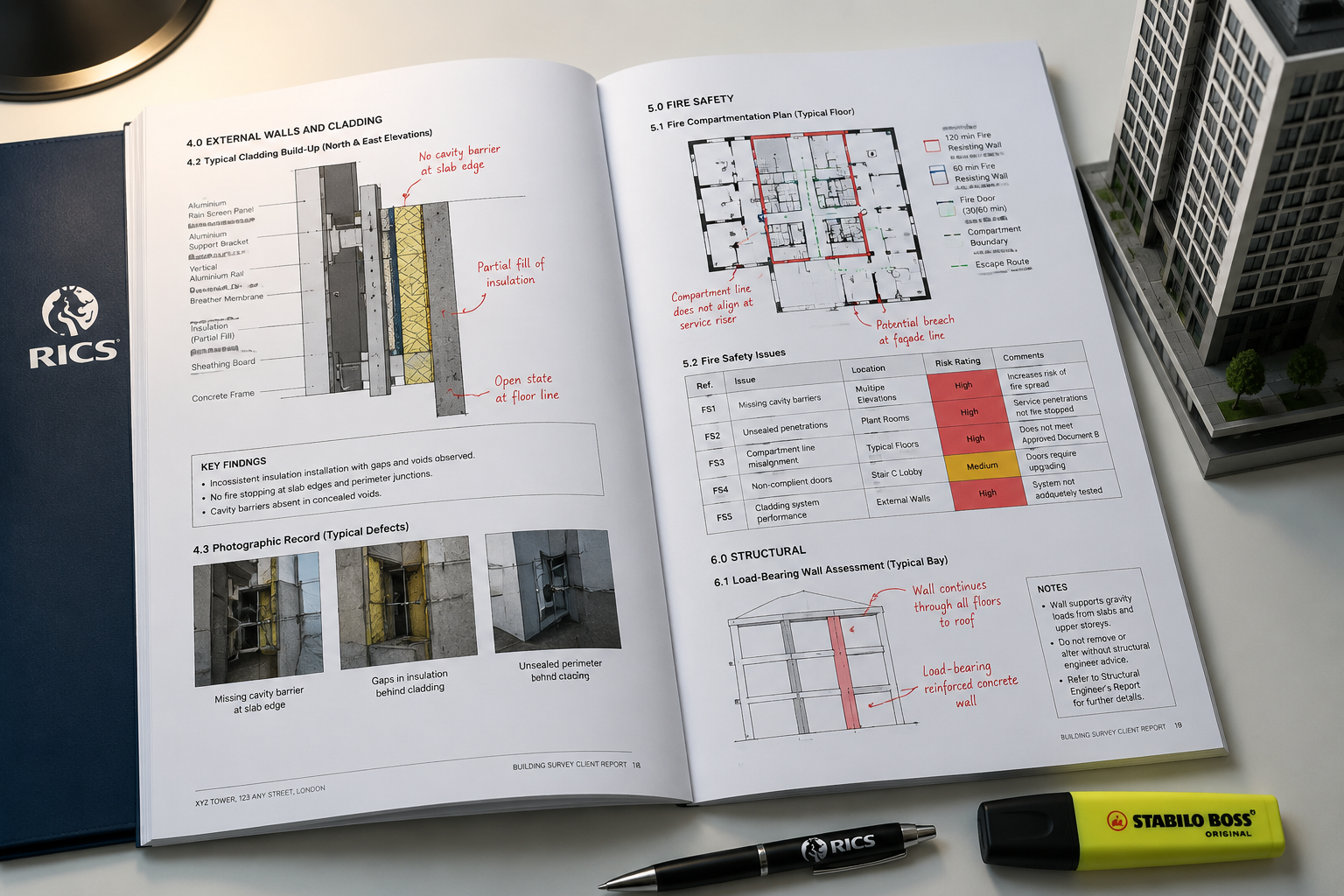
The core question for any surveyor in 2026 is: does my report give the client what they need to understand fire and structural risk? The answer, under the new regime, demands far more than a traffic-light condition rating.
1. Explicit Identification of Historic Fire and Structural Risks
Reports must now actively identify — not merely note in passing — the following categories of risk:
| Risk Category | What to Look For | Why It Matters Now |
|---|---|---|
| External wall cladding | ACM panels, HPL cladding, EIFS systems | Extended liability; EWS1 implications |
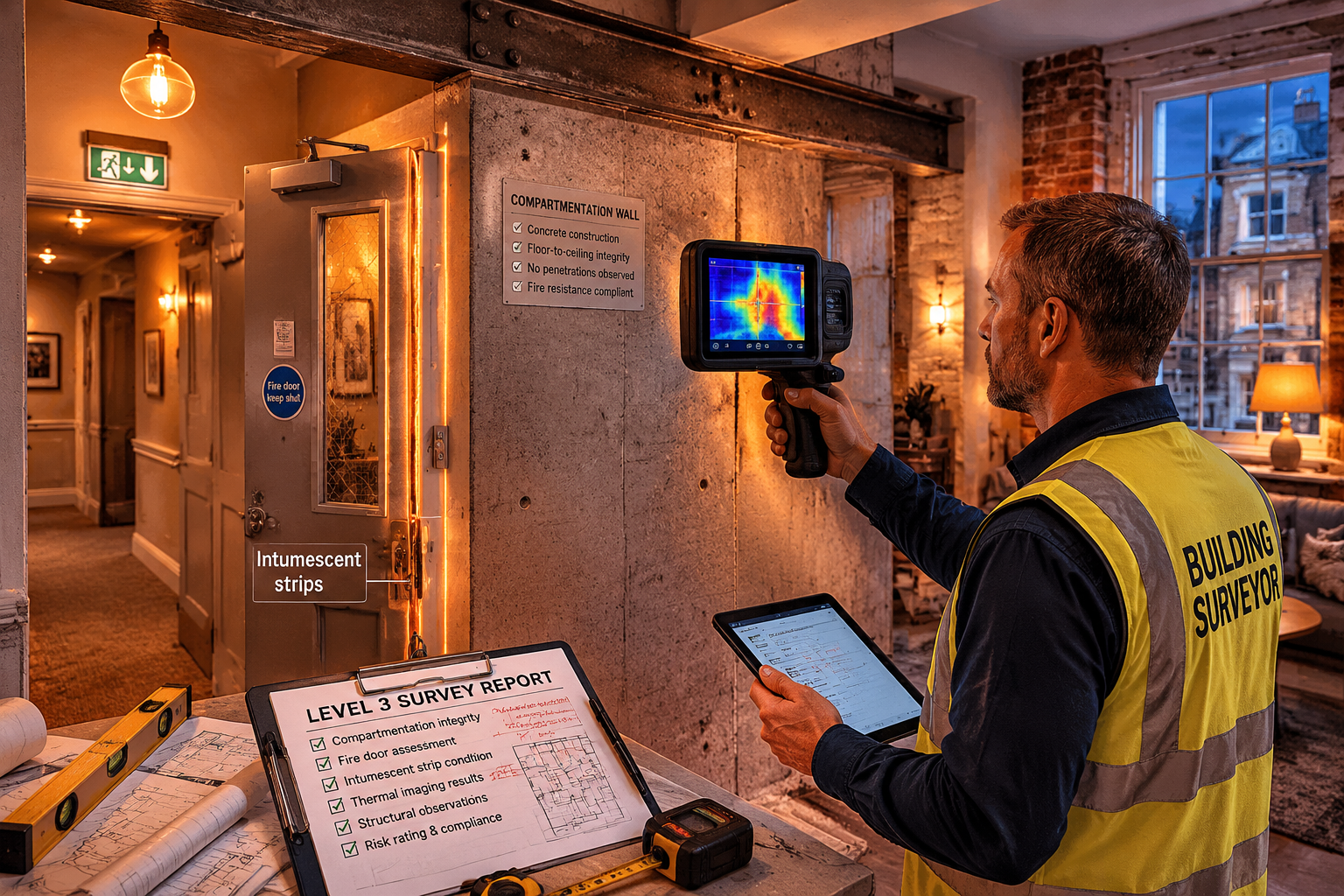
| Fire compartmentation | Breaches in floor/ceiling voids, missing fire stops | Fundamental to life safety in flats |
| Fire doors | Condition, self-closing mechanisms, intumescent strips | Regulatory requirement in HRBs |
| Structural alterations | Removed load-bearing walls, altered beams, loft conversions | Risk of progressive collapse |
| Balconies and external structures | Timber decking, fixing integrity, drainage | Fire spread and structural failure risk |
| Cavity barriers | Presence and condition in cavity walls | Critical for fire containment |
A Level 3 building survey is now the minimum appropriate product for any flat in a converted house or apartment block where fire safety or structural concerns are plausible. A Level 2 survey may be suitable for straightforward modern properties, but surveyors must be explicit about what has and has not been inspected [8].
For commercial properties with residential elements, a RICS commercial building survey should similarly address mixed-use fire compartmentation and means of escape.
2. Clear Advice on Residual Risk and Remediation
The old model of "we noted cracking to the party wall — seek further advice" is no longer sufficient. The Building Safety Regime expects reports to:
- Quantify risk where possible — Is a structural crack active or historic? Is cladding confirmed non-compliant or merely unverified?
- Recommend specific specialist investigations — Not just "seek further advice" but "commission a fire engineer's assessment of the external wall system" or "obtain a structural engineer's report on the altered ground-floor beam"
- Advise on remediation pathways — Including reference to the Building Safety Fund, developer remediation obligations under the Act, and leaseholder protections [3]
This is where structural surveys and specialist structural engineering assessments become integral to the surveying process rather than optional add-ons.
🔑 Key point: Clients buying flats need to know not just that a risk exists, but who is responsible for fixing it and what it might cost — especially given the leaseholder protection provisions of the Building Safety Act.
3. Heightened Explanation of Limitations and Caveats
Because claims can now arise decades after a survey is completed, the scope of inspection and its limitations must be documented with exceptional precision. Reports should clearly state:
- What was and was not inspected (e.g., "void spaces above suspended ceilings were not opened")
- What specialist investigations were recommended and why
- The basis on which fire safety judgements were made (visual inspection vs. documentary evidence vs. specialist testing)
- Whether an EWS1 form exists and its implications for mortgage lending and insurability
Surveyors producing specific defect reports on fire or structural issues must be especially careful to define the precise scope of their assessment and its limits.
4. Resident Risk Information in Multi-Occupied Buildings
For blocks of flats, the Building Safety Act introduced the concept of Resident Engagement — the principle that residents have a right to safety information about their building. While this obligation falls primarily on the Accountable Person (the building owner or manager), surveyors contributing reports to the Golden Thread must ensure their findings are communicated in plain language that residents can act upon [2].
This includes:
- ✅ Plain-English summaries of fire and structural risks
- ✅ Identification of any immediate life-safety concerns requiring urgent action
- ✅ Signposting to the Building Safety Regulator's resources
- ✅ Clarity on whether the building has a current Building Assessment Certificate
Practical Implications: How Surveyors and Clients Must Adapt
For Surveyors: Upgrading Practice and Professional Liability
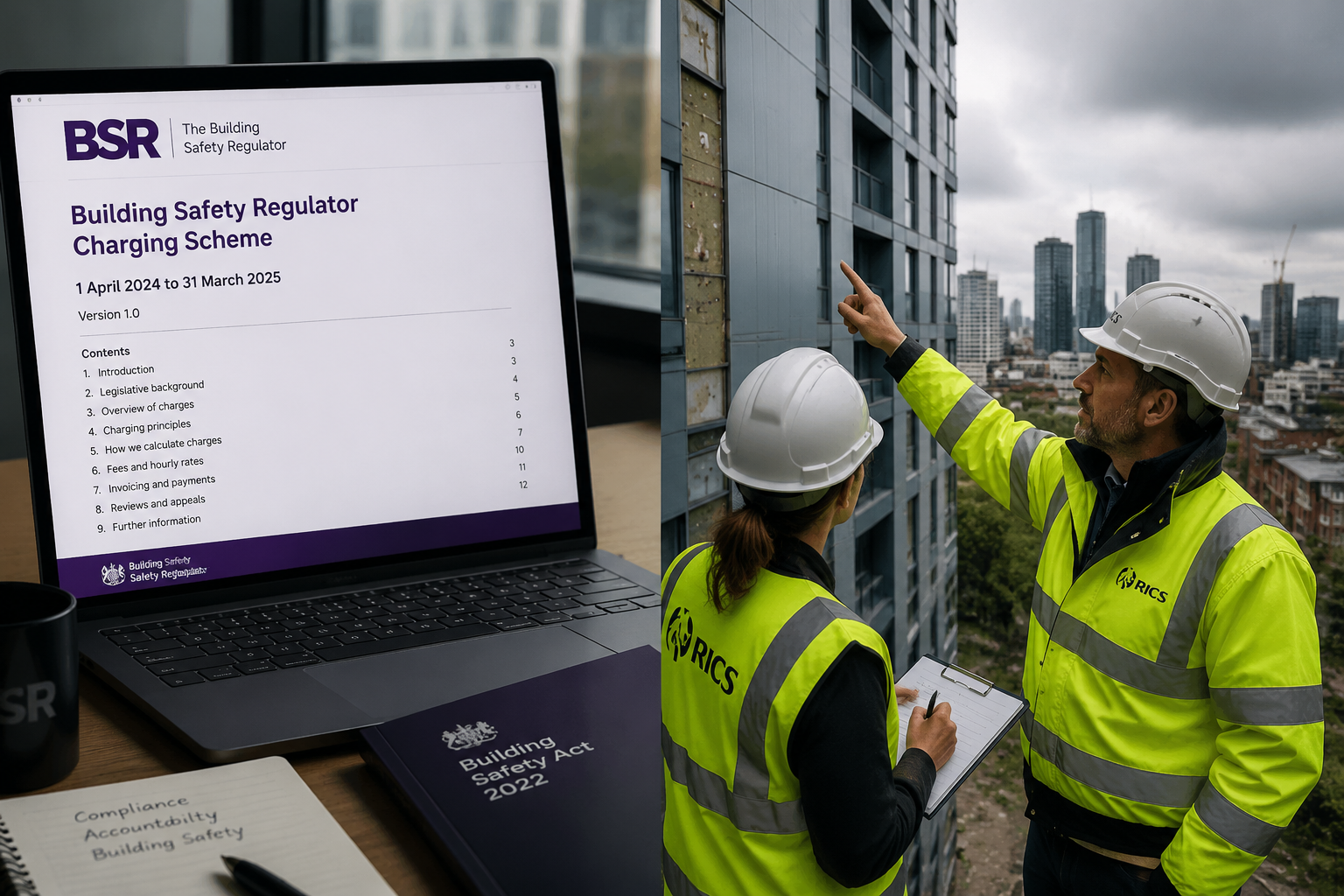
The shift described above is not theoretical. Surveying firms are actively updating their report templates, terms of engagement, and professional indemnity insurance arrangements to reflect the new risk landscape [6].
Key practice changes include:
- Pre-instruction screening — Identifying whether a property is an HRB or contains fire-safety-relevant features before deciding which survey product to offer
- Enhanced photographic records — Documenting all observed fire and structural elements with timestamped photographs
- Clearer referral protocols — Building relationships with fire engineers and structural engineers for timely specialist referrals
- Updated PI cover — Ensuring professional indemnity policies reflect the extended limitation periods under the amended Defective Premises Act
The RICS has signalled that its Home Survey Standard and Building Survey guidance will continue to evolve in line with BSA requirements [8]. Surveyors who are not keeping pace with these updates face both regulatory and legal exposure.
Working with a RICS Chartered Building Surveyor who understands the Building Safety Regime is therefore not just good practice — it is essential protection for clients.
For Clients: What to Ask For and Expect
Clients — whether buyers, leaseholders, or freeholders — should now expect and demand the following from their survey reports:
Before commissioning a survey:
- Ask whether the surveyor has experience with BSA-compliant reporting
- Confirm whether a Level 3 survey (rather than Level 2) is appropriate for the property type
- Ask about the surveyor's referral network for fire and structural specialists
Within the report itself:
- A dedicated section on fire safety observations
- Explicit commentary on cladding, compartmentation, and fire doors where applicable
- Structural risk commentary that goes beyond "monitor and review"
- Clear advice on EWS1 requirements and their mortgage implications
After the report:
- Follow up on all recommended specialist investigations before exchange of contracts
- Retain the report as part of the property's Golden Thread documentation
For properties where structural concerns are identified, a structural survey commissioned alongside the building survey provides the depth of analysis the Building Safety Regime now expects.
The Insurance Dimension 🏛️
One often-overlooked consequence of the new regime is its impact on insurance reinstatement valuations. Buildings with unresolved fire safety defects may be underinsured — or face exclusions — if their reinstatement cost has not been properly assessed in light of remediation requirements. An accurate insurance reinstatement valuation is now a critical companion to any fire-safety-focused building survey.
The Evolving Standard: Where Building Survey Reports Are Heading
The trajectory is clear. Building Surveying Under the Building Safety Regime: What Client Reports Now Need to Say About Fire and Structural Risk is moving the profession from passive description toward active risk advisory. The IStructE's 2026 Safety Conference has highlighted the need for closer collaboration between structural engineers and building surveyors in assessing complex residential buildings [10].
By the end of 2026, the expectation is that:
- All Level 3 surveys on flats and converted houses will include a structured fire safety section as standard
- EWS1 status will be routinely referenced in survey reports on apartment blocks
- Structural risk ratings will be more granular, with explicit links to Building Safety Act obligations
- Digital report formats will facilitate easier integration with Golden Thread databases
The BSR's own 2026 plan emphasises that the regulator will increasingly scrutinise the quality of building safety information — including survey reports — as part of its oversight of HRBs [9].
Conclusion: Actionable Next Steps for Surveyors and Clients in 2026
The Building Safety Act 2022 has permanently elevated the standard of care required in building survey reports. Fire and structural risk are no longer footnotes — they are headline obligations. Here is what to do now:
If you are a surveyor:
- ✅ Review and update your report templates to include dedicated fire safety and structural risk sections
- ✅ Ensure your professional indemnity cover reflects the extended limitation periods
- ✅ Build referral relationships with fire engineers and structural engineers
- ✅ Stay current with RICS guidance updates and BSR publications
- ✅ Clearly communicate survey scope and limitations in every report
If you are a client (buyer, leaseholder, or freeholder):
- ✅ Commission a Level 3 building survey for any flat or converted property
- ✅ Ask your surveyor directly about their approach to fire safety and structural risk reporting
- ✅ Do not rely on a mortgage valuation — it is not the same as a survey
- ✅ Follow up on all specialist referrals before committing to a purchase
- ✅ Retain all survey documentation as part of the property's ongoing safety record
The buildings we live and work in are safer when the professionals who assess them are held to the highest standards. The Building Safety Regime has set that bar — and the best surveyors are already clearing it.
References
[1] Jon Rowling – How To Navigate Fire And Structural Risks – https://www.linkedin.com/posts/jon-rowling-41a09329_how-to-navigate-fire-and-structural-risks-activity-7404837462587637762-ed2y
[2] Building Survey Defect Documentation Under Awaab's Law 2026: Fire, Electrical And Structural Hazard Protocols For PRS Properties – https://nottinghillsurveyors.com/blog/building-survey-defect-documentation-under-awaabs-law-2026-fire-electrical-and-structural-hazard-protocols-for-prs-properties
[3] Building Safety Update: What's New In The Building Safety Sector – https://www.penningtonslaw.com/insights/building-safety-update-whats-new-in-the-building-safety-sector/
[4] Building Safety Legislation In 2026 – https://awh.co.uk/thought-leadership-articles/building-safety-legislation-in-2026/
[5] Building Safety Regulator Charging Scheme 2026 To 2027 – https://www.gov.uk/government/publications/building-safety-regulator-charging-scheme/building-safety-regulator-charging-scheme-2026-to-2027
[6] Building Safety Act 2026: What Surveying Firms Must Do Now – https://goreport.com/building-safety-act-2026-what-surveying-firms-must-do-now/
[7] Building Safety Reforms 2026: How Surveyors Assess Compliance In High-Rise Residential Blocks – https://princesurveyors.co.uk/blog/building-safety-reforms-2026-how-surveyors-assess-compliance-in-high-rise-residential-blocks/
[8] Building Survey Quality Standards 2026: Navigating RICS Updates And Enhanced Home Inspection Requirements – https://nottinghillsurveyors.com/blog/building-survey-quality-standards-2026-navigating-rics-updates-and-enhanced-home-inspection-requirements
[9] Inside The Building Safety Regulator's 2026 Plan – https://www.riba.org/work/insights-and-resources/professional-features/inside-the-building-safety-regulators-2026-plan/
[10] IStructE Safety Conference 2026 – https://www.istructe.org/events/hq/2026/safety-conference/