A routine building survey and a formal expert witness report may look similar on paper — both involve a qualified surveyor, a property inspection, and a written opinion. But in 2026, the legal and professional distance between the two has never been wider, and the consequences of confusing them have never been more costly. [4]
When a building survey becomes expert evidence: the red flags that change the brief is not a theoretical question. It is a practical crisis that plays out in professional negligence claims, misrepresentation disputes, and property litigation every week across England and Wales. Understanding exactly where the line falls — and what surveyors must do once they cross it — is now a core professional competency, not an optional specialism. [5]
Key Takeaways 📋
- A standard building survey can become de facto expert evidence the moment it contains diagnostic opinions, causation judgments, or cost-impact assessments — even if it was never commissioned for that purpose.
- The RICS Home Survey Standard (3rd Edition, 2026) requires clearer scoping, documented limitations, and explicit referral recommendations precisely to reduce this risk. [4]
- Specific red flags — including suspected structural movement, non-standard construction, and serious damp or timber decay — are the triggers that should prompt a formal re-brief. [3]
- Insurers are actively warning that generic survey language, absent caveats, and delayed referral recommendations are the three features most likely to see a consumer report treated as expert testimony in court. [5]
- When the brief changes, so must the instruction, the report structure, the record-keeping, and the surveyor's declared duty of care.
The Legal Threshold: What Makes a Survey "Expert Evidence"?
Under the Civil Procedure Rules (CPR) Part 35, expert evidence is opinion evidence given by a person with relevant knowledge or experience, where that opinion is relevant to a fact in issue. The critical word is opinion — and building surveys are full of it.
Every time a surveyor writes that a crack "is consistent with" differential settlement, or that damp penetration "appears to originate from" a failed parapet detail, they are offering a diagnostic opinion. In a consumer-facing RICS building survey, that opinion is contextualised by caveats, condition ratings, and recommendations to seek further advice. In litigation, those same sentences can be extracted and treated as authoritative expert testimony — without any of the procedural safeguards that formal expert evidence requires. [8]
💬 "The problem is not that surveyors give opinions. It's that they give opinions without knowing those opinions may later be tested in a courtroom." — Expert witness surveyor commentary, 2026 [8]
The RICS Home Survey Standard (3rd Edition, 2026) directly addresses this tension. It now requires survey reports to clearly state their purpose, document inspection limitations, and make explicit recommendations for specialist investigation where significant defects are suspected. The intent is to create a clearer boundary between consumer advice and forensic opinion — but the practical effect is also to highlight exactly when a surveyor has strayed into territory that courts will treat as expert evidence. [4]
When a Building Survey Becomes Expert Evidence: The Red Flags That Change the Brief
Not every defect triggers a re-brief. A cracked render panel, a missing roof tile, or a dripping overflow pipe are the bread-and-butter of any Level 3 building survey. The brief changes when the defect — or the combination of defects — raises questions that a consumer-facing report cannot safely answer. [1]
🚨 The Seven Red Flags
The following defects are the most commonly cited triggers in professional indemnity claims and litigation involving surveyor reports in 2026:
| Red Flag | Why It Changes the Brief |
|---|---|
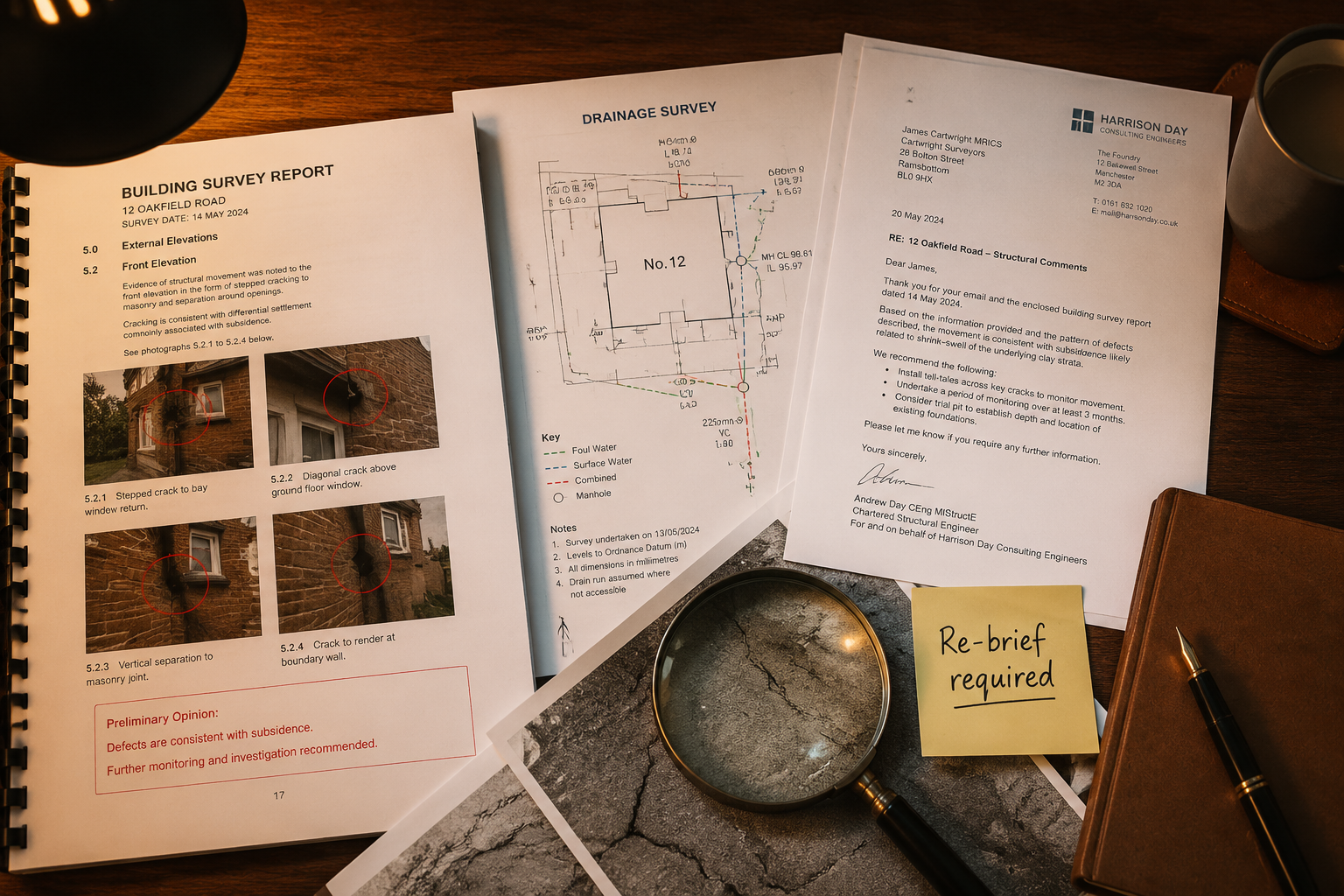
| Suspected structural movement or subsidence | Requires causation analysis, monitoring data, and cost modelling beyond standard survey scope [3] |
| Non-standard construction | Liability for missed defects is significantly elevated; specialist assessment is needed [6] |
| Serious damp or timber decay | Extent, cause, and remediation cost are all contested in disputes; generic descriptions become dangerous [1] |
| Evidence of previous underpinning | Implies historic structural failure; requires engineering sign-off, not surveyor opinion alone |
| Drainage defects or suspected tree root damage | Causation and cost are highly disputed; a drainage survey is essential before any opinion on liability |
| Fire, flood, or contamination history | Remediation adequacy cannot be assessed visually; specialist reports are mandatory |
| Significant discrepancy between visible condition and seller's representations | Raises misrepresentation risk; the survey may immediately become evidence in a future claim [5] |
When any of these red flags appear, the surveyor faces a binary choice: limit the report's scope explicitly and recommend specialist investigation, or re-brief formally as an expert witness instruction. Doing neither — and continuing to offer diagnostic opinions within a standard survey format — is precisely the "hot zone" that insurers are warning about in 2026. [5]
The 2026 Homebuying Reforms: A New Layer of Risk
The UK Government's proposed mandatory upfront building surveys, introduced as part of the 2026 homebuying reforms, add a significant new dimension to this problem. [6]
When a pre-sale survey is the first detailed technical record of a property, it will almost certainly be disclosed in any subsequent misrepresentation or defects dispute. Surveyors who record red flags in these upfront reports — and then offer even tentative diagnostic opinions — may find those opinions tested in court as expert evidence, without ever having been instructed on that basis. [6]
This is not a hypothetical risk. Specialist expert witness surveyor practices are already reporting that an increasing proportion of their instructions begin with a pre-existing homebuyer or building survey that has been disclosed in litigation. [8]
What Surveyors Must Do Differently Once a Dispute Is Likely
Recognising the red flags is only the first step. Once a surveyor identifies that a dispute is likely — or that their report may be used in one — the professional obligations change substantially. [5]
1. Re-Brief the Instruction
The moment a client indicates that a dispute is possible, or that the survey findings may be used to support a claim, the original instruction must be reviewed. A consumer survey brief and an expert witness brief are fundamentally different documents with different duties, different audiences, and different legal standards.
A formal expert witness report must comply with CPR Part 35, Practice Direction 35, and the RICS guidance on expert witness services. It must include:
- A declaration that the surveyor's duty is to the court, not the client
- A clear statement of the surveyor's qualifications and the basis of their opinion
- A list of documents and information relied upon
- A statement of any limitations on the inspection or the opinion
None of these elements are required in — or appropriate for — a standard building survey. Mixing the two formats is a professional risk that no RICS chartered building surveyor should accept.
2. Document Everything — Immediately
Record-keeping standards shift dramatically when litigation is in prospect. Notes made at the time of inspection carry far greater evidential weight than reconstructed accounts. Surveyors should:
- Retain all inspection photographs, including those not included in the final report
- Record the date, time, and weather conditions of the inspection
- Note any access restrictions or limitations on the inspection scope
- Keep all client correspondence, including pre-instruction discussions about the purpose of the survey
- Document any verbal advice given to the client at or after the inspection
The RICS Home Survey Standard (3rd Edition, 2026) already requires clearer documentation of limitations and scope. In a dispute context, this documentation becomes the first line of defence against a professional negligence claim. [4]
3. Restructure the Report
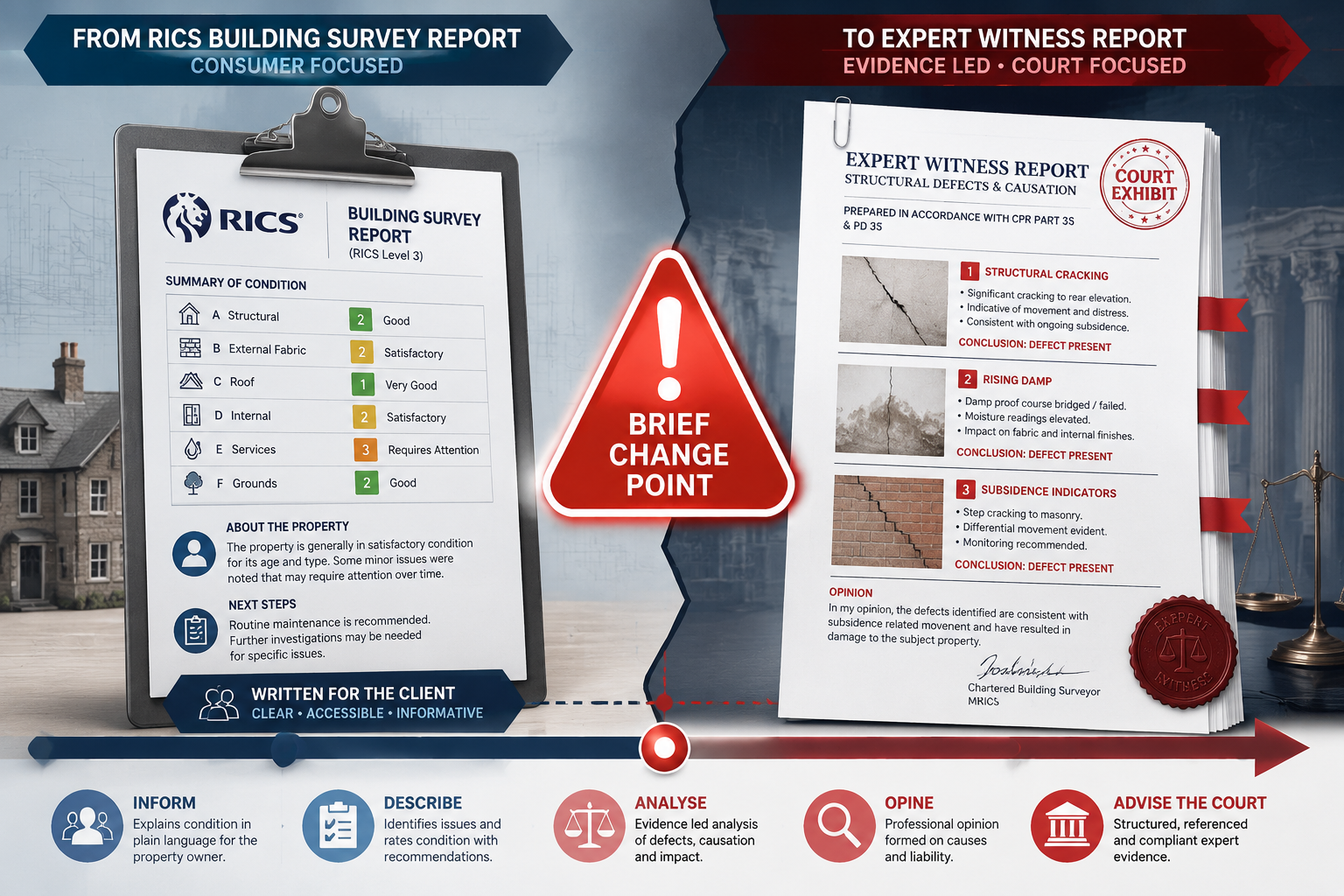
A consumer building survey is written to help a buyer make a decision. An expert witness report is written to help a court understand a technical issue. The structure, language, and emphasis are completely different.
| Feature | Consumer Survey | Expert Witness Report |
|---|---|---|
| Primary audience | Buyer / client | Court / tribunal |
| Duty of care | Client | Court (overrides client) |
| Opinion language | Conditional, caveated | Precise, reasoned, referenced |
| Scope statements | Standard limitations | Specific to instruction |
| Recommendations | Further investigation | Definitive or qualified opinion |
| Format | RICS condition ratings | CPR Part 35 compliant |
Surveyors who attempt to "upgrade" a consumer survey into expert evidence by adding a CPR declaration are taking a significant risk. Courts and opposing parties will scrutinise the original document, and inconsistencies between consumer-facing language and expert-level opinions will undermine credibility. [8]
4. Know When to Bring in a Specialist
Some red flags require not just a re-brief, but a referral. A structural survey by a qualified structural engineer, a subsidence survey with monitoring data, or a specialist specific defect report may be necessary before any expert opinion on causation or liability can be safely offered.
Surveyors who offer opinions on matters outside their competence — even within a formally instructed expert witness report — are exposed to both professional negligence claims and regulatory sanction. The duty to refer is not a sign of weakness; it is a professional obligation. [4]
When a Building Survey Becomes Expert Evidence: Protecting the Surveyor and the Client
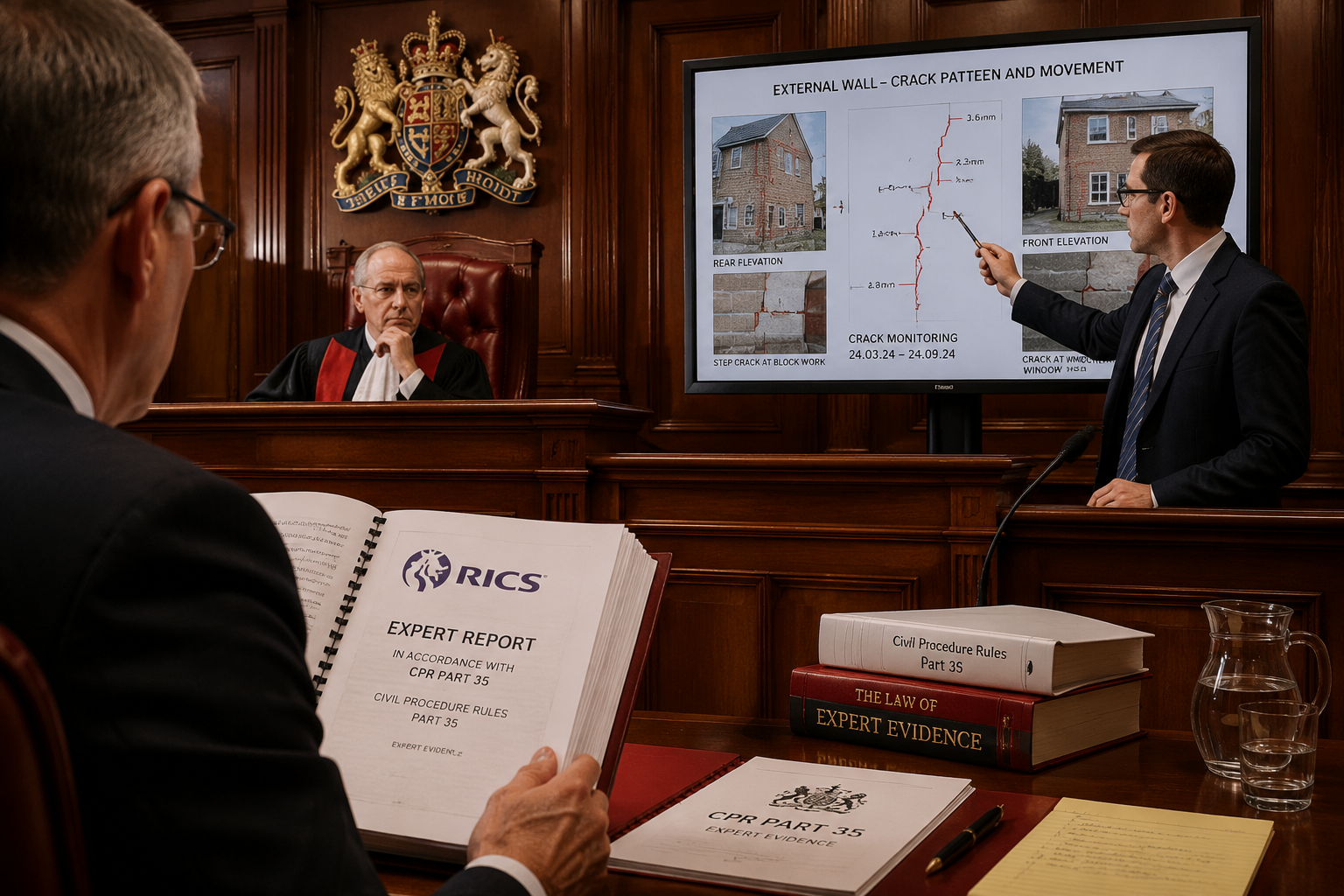
The practical reality in 2026 is that the risk runs in both directions. Surveyors face professional negligence exposure if their consumer reports are treated as expert evidence and found wanting. Clients face the risk of relying on a consumer survey in a dispute where only formal expert evidence will be persuasive.
Howden's 2026 risk review for surveyors identifies three specific report features that increase the likelihood of a consumer survey being weaponised in litigation: [5]
- Generic condition statements that read as definitive assurances (e.g., "no structural issues were identified" without adequate caveats)
- Absent or buried limitations — caveats placed in appendices or standard terms rather than prominently in the report body
- Delayed or unclear referral recommendations — where the surveyor noted a concern but did not clearly communicate the urgency of further investigation
All three of these features are directly addressed by the RICS Home Survey Standard (3rd Edition, 2026), which requires clearer scoping, prominent limitation statements, and explicit referral recommendations. [4] But compliance with the standard is not, by itself, a complete defence if the report's content crosses into diagnostic opinion territory.
The Insurer's Triage Model
Leading professional indemnity insurers are now advising surveying firms to adopt an internal triage protocol for instructions where significant defects, complex causation, or major diminution in value are identified. The triage decision tree looks broadly like this:
- Simple defects, clear condition ratings, no causation opinion → Standard consumer survey, standard caveats ✅
- Complex defects, tentative causation opinion, referral recommended → Enhanced scope, prominent caveats, urgent referral advice ⚠️
- Structural movement, non-standard construction, or dispute already indicated → Formal re-brief as expert witness instruction, or decline and refer 🔴
This model is not yet mandated by RICS, but it reflects the direction of travel in both professional standards and insurer expectations for 2026 and beyond. [5]
Conclusion: Actionable Steps for Surveyors and Clients in 2026
The question of when a building survey becomes expert evidence is not answered by a single rule or a bright-line test. It is answered by a combination of what the report says, how it says it, and what the client intends to do with it.
For surveyors, the actionable steps are clear:
✅ Scope every instruction carefully — understand the client's purpose before the inspection begins, not after.
✅ Document limitations prominently — not in buried appendices, but in the body of the report where they cannot be overlooked.
✅ Treat red flags as brief-change triggers — suspected structural movement, non-standard construction, serious damp, and drainage defects all require a formal decision about whether the instruction should be re-briefed.
✅ Re-brief formally when litigation is indicated — a CPR Part 35 compliant expert witness report is a different document with different duties; do not attempt to convert a consumer survey into one.
✅ Refer to specialists without hesitation — the duty to refer is a professional obligation, not an admission of incompetence.
For clients and their legal advisers, the message is equally direct: if a building survey has identified red flags and a dispute is in prospect, instruct a qualified RICS chartered surveyor to provide a formal expert witness report from the outset. Attempting to rely on a consumer survey in litigation is a false economy that rarely ends well.
The stakes in 2026 are higher than ever. The RICS standards are tighter, the insurer scrutiny is more intense, and the courts are less forgiving of the blurred line between market advice and forensic opinion. Getting the brief right from the start is not just good practice — it is the only defensible approach.
References
[1] What Do Red Flags In A Home Survey Mean A Clear Guide For Buyers – https://harrisonclarke.co.uk/what-do-red-flags-in-a-home-survey-mean-a-clear-guide-for-buyers/
[2] Building Survey Standards For New Builds In 2026 Spotting Latent Defects Amid 2 5 Price Growth Forecasts – https://manchestersurveyors.com/building-survey-standards-for-new-builds-in-2026-spotting-latent-defects-amid-2-5-price-growth-forecasts/
[3] Red Flags On A House Survey – https://www.hobbsparker.co.uk/blog/red-flags-on-a-house-survey/
[4] RICS Home Survey Standard 3rd Edition 2026 Critical Updates For Building Surveyors And Valuation Accuracy – https://www.canterburysurveyors.com/blog/rics-home-survey-standard-3rd-edition-2026-critical-updates-for-building-surveyors-and-valuation-accuracy/
[5] Top 5 Claims Risks Facing Surveyors 2026 – https://www.howdengroup.com/uk-en/top-5-claims-risks-facing-surveyors-2026
[6] Mandatory Upfront Building Surveys Under 2026 Homebuying Reforms What Surveyors And Buyers Need To Know – https://kingstonsurveyors.com/mandatory-upfront-building-surveys-under-2026-homebuying-reforms-what-surveyors-and-buyers-need-to-know/
[8] Expert Witness Surveyor Specializations In 2026 Building Your Practice Across Land Property And Construction Disputes – https://wimbledonsurveyors.com/expert-witness-surveyor-specializations-in-2026-building-your-practice-across-land-property-and-construction-disputes/