Approximately 5 million homes in England and Wales are leasehold — and the vast majority are flats [4]. Yet despite sweeping legislative changes reshaping how these properties are owned and managed, one critical truth remains unchanged in 2026: a building survey is still your most powerful tool for avoiding a financially devastating purchase. Understanding the intersection of Leasehold Reform and Building Surveys: What Buyers Need from Surveyors Before Committing to a UK Flat has never been more urgent, especially as ground rent caps, fire safety obligations, and the incoming shift to commonhold fundamentally alter what a competent surveyor must now examine on your behalf.
The Leasehold and Freehold Reform Act 2024 improved leaseholder protections in meaningful ways — but it does not inspect buildings for you [1]. That job still falls to a qualified RICS surveyor, and the checklist they should be working through has grown considerably.
Key Takeaways 📋
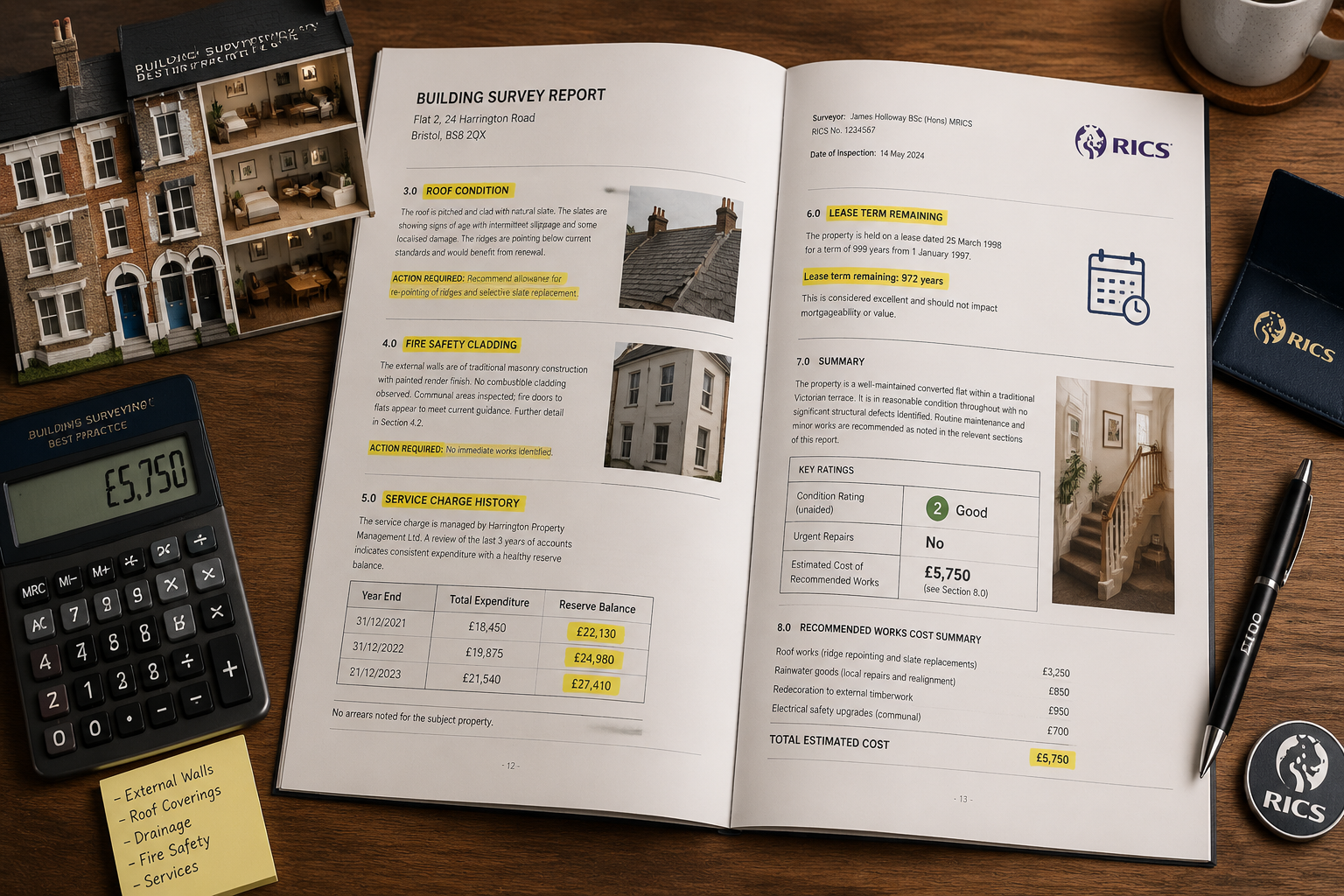
- Skipping a survey costs an average of £5,750 in unexpected repair bills after moving in [1]
- The Leasehold and Freehold Reform Act 2024 improves tenant rights but does not address physical building condition
- Surveys for leasehold flats must now explicitly cover fire safety, cladding, and EWS1 compliance
- Commonhold becomes the default for new-build flats from 2026, changing how future surveys should be scoped [3]
- A Level 2 or Level 3 RICS survey is almost always the right choice for flats in converted or mid/high-rise blocks
Why Leasehold Reform and Building Surveys Still Go Hand in Hand
It would be tempting to assume that stronger leaseholder protections mean less risk when buying a flat. That assumption is dangerous.
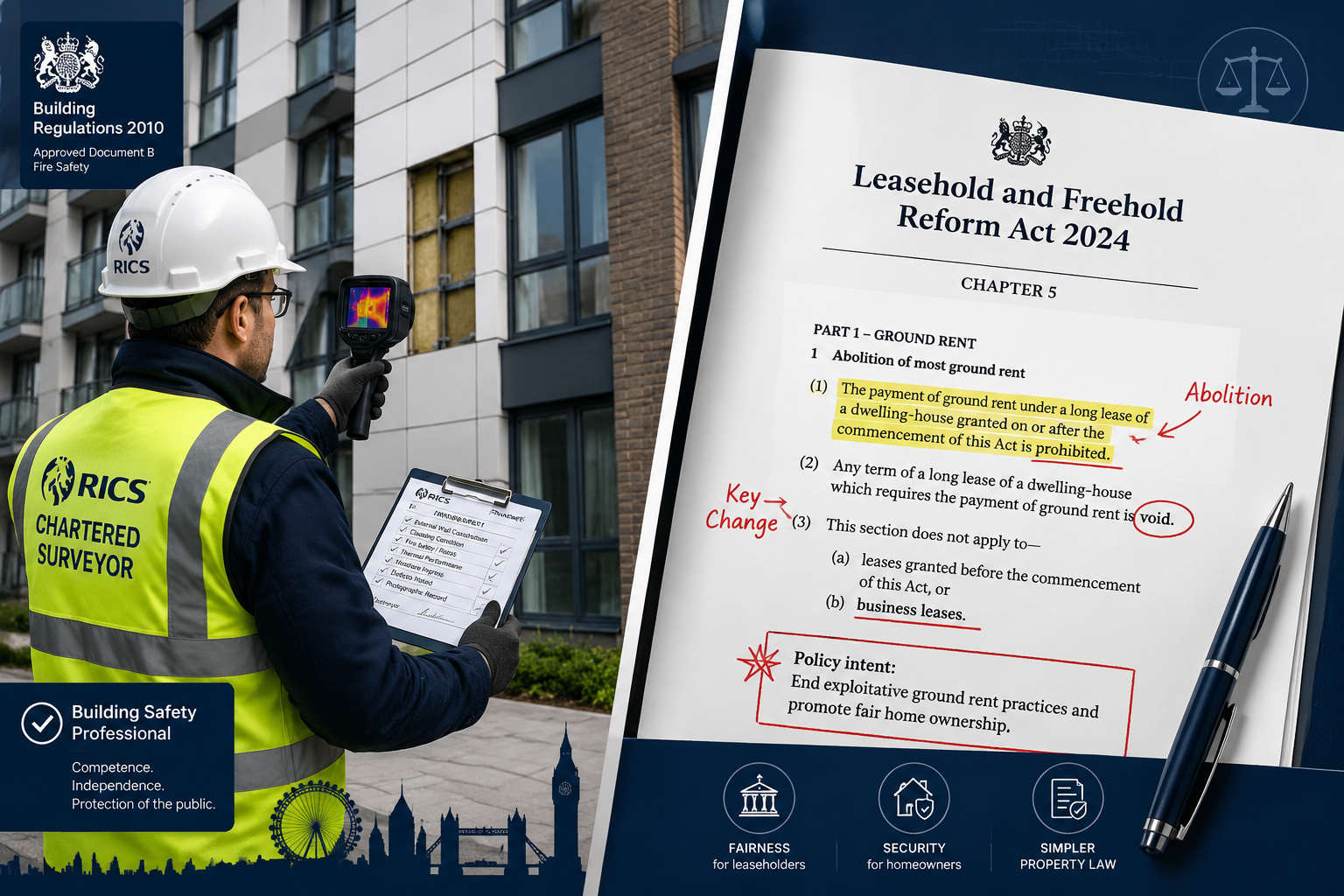
The Leasehold and Freehold Reform Act 2024 delivered genuine progress: ground rents on new leases are capped at a peppercorn rate, lease extensions have become easier and cheaper to obtain, and service charge transparency has been significantly improved [3]. From 2026, the government has moved further still — new residential flat developments must default to commonhold rather than leasehold, meaning residents collectively own the building rather than holding time-limited leases [7].
💬 "Legislative reform protects your rights as a leaseholder. A building survey protects your money."
But none of these reforms tell you whether the roof is failing, whether the external wall cladding meets fire safety standards, or whether a £40,000 major works bill is sitting quietly in the freeholder's plans. That is precisely why the principle of Caveat Emptor — buyer beware — still governs property transactions in England and Wales [1]. The legal responsibility for identifying defects rests firmly with the buyer, not the seller.
What the Reforms Actually Change (and Don't Change)
| Reform Area | What Changed | Survey Impact |
|---|---|---|
| Ground rent | Capped at peppercorn on new leases | Reduces ongoing cost risk, not structural risk |
| Lease extensions | Simpler, cheaper process | Surveyor should still flag short leases (<80 years) |
| Service charge transparency | Landlords must justify charges | Surveyor should review service charge history |
| Right to Manage | Threshold reduced from 50% to 25% of leaseholders [3] | Affects future maintenance decisions |
| Commonhold default (2026) | New flats must be commonhold [7] | Survey scope evolves for collective ownership |
| Fire safety/cladding | EWS1 requirements remain | Must be explicitly covered in survey brief |
The right to manage threshold reduction is particularly significant. With just 25% of leaseholders now able to trigger collective management, the future maintenance trajectory of a building could shift considerably after purchase. A surveyor who understands the current physical condition of the building gives you critical intelligence before that shift occurs.
What Leasehold Reform and Building Surveys Require Surveyors to Examine in 2026
The checklist for a flat survey has expanded. Here is what a competent RICS surveyor should be covering when instructed on a leasehold flat — particularly in converted Victorian terraces, purpose-built mid-rise blocks, or high-rise developments.
🔥 Fire Safety and Cladding: The Non-Negotiable Priority
Post-Grenfell, fire safety compliance is the single most consequential issue for buyers of flats in blocks above 11 metres. An EWS1 (External Wall System) form is required by most mortgage lenders for flats in buildings over this height, and your surveyor should:
- Confirm whether an EWS1 form exists and is valid
- Identify the type of cladding present (ACM, HPL, timber) and flag non-compliant materials
- Note whether the building is registered under the Building Safety Act 2022 regime
- Check for evidence of interim fire safety measures (waking watches, alarm upgrades) that inflate service charges
Buyers of flats in mid-rise or high-rise blocks should explicitly instruct their surveyor to address fire safety as part of the survey brief. A standard survey instruction may not automatically trigger this level of scrutiny.
🏗️ Structural and Communal Areas
Because flat owners share liability for the building's fabric, the surveyor's inspection should extend well beyond the four walls of the individual unit. Priority inspection areas include [2]:
- Roof — condition, age, evidence of leaks or ponding water (see our roof survey guidance for what a thorough roof inspection involves)
- External walls — pointing, render, brickwork, damp penetration
- Drains and drainage systems — shared drainage is a common source of expensive disputes
- Basements and lower floors — rising damp, waterproofing failures
- Communal corridors and stairwells — structural integrity, fire door compliance
- Lifts and mechanical plant — age, maintenance records, replacement likelihood
📋 Service Charge and Major Works Intelligence
A surveyor cannot read a freeholder's mind, but they can identify the physical warning signs that major works are imminent. Cracked render, deteriorating flat roofs, aging heating systems — these are the precursors to five-figure service charge demands. Ask your surveyor to provide a condition-based forecast of likely expenditure, not just a snapshot of current defects.
Separately, always request the last three years of service charge accounts from the seller. Cross-referencing the surveyor's findings against actual expenditure patterns reveals whether the building is being adequately maintained.
⏱️ Lease Term and Mortgage Eligibility
A surveyor conducting a RICS building survey on a leasehold flat should flag any lease with fewer than 80 years remaining. Below this threshold, the cost of lease extension rises sharply due to the "marriage value" calculation. Below 70 years, many lenders will refuse to mortgage the property entirely.
The Leasehold and Freehold Reform Act 2024 has made extensions easier to obtain, but the process still takes time and money. A surveyor who identifies a short lease early gives you negotiating power before exchange.
Choosing the Right Survey Level: A Practical Guide for Flat Buyers
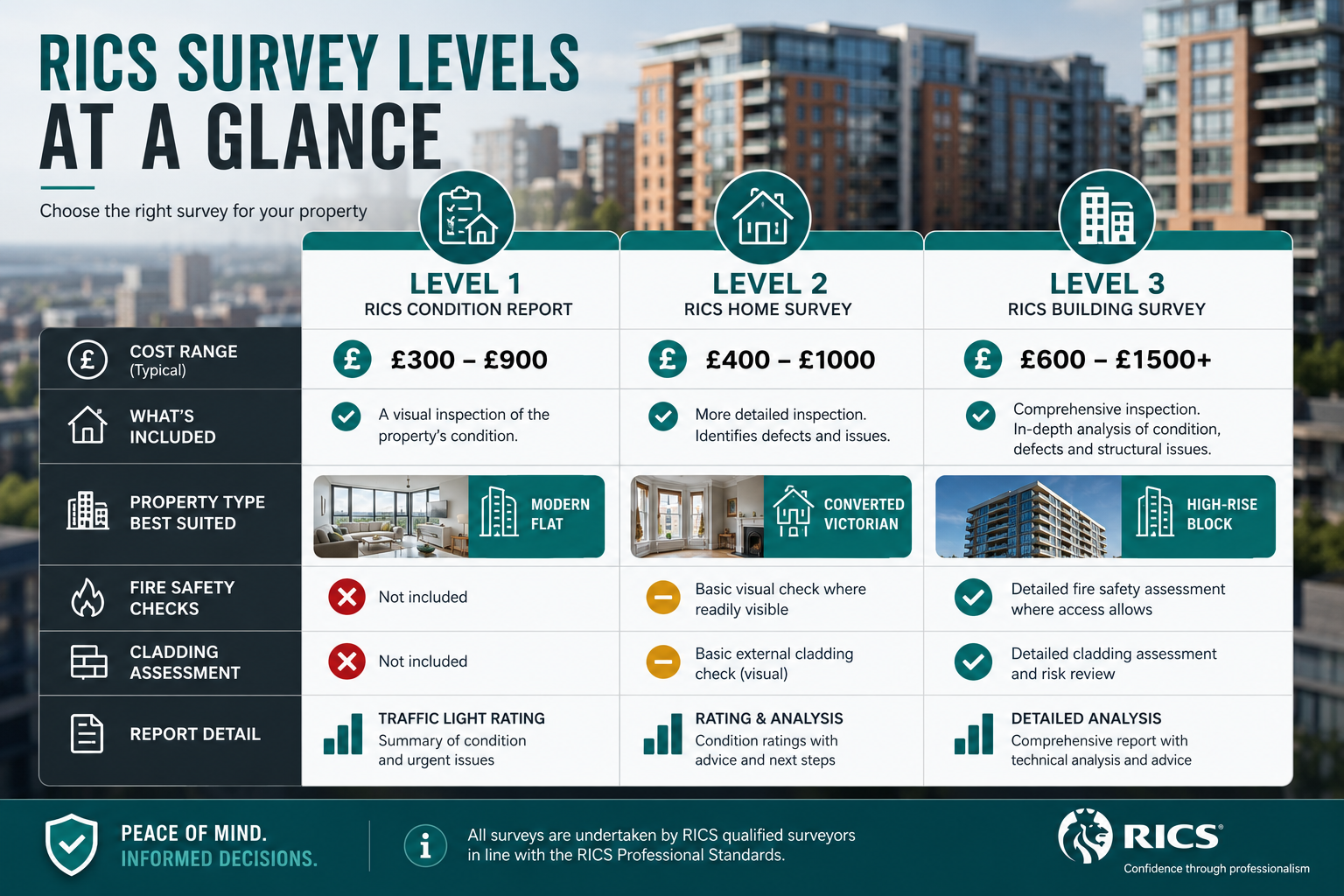
Not all surveys are equal, and the right level depends on the age, type, and condition of the building. Here is a practical breakdown:
RICS Survey Levels Explained
🟢 Level 1 — Condition Report (£300–£900)
- Basic traffic-light condition ratings
- Suitable only for new-build or near-new conventional flats in excellent condition
- Does not include advice on repairs or valuations [2]
🟡 Level 2 — HomeBuyer Report (£400–£1,000)
- Recommended for modern purpose-built flats in reasonable condition
- Covers visible defects, urgent repairs, and market valuation (if included)
- Appropriate for most standard leasehold flat purchases
- Explore RICS HomeBuyer Survey Level 2 options for full scope details
🔴 Level 3 — Building Survey (£600–£1,500+)
- Comprehensive structural investigation
- Essential for converted properties, pre-1950 buildings, flats with significant alterations, or any property showing signs of distress [1]
- Includes advice on remediation, estimated costs, and hidden defects
- For complex cases, a structural survey may be commissioned alongside
⚠️ A mortgage valuation is not a survey. It protects the lender, not the buyer. For a full explanation of the difference, see Is a Mortgage Valuation the Same as a Survey?
High-Risk Property Types That Always Warrant Level 3
The following flat types should never be surveyed at Level 1, regardless of apparent condition [1]:
- Period conversions (pre-1950), especially Victorian and Edwardian terraces
- Properties with flat or felt roofs
- Flats above commercial premises
- Buildings with a history of major works or planning alterations
- Any block where cladding type is uncertain
- Properties with short leases or complex tenure arrangements
New Build Leasehold Flats: Don't Assume Perfection
New build flats carry their own risks. A snagging survey conducted before legal completion identifies cosmetic and minor defects that developers are obligated to rectify under warranty [1]. From 2026, new flats must be structured as commonhold rather than leasehold [7], but the physical quality of construction remains variable — and a snagging survey remains as important as ever.
Collective Enfranchisement, Freehold Valuations, and Survey Synergies
One underused strategy for leasehold flat buyers is commissioning a survey alongside a freehold valuation or exploring collective enfranchisement options before purchase. If the building is a good candidate for residents to collectively purchase the freehold, understanding its physical condition in advance is essential to pricing that transaction accurately.
A surveyor with experience in collective enfranchisement valuations can help buyers understand not just the flat's current value but its potential trajectory under collective ownership. Similarly, a freehold valuation provides context for negotiating the purchase price of the flat itself.
The Professional Indemnity Safety Net
One compelling reason to use a RICS-registered surveyor rather than an independent inspector is professional indemnity insurance. If a surveyor misses a significant defect due to negligence, this insurance provides financial recourse [1]. Independent inspectors carry no such obligation. When committing to a purchase worth hundreds of thousands of pounds, that protection is not a luxury — it is a baseline requirement.
For buyers in London and the South East, chartered surveyors in London and chartered surveyors in Surrey provide locally experienced professionals familiar with the specific building stock, planning history, and fire safety compliance landscape in those markets.
Leasehold Reform and Building Surveys: What Buyers Need from Surveyors — A Final Checklist
Before instructing a surveyor on a leasehold flat purchase, use this checklist to ensure the brief is comprehensive:
✅ Pre-Instruction Checklist
- Confirm surveyor is RICS-registered with professional indemnity insurance
- Request Level 2 minimum; Level 3 for older, converted, or high-risk properties
- Explicitly instruct surveyor to address fire safety and cladding compliance
- Ask for EWS1 status confirmation (for blocks over 11 metres)
- Request a condition-based forecast of likely major works
- Ask surveyor to comment on lease term and extension implications
- Obtain last three years of service charge accounts from seller
- Cross-reference surveyor findings with service charge history
✅ Post-Report Actions
- Use repair estimates to renegotiate purchase price if significant defects found
- Instruct solicitor to review service charge reserve fund adequacy
- Check whether building is registered under Building Safety Act regime
- Confirm mortgage lender's requirements regarding EWS1 and lease length
Conclusion: Don't Let Reform Confidence Replace Survey Diligence
The leasehold reform agenda of 2024–2026 represents the most significant shift in flat ownership law in a generation. Ground rent caps, easier lease extensions, improved service charge transparency, and the move to commonhold for new developments are all genuine wins for buyers [3][4]. But legislative progress does not waterproof a roof, remediate dangerous cladding, or predict a £30,000 major works demand.
Leasehold Reform and Building Surveys: What Buyers Need from Surveyors Before Committing to a UK Flat is ultimately a question of risk management. The average buyer who skips a survey faces £5,750 in unexpected repair costs [1] — and for leasehold flats in older or mid/high-rise blocks, that figure can be dramatically higher when shared building liabilities are factored in.
Actionable Next Steps
- Book a Level 2 or Level 3 RICS survey before exchanging contracts on any leasehold flat
- Explicitly brief your surveyor on fire safety, cladding, EWS1, and major works risk
- Request service charge accounts for the past three years from the seller
- Use survey findings as a negotiation tool — identified defects justify price reductions
- Consult a RICS-registered surveyor with local expertise in your target area for tailored advice
The reforms have changed the rules of leasehold ownership. A thorough building survey ensures you understand the physical reality of what you are buying before those rules apply to you.
References
[1] Do I Need A Survey On A Leasehold Flat – https://www.samconveyancing.co.uk/news/house-survey/do-i-need-a-survey-on-a-leasehold-flat
[2] Do I Need A Survey On A Leasehold Flat – https://hoa.org.uk/advice/guides-for-homeowners/i-am-buying/do-i-need-a-survey-on-a-leasehold-flat/
[3] Leasehold Reform 2026 – https://homedata.co.uk/data/leasehold-reform-2026
[4] Leasehold Reform 2026 Buyers Sellers – https://www.bandhattonbutton.com/blog/leasehold-reform-2026-buyers-sellers/
[7] Moving To Commonhold Banning Leasehold For New Flats – https://www.gov.uk/government/consultations/moving-to-commonhold-banning-leasehold-for-new-flats/moving-to-commonhold-banning-leasehold-for-new-flats