Nearly one in three party wall disputes handled by surveyors in England and Wales involves work that the building owner genuinely believed was purely internal — only to discover it triggered the Party Wall etc. Act 1996 the moment a steel beam touched a shared wall. That gap between assumption and legal reality costs homeowners thousands in aborted work, emergency surveys, and neighbour disputes every year.
This guide cuts through the confusion. Whether planning an open-plan kitchen conversion, a through-lounge, or any alteration that removes or modifies a load-bearing structure connected to a shared wall, understanding Party Wall Notices for Structural Openings, Steel Beams, and Load-Bearing Alterations is not optional — it is the legal foundation on which safe, dispute-free renovation rests.
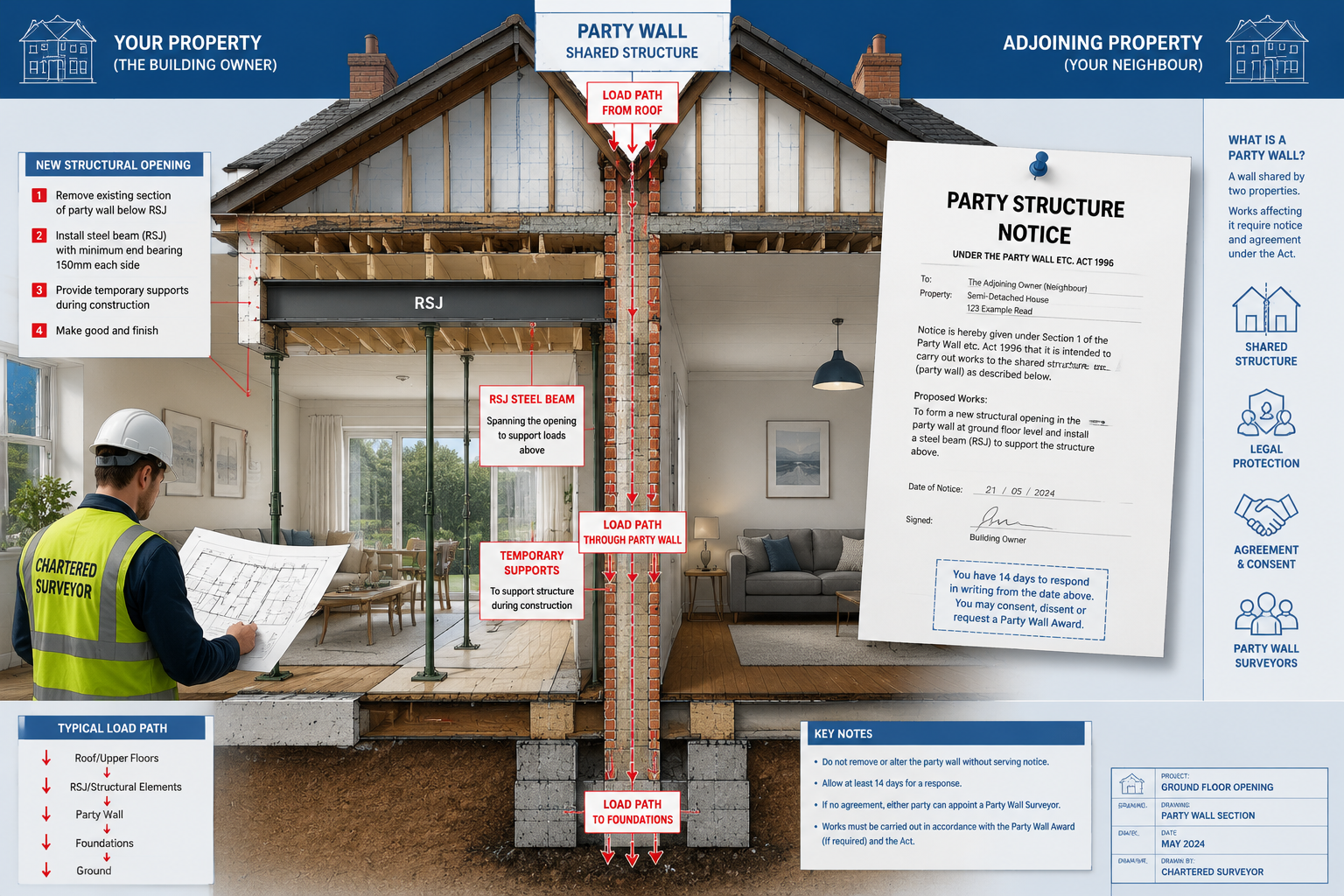
Key Takeaways 📌
- Section 2 of the Party Wall etc. Act 1996 governs virtually all structural alterations to party walls, including steel beam insertions and new structural openings.
- A Party Structure Notice must be served at least two months before works begin — not two months before you apply for planning permission.
- The notice does not give neighbours a right to veto lawful works; it triggers a formal process that protects both parties.
- Failing to serve notice can result in injunctions, forced demolition of completed work, and costly legal disputes.
- Structural drawings, beam specifications, and padstone details should accompany the notice to enable informed consent.
What the Party Wall etc. Act 1996 Actually Covers
The Party Wall etc. Act 1996 is the sole governing statute in England and Wales for works affecting shared walls, floors, and structures between neighbouring properties. Despite being nearly three decades old, no amending Act or statutory instrument has changed its core provisions — it remains fully operative in 2026 [1].
The Act defines three main categories of notifiable work:
| Section | Type of Work | Notice Required | Minimum Notice Period |
|---|---|---|---|
| Section 1 | New walls on or at the boundary | Line of Junction Notice | 1 month |
| Section 2 | Works to existing party structures | Party Structure Notice | 2 months |
| Section 6 | Excavation near neighbouring foundations | Three Metre / Six Metre Notice | 1 month |
For anyone inserting a steel beam, forming a new structural opening, or removing a load-bearing wall that relies on a party wall for support, Section 2 is the critical provision.
What Counts as a "Party Wall"?
A party wall is any wall that stands on the boundary between two properties and is shared — even partially — by those properties. This includes:
- External walls of terraced or semi-detached houses that are shared with a neighbour
- Floors and ceilings between flats (known as party floors or party structures)
- Internal walls that sit on or straddle the boundary line
Crucially, a wall does not need to be labelled "party wall" in the title deeds to qualify. If it performs a shared structural function, the Act applies.
When Do Party Wall Notices for Structural Openings, Steel Beams, and Load-Bearing Alterations Become Mandatory?
This is where many homeowners go wrong. The instinct is to think: "It's inside my house, so it's my business." But the Act focuses on structural impact, not physical location.
Steel Beam Insertions (RSJs and Universal Beams)
Inserting a steel beam — whether an RSJ, universal beam, or any other structural steel section — into a party wall is one of the most common triggers for a Party Structure Notice [3][4]. The notifiable actions include:
- Cutting pockets into the party wall to bear the beam ends
- Installing padstones (concrete or engineering brick bearing plates) within the wall
- Exposing or cutting into the party structure at any point along the beam's span
- Transferring new loads onto a wall that previously carried a different load path [5]
Even if the beam spans an entirely internal opening and only its ends touch the party wall, those bearing points make the work notifiable. The Act is explicit: cutting into or otherwise exposing a party structure falls under Section 2(2) [1][4].
💬 "Steel beam insertions into a party wall almost always require a Section 2 Party Structure Notice served at least two months before works begin." [6]
Structural Openings and Open-Plan Conversions
Forming a new opening in a party wall — for example, to create a through-lounge or connect two rooms — is equally notifiable. This applies whether the opening is:
- A new doorway cut through a shared wall
- A widened existing opening that changes the structural load distribution
- A full or partial removal of a party wall section to create open-plan space [10]
The removal of a load-bearing wall that transfers its load to or through a party wall also triggers Section 2, even if the wall being demolished is not itself a party wall [10].
Load-Bearing Alterations That Are Easily Missed ⚠️
Several common scenarios catch homeowners off guard:
- Loft conversions — steel beams bearing into party walls to support new floor joists
- Rear extensions — new steelwork spanning from a party wall to a new support column
- Basement conversions — underpinning or new beams affecting shared foundations
- Chimney breast removals — where the chimney breast is part of or bonded to a party wall [4]
- Internal wall removal — where the removed wall previously transferred loads to the party wall, changing its stress profile
Serving the Notice: Process, Timing, and Common Drafting Mistakes
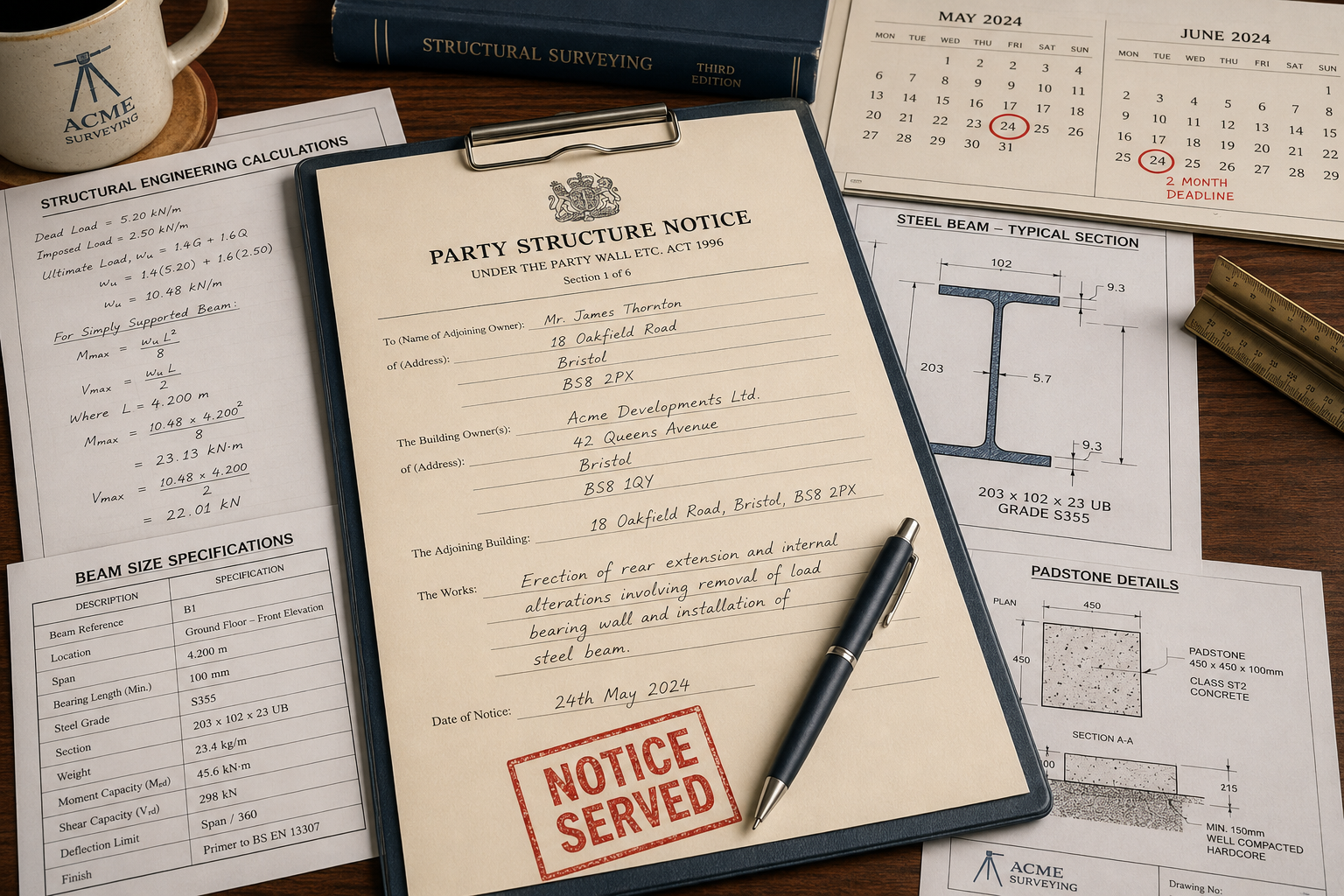
Understanding when and how to serve notice is as important as knowing whether notice is required. Errors at this stage are among the most common — and most expensive — mistakes in residential construction projects.
The Two-Month Rule
Section 3 of the Act requires that a Party Structure Notice be served a minimum of two calendar months before the intended start date of the works [2][6]. This is not a guideline — it is a statutory requirement.
The clock starts when the adjoining owner receives the notice, not when it is posted or emailed. Practical implications:
- Allow extra days for postal delivery
- Confirm receipt in writing where possible
- Do not book contractors for a start date that falls within the two-month window
The only way to compress this timetable is if the adjoining owner provides express written consent after receiving full structural details [6]. Verbal agreements carry no legal weight under the Act.
What Must the Notice Include?
A valid Party Structure Notice must contain [1][3]:
- ✅ The name and address of the building owner (the person carrying out works)
- ✅ The address of the building to which the work relates
- ✅ A description of the proposed works, including the type and size of beam, bearing details, and depth of any pockets cut into the wall
- ✅ The proposed start date of the works
- ✅ A statement that the notice is served under the Party Wall etc. Act 1996
Many practitioners also recommend including structural drawings and engineer's calculations with the notice. While not strictly required by statute, providing these documents allows the adjoining owner to make an informed decision and significantly reduces the likelihood of a dispute [3][5].
For professional support with beam calculations and structural specifications, engaging a structural engineer before serving notice is strongly advisable.
Common Drafting Mistakes to Avoid
| Mistake | Consequence |
|---|---|
| Serving notice too late (under 2 months) | Notice is invalid; works cannot legally begin |
| Vague description of works | Adjoining owner can dispute on grounds of insufficient information |
| Wrong recipient (tenant instead of owner) | Notice is invalid; must be re-served to the freeholder |
| No mention of the 1996 Act | Notice may be challenged as informal communication |
| Failing to include proposed start date | Dispute period cannot be calculated correctly |
| Serving only one notice for multiple types of work | Separate notices may be required for Section 1, 2, and 6 works |
For a broader understanding of the party wall consent process, including how adjoining owners should respond, reviewing the full procedural framework is essential before any notice is drafted.
What Happens After Notice Is Served?
Once the notice is received, the adjoining owner has 14 days to respond. They can:
- Consent in writing — works can proceed on the agreed start date
- Dissent and agree to appoint a surveyor — a Party Wall Award is then prepared
- Do nothing — after 14 days, a dispute is deemed to have arisen, triggering the surveyor appointment process
A Party Wall Award (also called a party wall agreement) is a legally binding document prepared by one or more surveyors. It sets out the scope of works, working hours, protection measures, and the right to inspect. It does not prevent the works from proceeding — it regulates how they are carried out.
Understanding the difference between a notice and an award is crucial. For more detail on what a party wall dispute involves and how surveyors resolve disagreements, the process is more straightforward than most homeowners expect.
The Consequences of Getting It Wrong
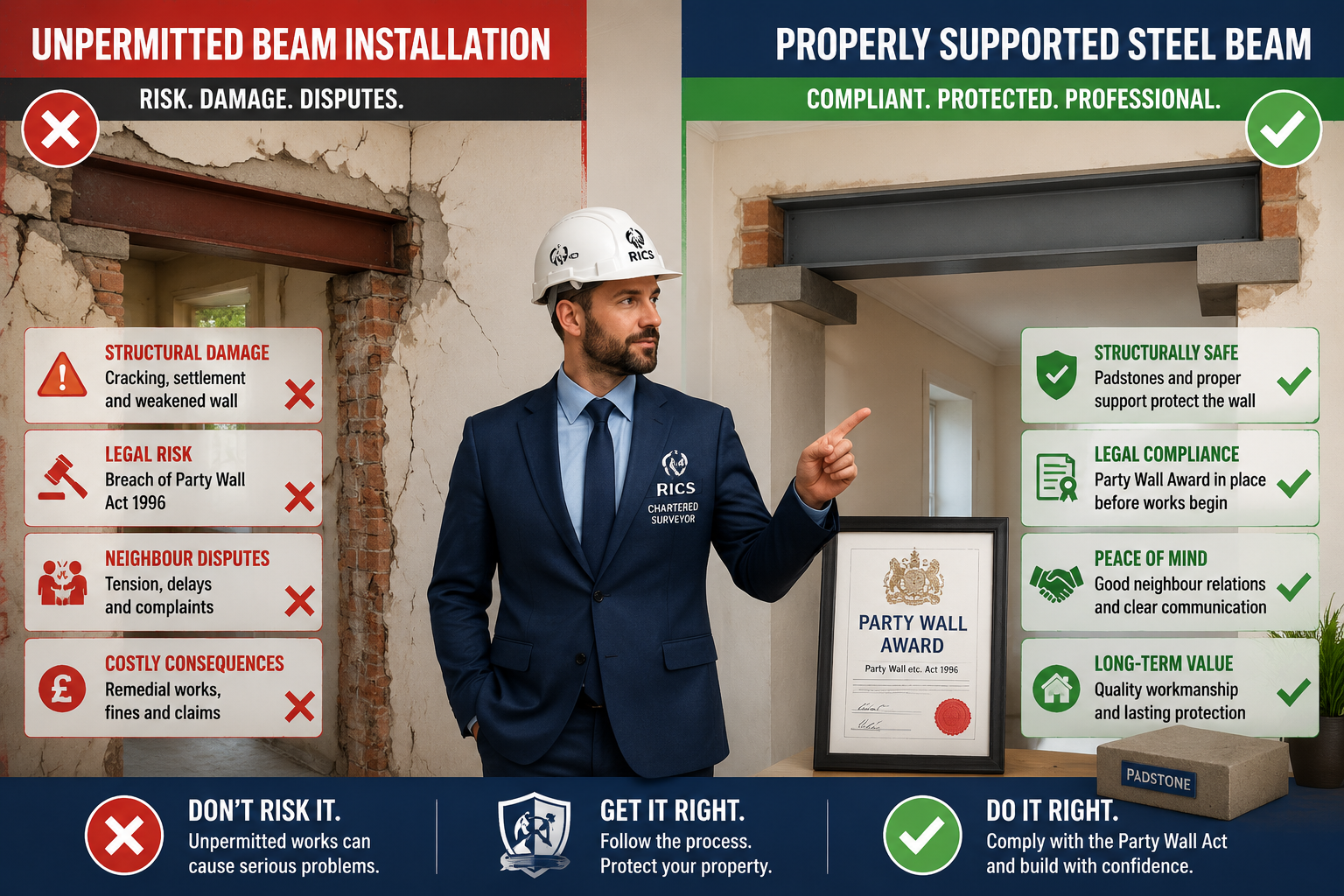
Skipping the notice process is a gamble that rarely pays off. The consequences of proceeding without serving valid Party Wall Notices for Structural Openings, Steel Beams, and Load-Bearing Alterations can include:
Legal and Financial Risks 💰
- Injunctions — a neighbour can apply to court to stop works mid-project, even if the steel beam is already partially installed
- Mandatory demolition — courts have ordered completed structural works to be undone where no notice was served
- Compensation claims — the adjoining owner can claim for damage, disturbance, and professional fees
- Difficulty selling — solicitors routinely ask for party wall agreements during conveyancing; absence of one can delay or collapse a sale [7]
Structural Risks 🏗️
Beyond the legal dimension, structural alterations to party walls without proper oversight carry genuine safety risks. A structural survey before and after major beam insertions helps establish a baseline condition record — essential if damage claims arise later.
The Party Wall Award process includes a Schedule of Condition — a photographic and written record of the adjoining property's state before works begin. This protects both the building owner (against inflated damage claims) and the adjoining owner (against genuine damage going uncompensated).
What If You Discover Notice Was Never Served?
If works have already started without notice, the situation is serious but not always irretrievable. Options include:
- Retrospective notice — technically invalid under the Act, but sometimes accepted by cooperative neighbours
- Agreed surveyor appointment — both parties appoint a single surveyor to regularise the situation
- Legal advice — essential if the neighbour is threatening injunction proceedings
For a detailed look at what happens without a party wall agreement, the risks are significant and worth understanding before any work begins.
Practical Steps for Homeowners in 2026
Here is a clear action plan for anyone planning structural alterations that may affect a party wall:
Step 1: Identify Whether the Work Is Notifiable
Consult a party wall surveyor at the earliest planning stage. Many offer free initial consultations. If a steel beam will bear into a shared wall, the answer is almost certainly yes.
Step 2: Commission Structural Engineering Input
Before drafting the notice, obtain structural drawings and beam specifications from a qualified engineer. This information should accompany the notice to facilitate informed consent [3][5].
Step 3: Serve the Party Structure Notice
Serve written notice on all adjoining owners — not tenants — at least two months before the planned start date. Keep proof of delivery.
Step 4: Await Response and Appoint Surveyors If Needed
If consent is not received within 14 days, appoint surveyors promptly. Delays in appointment extend the overall timeline.
Step 5: Obtain the Party Wall Award Before Work Starts
Do not allow contractors to begin cutting pockets or installing padstones until the Award is in place or written consent has been received.
Step 6: Arrange a Schedule of Condition
Ensure a Schedule of Condition is prepared for the adjoining property before any structural work commences. This is typically arranged by the appointed surveyor.
Understanding the cost of party wall procedures — including surveyor fees and Award preparation costs — helps with accurate project budgeting from the outset.
Conclusion: Protect the Project Before the First Cut
Structural alterations to party walls are among the most technically and legally complex aspects of residential renovation. The good news is that the framework — the Party Wall etc. Act 1996 — is clear, well-established, and designed to enable works to proceed, not to block them.
Party Wall Notices for Structural Openings, Steel Beams, and Load-Bearing Alterations are not bureaucratic obstacles. They are the mechanism that protects building owners from injunctions, protects neighbours from uncompensated damage, and ensures that structural work is carried out safely and with proper oversight.
Actionable Next Steps ✅
- Book a party wall surveyor consultation before finalising any structural design
- Commission structural calculations early so they can accompany the notice
- Serve notice at least two months before the intended start date — not two months before planning approval
- Never rely on verbal agreements with neighbours; everything must be in writing
- Budget for surveyor fees as part of the overall project cost from day one
The two-month notice period feels like a delay. In practice, it is the time needed to protect a project worth tens of thousands of pounds from a dispute that could cost far more.
References
[1] Party Structure Works – https://www.partywalllondonlimited.com/post/party-structure-works
[2] Party Wall Requirements For Inserting A Steel Beam What Homeowners Need To Know – https://simplesurvey.stck.me/post/1671578/Party-Wall-Requirements-for-Inserting-a-Steel-Beam-What-Homeowners-Need-to-Know
[3] Party Wall Requirements For Inserting A Steel Beam What Homeowners Need To Know – https://www.simplesurvey.co.uk/article/party-wall-requirements-for-inserting-a-steel-beam-what-homeowners-need-to-know/
[4] Inserting Beams Into A Party Wall – https://efficientpartywall.co.uk/inserting-beams-into-a-party-wall/
[5] Steel Beam Into Party Wall – https://mosaicpw.co.uk/steel-beam-into-party-wall
[6] Party Wall Notices For Steel Beam Installations Structural Protocols And Award Essentials Under The 2026 Act – https://partywallsurveyorlondon.uk/blogs/party-wall-notices-for-steel-beam-installations-structural-protocols-and-award-essentials-under-the-2026-act/
[7] Neighbor Has Given Notice 2months Or Three Days – https://www.reddit.com/r/HousingUK/comments/1ay1r48/neighbor_has_given_notice_2months_or_three_days/
[10] Removal Of Load Bearing Walls And Forming Structural Openings And The Party Wall Etc Act 1996 – https://arunassociates.co.uk/removal-of-load-bearing-walls-and-forming-structural-openings-and-the-party-wall-etc-act-1996/