Fewer than one in three expert witness reports submitted to UK civil courts fully comply with the requirements of CPR Part 35 on the first submission — a sobering statistic that highlights just how demanding the standards truly are. Understanding what makes an expert witness surveyor credible under CPR Part 35 and RICS guidance is not merely an academic exercise. It directly determines whether a surveyor's evidence is accepted, given weight, or dismissed entirely by the court.
This article breaks down the hallmarks of a reliable expert witness report, from independence and scope of instructions to reasoning, objectivity, and presentation. It also identifies the most common failures that undermine admissibility — and how to avoid them.
Key Takeaways 📋
- Overriding duty to the court is the single most important test of expert witness credibility under CPR 35.3.
- A CPR Part 35-compliant report must include qualifications, instructions, materials relied upon, reasoned conclusions, a Statement of Truth, and a Declaration of Compliance.
- RICS guidance adds professional obligations around impartiality, scope, and methodology that go beyond the minimum legal requirements.
- Common failures — such as advocacy, vague reasoning, or missing declarations — can render an expert's evidence inadmissible or significantly reduce its weight.
- Surveyors who combine technical expertise with procedural rigour are consistently the most credible witnesses in property and construction disputes.
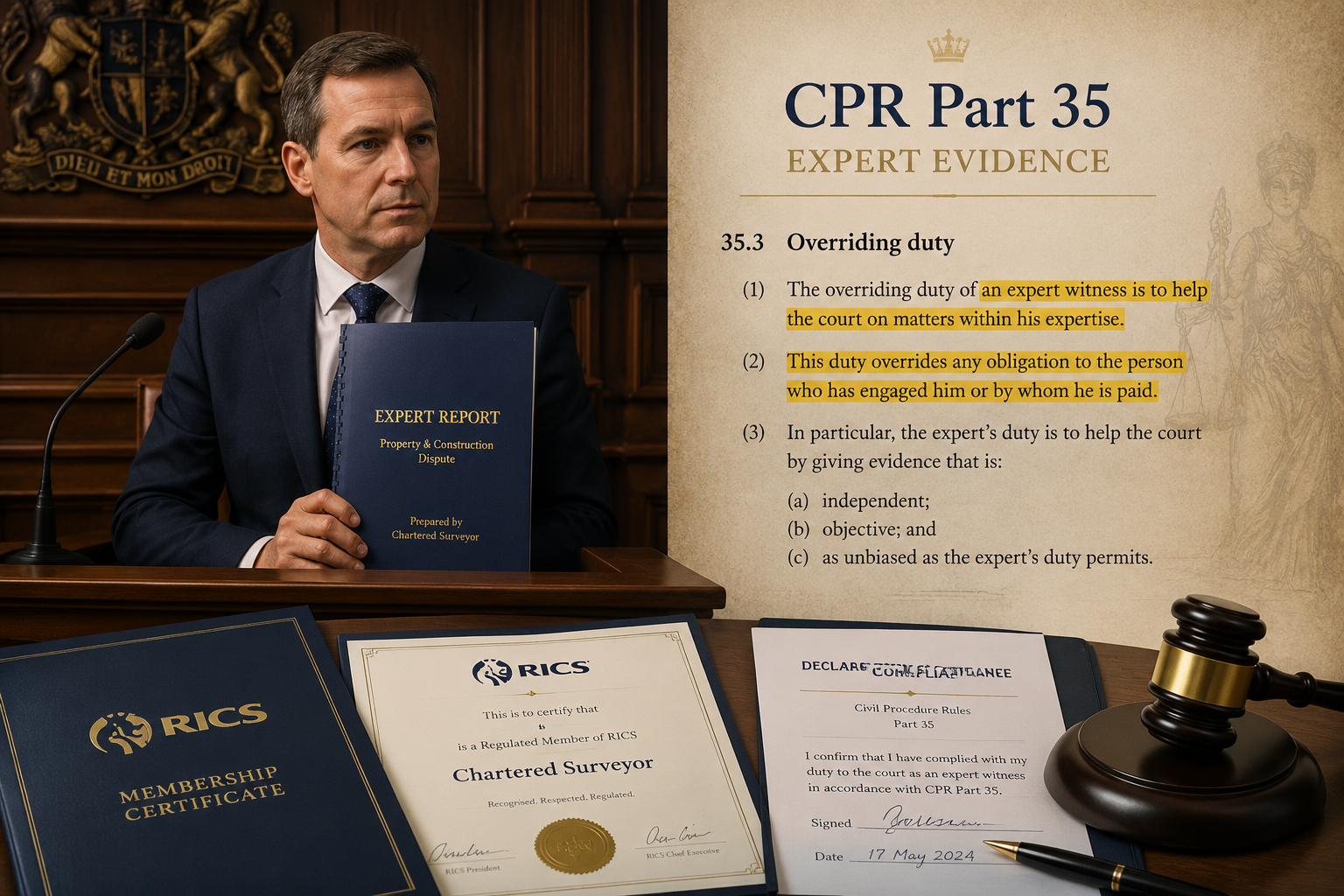
The Legal Foundation: What CPR Part 35 Actually Requires
Civil Procedure Rules (CPR) Part 35 governs expert evidence in English and Welsh civil proceedings. It sets out the framework within which any expert — including a surveyor — must operate. Understanding this framework is the starting point for answering what makes an expert witness surveyor credible under CPR Part 35 and RICS guidance.
The Overriding Duty to the Court
CPR 35.3 is unambiguous: an expert's duty is "to help the court on matters within their expertise", and this duty "overrides any obligation to the person from whom experts have received instructions or by whom they are paid." [1]
This is not a formality. Judges actively assess whether an expert is genuinely independent or whether they are functioning as an advocate for the instructing party. A surveyor who consistently supports their client's position without acknowledging contrary evidence or limitations in their own findings will quickly lose credibility — and the court's trust. [5]
💬 "An expert who is perceived as a hired gun will be given little or no weight, regardless of their technical qualifications." — Fenwick Elliott, CPR 35 commentary [5]
What Must Appear in a Compliant Report
Under CPR 35.10 and Practice Direction 35, an expert report must contain the following elements [4]:
| Requirement | Purpose |
|---|---|
| Qualifications and experience | Establishes authority to give the opinion |
| All instructions received | Ensures transparency about scope |
| Documents and materials relied upon | Allows the court to assess the evidence base |
| Assumptions made | Flags where conclusions depend on unverified facts |
| Reasoned methodology | Explains how the conclusion was reached |
| Statement of Truth | Confirms the expert believes the report is accurate |
| Declaration of Compliance | Confirms understanding of the CPR 35 duty |
Missing any one of these elements is a procedural failure that can reduce the weight given to the report — or, in serious cases, lead to the evidence being excluded altogether. [4]
RICS Professional Standards: Raising the Bar Beyond Legal Compliance
While CPR Part 35 sets the legal minimum, the RICS (Royal Institution of Chartered Surveyors) imposes additional professional obligations on its members acting as expert witnesses. These standards are found in the RICS professional statement Surveyors Acting as Expert Witnesses [3], which is mandatory for RICS-regulated professionals.
The RICS Professional Statement: Core Obligations
RICS members must [3]:
- Accept instructions only within their area of competence. A residential valuation surveyor should not accept instructions in complex construction defect disputes without relevant experience.
- Maintain impartiality at all times. This includes being willing to change an opinion if new evidence warrants it.
- Disclose any conflicts of interest before accepting instructions.
- Follow a structured methodology that is transparent and reproducible.
- Keep a clear record of instructions, including any changes to the scope of the engagement.
For surveyors working across property types and dispute categories, understanding these obligations is essential. Whether the matter involves a party wall dispute, a valuation challenge, or a dilapidations claim, the same professional standards apply. [3]
Why RICS Membership Matters to Credibility
A surveyor's RICS membership signals to the court that they are subject to enforceable professional standards, continuing professional development requirements, and a disciplinary framework. This institutional accountability is a significant credibility factor. [1]
Courts and opposing counsel are far more likely to accept the evidence of a RICS-chartered building surveyor than that of an unregulated consultant — particularly in complex technical disputes where methodology is contested.
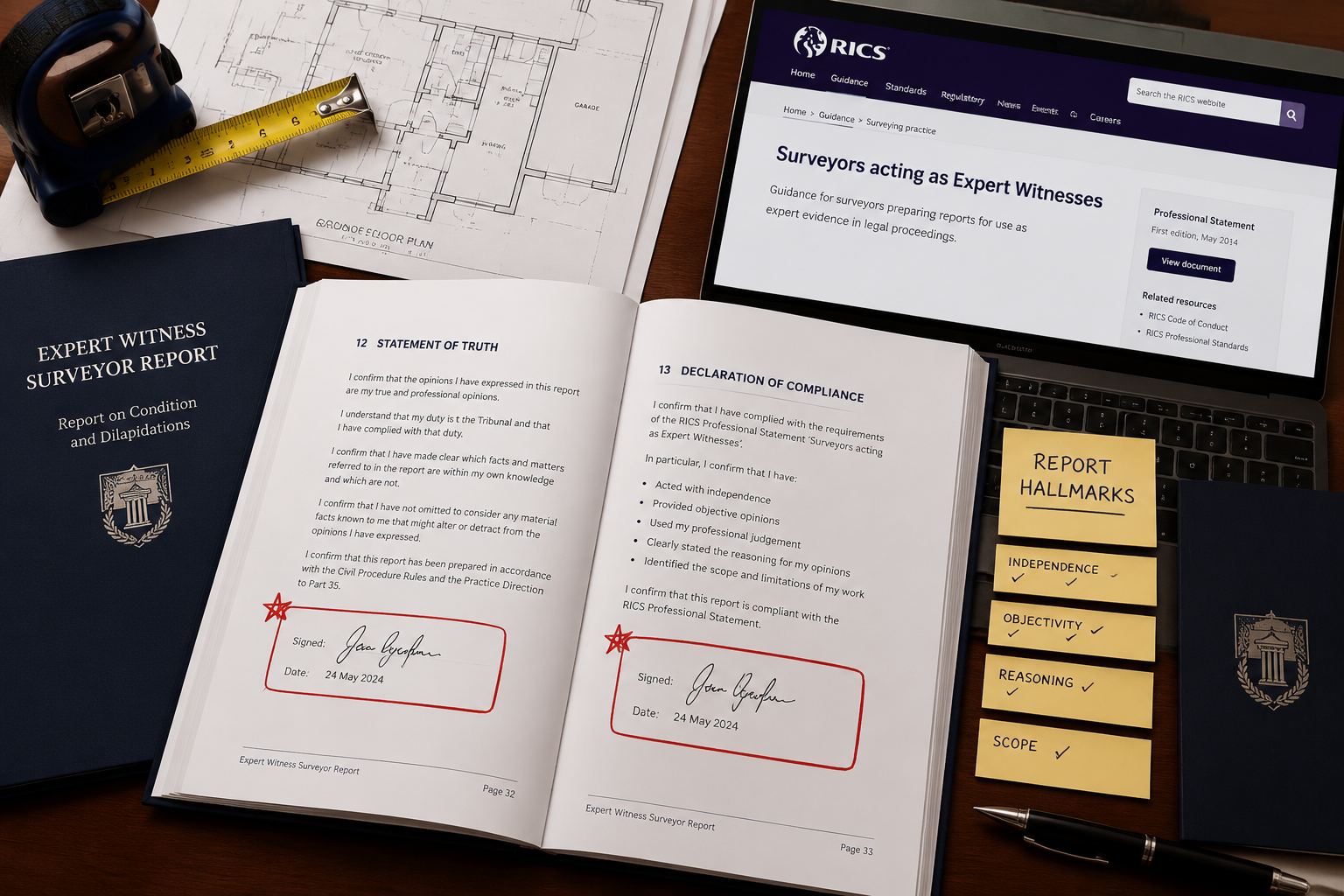
The Hallmarks of a Credible Expert Witness Report
So, in practical terms, what makes an expert witness surveyor credible under CPR Part 35 and RICS guidance when a judge reads their report? The answer lies in five core hallmarks.
1. 🔍 Genuine Independence
Independence is not simply a declaration — it must be demonstrated throughout the report. A credible expert witness surveyor will:
- Acknowledge weaknesses in their own analysis where they exist.
- Concede points to the opposing expert where the evidence supports it.
- Avoid language that reads as advocacy ("my client's position is correct because…").
- Present alternative interpretations of the evidence, even if ultimately rejected.
Research and practitioner commentary consistently identify perceived advocacy as the single most damaging credibility failure in expert witness work. [5] [6]
2. 📋 Clear Scope of Instructions
The report must clearly state what the expert was asked to do — and, critically, what falls outside the scope of their instructions. Scope creep (where an expert strays into areas not covered by their instructions or expertise) is a common problem that undermines credibility. [7]
A well-scoped report will:
- Quote or summarise the letter of instruction.
- Identify any limitations placed on the expert's access to evidence.
- Flag where additional investigation would be needed to answer questions fully.
3. 🧠 Transparent Reasoning and Methodology
Courts do not simply want to know what a surveyor concluded — they want to know why and how. A credible report will walk the reader through the reasoning process step by step. [4]
For example, in a valuation dispute, this means explaining:
- Which comparable transactions were selected and why.
- How adjustments were made for differences between comparables and the subject property.
- Why certain comparables were rejected.
This level of transparency allows the court (and the opposing expert) to scrutinise the methodology, which is precisely the point. Surveyors who offer conclusions without reasoning invite challenge. For context on how RICS valuation methodology works in practice, the RICS Red Book valuation framework provides a useful reference point.
4. ⚖️ Objectivity in Presenting Conflicting Evidence
A credible expert witness does not ignore inconvenient evidence. Where there is conflicting data — for example, comparable sales that support a lower value, or a structural report that contradicts the expert's findings — these must be acknowledged and addressed. [1]
Failing to engage with contrary evidence is one of the most common reasons expert reports are given reduced weight by courts. [5]
5. 📝 Procedural Completeness
Every required element of a CPR Part 35-compliant report must be present. This includes the Statement of Truth and the Declaration of Compliance. These are not optional formalities — they are the expert's formal acknowledgement of their duty to the court. [4]
Surveyors who provide expert witness services as part of a broader practice must ensure that every report produced meets these procedural requirements without exception.
Common Failures That Undermine Credibility ⚠️
Understanding what makes an expert witness surveyor credible under CPR Part 35 and RICS guidance also means understanding what destroys credibility. The following failures are the most frequently cited by judges and legal practitioners.
Advocacy Over Independence
As noted above, this is the most damaging failure. When a surveyor's report reads like a legal submission rather than an independent technical opinion, the court will discount it heavily. [5]
Overstating Certainty
Expert witnesses are expected to express opinions with appropriate qualification. Phrases like "it is possible that…" or "on the balance of probabilities…" reflect honest professional judgement. Absolute certainty where genuine uncertainty exists is a red flag. [6]
Failing to Update Opinions
If new evidence emerges during proceedings — for example, following a joint expert meeting — a credible expert will update their report or produce a supplemental statement. Rigidly maintaining an original position in the face of new evidence damages credibility significantly. [3]
Missing or Defective Declarations
A report without a proper Statement of Truth or Declaration of Compliance is technically non-compliant with CPR Part 35. Courts have the power to exclude such evidence or refuse permission for the expert to give oral testimony. [4]
Exceeding the Scope of Expertise
A surveyor instructed to opine on structural defects should not offer opinions on legal liability or quantum of damages unless specifically instructed and qualified to do so. Overreach undermines the expert's credibility across the entire report. [7]

Practical Application: Dispute Types Where Credibility Is Most Tested
Expert witness surveyors are called upon across a wide range of property and construction disputes. The credibility standards discussed above apply in all of them, but certain dispute types place particular demands on the expert.
Dilapidations Claims
In dilapidations disputes, the expert must carefully distinguish between disrepair and fair wear and tear, and must apply the correct legal standard (the Leasehold Property (Repairs) Act 1938 and the Jervis v Harris principles). A dilapidations surveyor acting as an expert witness must demonstrate both technical and legal literacy. [8]
Party Wall Disputes
Party wall matters frequently escalate to court when the appointed surveyors cannot agree. In these cases, the expert must be able to explain technical findings — such as the extent of damage or the adequacy of a schedule of condition — in terms accessible to a non-specialist judge. [8]
Valuation Disputes
Valuation disputes — whether in matrimonial proceedings, probate, or commercial litigation — require the expert to demonstrate rigorous adherence to RICS Red Book methodology and to justify every material assumption. [9]
Specific Defect and Building Condition Disputes
Where the dispute centres on a specific defect — such as subsidence, damp, or structural failure — the expert must demonstrate hands-on inspection experience and familiarity with relevant British Standards and building regulations. An RICS specific defect survey provides the kind of detailed technical foundation that supports credible expert evidence. [1]
Joint Expert Meetings and Single Joint Experts
CPR Part 35 also provides for joint expert meetings (where each party's expert meets to identify areas of agreement and disagreement) and single joint experts (where one expert is appointed by both parties). [2]
In joint meetings, credibility is tested in real time. An expert who refuses to concede obvious points, or who cannot articulate the reasoning behind their conclusions under questioning, will lose standing rapidly. The outcome of joint meetings — typically a joint statement — is given significant weight by courts.
Single joint experts carry an even greater responsibility for impartiality, as there is no opposing expert to provide a check on their conclusions.
Conclusion: Actionable Steps for Surveyors and Instructing Parties
Credibility as an expert witness surveyor is earned through consistent adherence to both the legal requirements of CPR Part 35 and the professional standards set by RICS. It is not a status that can be assumed on the basis of technical qualifications alone.
For surveyors seeking to build or maintain credibility as expert witnesses:
- ✅ Review every report against the CPR 35 and PD 35 checklist before submission — qualifications, instructions, materials, assumptions, reasoning, Statement of Truth, Declaration of Compliance.
- ✅ Engage with contrary evidence openly and explain why it has or has not changed your opinion.
- ✅ Accept instructions only within your genuine area of expertise — scope discipline is a credibility asset, not a limitation.
- ✅ Prepare thoroughly for joint expert meetings — your oral performance matters as much as your written report.
- ✅ Keep up to date with RICS professional statements on expert witness work, which are updated periodically to reflect case law and practice developments. [3]
For solicitors and parties instructing expert witness surveyors:
- Choose an expert with demonstrable experience in the specific dispute type.
- Ensure the letter of instruction is clear, complete, and does not inadvertently compromise the expert's independence.
- Allow sufficient time for the expert to produce a fully compliant report — rushed reports are a leading cause of procedural failures.
The courts rely on expert witnesses to illuminate technical matters that are beyond the knowledge of judges and juries. A surveyor who takes that responsibility seriously — and who demonstrates it through every element of their report and conduct — will always be the most credible voice in the room.
References
[1] Expert Witness Duties Responsibilities – https://ww3.rics.org/uk/en/journals/built-environment-journal/expert-witness-duties-responsibilities.html
[2] Watch – https://www.youtube.com/watch?v=q-VnCRyMi90
[3] Surveyors Acting As Expert Witnesses – https://www.rics.org/profession-standards/rics-standards-and-guidance/sector-standards/dispute-resolution-standards/surveyors-acting-as-expert-witnesses
[4] Expert Evidence Part 35 Civil Procedure Rules Quantik Vhzge – https://www.linkedin.com/pulse/expert-evidence-part-35-civil-procedure-rules-quantik–vhzge
[5] fenwickelliott – https://www.fenwickelliott.com/research-insight/newsletters/insight/39
[6] Expert Witness Impartiality Under Cpr Part 35 Building Surveyors Guide To Courtroom Credibility In 2026 – https://kingstonsurveyors.com/expert-witness-impartiality-under-cpr-part-35-building-surveyors-guide-to-courtroom-credibility-in-2026/
[7] Expert Witness Surveyor Specializations In 2026 Building Your Practice Across Land Property And Construction Disputes – https://wimbledonsurveyors.com/expert-witness-surveyor-specializations-in-2026-building-your-practice-across-land-property-and-construction-disputes/
[8] Building Your Expert Witness Practice In 2026 Specializations In Party Wall Defects And Valuations – https://www.canterburysurveyors.com/blog/building-your-expert-witness-practice-in-2026-specializations-in-party-wall-defects-and-valuations/
[9] Valuation Surveying Expert Witnesses Navigating 2026 Court Challenges With Rics Evidence Standards – https://wimbledonsurveyors.com/valuation-surveying-expert-witnesses-navigating-2026-court-challenges-with-rics-evidence-standards/
[10] View – https://consultations.rics.org/surveyorsasexpertwitness/view?objectID=257098181