Nearly one in three suburban extension projects in the UK triggers some form of neighbour dispute — yet most homeowners only discover they've instructed the wrong professional after the damage is done. Understanding the distinction between Boundary and Access Disputes in Suburban Extensions: When to Instruct a Building Surveyor vs a Party Wall Surveyor is not a technicality — it is the difference between a smooth build and a costly legal standoff.
Boundary disputes are becoming increasingly common in 2026 as the UK property market recovers, making expert surveyor selection more critical than ever [4]. Whether a homeowner is planning a rear kitchen extension, a loft conversion with a dormer, or a side infill that creeps close to the neighbour's wall, knowing which professional to call — and when — can save thousands of pounds and months of stress.
Key Takeaways 📋
- Building surveyors assess structural condition, defects, and construction quality; they do not administer Party Wall Act procedures.
- Party wall surveyors are appointed specifically under the Party Wall etc. Act 1996 to protect both building and adjoining owners during notifiable works.
- Boundary disputes and party wall disputes are legally distinct — confusing them leads to delays, invalid notices, and potential litigation.
- A schedule of condition is a critical document in both types of dispute and should be prepared before works begin.
- When disputes escalate, an expert witness surveyor may be required — a separate specialism entirely.
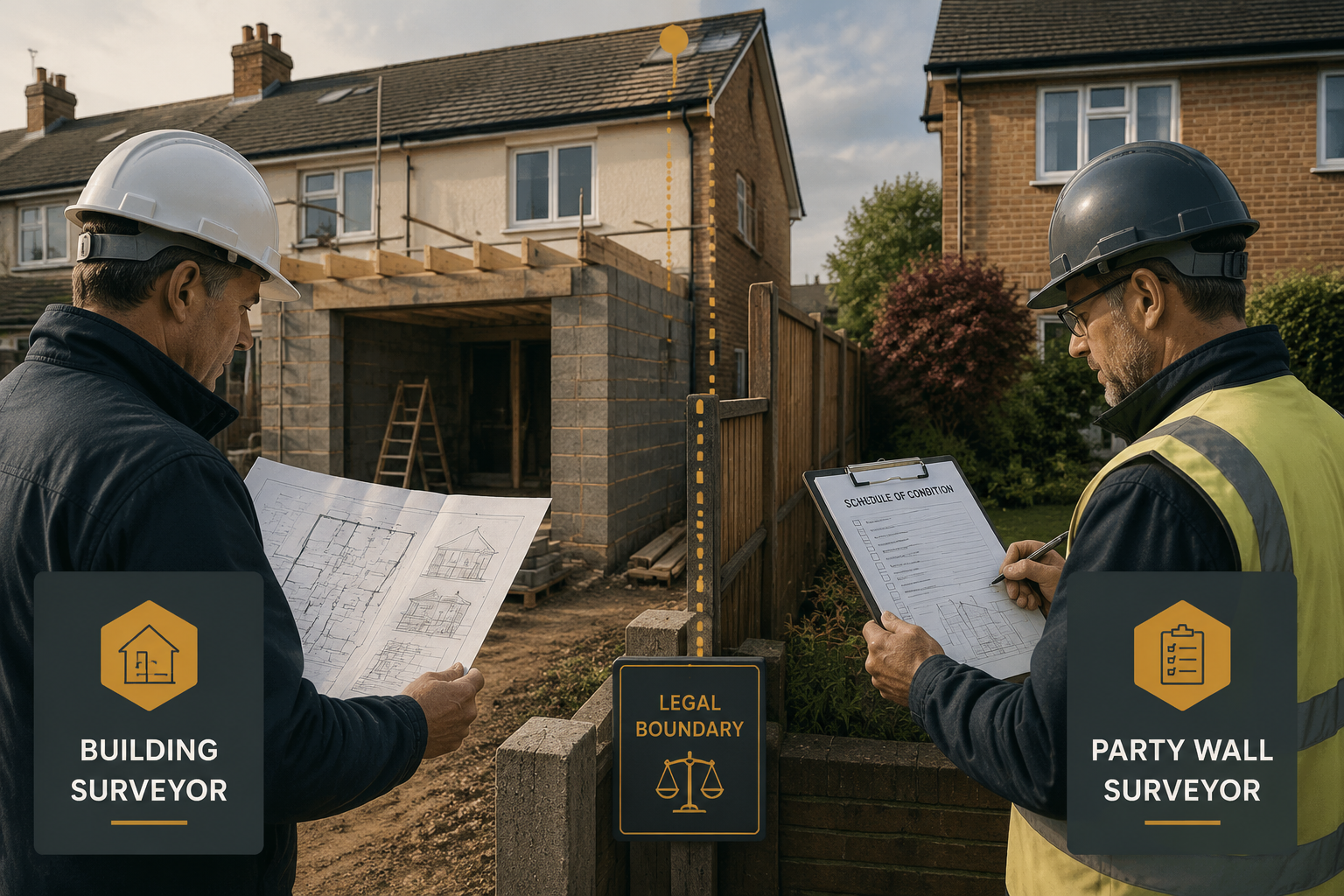
Understanding the Two Roles: Building Surveyor vs Party Wall Surveyor
Before diving into specific scenarios, it helps to understand what each professional actually does — because the titles are frequently (and dangerously) conflated.
What Does a Building Surveyor Do?
A chartered building surveyor is a broad construction and property professional. Their remit covers:
- Structural surveys and defect analysis 🔍
- Pre-purchase building surveys (Level 2 and Level 3)
- Specification writing and contract administration
- Overseeing extension projects and managing contractors
- Assessing damage caused by construction works
A building surveyor is the right professional to assess whether an extension has been built correctly, whether cracks in a wall indicate structural failure, or whether a proposed design is sound. They work across the full lifecycle of a building project.
💡 Key point: A building surveyor does not automatically have authority or expertise in administering the Party Wall etc. Act 1996 — even though many are also qualified to act as party wall surveyors.
What Does a Party Wall Surveyor Do?
A party wall surveyor is appointed specifically to administer the Party Wall etc. Act 1996. Their role is narrower but legally precise:
- Serving and receiving party wall notices
- Preparing and agreeing Party Wall Awards
- Conducting schedules of condition on adjoining properties before works begin
- Resolving disputes between building owners and adjoining owners
- Assessing damage to property caused by party wall works
Importantly, a party wall surveyor acts in a quasi-judicial capacity — they must act impartially, even when appointed by one party. This is a statutory function, not a commercial one.
Quick Comparison Table
| Feature | Building Surveyor | Party Wall Surveyor |
|---|---|---|
| Legal authority | No statutory powers | Acts under Party Wall Act 1996 |
| Scope | Broad — defects, design, contracts | Narrow — party wall procedures |
| When appointed | Any stage of a project | Before notifiable works begin |
| Who appoints them | Building owner or buyer | Building owner and/or adjoining owner |
| Produces | Survey reports, specs, certificates | Party Wall Awards, Schedules of Condition |
| Dispute resolution | Advisory only | Binding determinations |
Common Suburban Scenarios: When to Instruct Which Surveyor
The most useful way to understand Boundary and Access Disputes in Suburban Extensions: When to Instruct a Building Surveyor vs a Party Wall Surveyor is through the lens of real-world extension scenarios.
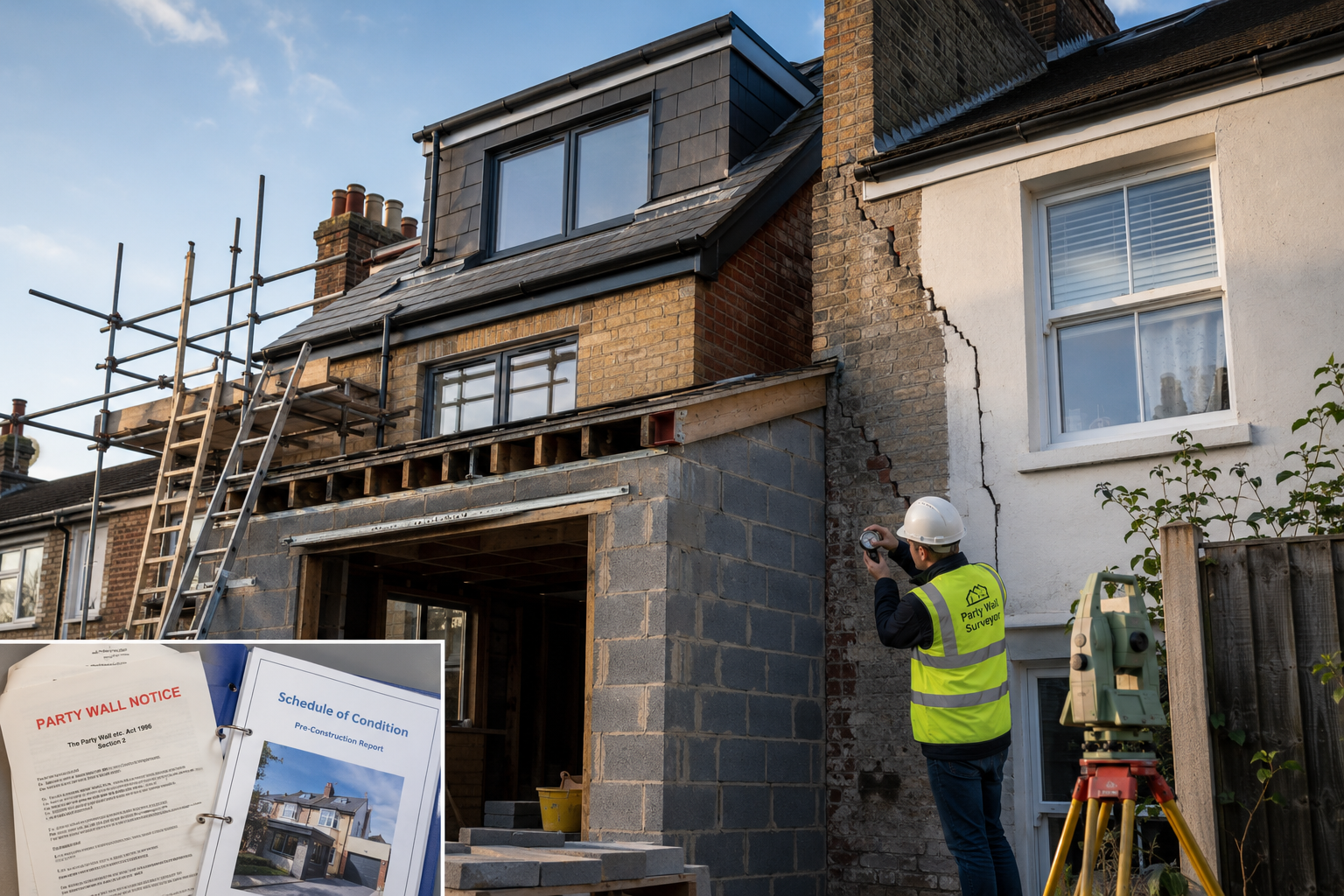
Scenario 1: Rear Kitchen Extension 🏠
A homeowner in a semi-detached property plans a single-storey rear extension that runs along the shared boundary wall. The extension will:
- Use the existing party wall as one side of the new structure
- Require excavation within 3 metres of the neighbour's foundations
- Potentially encroach on a disputed boundary line near the rear garden
Who to instruct:
- ✅ Party wall surveyor — immediately, before any works begin. The works trigger the Party Wall etc. Act 1996 under both Section 2 (works to a party wall) and possibly Section 6 (excavation near adjoining foundations). Party wall consent must be obtained or a formal Award agreed.
- ✅ Building surveyor — to assess the structural design of the extension, specify materials, and oversee construction quality.
- ⚠️ Boundary issue — if the rear boundary line is genuinely disputed, neither a party wall surveyor nor a standard building surveyor resolves this. A boundary surveyor (often a specialist RICS member) or a solicitor will be needed first, with a formal survey and title review as the essential first step [1].
🔑 Pull Quote: "The party wall process protects both neighbours during construction — but it cannot determine where the legal boundary actually lies. Those are two separate questions."
Scenario 2: Loft Conversion with Dormer
A terraced house owner wants to convert the loft, adding a rear dormer and raising the party wall by 600mm to achieve headroom. The neighbour is concerned about:
- Structural loading on the shared party wall
- Noise and vibration during construction
- Potential cracking to their bedroom ceiling
Who to instruct:
- ✅ Party wall surveyor — essential. Raising or cutting into a party wall is a notifiable act under Section 2 of the Act. A Party Wall Award will set out the method of works, hours of operation, and the adjoining owner's rights. A schedule of condition of the neighbour's property should be prepared beforehand.
- ✅ Building surveyor — to review the structural engineer's beam calculations, inspect the dormer construction, and certify practical completion.
- ❌ Not a boundary dispute — unless the dormer overhangs the boundary line, this is a party wall matter, not a boundary matter.
Scenario 3: Side Infill Extension
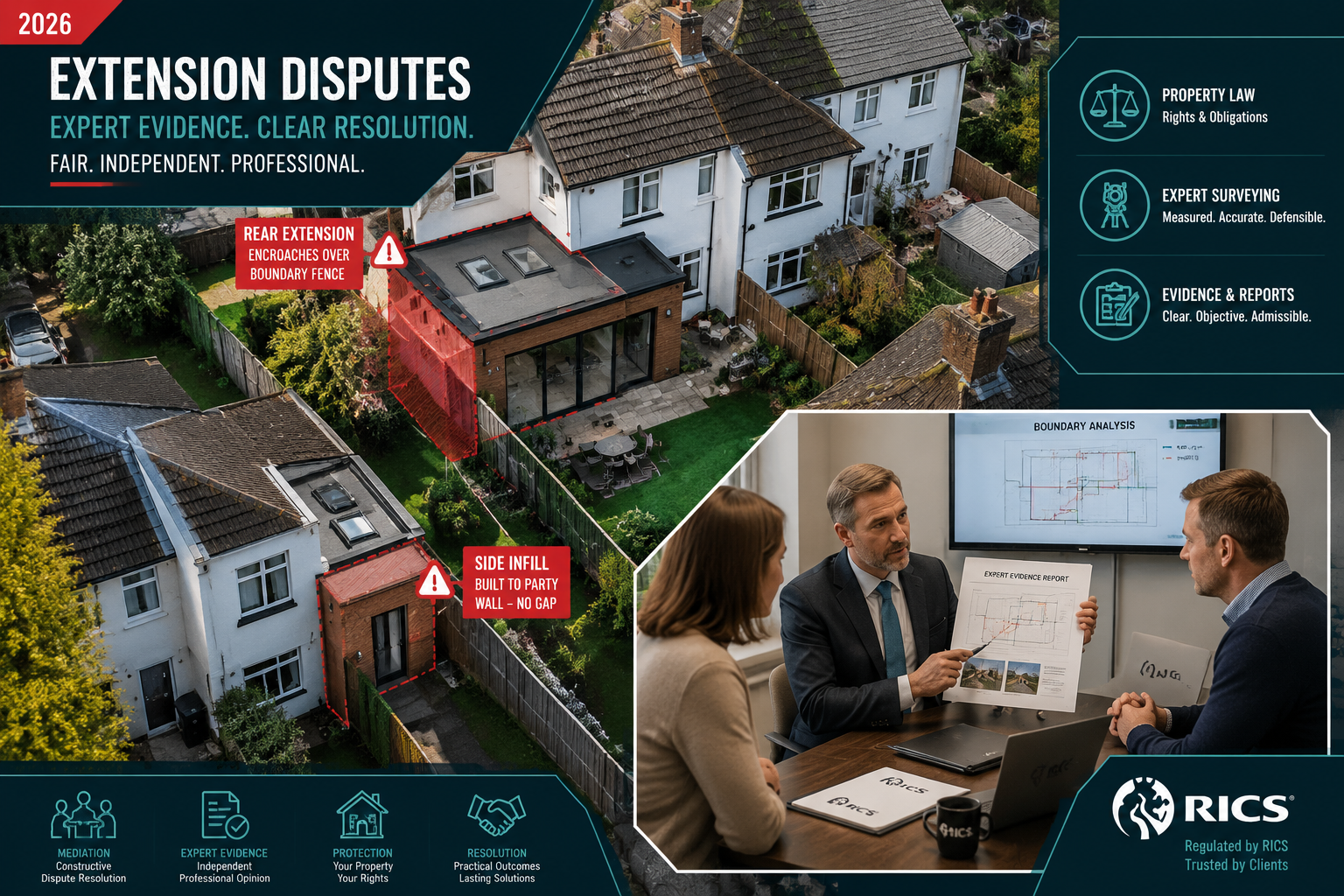
A homeowner builds a side return extension that fills the gap between their property and the boundary wall. The neighbour claims the new wall is built on their land — not adjacent to it.
Who to instruct:
- ✅ Boundary surveyor / RICS expert — first. Encroachment disputes commonly involve physical boundary violations such as fences or walls built on incorrect property lines [5]. Documentation and property deed validation are essential before engaging any other professional [5].
- ✅ Party wall surveyor — if the wall is confirmed to be a party wall or sits on the boundary, the Act applies. If no party wall notice was served, the adjoining owner has specific rights — and works carried out without a party wall agreement can be challenged.
- ✅ Building surveyor — to assess whether the new wall has caused any structural damage to the neighbour's property.
When Disputes Escalate: The Expert Witness Surveyor
Standard building and party wall surveying resolves the majority of suburban extension disputes. But some situations escalate — and when they do, a third professional enters the picture: the expert witness surveyor.
Expert witnesses with surveying expertise are now essential for strengthening boundary dispute cases in 2026, reflecting growing complexity in suburban boundary matters [4]. An expert witness surveyor:
- Prepares independent technical reports for use in court or tribunal
- Provides evidence on matters such as encroachment, structural damage causation, or the validity of a Party Wall Award
- Is bound by the Civil Procedure Rules (CPR Part 35) to serve the court, not the instructing party
⚠️ Important: An expert witness surveyor is not a replacement for a party wall surveyor or a building surveyor. They are instructed after a dispute has failed to resolve through normal channels.
Signs a Dispute May Need an Expert Witness 🚨
- A Party Wall Award has been made but one party alleges it was improperly prepared
- A boundary has been formally disputed and legal proceedings have commenced
- Significant structural damage is alleged and causation is contested
- A neighbour claims an extension encroaches on their land and is seeking an injunction
Land survey costs for suburban properties in 2026 range from approximately £430–£860 (equivalent to $550–$1,100) for standard residential assessments [3], though expert witness reports for complex litigation can run considerably higher. Budgeting for the right professional at the right stage avoids compounding costs later.
Practical Guidance: A Step-by-Step Decision Framework
Use this framework before instructing any professional for a suburban extension dispute.
Step 1 — Identify the Nature of the Dispute
Ask: Is this about the legal boundary line, the party wall, or the quality/safety of construction?
- Boundary line → Instruct a boundary surveyor and solicitor first
- Party wall → Instruct a party wall surveyor
- Construction defect or damage → Instruct a chartered building surveyor
Step 2 — Check Whether the Party Wall Act Applies
The Act applies when works involve:
- Cutting into, raising, or underpinning a party wall or party fence wall
- Building on or at the boundary line
- Excavating within 3 metres of an adjoining structure (or 6 metres for deeper excavations)
If the Act applies and no notice has been served, works may be unlawful — see guidance on what happens when a neighbour carries out works without a party wall agreement.
Step 3 — Obtain a Schedule of Condition Before Works Begin
Regardless of which surveyor is instructed, a schedule of condition documents the pre-works state of the adjoining property. This is the single most important protective document in any extension dispute. Without it, attributing post-works damage becomes almost impossible.
Step 4 — Do Not Rely on the Same Surveyor for Both Roles
A common and costly mistake is assuming one surveyor can handle everything. A building surveyor overseeing a project cannot also act as the agreed party wall surveyor — this creates a conflict of interest. Appoint professionals independently for each function.
Step 5 — Escalate Early if Needed
Common mistakes in boundary disputes include waiting too long to seek professional advice, which allows situations to deteriorate [10]. If a neighbour is unresponsive, aggressive, or has already begun works without notice, seek specialist advice promptly rather than allowing the dispute to entrench.
Choosing the Right Surveyor for Your Location
Suburban extension disputes are highly localised. The density of semi-detached and terraced housing, local planning policies, and the age of the housing stock all affect the frequency and complexity of party wall and boundary matters.
Specialist chartered surveyors operate across suburban areas including South West London, Surrey, Hertfordshire, and Buckinghamshire — all areas with high volumes of suburban extension activity and corresponding dispute rates.
When selecting a surveyor, look for:
- RICS membership (Royal Institution of Chartered Surveyors) ✔️
- Demonstrated experience in party wall matters or boundary disputes specifically ✔️
- Professional indemnity insurance ✔️
- Clear fee transparency before instruction ✔️
Conclusion: Get the Right Professional From the Start
Boundary and Access Disputes in Suburban Extensions: When to Instruct a Building Surveyor vs a Party Wall Surveyor is ultimately a question of matching the right expertise to the right problem — at the right time.
The three roles — building surveyor, party wall surveyor, and expert witness surveyor — are complementary but distinct. Conflating them, or hoping one professional can cover all bases, is one of the most common and expensive mistakes made during suburban extension projects.
Actionable Next Steps ✅
- Before any extension works begin — identify whether the Party Wall Act applies and serve notice promptly.
- Commission a schedule of condition on any adjoining property before works start.
- If a boundary is in dispute — instruct a boundary specialist and review title deeds before proceeding with construction.
- Appoint a building surveyor separately to oversee construction quality and structural integrity.
- If the dispute escalates — instruct an expert witness surveyor early, not as a last resort.
- Seek local specialist advice — contact a chartered surveyor experienced in suburban extension disputes in your specific area.
Getting the professional selection right from the outset is not just good practice — in 2026's increasingly active property market, it is essential protection for one of the most significant investments most people will ever make.
References
[1] Boundary And Property Line Disputes Legal Option – https://www.strategylaw.com/blog/2026/january/boundary-and-property-line-disputes-legal-option/
[3] Land Survey Costs In 2026 Price Trends Technologys Impact And Budget Planning For Property Owners – https://wimbledonsurveyors.com/land-survey-costs-in-2026-price-trends-technologys-impact-and-budget-planning-for-property-owners/
[4] Expert Witness Essentials For 2026 Boundary Disputes Strengthening Cases In A Recovering Property Market – https://nottinghillsurveyors.com/blog/expert-witness-essentials-for-2026-boundary-disputes-strengthening-cases-in-a-recovering-property-market
[5] Boundary Disputes How To Resolve Conflicts Over Property Lines – https://kinglawoffices.com/blog/boundary-disputes-how-to-resolve-conflicts-over-property-lines
[10] Common Mistakes In Boundary Disputes And How To Avoid Them – https://thebarristersinc.com/news/common-mistakes-in-boundary-disputes-and-how-to-avoid-them/