Nearly one in three party wall disputes escalates unnecessarily — not because of genuine disagreement, but because the wrong surveyor model was chosen at the outset. For homeowners planning builds in 2026, that is an expensive and avoidable mistake.
This guide on Agreed Party Wall Surveyors: Ensuring Independence, Fee Benchmarks, and Award Best Practices for 2026 Builds explains how appointing a single neutral surveyor for both parties can reduce costs, speed up the process, and still deliver a legally sound Party Wall Award — provided that surveyor operates with genuine impartiality. Whether planning a loft conversion, rear extension, or basement excavation, understanding this model before serving notice could save thousands of pounds and weeks of delay.
Key Takeaways 📌
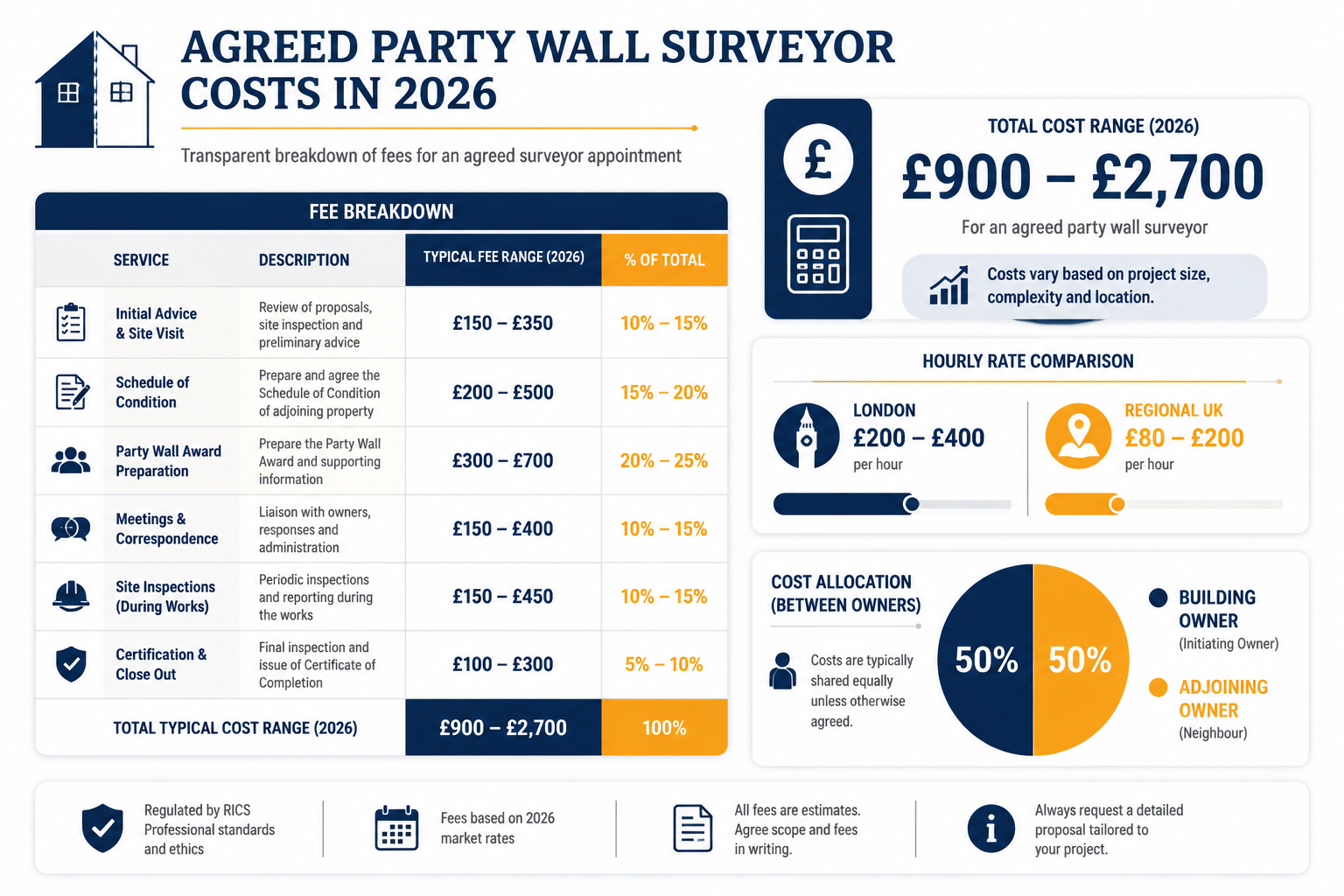
- One agreed surveyor acting for both parties typically costs £900–£2,700 total, significantly less than the two-surveyor model.
- RICS 8th Edition guidance (2026) explicitly requires that fee arrangements must not compromise surveyor independence.
- London surveyors charge £200–£400/hour versus £80–£200/hour in regional areas — location matters enormously for budgeting.
- Building owners bear all reasonable party wall costs under the Party Wall etc. Act 1996, including the adjoining owner's surveyor fees.
- A 20–30% cost contingency above quoted fees is industry best practice for 2026 projects.
What Is an Agreed Party Wall Surveyor and Why Does It Matter in 2026?
The Core Concept
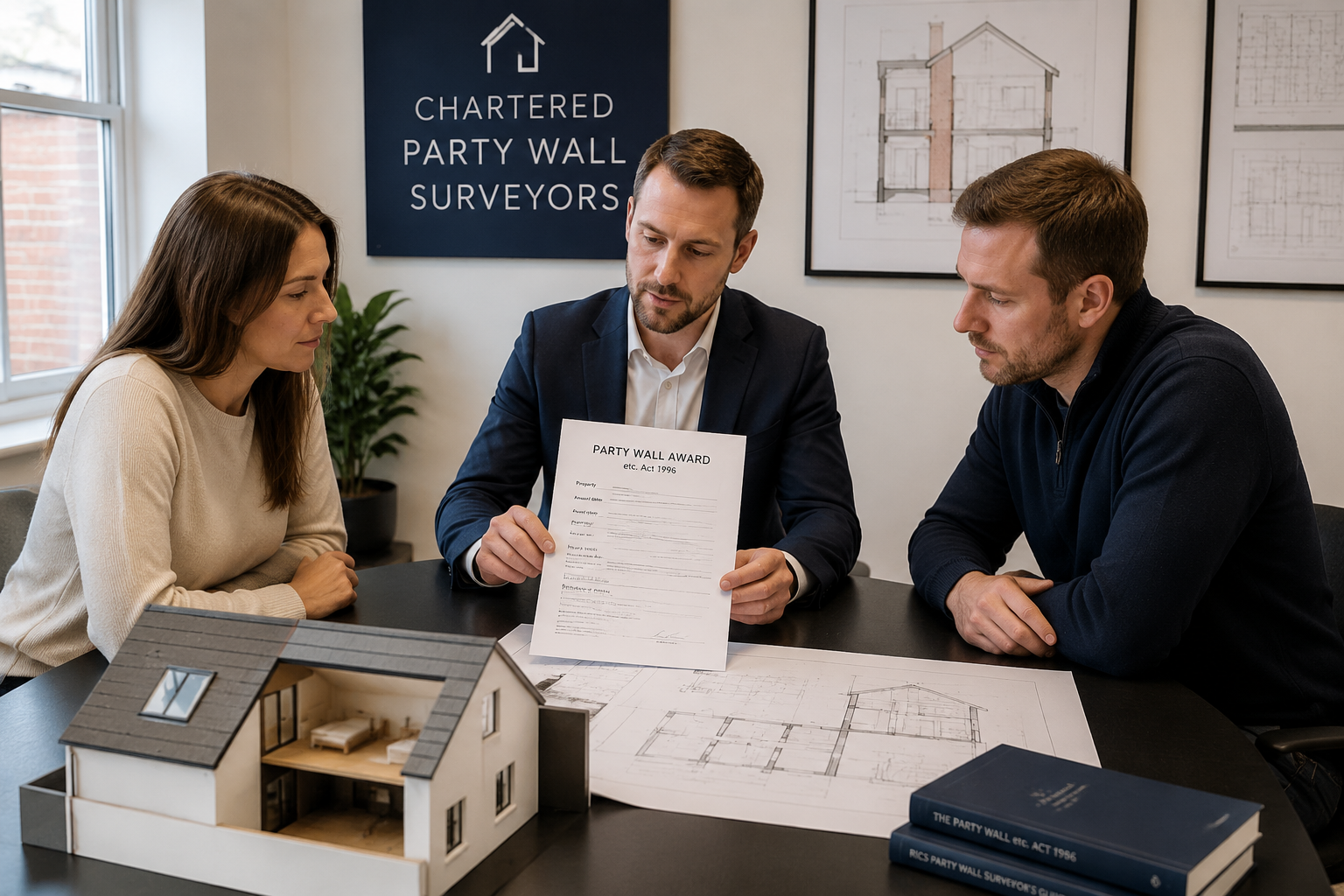
Under the Party Wall etc. Act 1996, when a building owner proposes notifiable works — such as building on or near a boundary, or excavating within 3–6 metres of a neighbour's structure — the adjoining owner has the right to appoint their own surveyor. However, both parties can instead jointly appoint a single agreed surveyor to act impartially for both sides.
This is not a compromise. It is a formal, legally recognised mechanism within the Act. The agreed surveyor does not represent either party — they act as a quasi-judicial officer, determining what is fair and reasonable for all concerned. Understanding how party wall consent works is the essential first step before choosing which surveyor model to use.
Why 2026 Makes This More Relevant Than Ever
The 2026 construction uptick — driven by returning buyer confidence and pent-up renovation demand — has placed significant pressure on party wall surveyor capacity. With more notices being served simultaneously, the agreed surveyor model is increasingly attractive because it:
- ✅ Reduces the total number of professionals involved
- ✅ Speeds up the Award preparation timeline
- ✅ Cuts total costs for all parties
- ✅ Minimises adversarial dynamics between neighbours
"The agreed surveyor model works best when both parties approach the process in good faith and when the proposed works are relatively straightforward." [3]
Fee Benchmarks for Agreed Party Wall Surveyors: Ensuring Independence, Fee Benchmarks, and Award Best Practices for 2026 Builds
Total Cost Ranges by Project Type
The single agreed surveyor model offers meaningful savings over the two-surveyor alternative. Here is a breakdown of typical 2026 costs:
| Project Type | Agreed Surveyor Total Cost | Two-Surveyor Total (Estimate) |
|---|---|---|
| Loft conversion | £900–£1,200 | £1,500–£3,600 |
| Rear extension | £1,000–£1,500 | £1,800–£4,000 |
| Basement excavation | £1,800–£2,700 | £3,000–£8,000+ |
| Multiple adjoining owners | £2,000–£4,000+ | £4,000–£12,000+ |
Sources: [2][3][6]
For straightforward residential matters, fixed fees typically range from £1,050–£1,650 per adjoining owner — a structured alternative to hourly billing that provides cost certainty for both parties [6]. For more detail on what drives the cost of party wall work, it is worth reviewing the full breakdown before appointing anyone.
Hourly Rates: London vs. Regional Areas
Geographic location is one of the biggest cost variables in 2026:
- 🏙️ London: £200–£400 per hour
- 🏘️ Regional areas: £80–£200 per hour [1]
This disparity means a London-based project involving three site visits and Award preparation could easily cost £1,200–£2,400 in surveyor time alone, before any disbursements. Regional projects for equivalent work might cost £480–£900.
What the Building Owner Pays
Under the Party Wall etc. Act 1996, the building owner bears all reasonable party wall costs, including:
- Their own surveyor's fees
- The adjoining owner's surveyor fees (if separately appointed)
- Party Wall Award preparation costs
- Third surveyor fees (where applicable)
- Land Registry search fees (£8 per search) to identify legal owners and leaseholders [1]
The only exception is where a party wall requires repair due to shared defects or shared use — in that case, costs may be split between parties, with a chartered surveyor determining the correct apportionment [2].
Per-Surveyor Fees When the Two-Surveyor Model Applies
Where the agreed model is not used, individual surveyor fees range from £750–£1,800 per affected neighbour when acting as the building owner's appointed surveyor [5]. This is why the agreed model — when appropriate — delivers such clear financial benefits.
Third Surveyor Costs
When two appointed surveyors reach deadlock, a third independent surveyor makes binding determinations. Third surveyor fees typically range from £500–£1,500 depending on dispute complexity, with fault-based allocation principles applied to fee responsibility [1]. Avoiding this outcome is one of the strongest arguments for using an agreed surveyor from the outset.
Budgeting Advice: The 20–30% Contingency Rule
Industry best practice in 2026 suggests budgeting a 20–30% contingency above quoted surveyor fees to cover:
- Specialist engineer reports: £500–£2,000
- Additional site visits: £150–£400 per visit
- Escalation and dispute resolution expenses [1]
For loft conversion projects specifically, reviewing loft conversions and party wall obligations before instructing a surveyor can help identify whether additional specialist input will be needed.
RICS Independence Requirements and Award Best Practices for 2026
RICS 8th Edition Guidance: What Changed in 2026
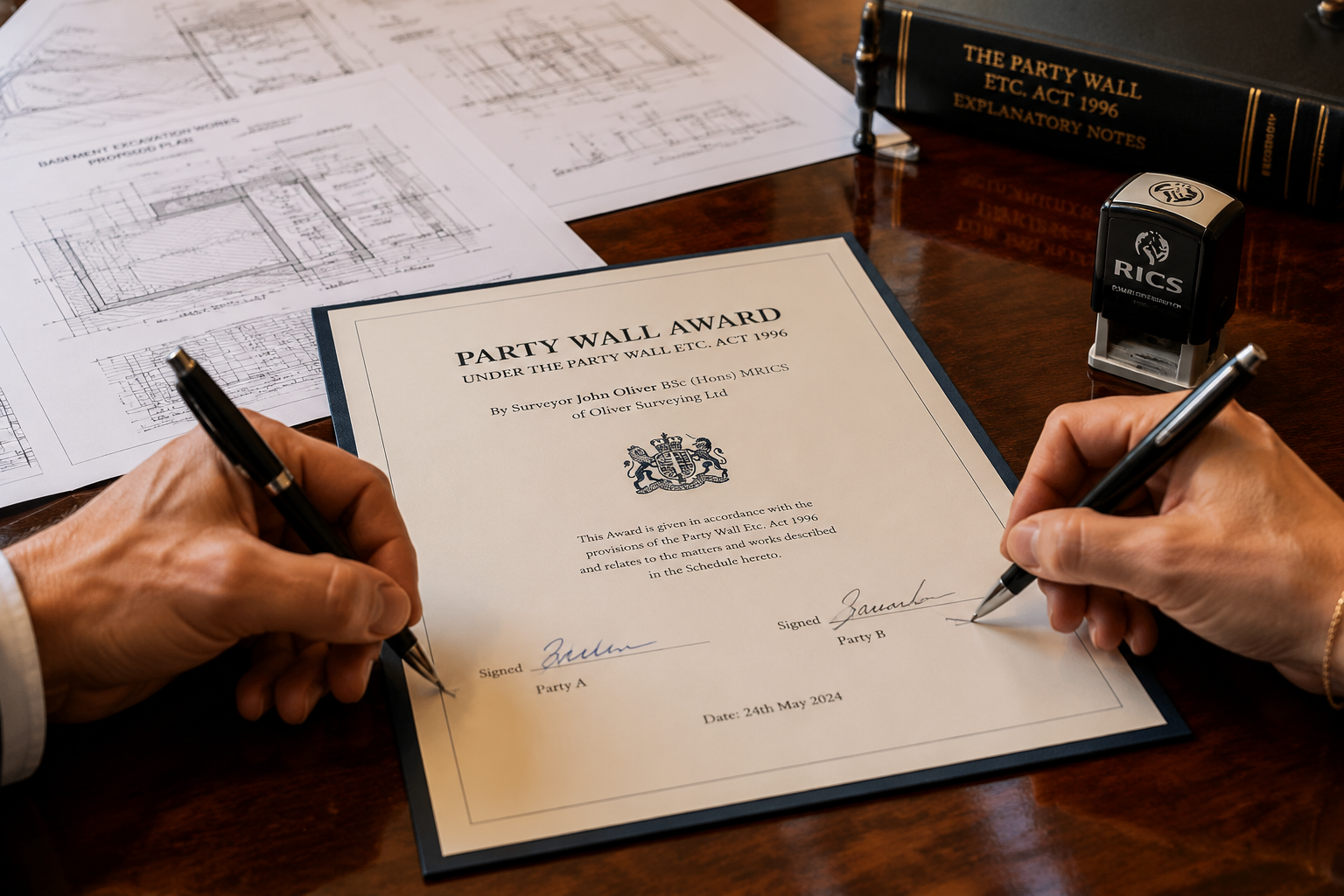
The updated RICS 8th Edition guidance places independence at the centre of the agreed surveyor model. Critically, it states that fee arrangements must not compromise surveyor independence — directly addressing concerns about the party wall process and professional integrity [7].
In practical terms, this means:
- ❌ A surveyor cannot accept a fee structure that incentivises them to favour one party
- ❌ A surveyor cannot have a pre-existing financial relationship with one party that is not disclosed
- ✅ Fee transparency must be established before appointment
- ✅ Both parties must consent to the agreed surveyor's appointment in writing
The Independence Framework: How It Works in Practice
The agreed surveyor model operates on a specific impartiality framework:
- Both parties jointly appoint one surveyor in writing
- The surveyor confirms no conflicts of interest before accepting
- The surveyor conducts a schedule of condition of the adjoining property before works begin
- The surveyor prepares the Party Wall Award, setting out the rights and obligations of both parties
- Either party can appeal the Award to the County Court within 14 days if they believe it is unjust
This process is fundamentally different from the two-surveyor model, where each party's surveyor acts as an advocate. The agreed surveyor must reach conclusions that are defensible to both sides simultaneously.
Avoiding Bias Pitfalls: A Practical Checklist
Before appointing an agreed surveyor, both the building owner and adjoining owner should verify:
- The surveyor holds RICS membership or equivalent professional accreditation
- The surveyor has no prior relationship with either party or their contractors
- Fee terms are agreed in writing before appointment, not after
- The surveyor can demonstrate experience with the specific work type (e.g., basement excavations require different expertise than loft conversions)
- The surveyor provides a clear timeline for Award preparation
- The surveyor explains the appeals process to both parties at the outset
Template: Homeowner-Neighbour Agreement for Appointing an Agreed Surveyor
The following template language can be adapted for a written agreement between neighbours:
Draft Agreed Surveyor Appointment Letter
Date: [Insert Date]
To: [Surveyor Name and Firm]
We, [Building Owner Name] of [Address] and [Adjoining Owner Name] of [Address], jointly appoint you as the Agreed Surveyor under Section 10(1)(b) of the Party Wall etc. Act 1996 in respect of the proposed works at [Building Owner Address].
We confirm that:
- We understand you act impartially for both parties.
- We have been informed of your fee structure: [Insert agreed fee or hourly rate].
- We understand that [Building Owner Name] will bear all reasonable costs unless otherwise determined.
- We understand our right to appeal any Award to the County Court within 14 days of service.
Signed: _________________________ (Building Owner)
Signed: _________________________ (Adjoining Owner)
Date: _________________________
This written record protects both parties and gives the surveyor a clear mandate to act. It also serves as evidence of informed consent should any dispute arise later.
What a Well-Drafted Party Wall Award Must Include
A properly prepared Party Wall Award for 2026 builds should contain:
- Description of the proposed works in sufficient detail
- Working hours during which notifiable works may be carried out
- Method of construction for sensitive elements (e.g., underpinning, excavation)
- Schedule of condition of the adjoining property (photographic and written)
- Access rights for the building owner and their contractors
- Dispute resolution mechanism if damage occurs during works
- Surveyor's fees and the party responsible for payment
For a detailed breakdown of what a Party Wall Award covers and how it protects both parties, the party wall award guidance resource provides a thorough overview.
Handling Damage Claims Under the Agreed Model
One area where the agreed surveyor model requires particular care is damage claims. If the adjoining owner believes the building works caused damage to their property, the agreed surveyor must assess this claim impartially — even though the building owner is paying the fees.
This is why the pre-works schedule of condition is so critical. Without a documented baseline, attributing damage to the notifiable works becomes a matter of dispute rather than evidence. Understanding damage to property in party wall situations helps both parties understand their rights before works begin.
For complex projects — particularly those involving excavation near foundations — a structural survey of the adjoining property before works commence can provide an additional layer of protection for both parties.
When the Agreed Model Is Not Appropriate
The agreed surveyor model is not suitable in every situation. Consider the two-surveyor model instead when:
- 🚩 There is already significant distrust between neighbours
- 🚩 The works are highly complex (e.g., deep basement excavations with multiple affected properties)
- 🚩 The adjoining owner has specific concerns they want independently represented
- 🚩 There is a history of obstruction in the party wall process — a situation explored in detail in this guide on obstruction in party wall matters
In these cases, the additional cost of separate representation is justified by the protection it provides.
Conclusion: Getting the 2026 Party Wall Process Right From Day One
The principles behind Agreed Party Wall Surveyors: Ensuring Independence, Fee Benchmarks, and Award Best Practices for 2026 Builds are straightforward: appoint the right professional early, establish fee transparency before work begins, and ensure the Award is thorough enough to prevent disputes during construction.
Actionable Next Steps ✅
-
Serve notice early. Party wall notices must be served at least one month before works begin (two months for structural works). Do not leave this until the last minute in a busy 2026 construction market.
-
Discuss the agreed surveyor model with your neighbour before serving notice. A cooperative approach from the outset sets the right tone and can save both parties significant money.
-
Verify RICS credentials. Only appoint a surveyor who can demonstrate current RICS membership and relevant experience with your specific project type.
-
Get fee terms in writing before appointment. This protects both parties and aligns with updated RICS 8th Edition independence requirements.
-
Budget with a 20–30% contingency. Even straightforward projects can encounter unexpected complications. Build this buffer into the project budget from day one.
-
Commission a schedule of condition before works start. This single step prevents the majority of post-works damage disputes.
-
Get a quote from a qualified party wall surveyor to understand the specific costs for your project type and location before committing to any appointment.
The agreed surveyor model, when used correctly and with a genuinely independent professional, remains one of the most cost-effective and efficient ways to navigate the party wall process in 2026. The key is choosing the right surveyor — and holding them to the independence standards the law requires.
References
[1] Party Wall Dispute – https://onlinearchitecturalservices.com/party-wall-dispute/
[2] Party Wall Surveyor Cost – https://hoa.org.uk/advice/guides-for-homeowners/i-am-improving/party-wall-surveyor-cost/
[3] Party Wall Awards And Fee Structures In 2026 Navigating Increased Demand And Cost Pressures – https://wimbledonsurveyors.com/party-wall-awards-and-fee-structures-in-2026-navigating-increased-demand-and-cost-pressures/
[4] Agreed Surveyor Vs Two Surveyors Cost Comparisons And Decision Frameworks For 2026 Disputes – https://partywallsurveyorlondon.uk/blogs/agreed-surveyor-vs-two-surveyors-cost-comparisons-and-decision-frameworks-for-2026-disputes/
[5] Party Wall Agreements For 2026 Renovation Surge Managing Notices As Buyer Confidence Returns – https://princesurveyors.co.uk/blog/party-wall-agreements-for-2026-renovation-surge-managing-notices-as-buyer-confidence-returns/
[6] Party Wall Surveyor Fees – https://akt-surveyors.com/party-wall-surveyor-fees/
[7] Rics 8th Edition Party Wall Guidance 2026 Whats Changed And How Surveyors Must Adapt – https://wimbledonsurveyors.com/rics-8th-edition-party-wall-guidance-2026-whats-changed-and-how-surveyors-must-adapt/
[8] Agreed Surveyors Under Party Wall Act 2026 Cost And Time Savings For Urban Extensions – https://kingstonsurveyors.com/agreed-surveyors-under-party-wall-act-2026-cost-and-time-savings-for-urban-extensions/
[9] Party Wall Surveys And Neighbour Disputes During 2026s Construction Uptick Rics Compliance Framework – https://nottinghillsurveyors.com/blog/party-wall-surveys-and-neighbour-disputes-during-2026s-construction-uptick-rics-compliance-framework
[10] Who Pays Party Wall Surveyor Fees Cost Breakdown And Recovery Strategies Under The 2026 Act – https://partywallsurveyorlondon.uk/blogs/who-pays-party-wall-surveyor-fees-cost-breakdown-and-recovery-strategies-under-the-2026-act/